On this page
- What Is an AI Agent Manager?
- Why AI Agent Managers Matter for Australian Businesses
- How Flowtivity Helps You Build and Deploy AI Agents
- What AI Agent Management Looks Like in Practice
- Phase 1: Strategic Prioritization
- Phase 2: Build Domain-Expert Agents
- Phase 3: Embed the Evaluation Framework
- Phase 4: Self-Learning Loop
- The Result: A Compounding Business Asset
- The Real ROI of Proper Agent Management
- How to Get Started with AI Agent Management
- Why This Matters Right Now
Last Updated: May 3, 2026
In February 2026, Harvard Business Review published a landmark article: To Thrive in the AI Era, Companies Need Agent Managers. The piece introduced a role that did not exist three years ago: someone whose full-time job is managing AI agents the way a team lead manages people.
The article profiles Zach Stauber, a support agent manager at Salesforce. His day starts and ends in dashboards, scorecards, and agent observability monitoring. He does not build the AI. He manages it. He evaluates output, catches errors before they reach customers, retrains agents when quality drops, and handles the edge cases the AI cannot figure out.
This is the future of every growing business. The question is not whether you will have AI agents. The question is whether you will have someone managing them and whether those agents are built properly in the first place.
That is where Flowtivity comes in.
What Is an AI Agent Manager?
An AI agent manager is a person responsible for overseeing, evaluating, and improving AI agents that handle tasks inside a business. Unlike traditional IT roles, agent management is not about writing code or maintaining servers. It is about setting goals for AI systems, reviewing their output, catching mistakes, retraining them when quality drops, and stepping in for edge cases.
The most important finding from the HBR piece is who makes the best agent managers. It is not engineers. It is project managers, operations leads, quality analysts, and domain experts. People who already know how to manage processes and evaluate output. They just have a new kind of team member now.
Think of it this way. A customer service team lead does not need to know how to build a phone system. They need to know how to coach their team, review calls, and improve quality. Agent management works the same way. You do not need to know how to build the AI. You need to know your business well enough to judge whether the AI is doing a good job.
Why AI Agent Managers Matter for Australian Businesses
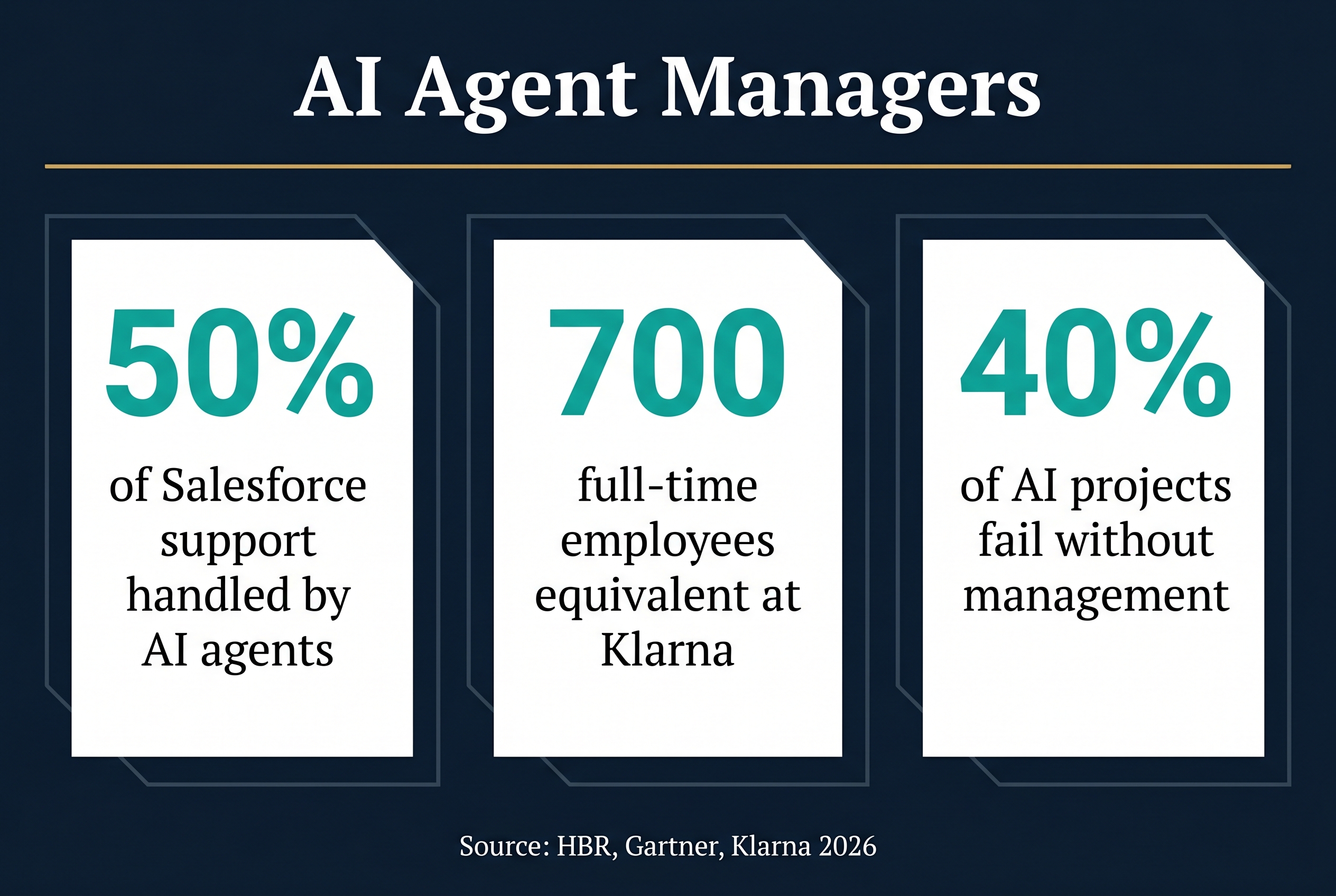
Australian businesses are adopting AI agents fast. According to Gartner, more than 40% of agentic AI projects will be cancelled by 2027. Not paused. Cancelled. The reason is not that the technology does not work. The reason is that companies deploy AI agents without anyone managing them properly.
Here is what happens without an agent manager:
Quality drifts. AI agents start strong but degrade as your business changes. Products update, policies shift, customer expectations evolve. Without someone reviewing output regularly, the agent gets worse over time and nobody notices until a customer complains.
Edge cases fall through. AI agents handle 80-90% of routine tasks well. The remaining 10-20% are edge cases that require human judgment. Without a manager triaging those cases, they either get handled badly or not at all.
ROI disappears. Without monitoring and optimization, AI agents become expensive toys instead of productive team members. You paid for the tool but never extracted the value.
The businesses that succeed with AI are not the ones with the most advanced technology. They are the ones with the best management layer around it.
How Flowtivity Helps You Build and Deploy AI Agents
Flowtivity specializes in exactly this challenge. We do not just hand you a tool and wish you luck. We work with you to build AI agents tailored to your business, then set up the systems so your team can manage them effectively.
Here is how the partnership works:
Flowtivity handles the technical side:
- Building custom AI agents for your specific workflows
- Connecting agents to your existing tools (CRM, email, calendar, documents)
- Setting up monitoring dashboards and quality scorecards
- Implementing guardrails so agents stay within defined boundaries
- Creating the feedback loops that let your team retrain agents easily
You focus on what you do best:
- Training agents on your business domain (your products, your customers, your processes)
- Reviewing agent output and providing quality feedback
- Making judgment calls on edge cases the AI cannot handle
- Setting the goals and priorities for what agents should accomplish
- Managing the human side: customer relationships, team culture, strategic decisions
This split is deliberate. The HBR article makes clear that the best agent managers are domain experts, not technologists. You know your business better than any AI company ever will. Our job is to give you agents worthy of your management and the tools to manage them well.
What AI Agent Management Looks Like in Practice
Most companies approach AI agents backwards. They start with the technology: "What can AI do?" Then they try to find a use case. This is why 40% of agentic AI projects get cancelled.
Flowtivity flips that approach. We start with your domain experts and the specific job functions where they need support. Then we build agents that act as subject matter experts embedded into those roles.
Here is what that looks like in practice.
Phase 1: Strategic Prioritization
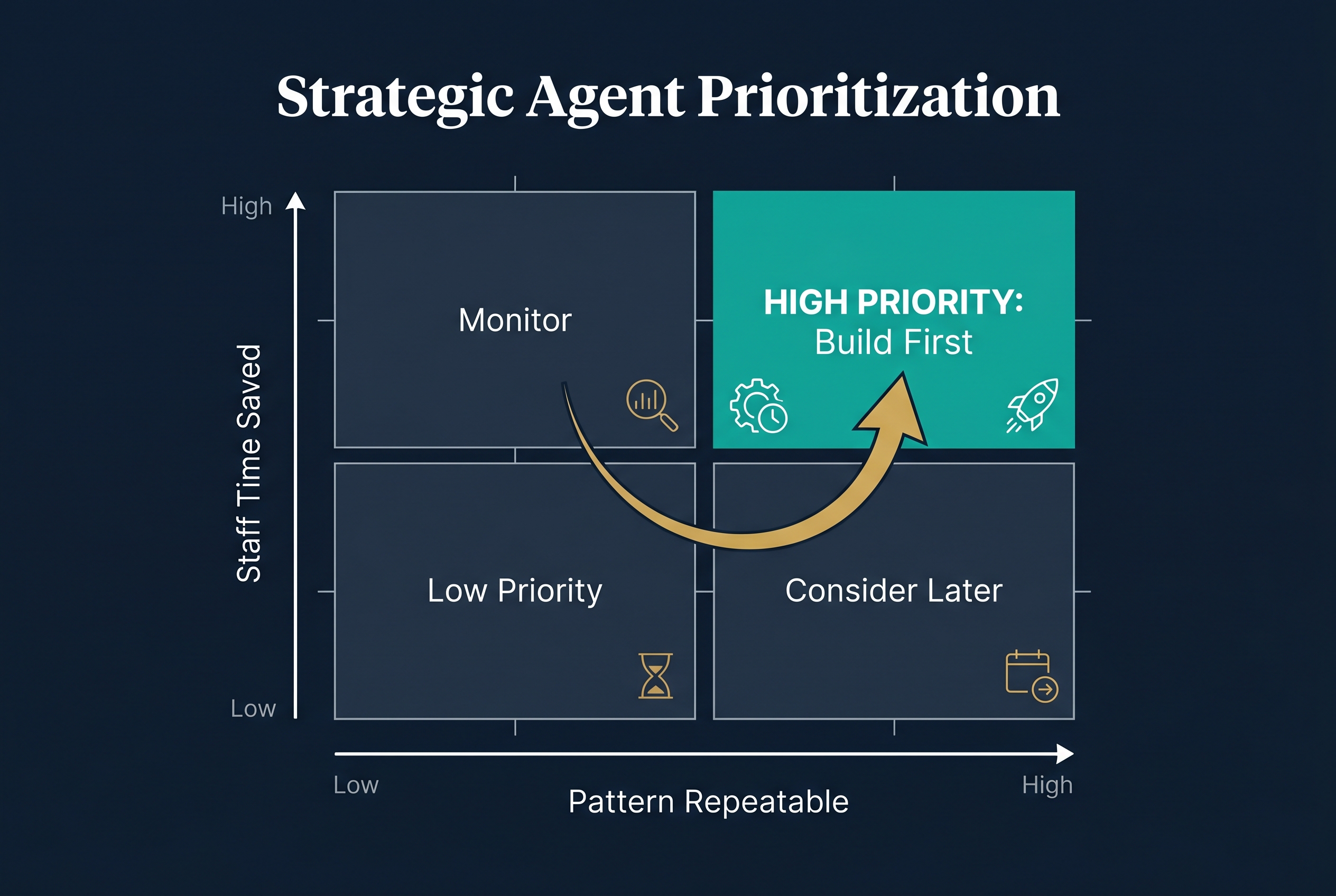
Not every workflow needs an AI agent. Some tasks are too rare, too high-stakes, or too dependent on human relationships. Flowtivity works with your leadership to identify the highest-value opportunities: job functions where staff spend significant time on repetitive, knowledge-based tasks that follow patterns an agent can learn.
The goal is not to replace employees. It is to give each employee a domain-expert AI assistant that handles the parts of their job that slow them down.
Phase 2: Build Domain-Expert Agents
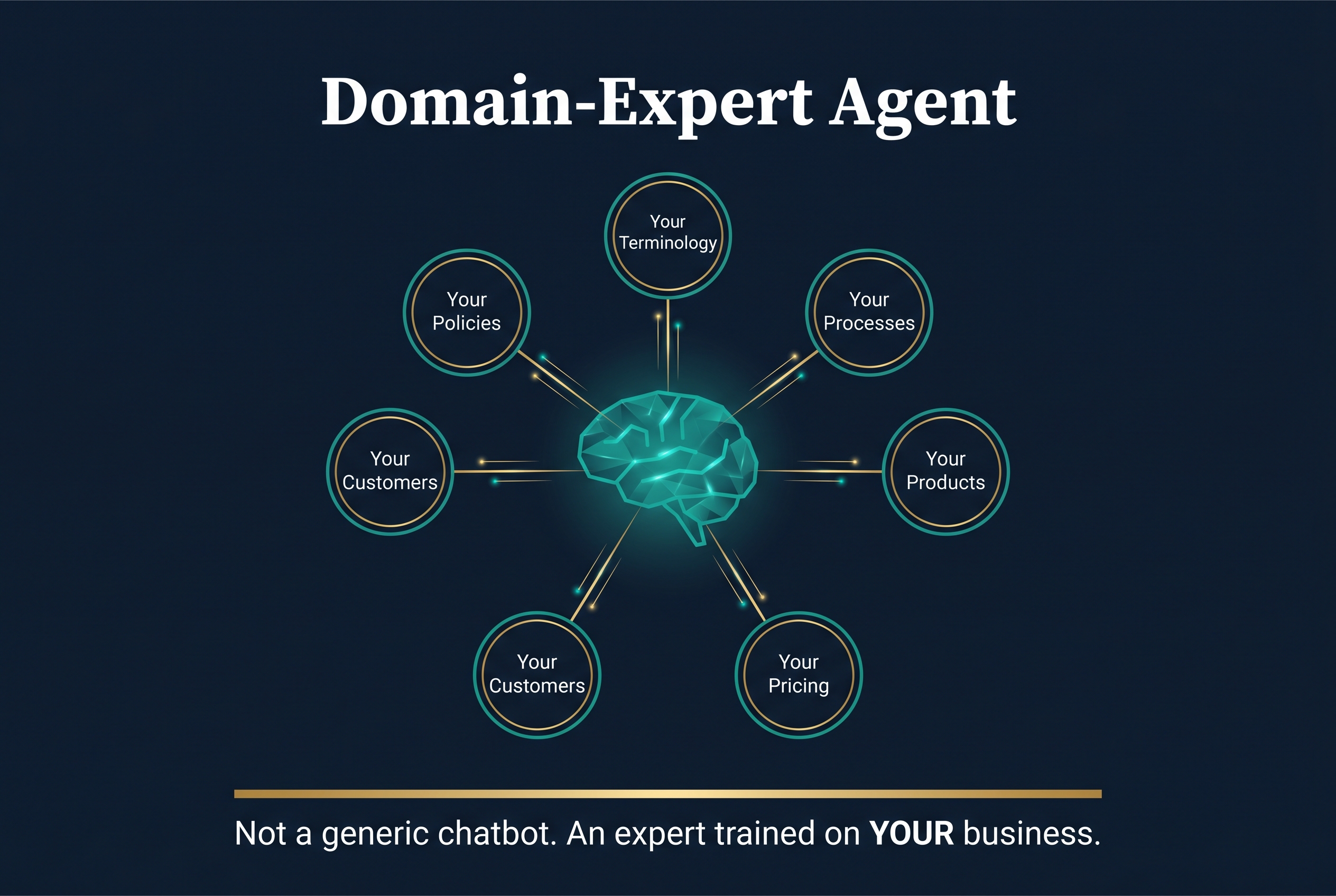
Once we identify the priority functions, Flowtivity builds agents that understand your specific business context. Not generic chatbots. Agents trained on your terminology, your processes, your products, your customer base.
For example, imagine a construction company where estimators spend hours reviewing tender documents and pulling relevant requirements. A domain-expert agent trained on your past bids, your capability statements, and your pricing matrices can pre-draft responses that the estimator reviews and refines. The estimator still makes the strategic calls. The agent handles the heavy lifting of document analysis and first-pass drafting.
Phase 3: Embed the Evaluation Framework
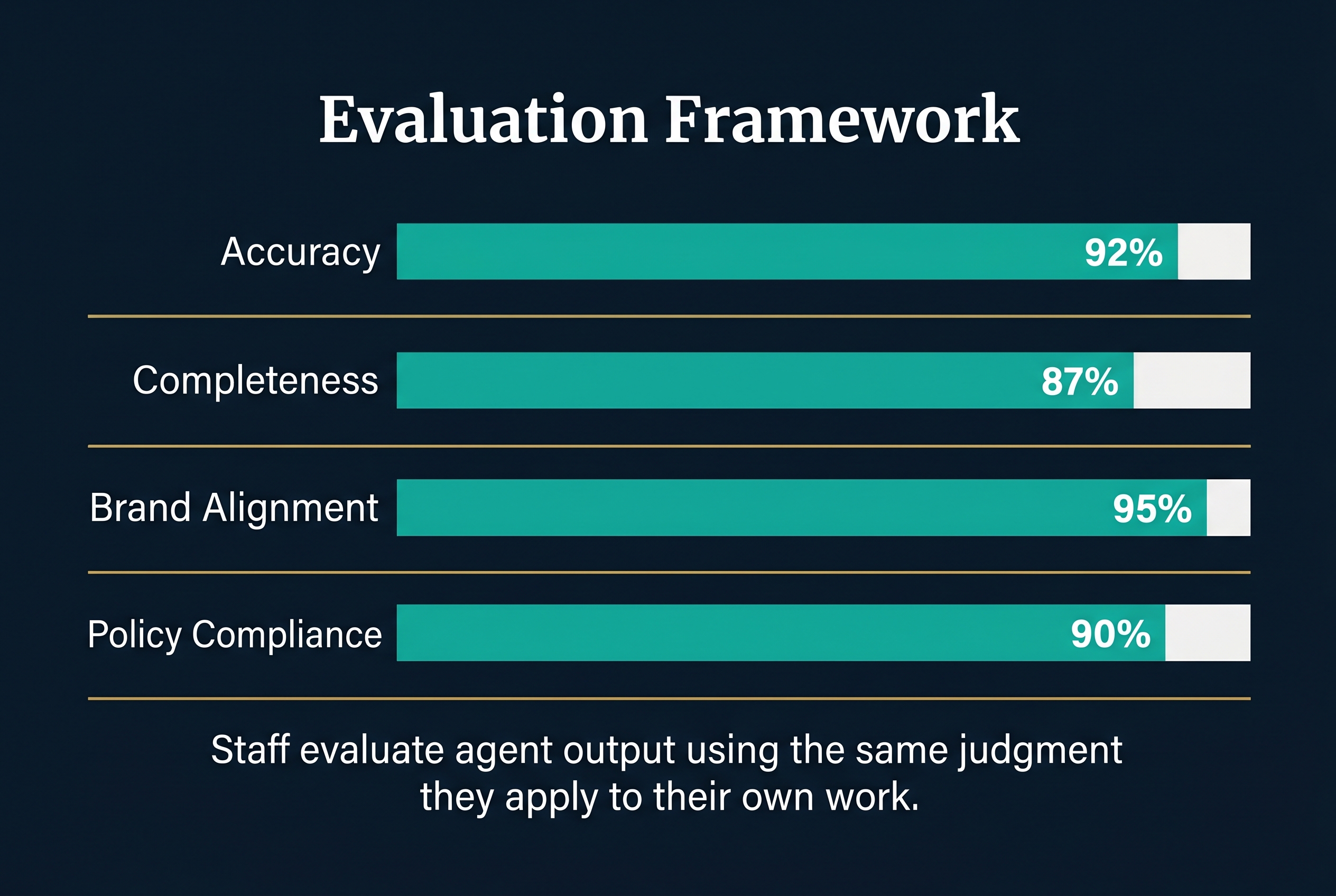
This is where most AI deployments fall apart and where Flowtivity's approach is different. We do not just hand over the agent and leave. We help your staff embed a structured evaluation framework to assess agent quality on an ongoing basis.
Your team learns to evaluate the agent's output using the same judgment they already apply to their own work. Is this response accurate? Does it follow our policies? Would I be comfortable sending this to a client?
This evaluation framework serves two purposes. First, it catches errors early before they affect customers or decisions. Second, and more importantly, it creates the feedback data that makes the agent smarter over time.
Phase 4: Self-Learning Loop
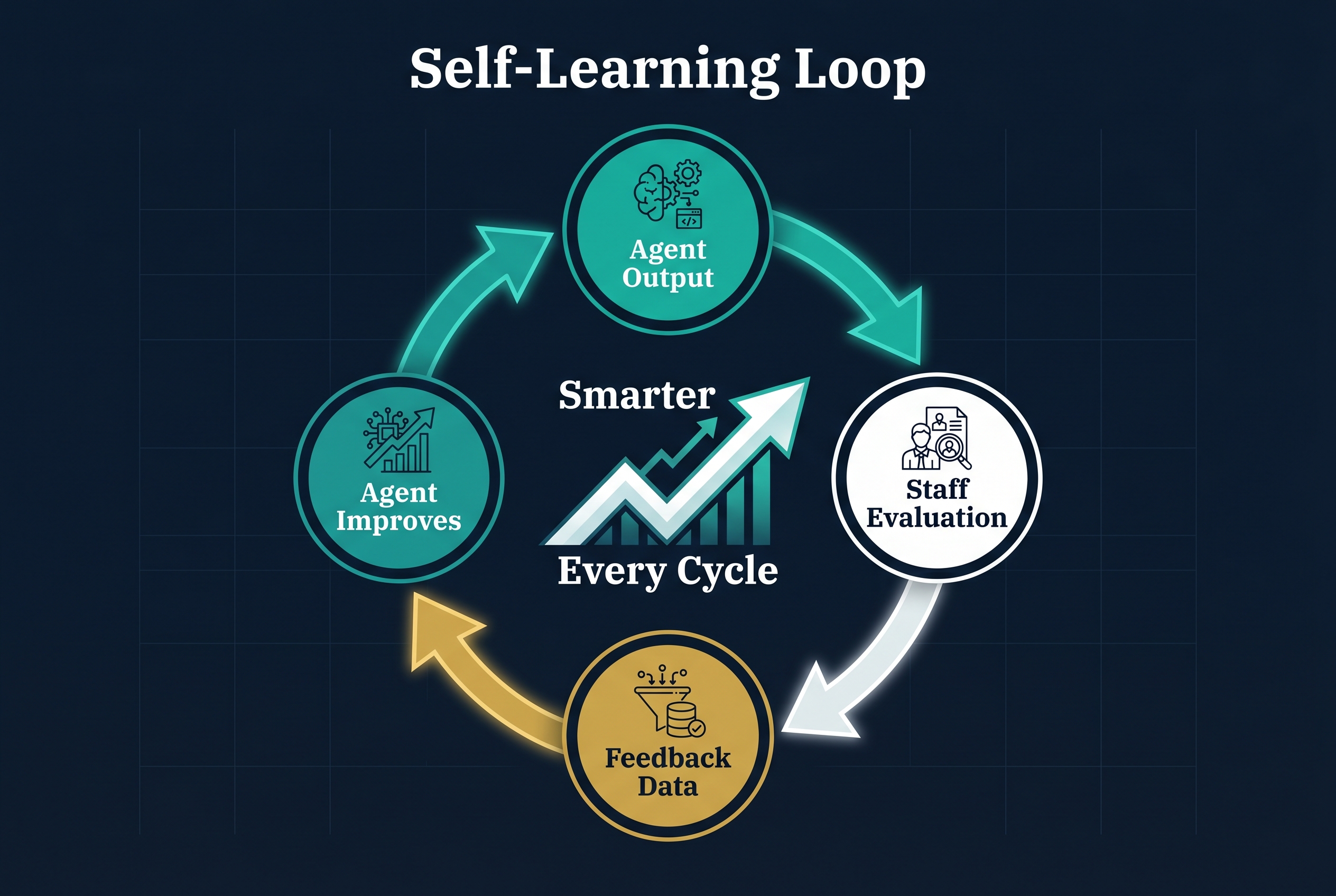
Every evaluation your staff completes feeds back into the agent. When someone marks an output as inaccurate, incomplete, or off-brand, the system learns from that correction. When someone approves a strong output, the system reinforces that pattern.
This dramatically speeds up the onboarding process for the agent. Instead of requiring months of manual configuration by developers, the agent learns from the people who actually do the work. After 30 to 60 days of active use and evaluation, the agent is typically handling 70-85% of its assigned tasks at quality levels that match or exceed the baseline.
The Result: A Compounding Business Asset
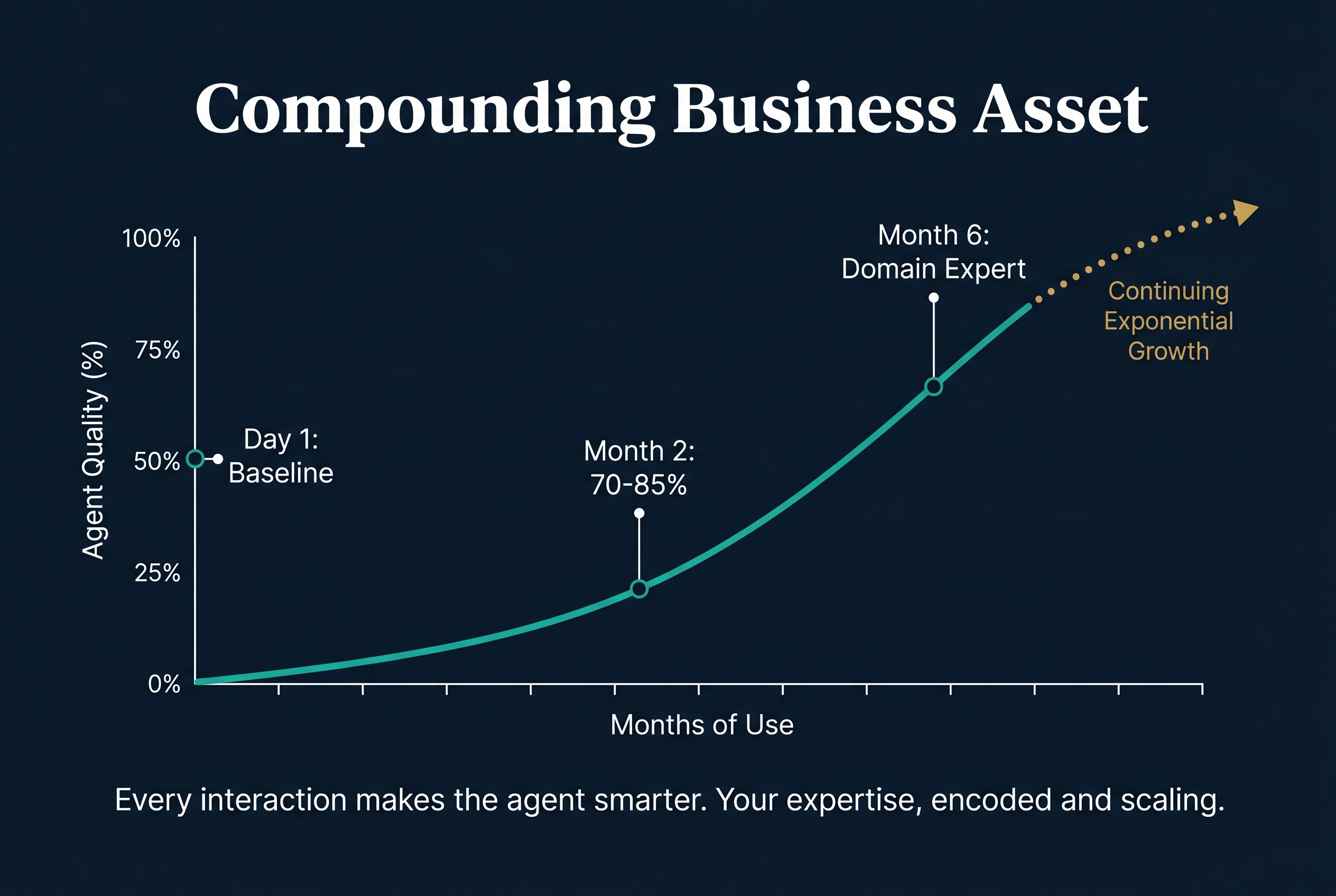
Here is what makes this model powerful. Every interaction, every evaluation, every correction makes the agent smarter. Unlike traditional software that degrades as your business changes, a well-managed AI agent actually gets better over time.
Your business is not just deploying a tool. You are building a proprietary knowledge asset that encodes your team's expertise, your processes, and your institutional knowledge into something that scales.
When a senior estimator retires, their expertise does not leave with them. It lives on in the agent they trained. When a new hire starts, they have a domain-expert assistant from day one, already trained on how your company does things.
This is the model HBR describes. The technology fades into the background. The management of the technology becomes the job. And the asset you build gets more valuable every month.
The Real ROI of Proper Agent Management
Salesforce went from 9,000 customer service staff to 5,000 after deploying AI agents that handle 50% of interactions. But they did not just fire people and hope for the best. They created an entirely new role: agent manager. Someone whose job is to make sure the AI actually delivers.
The numbers from companies doing this properly are significant:
- Klarna's AI agent system does work equivalent to 700 full-time employees
- Best Buy's agent handles rescheduling, troubleshooting, and appointment updates in a single conversation with no hold time
- Amazon used AI agents to modernize thousands of legacy Java applications in months instead of years
These results do not come from the technology alone. They come from the combination of good technology and good management.
How to Get Started with AI Agent Management
If you are an Australian business owner thinking about AI agents, here is the practical path:
Step 1: Prioritize strategically. Do not start with the easiest task or the most impressive demo. Start with the job function where a domain-expert agent would save the most staff time. Talk to your team. Ask them what slows them down.
Step 2: Build a domain-expert agent, not a generic chatbot. The agent needs to understand your terminology, your processes, and your quality standards from day one. This is where Flowtivity's technical expertise combines with your domain knowledge.
Step 3: Embed an evaluation framework. Train your staff to assess agent output using structured criteria: accuracy, completeness, brand alignment, policy compliance. This is not extra work. It is the same judgment they already apply, now formalized.
Step 4: Activate the self-learning loop. Every evaluation feeds back into the agent. Corrections teach it what not to do. Approvals reinforce what works. Within 30 to 60 days, the agent is handling most of its tasks at high quality.
Step 5: Expand to the next function. Once the first agent is performing well, apply the same framework to the next priority. Each agent makes the next one faster to deploy because the evaluation habits and management patterns are already established.
Flowtivity handles the build, the infrastructure, and the self-learning systems. You handle the prioritization, the domain training, and the quality evaluation. That is the partnership model.
Why This Matters Right Now
The role of agent manager is where social media manager was in 2008. Nobody had that title. By 2015, every company had one. Agent manager is on the same trajectory, just faster.
The businesses that act now will have a two to three year head start on building the management muscle around AI. The businesses that wait will eventually adopt AI agents anyway, but they will be managing catch-up instead of leading.
HBR's message is clear: the future belongs to companies that can both deploy AI agents and manage them well. Flowtivity exists to help with the first part so you can focus on the second.
If you want to explore what AI agents could look like in your business, reach out. We will build the agents. You train them on what makes your business unique.
About the author: AJ Awan is the founder of Flowtivity, an Australian AI consultancy specializing in workflow automation and AI agent deployment for growing businesses. With 9+ years of consulting experience including 6 years at EY, AJ helps companies build AI agents that work within their existing systems and processes.
One email a month, no noise
Practical AI notes for Australian businesses. Unsubscribe anytime.