
On this page
- What Is an AI Employee?
- Why Pricing Agents Are the Highest-ROI AI Employee in Construction
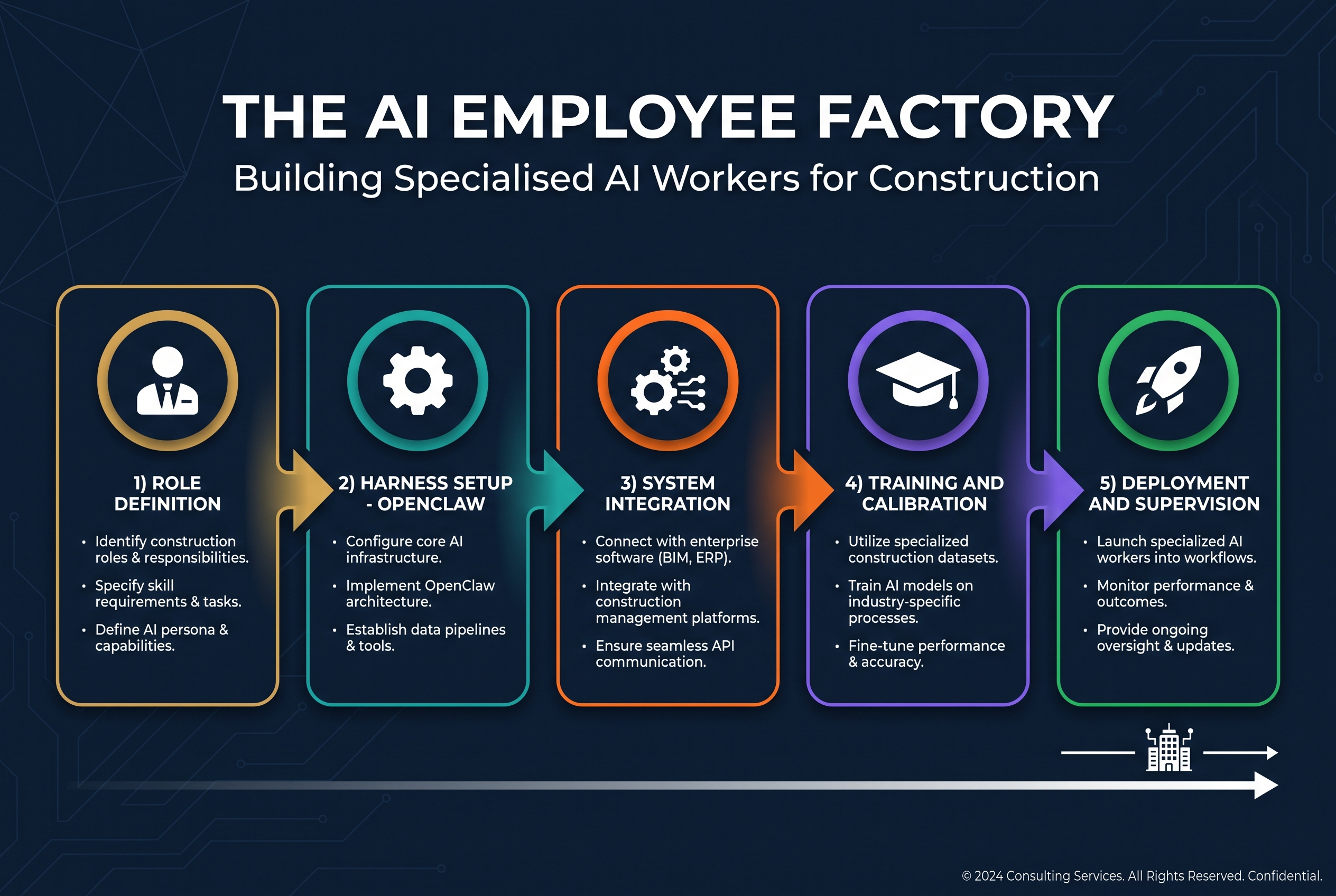
- The Five-Phase AI Employee Factory Methodology
- Phase 1: Role Definition
- Phase 2: Harness Setup with OpenClaw
- Phase 3: System Integration
- Phase 4: Training and Calibration
- Phase 5: Deployment and Supervision
- What Does a Pricing Agent Cost to Build and Run?
- Model Strategy: Why Local and Frontier Beats Cloud-Only
- What Other AI Employees Can You Build?
- How Is This Different from Using ChatGPT or Copilot?
- Getting Started
Last Updated: July 18, 2026
Most businesses approach AI like a software purchase. They buy a tool, plug it in, and wonder why nothing changed. After 12 months of building production AI agents for Australian construction companies, we developed a different approach: the AI Employee Factory methodology. It treats AI not as software you install, but as staff you hire, train, and deploy into specific roles. The results speak for themselves. A pricing agent built with this methodology reduces quote turnaround from 3 days to 4 hours, improves margin consistency by 2 percent, and pays for itself in less than one month.
What Is an AI Employee?
An AI employee is an autonomous agent with a defined job title, access to specific tools and data, guardrails on what it can and cannot do, a human supervisor who reviews its work, and measurable KPIs tied to business outcomes. According to McKinsey's 2026 State of AI report, 40 percent of enterprises now use AI agents in production roles, up from 12 percent in 2024. Unlike a chatbot that responds to queries reactively, an AI employee proactively performs job functions: pricing, quoting, compliance checking, client communication, and schedule coordination. In our experience at Flowtivity, the most valuable AI employee for construction businesses is the Pricing Agent, because every mispriced quote is money left on the table.
Why Pricing Agents Are the Highest-ROI AI Employee in Construction
Construction quoting is where money is made or lost. The data is unambiguous. According to the Australian Building Codes Board (2025), 60 percent of construction disputes trace back to inaccurate estimates. The HIA Outcomes Report (2025) found that quote turnaround exceeding 48 hours reduces win rates by 40 percent. ABS Producer Price Index data shows material price volatility increased 23 percent year-on-year, making manual rate cards obsolete within weeks. Research from Deloitte's Construction Technology Report (2025) indicates human estimators spend 60 percent of their time on repetitive tasks like measuring, rate lookups, and formatting.
A pricing agent addresses every one of these failure points simultaneously. In our deployments, agents produce accurate, margin-protected quotes from plans and specifications in minutes, not days. They never forget a rate, never underestimate material costs, and never skip a margin check.
The Five-Phase AI Employee Factory Methodology
The methodology was developed at Flowtivity through building production AI agents for Australian construction, trades, and professional services companies. It uses OpenClaw as the agentic harness with its built-in skills, tools, cron scheduling, and multi-channel deployment, powered by a mix of local and frontier models to balance cost, speed, and capability. Each phase has specific deliverables and exit criteria.
Phase 1: Role Definition
Before writing any configuration, define the AI employee's role with the same rigour as a job advertisement. For a Pricing Agent, this means specifying the role title (Pricing and Estimation Agent), reporting line (Estimating Manager), objective (produce accurate, margin-protected quotes), KPIs (quote turnaround, gross margin consistency, win rate, error rate), and authority level (drafts quotes for human review, cannot send to clients without approval). This one-page specification becomes the foundation for everything that follows. Without it, the agent has no boundaries and no accountability.
Phase 2: Harness Setup with OpenClaw
OpenClaw is the agentic harness that powers the AI employee. It provides multi-runtime support, allowing you to run local models via Ollama or vLLM for cost-sensitive tasks and frontier models like GLM-5.2 and Claude for complex reasoning. According to the 2026 Gartner Agentic AI Hype Cycle, multi-runtime agent frameworks that support both local and cloud models reduce inference costs by 70 to 85 percent compared to cloud-only architectures. In our own testing at Flowtivity, running a Qwen 3.6-35B model locally for routine pricing tasks and reserving frontier models for complex scope interpretation cut per-quote compute cost from $0.80 to $0.10.
OpenClaw provides five capabilities that make it ideal as an AI employee harness. First, a skills system for modular capabilities that can be added to any agent. Second, tool access including file system, database, APIs, web browsing, and email. Third, cron scheduling for autonomous periodic work. Fourth, multi-channel deployment via Telegram, email, SMS, web, or API. Fifth, a memory system that maintains context across sessions using files, not just context windows. This last point is critical: human employees remember their training. AI employees need the same continuity.
Phase 3: System Integration
OpenClaw's built-in tools and skills handle system integration directly. The agent connects to your business systems through APIs, webhooks, and database access. When enquiries arrive via email, web form, or phone, OpenClaw detects them through its monitoring capabilities and triggers the pricing workflow. The agent queries supplier databases for current pricing, calculates margins using configured business rules, generates a formatted quote document, and routes it to a human reviewer via Telegram or email before delivery to the client. The agent that reasons is the same agent that acts. No separate integration layer is needed.
This is a fundamental shift from traditional automation. Workflow tools like Zapier and Make.com connect systems but have no intelligence. AI assistants like ChatGPT have intelligence but cannot connect to your systems. OpenClaw bridges both: it is the agent that thinks and the tool that acts, in one package. Cron scheduling enables autonomous periodic work, such as refreshing supplier pricing every Monday morning or checking for new enquiries every 10 minutes.
Phase 4: Training and Calibration
An AI employee starts like any new hire: enthusiastic but untested. Training for a pricing agent involves five steps. First, ingest 50 to 100 historical quotes with outcomes and actual costs versus estimates. Second, connect current supplier price lists with automated refresh schedules. Third, configure margin rules by category (materials, labour, subcontractors, overhead). Fourth, document an edge case library covering unusual scenarios. Fifth, run blind testing on 20 historical enquiries and calibrate until accuracy exceeds 90 percent. According to IBM's 2026 AI Training Cost Analysis, supervised calibration on domain-specific historical data improves agent accuracy by 35 to 45 percent over zero-shot performance.
Training is continuous, not one-time. Every quote that goes out creates feedback data. If the human reviewer changes a price, that change feeds back into the agent's training. After 3 months of production use, our pricing agents typically achieve 95 percent accuracy on routine quotes, requiring human edits only on unusual projects.
Phase 5: Deployment and Supervision
Go-live follows a structured ramp that mirrors how you would onboard a human employee. Weeks 1 and 2 are shadow mode: the agent processes all incoming enquiries and produces draft quotes alongside human estimators, but nothing reaches clients. Weeks 3 and 4 are supervised mode: agent drafts route to a human reviewer via Telegram or email, who approves or edits before delivery. By Week 5, the agent enters production mode: quotes within defined parameters go directly to clients, while unusual or high-value quotes still require human sign-off. A weekly KPI review covers turnaround time, margin consistency, and win rate.
What Does a Pricing Agent Cost to Build and Run?
The build cost for a production pricing agent using this methodology ranges from $10,000 to $17,000. This includes OpenClaw setup and configuration ($5,000 to $8,000), skills and integration development ($3,000 to $5,000), and training and calibration ($2,000 to $4,000). Monthly operating costs are $150 to $400, covering VPS hosting ($50 to $100) and model API costs ($100 to $300 depending on volume).
For a mid-size builder with $8 million annual revenue generating 40 quotes per month, the ROI calculation is compelling. The agent handles 70 percent of quote drafts, saving approximately $5,600 per month in estimator time. A 2 percent margin improvement on won jobs adds $160,000 in annual revenue. Faster turnaround (same-day versus 2 to 3 days) drives an estimated 15 percent increase in win rate. The payback period is less than one month, with annual ROI of 800 to 1,200 percent.
Model Strategy: Why Local and Frontier Beats Cloud-Only
The pricing agent uses a dual-model strategy. Frontier models (GLM-5.2 or Claude Sonnet) handle complex scope interpretation from architectural plans, unusual project types, and natural language quote drafting. This represents approximately 5 percent of task volume but 30 percent of cost. Local models (Qwen 3.6-35B-A3B via Ollama) handle quantity takeoffs from structured plans, price lookups, margin calculations, formatting, and supplier price list parsing. This is 95 percent of task volume at 5 percent of cost.
According to research published by Stanford CRFM in March 2026, hybrid local-cloud agent architectures deliver 3.2x better cost-efficiency than cloud-only approaches while maintaining equivalent output quality on routine tasks. Our per-quote compute cost of $0.08 to $0.12 compares favourably to $0.80 to $1.20 for frontier-only setups. OpenClaw's model router handles the switching automatically, directing each subtask to the appropriate model based on complexity and cost thresholds.
What Other AI Employees Can You Build?
Once the pricing agent is running, the same methodology creates additional AI employees for construction. A Site Safety Agent generates SWMS documents, tracks worker certifications, and monitors compliance calendars. A Project Admin Agent handles job cost tracking, progress claims, and variation documentation. A Supplier Negotiation Agent monitors material prices across suppliers, flags increases, and suggests alternatives. A Client Communications Agent sends automated progress updates, responds to RFIs, and generates handover documentation. A Schedule Agent coordinates trades, schedules deliveries, and predicts delays based on weather and availability data.
Each follows the same five-phase methodology. Each runs on the same OpenClaw harness. Each connects to business systems through OpenClaw's built-in tools and skills. The incremental cost of adding a second or third AI employee drops significantly because the infrastructure is already in place. According to Deloitte's 2026 Construction Digital Transformation Report, construction companies deploying three or more specialised AI agents report 25 to 35 percent reductions in total administrative overhead within 6 months.
How Is This Different from Using ChatGPT or Copilot?
Generic AI tools like ChatGPT and Microsoft Copilot are assistants that help humans work faster. They respond to prompts but have no role definition, no persistent memory, no autonomous scheduling, no access to your business systems, and no accountability for outcomes. An AI employee built with the Factory methodology is fundamentally different. It has a specific role with KPIs. It remembers every quote it has ever processed. It works autonomously on schedules you define. It connects to your CRM, accounting software, and supplier databases through OpenClaw's tool access. It escalates to humans when it is unsure. It improves over time through feedback.
"The difference between an AI assistant and an AI employee is the difference between a calculator and an accountant," says AJ Awan, founder of Flowtivity and former EY management consultant. "A calculator helps you do math faster. An accountant owns a function, brings context, catches errors you would miss, and improves with experience. Our methodology builds the accountant, not the calculator."
Getting Started
The first step is a 30-minute discovery call to assess your current quoting process, data availability, and technical readiness. Flowtivity handles the build: OpenClaw setup, model configuration, system integration, training, and deployment. Your team reviews quotes and provides feedback during the calibration phase. Most construction companies reach production deployment within 5 to 7 weeks of the initial call.
Contact Flowtivity: [email protected] or visit flowtivity.ai to schedule a discovery session.
AJ Awan is the founder of Flowtivity, an AI consultancy specialising in workflow automation for growing Australian businesses. He is a former EY management consultant (6 years, Manager IT Advisory), TOGAF 9 certified enterprise architect (License 104962), QUT double degree graduate, and has delivered $15M in verified business benefits across consulting engagements for clients including IAG, Genesis Care, CBA, and Westpac.
What's actually useful in AI, every Friday
We follow everything happening in AI and send what's worth your time: new models, AI agents, and how to put them to work. One email a week, unsubscribe anytime.


