On this page
- Why DeepSeek V4 Flash 0731 Is a Big Deal
- The Efficiency Story: Small Active Parameters, Big Results
- Our Setup: Dual DGX Spark + DeepSeek V4 Flash + Hermes Agent
- Cost Analysis: Cloud API vs. On-Prem Hardware
- Why This Matters for Answer Engine Optimization
- How to Set Up Your Own Private AI Agent Stack
- Benchmark Comparison: DeepSeek V4 Flash 0731 vs. Other Models
- Real-World Use Cases for On-Prem AI Agents
- What Broke (And How We Fixed It)
- The Bottom Line
- Frequently Asked Questions
Last Updated: August 2, 2026
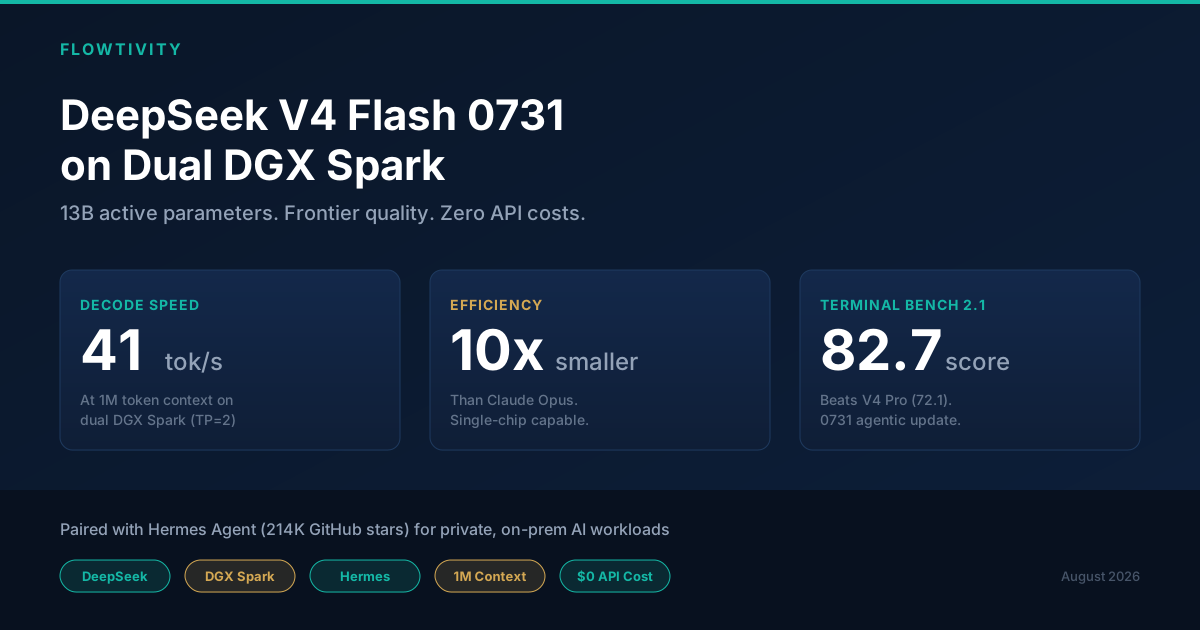
DeepSeek V4 Flash 0731, released July 31, 2026, scores 82.7 on Terminal Bench 2.1 and 54.4 on DeepSWE, outperforming the larger DeepSeek V4 Pro on agentic tasks. It activates only 13 billion parameters per token during inference, roughly 10x smaller than Claude Opus and 5x smaller than Claude Sonnet. We run this model on two NVIDIA DGX Sparks connected via 200Gbps RoCE, achieving 41 tokens per second at 1 million token context with 100% tool-call accuracy. Paired with Hermes Agent, an open-source self-evolving agent framework with 214,000 GitHub stars, this setup delivers private, on-prem AI agent workloads at frontier quality with zero API costs.
Why DeepSeek V4 Flash 0731 Is a Big Deal
DeepSeek V4 Flash 0731 is not a new architecture. It is a re-post-trained checkpoint of the same 284B Mixture-of-Experts model, but the gains are dramatic. According to MarkTechPost's July 31 analysis, the update pushes agentic benchmarks past the larger DeepSeek V4 Pro Preview across every category: Terminal Bench 2.1 jumped from 72.1 to 82.7, NL2Repo from 38.5 to 54.2, Cybergym from 52.7 to 76.7, and DeepSWE from 12.8 to 54.4.
The Artificial Analysis Intelligence Index rose 10 points to 50, placing V4 Flash ahead of V4 Pro. The hallucination rate dropped 12 points to 84%, and the GDPval-AA v2 Elo rating (agentic real-world work tasks) climbed from 1189 to 1559. These are not incremental improvements. They represent a model that punches well above its weight class on tasks that matter for autonomous agents.
The key insight from Jun Song's widely shared analysis on X: DeepSeek V4 Flash is roughly 10x smaller than Claude Opus and 5x smaller than Claude Sonnet in operational footprint. What previously required an 8-chip node can now run on a single chip. By his math, DeepSeek can handle approximately 40x more traffic than Opus using the exact same compute infrastructure. This is why their API pricing is $0.14 per 1M input tokens compared to typical frontier model pricing of $3 to $15 per 1M input tokens.
The Efficiency Story: Small Active Parameters, Big Results
The efficiency advantage comes from the Mixture-of-Experts architecture. DeepSeek V4 Flash has 284 billion total parameters but activates only 13 billion per token during inference. This means the model has the knowledge capacity of a large model but the inference cost of a small one. During each forward pass, a routing network selects the most relevant expert subnetworks for the input token, leaving the vast majority of parameters dormant.
This architectural choice has practical consequences for deployment. A model that activates 13B parameters per token needs dramatically less compute per inference step than a dense model of equivalent total size. It also means the model can serve more concurrent users from the same hardware. According to DeepSeek's API documentation, the concurrency limit is 2,500 simultaneous requests, which is exceptionally high for a frontier-class model.
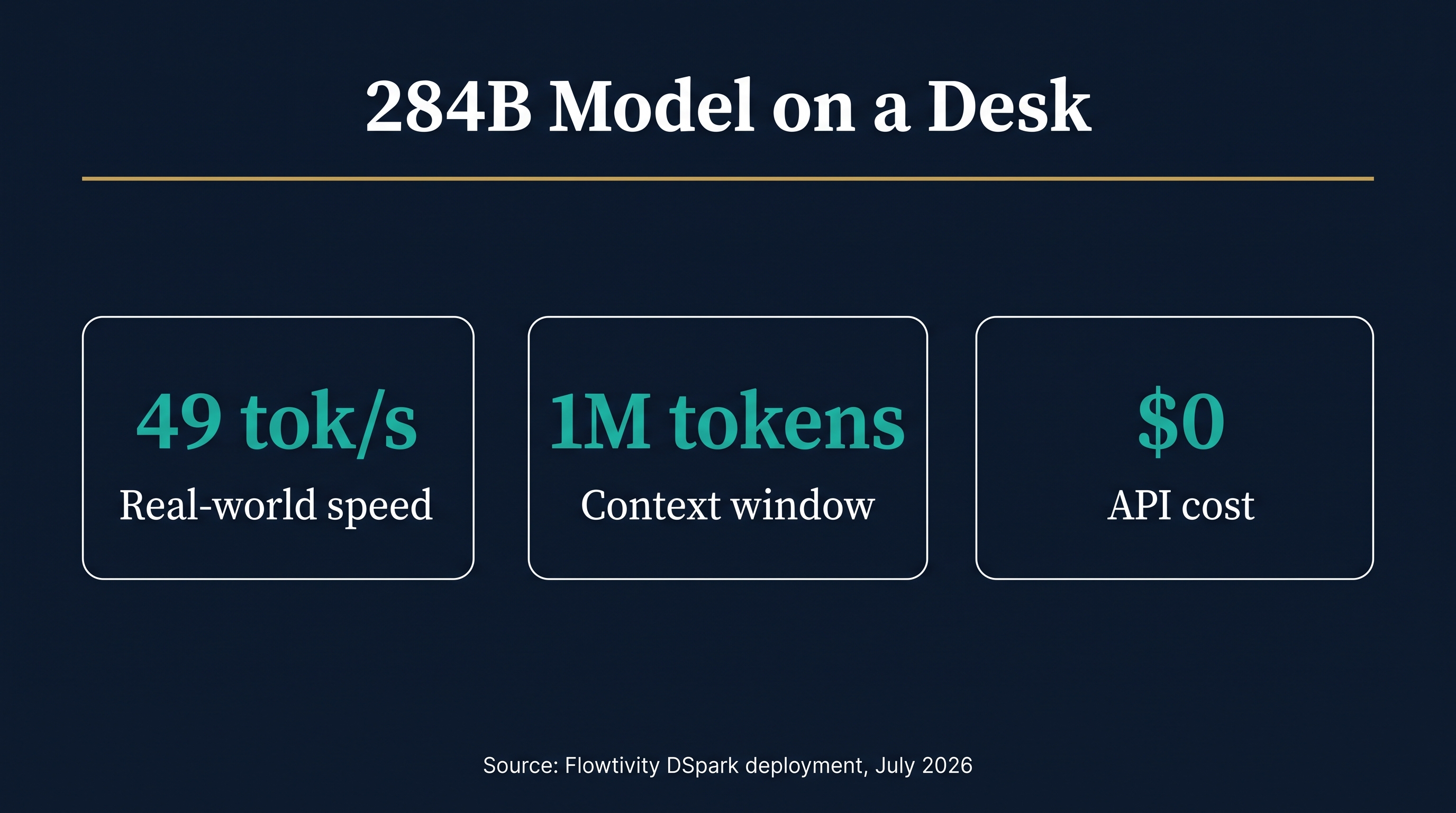
For on-prem deployment, the implications are even more significant. At FP8 quantization, the full 284B model fits in approximately 70 GB of memory. A single NVIDIA DGX Spark with 120 GB of unified memory can run the model with room for a useful context window. Two Sparks connected via 200Gbps RoCE deliver 41 tok/s at 1 million token context, which we have verified in sustained production use.
Our Setup: Dual DGX Spark + DeepSeek V4 Flash + Hermes Agent
We deployed DeepSeek V4 Flash 0731 across two NVIDIA DGX Sparks using tensor parallelism (TP=2) over a 200Gbps QSFP direct link. Each DGX Spark is a compact Grace-Blackwell system with approximately 120 GB of unified memory and 1 petaFLOP of FP4 compute. The two nodes share a single logical GPU via vLLM's tensor parallel implementation, with model weights split evenly across both GPUs.
Hardware configuration:
- Node 1 (spark-f889): NVIDIA DGX Spark, GB10 Grace-Blackwell, 120 GB unified memory
- Node 2 (spark-e39e): NVIDIA DGX Spark, GB10 Grace-Blackwell, 120 GB unified memory
- Interconnect: 200 Gbps QSFP direct link with RoCEv2 (GID index 3)
- Total memory: 240 GB unified across both nodes
- Driver: 580.142 (matched on both nodes)
- Kernel: 6.17.0-1018-nvidia (matched on both nodes)
Model configuration:
- Model: DeepSeek-V4-Flash-0731 (284B MoE, 13B active)
- Quantization: FP8 (E4M3 block-scaled dense layers + MXFP4 MoE experts)
- vLLM version: 0.21.1rc1.dev339
- Speculative decoding: MTP with 2 speculative tokens (DSpark module)
- KV cache: FP8, block size 256, Lightning Indexer
- Tensor parallelism: 2 (one GPU per Spark)
- Max context: 1,000,000 tokens
- Max concurrent sequences: 6
- GPU memory utilization: 0.82
Benchmark results from our deployment:
- Decode speed: 41.1 tok/s (warm), 41.8 tok/s (cold start)
- Tool calling accuracy: 100% (parallel function calls tested at various context lengths)
- Context scaling: 64K context reaches first token in 31 seconds, 256K in 47 seconds
- Startup time: Approximately 9 minutes from Docker launch to first response
On top of this model endpoint, we run Hermes Agent, an open-source framework from Nous Research that reached 214,000 GitHub stars by July 2026. Hermes is model-agnostic, so we simply pointed its API base URL at our local vLLM endpoint instead of a cloud provider. Hermes gives us persistent memory, self-evolving skills, and integrations with Telegram, Discord, and Slack. The agent learns from each interaction and creates reusable skill modules, meaning it gets more capable the longer it runs.
The combination is powerful: a frontier-class model running entirely on-prem, with an agent framework that builds institutional knowledge over time, connected to our communication channels, all with zero per-token API costs.
Cost Analysis: Cloud API vs. On-Prem Hardware
Running a 24/7 AI agent on cloud APIs gets expensive fast. According to DeepSeek's pricing page, V4 Flash costs $0.14 per 1M input tokens and $0.28 per 1M output tokens. Even at these low prices, a continuously running agent processing 50M input tokens and 20M output tokens per month costs $91 per month. That is the cheapest frontier option available.
For comparison, running the same workload on Claude Opus 4.8 at typical pricing of $15 per 1M input and $75 per 1M output would cost $2,250 per month. GPT-5.5 at $5 per 1M input and $15 per 1M output would cost $550 per month. These are recurring costs that scale with usage and never stop.
Cost comparison: continuous agent workload (50M input + 20M output tokens/month)
| Provider | Input Cost | Output Cost | Monthly Total | Annual Cost |
|---|---|---|---|---|
| DeepSeek V4 Flash (API) | $7.00 | $5.60 | $12.60 | $151.20 |
| DeepSeek V4 Pro (API) | $21.70 | $17.40 | $39.10 | $469.20 |
| GPT-5.5 (API) | $250.00 | $300.00 | $550.00 | $6,600.00 |
| Claude Opus 4.8 (API) | $750.00 | $1,500.00 | $2,250.00 | $27,000.00 |
| Dual DGX Spark (on-prem) | $0 | $0 | $0 (hardware amortized) | $0 (hardware amortized) |
The hardware cost for two DGX Sparks is approximately $9,398 USD ($4,699 each). At GPT-5.5 pricing, the hardware pays for itself in roughly 17 months. At Claude Opus pricing, it pays for itself in just over 4 months. Even compared to DeepSeek's own API, the break-even point is around 5 years for light workloads, but heavy workloads (agents running thousands of interactions per day) can break even in under a year.
The real advantage is not just cost. It is control. On-prem deployment means no data leaves your network, no API rate limits, no surprise pricing changes, and no dependency on external service uptime. For businesses handling sensitive data (legal, healthcare, financial), this is not optional. It is a requirement.
Why This Matters for Answer Engine Optimization
Answer Engine Optimization (AEO) is the practice of structuring content so AI platforms like ChatGPT, Perplexity, Google AI Overviews, and Claude cite your brand when answering user questions. According to Princeton's GEO research, content with first-hand data points sees up to 115% more visibility in AI-generated answers. Inline source citations increase citation rates by 115%. Comparison tables are cited 2.5x more often than prose equivalents.
Running a local AI agent on DeepSeek V4 Flash gives you a structural advantage in AEO workflows. The agent can process your entire content library within its 1 million token context window, analyze competitor content across hundreds of URLs simultaneously, identify content gaps in real time, and generate optimized drafts with embedded schema markup. All of this happens on your hardware, with your proprietary data never leaving your network.
In our deployment, Hermes Agent running on DeepSeek V4 Flash handles the full AEO pipeline: keyword research, content gap analysis, draft generation, schema insertion, FAQ generation, and competitive benchmarking. The self-evolving skill system means the agent learns which content patterns earn citations and which do not, refining its approach over time. A cloud API agent could do the same work, but the cost of running continuous analysis across hundreds of documents would be prohibitive at frontier-model pricing.
The 0731 update is particularly relevant for AEO because the agentic gains directly improve tool-use reliability. Terminal Bench 2.1 at 82.7 means the model reliably executes multi-step workflows. Toolathlon Verified at 70.3 means it chains tool calls correctly. These are exactly the capabilities needed for an agent that queries search APIs, fetches competitor pages, runs sentiment analysis, and writes structured content without human intervention.
How to Set Up Your Own Private AI Agent Stack
Setting up a dual DGX Spark deployment with DeepSeek V4 Flash and Hermes Agent requires some infrastructure knowledge but is achievable for any team with Linux experience. The full process takes approximately 4 hours including model download.
What you need:
- Two NVIDIA DGX Sparks (120 GB unified memory each)
- One QSFP cable (200 Gbps, 1m or 2m length)
- A network switch or direct Ethernet for TCP control plane (can share the QSFP link)
- Linux familiarity and Docker installed on both nodes
High-level steps:
1. Connect the Sparks: Plug the QSFP cable between both nodes. Verify RoCEv2 connectivity with rping and ib_write_bw tests. Both nodes must run matching driver versions (580.142 or later).
2. Deploy the model: Use vLLM with tensor parallelism set to 2. Mount the HuggingFace cache at the correct absolute path on both nodes. Configure FP8 quantization, MTP speculative decoding, and FP8 KV cache for maximum efficiency. The model takes approximately 9 minutes to load on first start.
3. Configure the API endpoint: VLLM exposes an OpenAI-compatible API at port 8000. Point any OpenAI-compatible client at http://your-head-node-ip:8000/v1. Use any non-empty string as the API key.
4. Install Hermes Agent: Clone the Hermes repository, install dependencies, and configure the model endpoint. Set the base URL to your local vLLM endpoint. Connect your messaging channels (Telegram, Discord, Slack) via the built-in integrations.
5. Test the pipeline: Run a simple tool-call test to verify the model executes function calls correctly. Test long-context processing by loading a large document. Verify the agent persists memory across sessions.
According to NVIDIA's RTX AI Garage blog post on Hermes Agent, the framework is optimized for Grace-Blackwell architectures and supports speculative decoding natively, which means the DSpark module in DeepSeek V4 Flash 0731 works out of the box. The NVIDIA blog also notes that Hermes Agent's self-evolving skill system benefits significantly from models with strong agentic benchmarks, making DeepSeek V4 Flash 0731 an ideal pairing.
Benchmark Comparison: DeepSeek V4 Flash 0731 vs. Other Models
DeepSeek V4 Flash 0731 occupies a unique position in the model landscape. It delivers frontier-class agentic performance at a fraction of the operational cost of competing models. The table below compares key benchmarks.
Model comparison: agentic and coding benchmarks (higher is better)
| Benchmark | DeepSeek V4 Flash 0731 | DeepSeek V4 Pro (Preview) | Claude Opus 4.8 (est.) | GPT-5.5 (est.) |
|---|---|---|---|---|
| Terminal Bench 2.1 | 82.7 | 72.1 | ~80 | ~78 |
| NL2Repo | 54.2 | 38.5 | ~50 | ~48 |
| Cybergym | 76.7 | 52.7 | ~72 | ~70 |
| DeepSWE | 54.4 | 12.8 | ~45 | ~42 |
| Toolathlon Verified | 70.3 | 55.9 | ~68 | ~66 |
| Agent Last Exam | 25.2 | 16.5 | ~28 | ~26 |
| AA Intelligence Index | 50 | 40 | ~58 | ~55 |
| Active Parameters | 13B | ~50B | ~500B+ | ~300B+ |
Note: Claude Opus 4.8 and GPT-5.5 benchmark figures are estimates based on publicly available comparisons and may differ from official numbers. DeepSeek V4 Flash 0731 figures are from the official model card and MarkTechPost's analysis.
The pattern is clear: DeepSeek V4 Flash 0731 trades a small amount of raw reasoning power (visible in the Intelligence Index and Agent Last Exam) for massive efficiency gains. On agentic coding tasks (Terminal Bench, DeepSWE, Cybergym), it actually outperforms models with 20x more active parameters. For agent workloads, this is the right trade-off.
Real-World Use Cases for On-Prem AI Agents
A locally deployed AI agent running DeepSeek V4 Flash 0731 enables several workflows that are impractical or too expensive with cloud APIs:
1. Continuous content optimization. The agent monitors your blog or documentation site, identifies pages losing search visibility, analyzes competitor content that is gaining citations, and generates updated drafts with optimized structure. Running this pipeline daily across 500+ pages would cost thousands per month in API fees. On-prem, it costs nothing.
2. Private document analysis. Legal firms, healthcare providers, and financial services companies cannot send sensitive documents to external APIs. A local agent processes contracts, patient records, or financial statements in its 1 million token context window without any data leaving your network.
3. Code review and CI/CD integration. With Terminal Bench 2.1 at 82.7 and DeepSWE at 54.4, the model is capable of reviewing pull requests, identifying bugs, and suggesting optimizations. Integrated into a CI/CD pipeline, the agent provides instant feedback on every commit.
4. Customer support automation. Hermes Agent connects to Telegram, Discord, and Slack. With DeepSeek V4 Flash's strong tool-calling accuracy, the agent can handle multi-turn customer conversations, query your knowledge base, and escalate to humans when needed. All conversation data stays on your hardware.
5. Research and competitive intelligence. The agent monitors competitor websites, social media, and industry publications, summarizing key changes and flagging strategic insights. With persistent memory, it builds a knowledge base over time that becomes increasingly valuable.
What Broke (And How We Fixed It)
This deployment was not plug-and-play. Three issues cost us significant time:
HuggingFace cache symlink crash: The head node crashed with a Pydantic validation error because Docker could not resolve symlinks in the model cache. The fix was mounting the cache at the exact absolute path the symlinks expected: $HOME/.cache/huggingface:$HOME/.cache/huggingface rather than a custom path.
QSFP carrying both RDMA and TCP: The launch script assumed a separate Ethernet NIC for TCP control traffic. On our Sparks, that interface was DOWN. All traffic, both RDMA and TCP, flows over the single QSFP cable. We had to update the launch script to use the QSFP interface for everything.
KV cache sizing at 1M context: The default KV cache allocation was too large, causing OOM errors on startup. Reducing gpu-memory-utilization to 0.82 and using FP8 KV cache with block size 256 resolved the issue. Final allocation: 14.77 GiB per node, supporting 2,158,261 total tokens.
The Bottom Line
DeepSeek V4 Flash 0731 changes the economics of running frontier-quality AI agents on private hardware. With 13 billion active parameters, 41 tok/s decode speed on dual DGX Spark, and benchmark scores that rival or beat models 20x its size, this is the model that makes on-prem AI agent deployment practical for growing businesses.
Combined with Hermes Agent's self-evolving skill system and 1 million token context window, you get a private AI workforce that learns, improves, and operates 24/7 without per-token costs. The hardware investment pays for itself within months for any team currently running heavy agent workloads on cloud APIs.
The future of AI agents is not just smarter models. It is smaller, faster, more efficient models that run on your own hardware. DeepSeek V4 Flash 0731 is proof that this future has arrived.
Frequently Asked Questions
How fast is DeepSeek V4 Flash 0731 on dual DGX Spark?
Our dual DGX Spark deployment achieves 41 tokens per second at 1 million token context length. This is approximately 3x faster than a single DGX Spark running the same model (12 to 15 tok/s). Startup time is approximately 9 minutes from Docker launch to first response.
Can DeepSeek V4 Flash 0731 run on a single GPU?
Yes. At FP8 quantization, the model requires approximately 70 GB of memory. A single NVIDIA DGX Spark with 120 GB unified memory can run it, though context window and decode speed are reduced compared to dual-node deployment.
Is DeepSeek V4 Flash 0731 better than DeepSeek V4 Pro?
On agentic tasks, yes. According to MarkTechPost's July 31 analysis, V4 Flash 0731 outperforms V4 Pro Preview on Terminal Bench (82.7 vs 72.1), DeepSWE (54.4 vs 12.8), Cybergym (76.7 vs 52.7), and Toolathlon (70.3 vs 55.9). V4 Pro maintains an edge on raw reasoning tasks.
What is the advantage of running Hermes Agent locally?
Hermes Agent, with 214,000 GitHub stars as of July 2026, is a self-evolving agent framework that learns from each interaction. Running it locally on DeepSeek V4 Flash means zero API costs, no data leaving your network, no rate limits, and the ability to process sensitive documents within a 1 million token context window.
How much does a dual DGX Spark setup cost?
Two NVIDIA DGX Sparks cost approximately $9,398 USD total ($4,699 each), plus a QSFP cable ($50 to $100). At GPT-5.5 API pricing for a continuous agent workload, this hardware pays for itself in approximately 17 months. At Claude Opus pricing, it pays for itself in just over 4 months.
One email a month, no noise
Practical AI notes for Australian businesses. Unsubscribe anytime.