On this page
- What Did Google Just Publish?
- Google Says AEO and GEO Are Just SEO
- Five Things Google Says You Do Not Need
- What Google Actually Wants: Non-Commodity Content
- How Query Fan-Out Changes Your Content Strategy
- What About AI Agents?
- How This Applies to Australian Businesses
- What This Means For Our Content Strategy at Flowtivity
- Frequently Asked Questions
Last Updated: May 19, 2026
What Did Google Just Publish?
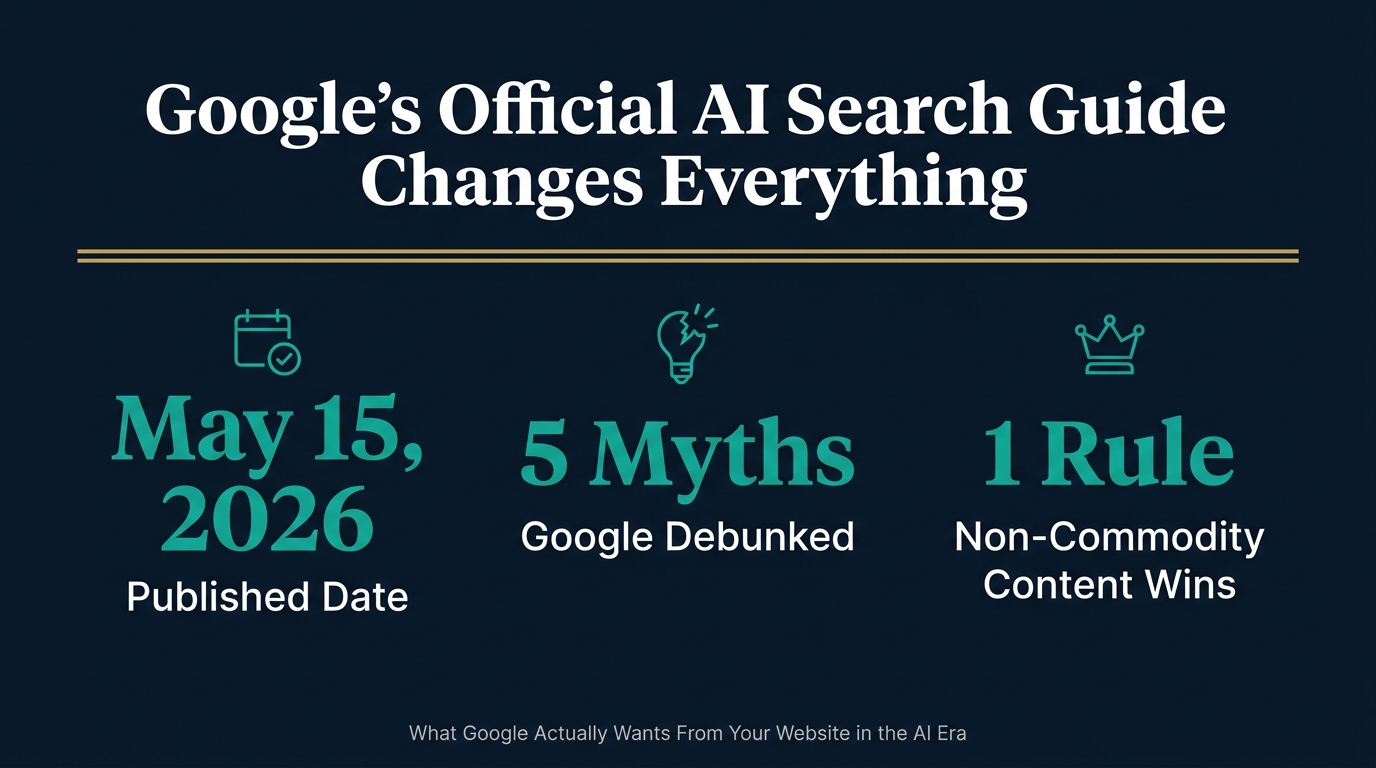
On May 15, 2026, Google published a new official guide called "Optimizing your website for generative AI features on Google Search." This is the first time Google has put its AI search optimisation advice into a single, formal documentation page. It expands on earlier guidance from 2025 and directly addresses the growing industry of AEO (answer engine optimisation) and GEO (generative engine optimisation) services.
The guide covers five areas: why unique content matters, tips for local and shopping content, a mythbusting section naming specific tactics you can ignore, initial guidance on AI agents, and a reminder that standard SEO best practices remain the foundation.
This matters because Google is now on record about what works and what does not for AI Overviews and AI Mode. If you have been following AEO advice from third parties, some of it may be wrong according to Google's own documentation.
Google Says AEO and GEO Are Just SEO
Google defines AEO as "answer engine optimisation" and GEO as "generative engine optimisation," then makes its position clear: "From Google's perspective, optimising for generative AI search is optimising for the search experience, and thus still SEO."
This echoes what Google employees have said at conferences. Gary Illyes and Cherry Prommawin told Search Central Live attendees that GEO and AEO do not require separate frameworks. The difference now is that this position appears in Google's published documentation, giving website owners an official reference to cite.
Google's AI features (AI Overviews and AI Mode) are "rooted in our core Search ranking and quality systems" and use retrieval-augmented generation (RAG) and a technique called "query fan-out" to surface content from the Search index. The same systems that rank your content for traditional search also determine whether it appears in AI responses.
Five Things Google Says You Do Not Need
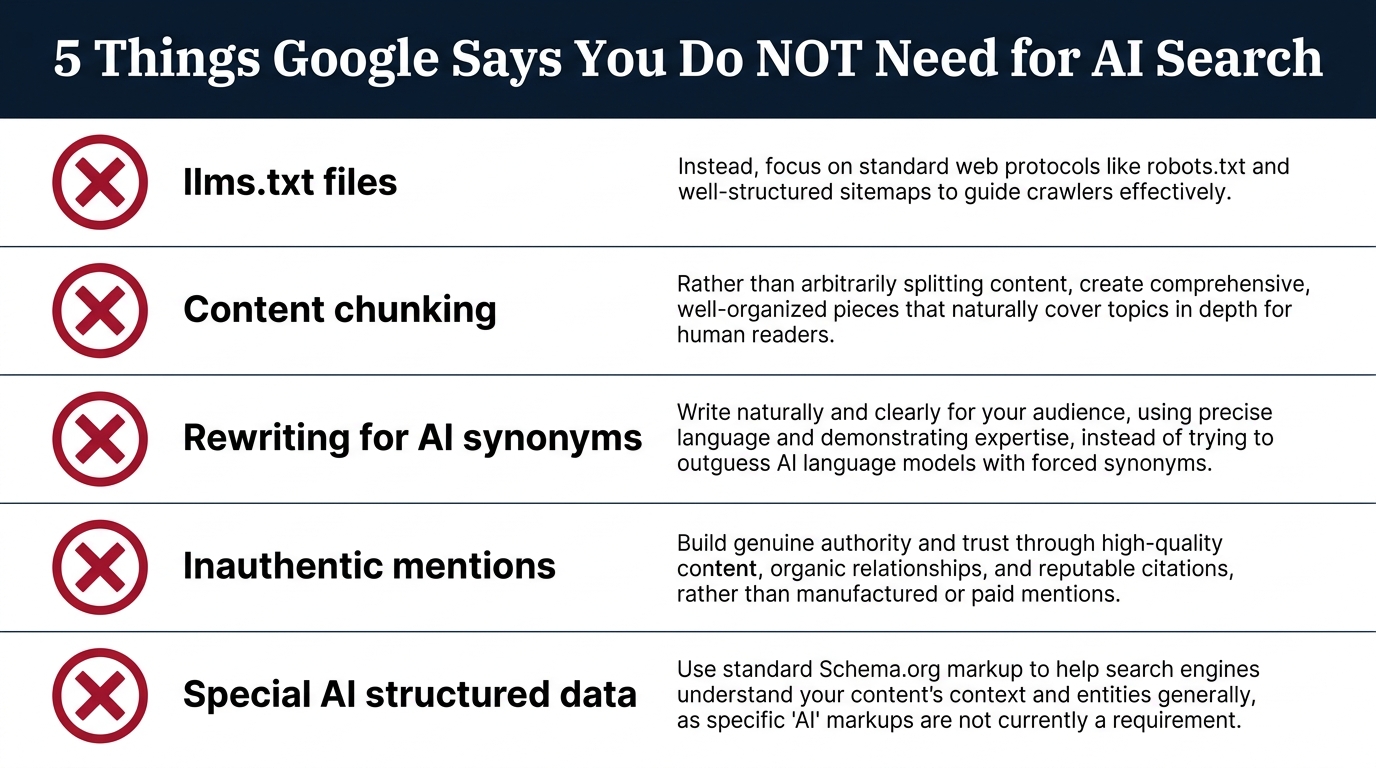
The mythbusting section is the most valuable part of the guide. Google explicitly names tactics it calls unnecessary.
1. llms.txt files and special AI markup. You do not need to create machine-readable files, AI text files, or special markdown for AI systems. Google may discover and index many file types beyond HTML, but those files do not receive special treatment.
2. Content chunking. There is no requirement to break content into small pieces for AI systems. Google says its systems "are able to understand the nuance of multiple topics on a page and show the relevant piece to users." Danny Sullivan confirmed this in January 2026, saying Google engineers specifically recommended against chunking.
3. Rewriting content for AI systems. AI systems understand synonyms and general meanings. You do not need to capture every long-tail keyword variation or write in a specific way for generative AI search. Write naturally for humans.
4. Seeking inauthentic mentions. AI features surface what is said about products and services across blogs, videos, and forums. But seeking fake mentions "is not as helpful as it might seem" because core ranking systems focus on quality while other systems block spam.
5. Special structured data for AI. There is no special schema.org markup for AI features. Google recommends continuing to use structured data as part of overall SEO strategy for rich results eligibility, but it is not required for AI search visibility.
What Google Actually Wants: Non-Commodity Content
The single most important takeaway from the guide is Google's emphasis on non-commodity content.
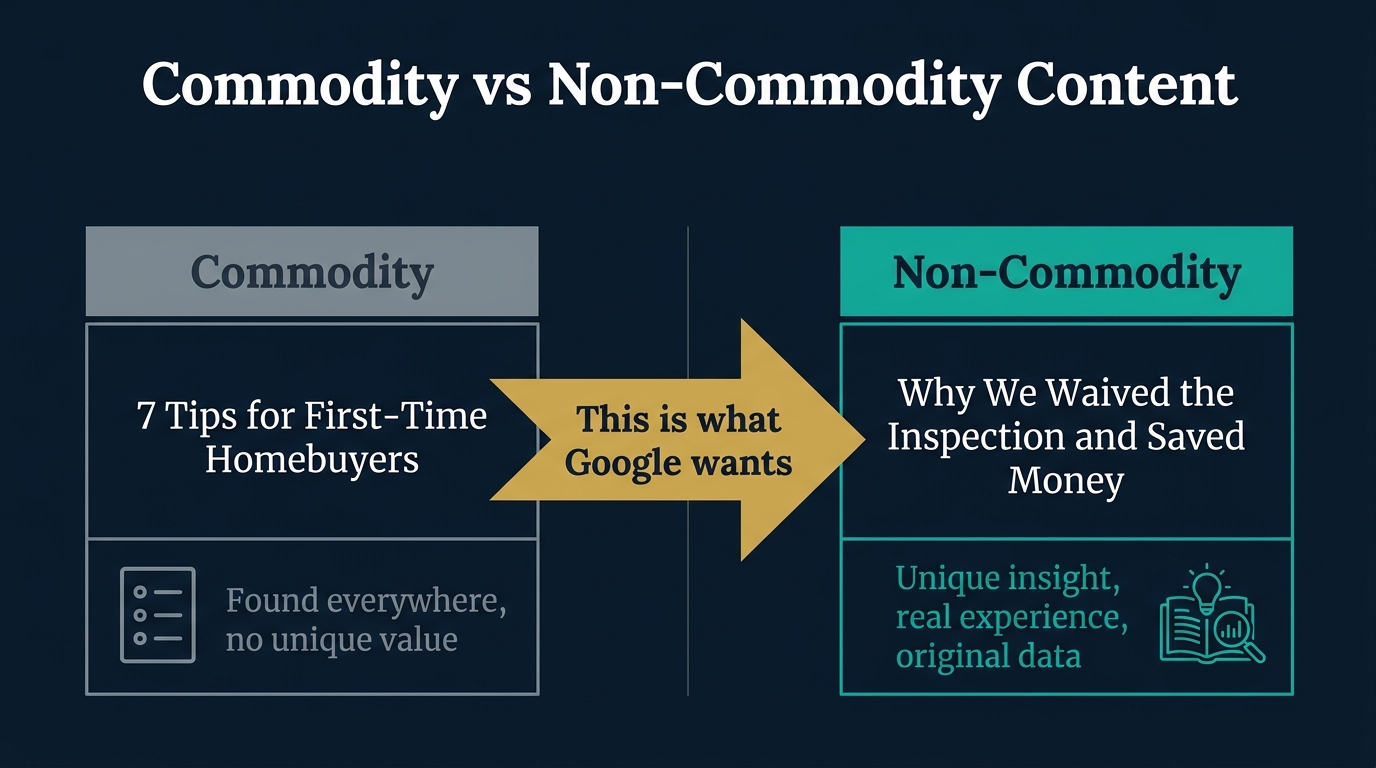
Google contrasts commodity content with non-commodity content. A commodity example: "7 Tips for First-Time Homebuyers." A non-commodity example: "Why We Waived the Inspection and Saved Money: A Look Inside the Sewer Line."
The difference is whether content provides unique insight beyond common knowledge. Commodity content is information you could find on dozens of other websites. Non-commodity content comes from real experience, original research, or unique perspective.
For Australian businesses, this means your most valuable content is not generic advice about your industry. It is the specific things you have learned from working with real clients, the data you have collected from real projects, and the insights that only someone in your position could share.
A plumbing company writing "How to Fix a Leaky Tap" is commodity content. That same company writing "Why 80 Per Cent of Gold Coast Homes Have Incorrectly Sized Hot Water Systems: What We Found in 500 Service Calls" is non-commodity content. It contains original data and unique insight that cannot be found anywhere else.
How Query Fan-Out Changes Your Content Strategy
Google's AI uses a technique called "query fan-out." When someone asks a question, the system issues multiple related searches across subtopics and data sources to build a comprehensive response. While the response is being generated, the models identify supporting web pages, displaying a wider and more diverse set of links than a classic web search.
This is significant for content strategy. Instead of trying to rank for one specific query, you benefit from having diverse content across related subtopics. A single user query might surface links from your comparison article, your case study, your FAQ page, and your data dashboard, all from the same website.
The implication: write broadly about your area of expertise, not just narrowly around target keywords. Cover related subtopics thoroughly. A law firm does not just write about conveyancing. It writes about property inspections, settlement timelines, first-home buyer grants, common contract traps, and local council regulations. Each of those subtopics becomes a potential entry point when Google's AI fans out across related searches.
What About AI Agents?
The guide includes initial guidance on AI agents, which Google defines as "autonomous systems that can perform tasks on behalf of people, such as booking a reservation or comparing product specifications."
Google notes that browser agents may access websites by analysing screenshots, inspecting the DOM, and interpreting the accessibility tree. The guide links to web.dev's guide to agent-friendly website best practices and references the Universal Commerce Protocol (UCP) as an emerging standard.
This guidance is early. Google frames it as optional, suggesting businesses explore it "if this is something that is relevant to your business and you have extra time." Agent optimisation is forward-looking rather than urgent.
For businesses selling products or services online, making your website accessible and well-structured for machine reading (clean HTML, clear pricing, structured product data) positions you well for both traditional search and emerging agent experiences.
How This Applies to Australian Businesses
Google's guide has specific implications for Australian businesses trying to appear in AI search results.
Focus on what only you can say. Your experience with local clients, local regulations, and local market conditions is non-commodity content. An accounting firm in Brisbane has different insights than one in Sydney. Write about what you have actually seen and done.
Stop chasing AEO hacks. If someone is selling you llms.txt files, content chunking services, or "AI-optimised" rewriting, Google says those are unnecessary. Spend that budget on creating original research, case studies, and data-driven content instead.
Keep your technical SEO solid. The basics matter more than ever. Crawlability, semantic HTML, fast page load times, mobile usability, and reduced duplicate content are what Google checks before your content can appear in AI features.
Use structured data normally. FAQPage schema, Article schema, and local business schema help with rich results. They do not get special AI treatment, but they remain valuable for overall search visibility.
Think in subtopics, not keywords. Google's query fan-out means covering a topic thoroughly across multiple angles gives you more chances to appear. Write the main article, then the FAQ, then the case study, then the comparison, then the data analysis.
What This Means For Our Content Strategy at Flowtivity
We have been following many of these principles already. Our benchmark posts with original data (like our DGX Spark tests) are exactly the kind of non-commodity content Google is talking about. Nobody else has tested Atlas at 1M context on a DGX Spark and published the results.
Going forward, we are doubling down on original data and first-hand experience. Every piece of content we publish will answer the question: "What does Flowtivity know that nobody else does?"
Frequently Asked Questions
What is Google's AI optimisation guide?
Google published an official guide on May 15, 2026 called "Optimizing your website for generative AI features on Google Search." It provides the first consolidated, formal documentation on how to appear in AI Overviews and AI Mode. The guide emphasises non-commodity content, debunks common AEO/GEO tactics, and confirms that standard SEO best practices remain the foundation.
Do I need llms.txt for Google AI search?
No. Google explicitly says you do not need to create llms.txt files, special AI text files, or unique markup for generative AI search. Google may discover many file types, but they do not receive special treatment for AI features.
Should I chunk my content for AI search?
No. Google says its systems understand multiple topics on a single page and can show the relevant piece to users. Google engineers have specifically recommended against breaking content into small pieces. Write naturally with comprehensive coverage on each page.
What is non-commodity content?
Non-commodity content provides unique insight that cannot be found on dozens of other websites. It comes from real experience, original research, or unique data. Google contrasts it with commodity content like "7 Tips for First-Time Homebuyers" (generic) versus "Why We Waived the Inspection and Saved Money" (unique, experience-based).
What is query fan-out?
Query fan-out is a technique Google's AI uses to issue multiple related searches across subtopics when responding to a user query. This means a single question can surface links from many different pages. Covering a topic thoroughly across related subtopics gives you more chances to appear in AI responses.
Does Google's AI guide apply to ChatGPT and Perplexity?
Google's guidance applies to Google AI features only (AI Overviews and AI Mode). ChatGPT uses Bing and values authority differently. Perplexity weights recency more heavily. Claude uses Brave Search. Each platform has its own weighting, but Google's emphasis on unique, helpful content aligns with what all AI platforms value.
One email a month, no noise
Practical AI notes for Australian businesses. Unsubscribe anytime.