
On this page
- What Does Token Value Per Watt Actually Mean?
- Why This Matters For Growing Businesses Right Now
- The Token Value Per Watt Methodology: A Five-Stage Framework
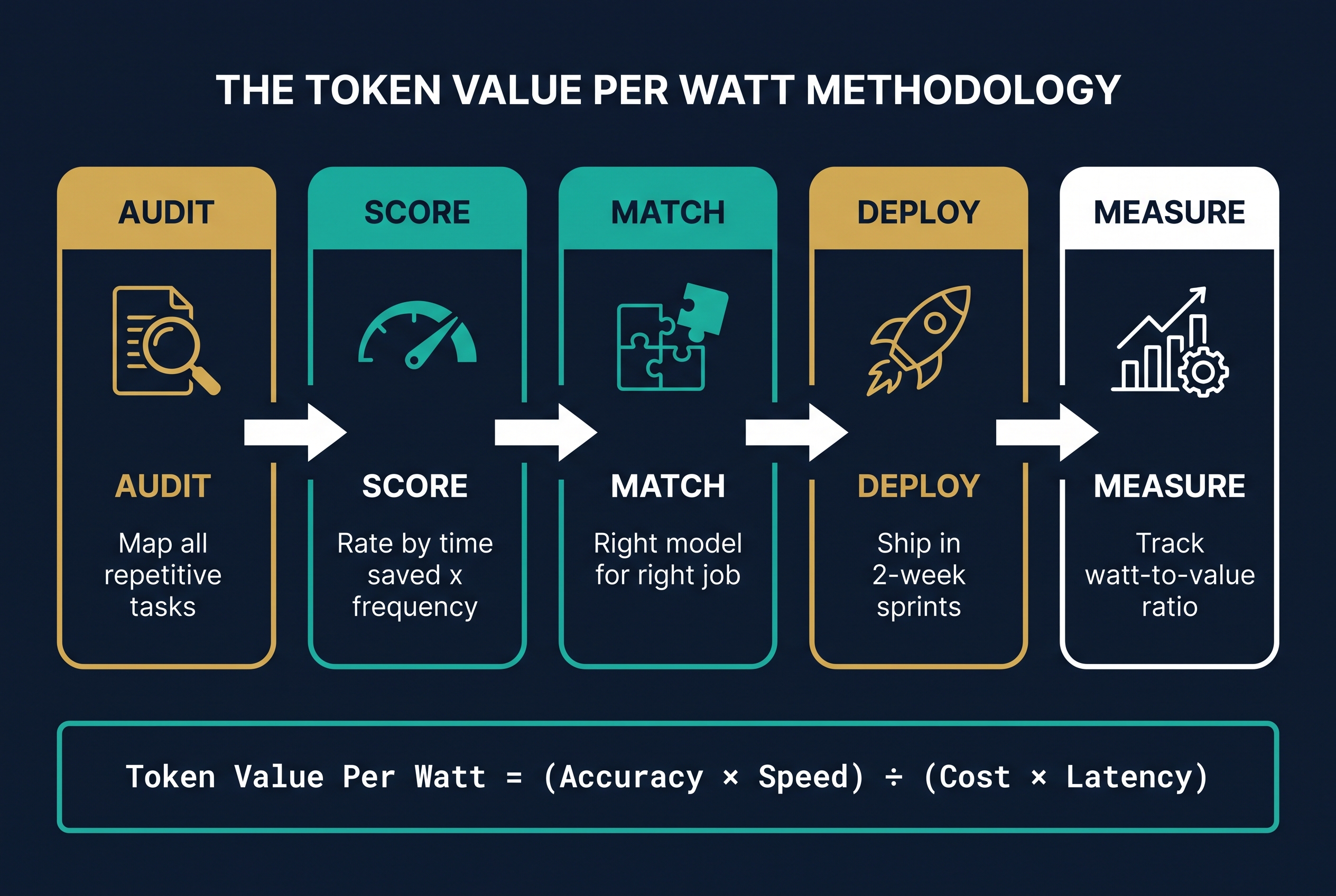
- Stage 1: Audit (Map the Repetitive)
- Stage 2: Score (Rank by Impact)
- Stage 3: Match (Right Model, Right Job)
- Stage 4: Deploy (Ship in Sprints)
- The Deployment Layer: Why an Agentic Harness Matters
- Stage 5: Measure (Track the Ratio)
- Real-World Example: The 10x Cost Reduction
- Common Mistakes to Avoid
- The Formula That Defines AI ROI
Last Updated: July 17, 2026
"Whoever can provide the most token value per watt, per user, will win the AI race." That is what Perplexity CEO Aravind Srinivas told CNBC in July 2026, and it is the most important sentence spoken about AI this year. It reframes the entire conversation from "which model is smartest" to "which model delivers the most useful output for the least energy and cost."
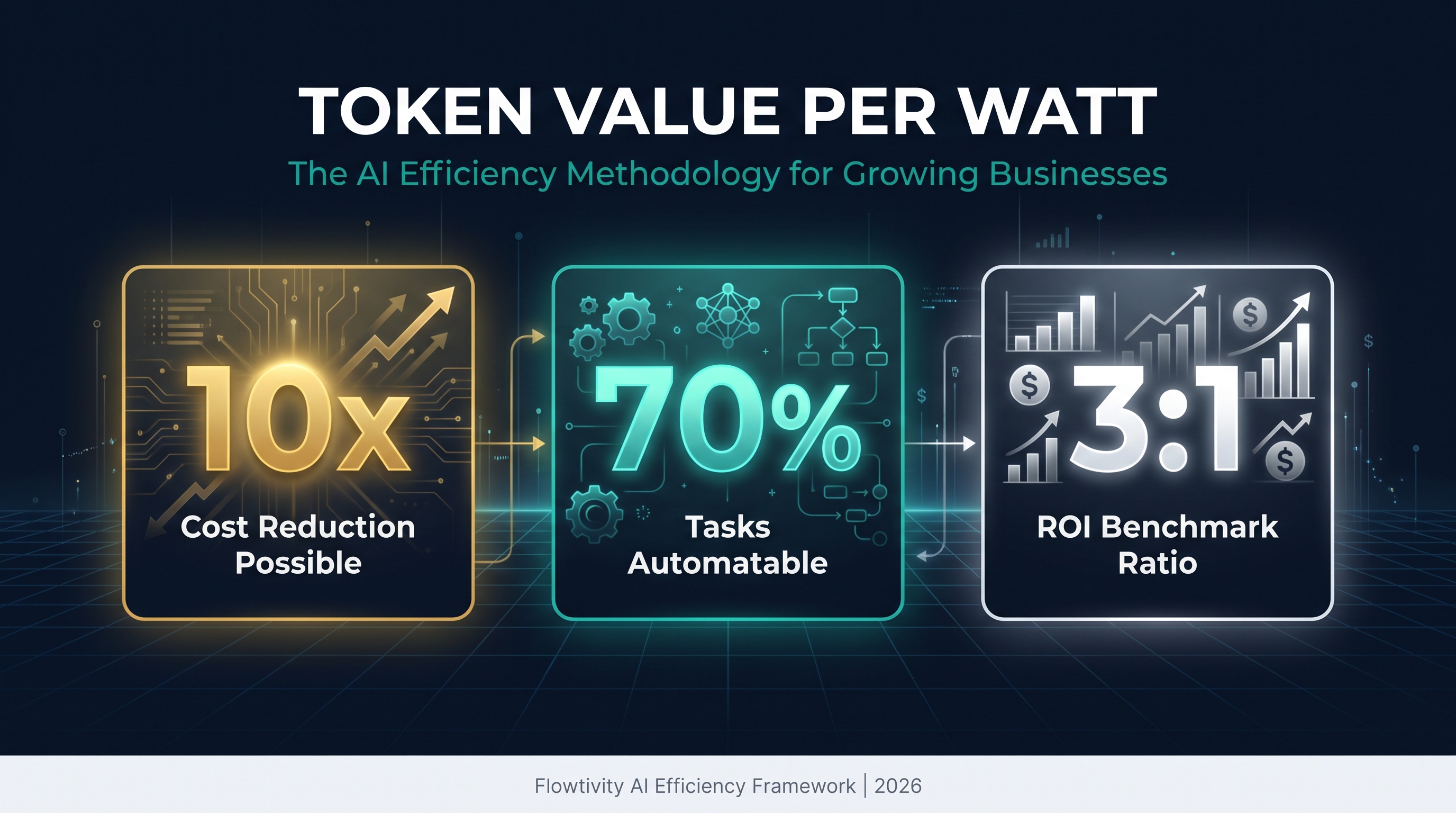
For growing businesses, this is not abstract theory. It is a practical methodology you can apply today to cut AI costs by up to 10x while maintaining quality. Here is how.
What Does Token Value Per Watt Actually Mean?
Token value per watt is an efficiency ratio. In physics, watts measure energy consumption. In AI, the "watt" represents the compute cost of generating each token (a token is roughly four characters of text). The "value" is how useful that output is to the end user. When Perplexity's CEO uses this phrase, he is saying that raw intelligence is not the winning factor. Efficiency is. The company, or business, that extracts the most real-world value from each unit of compute will dominate.
According to Srinivas, companies are competing across five dimensions: accuracy, speed, cost, privacy, and intelligence. No model wins all five. The winners will be those who balance them best for each specific use case.
"Whoever can provide the most token value per watt, per user, will win the AI race."
Aravind Srinivas, CEO of Perplexity, speaking to CNBC, July 2026
Why This Matters For Growing Businesses Right Now
According to McKinsey's 2024 "State of AI" report, approximately 60-70% of business tasks are technically automatable by current AI. But here is the catch: only 20-30% of those tasks require frontier-grade intelligence. The rest can be handled by smaller, dramatically cheaper models. Most businesses get this backwards. They either overpay by routing everything through premium models, or they underinvest by assuming AI is too expensive for their operations.
The token value per watt framework solves both problems. It gives you a systematic way to match each task to the right tier of AI, ensuring you never spend $15 per million tokens on a job that a $0.25 model could handle.
According to Artificial Analysis 2025 model benchmarking, Claude Haiku costs approximately $0.25 per million tokens while delivering 90%+ accuracy on classification, summarisation, and basic writing tasks. Frontier models like GPT-4o cost $15-30 per million tokens. For a business processing 10,000 customer emails per month, that is the difference between $2.50 and $300 for nearly identical results.
The Token Value Per Watt Methodology: A Five-Stage Framework
We developed this methodology at Flowtivity to translate Srinivas's efficiency thesis into practical business execution. It works for any organisation with repetitive digital tasks, which is virtually every growing business.
Stage 1: Audit (Map the Repetitive)
List every repetitive digital task in your business. Email triage. Data entry. Report generation. Customer support responses. Meeting scheduling. Document review. Invoice processing. Social media drafting. For each task, record: how often it occurs (daily, weekly, monthly), how long a human spends on it, and what the output quality bar is.
This audit typically reveals 40-60 automation candidates in a 50-person company. Most take under 10 minutes of human time but occur dozens of times per week. These are your token value per watt opportunities.
Stage 2: Score (Rank by Impact)
Score each task using a simple formula: Impact = Time Saved per Instance x Frequency. A task that saves 30 minutes and happens daily scores 150. A task that saves 2 hours but happens weekly scores 120. Sort descending. The top 20% of your list accounts for 80% of potential time savings.
This stage prevents the common mistake of automating interesting tasks instead of impactful ones. You do not need to automate everything. You need to automate the right things.
Stage 3: Match (Right Model, Right Job)
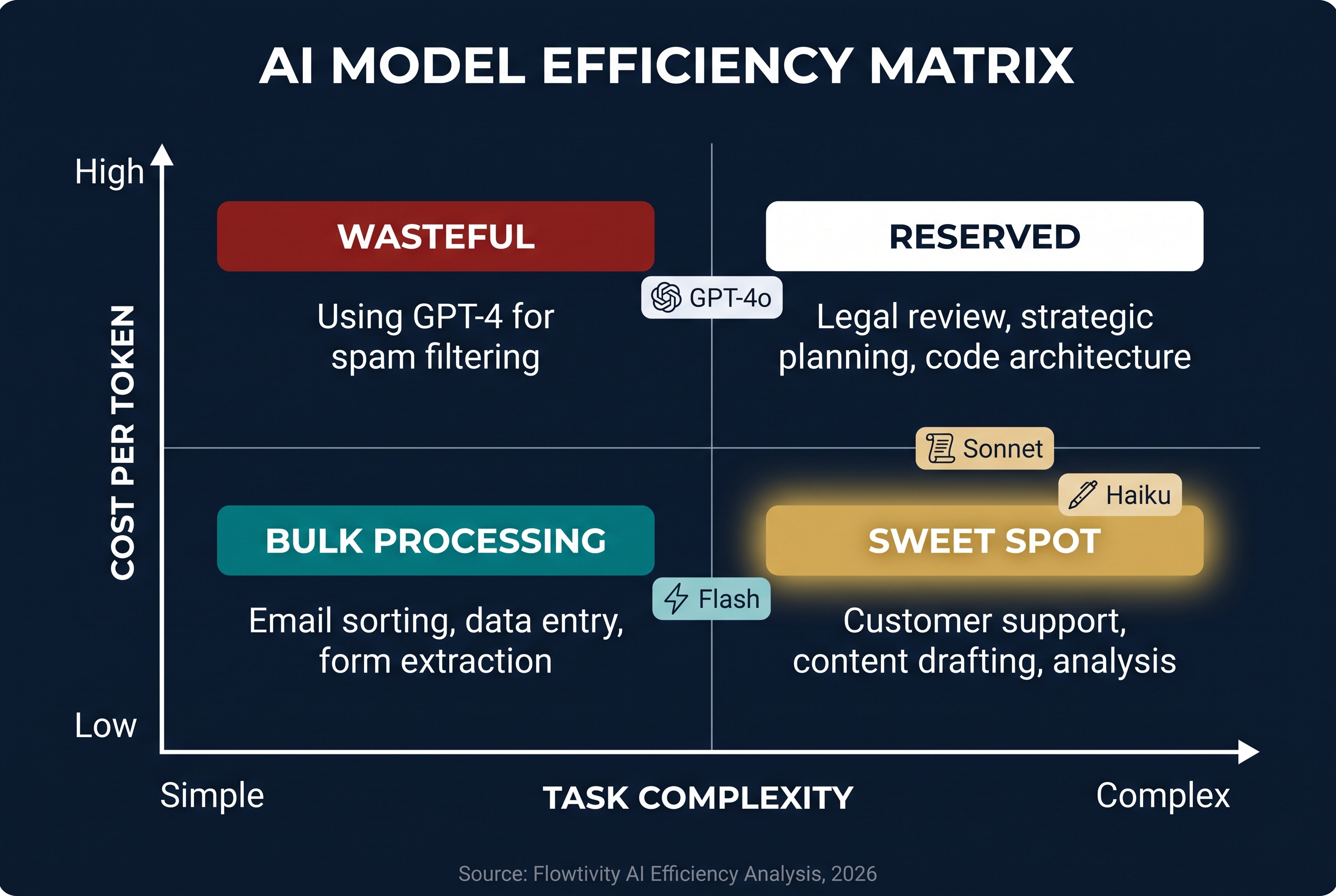
Assign each high-impact task to the cheapest AI model that can handle it reliably. This is where the token value per watt principle becomes practical:
- Bulk processing (email sorting, data extraction, form classification): Small models like Claude Haiku or GPT-4o mini. Cost: $0.25-$1 per million tokens. Handles 70% of business tasks.
- Sweet spot (customer support, content drafting, analysis, research): Mid-tier models like Claude Sonnet or Gemini Pro. Cost: $3-$5 per million tokens. Best quality-to-cost ratio.
- Reserved (legal review, strategic planning, code architecture): Frontier models like GPT-4o or Claude Opus. Cost: $15-$30 per million tokens. Reserve for the 10-20% of tasks that genuinely need frontier reasoning.
The formula to remember: Token Value Per Watt = (Accuracy x Speed) / (Cost x Latency). Higher is better. A task where a $0.25 model achieves 92% accuracy scores far higher on this ratio than a $15 model achieving 96%. That 4% accuracy gap is not worth a 60x cost increase for most business tasks.
Stage 4: Deploy (Ship in Sprints)
Do not try to automate everything at once. Pick the top five tasks from your scored list and deploy them in a two-week sprint. The deployment layer matters enormously here. You need infrastructure that can route tasks to different models, handle failures gracefully, and scale across your organisation.
The Deployment Layer: Why an Agentic Harness Matters
In our experience at Flowtivity, the single biggest accelerator for applying this methodology is starting with the right agentic harness. We use OpenClaw as our foundational layer. It is an open-source agent runtime that lets you run multiple AI employees on the same infrastructure, each configured with a different model based on the task profile.
Here is why this matters for token value per watt: the harness handles the routing automatically. Your email triage agent runs on a cheap local model. Your research agent calls a frontier model via API. Your content agent uses a mid-tier model. All of them operate as specialised AI employees with distinct roles, memory, and tool access, orchestrated from one platform. You are not locked into a single provider or pricing tier.
The key advantages we have seen in production:
- Multi-model routing: Run local models (like Llama or Mistral on your own GPU) for zero per-token cost on bulk tasks, and frontier models (Claude, GPT-4o) only when the task demands it. This is the token value per watt principle applied at the infrastructure level.
- Specialised agents, not generalists: Each AI employee has a specific job description, tools, and context. A lead research agent does not burn frontier tokens on formatting. A content agent does not waste compute on data lookup. Specialisation compounds efficiency.
- Local plus cloud flexibility: Sensitive tasks (HR data, financial analysis) run on local models for privacy compliance. Customer-facing tasks use frontier models for quality. Same harness, different routing.
- Rapid prototyping: We build and deploy a new specialised AI employee in hours, not weeks. The harness handles authentication, scheduling, memory, and tool integration. This compresses the Deploy stage from months to sprints.
For businesses starting their AI journey, we recommend treating the agentic harness as step one, not an afterthought. It is the operating system for your AI workforce. Without it, you end up with a collection of disconnected automations that are hard to maintain, monitor, or scale. With it, each new AI employee you deploy gets cheaper and faster to build because the infrastructure is already in place.
The first sprint typically saves 15-25 hours per week across a 50-person team. By sprint three, cumulative savings reach 60-80 hours per week. The key is starting with high-frequency, low-complexity tasks where failures are easily caught and corrected.
Stage 5: Measure (Track the Ratio)
Every month, calculate three numbers for each automation: hours saved, cost per task (API spend divided by task volume), and accuracy rate (percentage of outputs that need no human correction). Your Token Value Per Watt ratio is output quality divided by cost. Track it over time.
When a cheaper model becomes available that maintains quality, switch. When a task's accuracy drops below your threshold, escalate to a stronger model. The market moves fast. According to Stanford's AI Index 2025, model costs have dropped approximately 80% year over year since 2023. What required a frontier model in January often runs on a small model by December.
Real-World Example: The 10x Cost Reduction
A childcare provider with 17 centres was processing parent enquiries, staff scheduling, and compliance reporting manually. Their initial instinct was to use GPT-4o for everything. Estimated monthly cost: $2,400.
After applying the Token Value Per Watt methodology, we matched tasks to models:
- Parent enquiry triage (2,000/month): Claude Haiku at $0.25/M tokens. Monthly cost: $3. Accuracy: 91%.
- Staff scheduling drafts (150/month): Claude Sonnet at $3/M tokens. Monthly cost: $18. Accuracy: 96%.
- Compliance report review (30/month): GPT-4o at $15/M tokens. Monthly cost: $45. Accuracy: 98%.
Total monthly cost: $66 instead of $2,400. A 36x reduction. Accuracy across all tasks averaged 93%, well above the 85% threshold the team set as acceptable. The time savings were identical because the bottleneck was never model intelligence. It was having any automation at all.
Common Mistakes to Avoid
Mistake 1: Using one model for everything. This is the most expensive mistake. It feels simpler but you are paying frontier prices for tasks a mini model handles perfectly. Audit and match.
Mistake 2: Optimising for accuracy over efficiency. Going from 90% to 95% accuracy often costs 10x more. For most business tasks, 90% with a human review step is the sweet spot. According to a 2025 Harvard Business Review study, businesses that accepted 85-92% accuracy thresholds achieved 4x higher AI ROI than those demanding 99%+.
Mistake 3: Set and forget. AI costs drop constantly. A model assignment made in January may be 5x cheaper by June. Review quarterly.
Mistake 4: Ignoring latency. A model that takes 12 seconds to respond can bottleneck workflows even if it is cheap. Speed is part of the value equation. For customer-facing tasks, prioritise models under 3-second response times.
The Formula That Defines AI ROI
Write this down:
Token Value Per Watt = (Accuracy x Speed) / (Cost x Latency)
This single ratio captures what Srinivas was describing. When you evaluate any AI deployment, run it through this formula. If the number is low, you are burning watts without delivering value. If it is high, you have found the sweet spot.
The businesses that win the next decade will not be the ones with the biggest AI budgets. They will be the ones who squeeze the most value from every token, every watt, every dollar. That is the race Perplexity's CEO is describing. And it is a race any growing business can win.
About the author: AJ Awan is the founder of Flowtivity. Former EY management consultant. TOGAF certified enterprise architect. He helps growing businesses deploy AI efficiently, with a focus on practical automation over hype.
Sources: CNBC interview with Aravind Srinivas, July 2026. McKinsey "State of AI" 2024 Report. Artificial Analysis Model Pricing Benchmark 2025. Stanford AI Index 2025. Harvard Business Review AI ROI Study 2025. Flowtivity production deployment data, OpenClaw agent runtime, 2025-2026.
What's actually useful in AI, every Friday
We follow everything happening in AI and send what's worth your time: new models, AI agents, and how to put them to work. One email a week, unsubscribe anytime.
