Back to Blog
Future of Work
Original
Draft Preview

Will AI Replace Jobs in Australia? What Small Business Owners Need to Know in 2026

Only 4% of Australian jobs are highly exposed to AI automation, but 21% face medium-to-high exposure. Learn which jobs are at risk, which are growing, and how small businesses should prepare.

19 min read
AI and the Australian workforce: a professional illustration showing artificial intelligence augmenting human workers in Australian small businesses
Last Updated: February 6, 2026

Key Takeaways

In summary, AI is far more likely to augment your team than replace it—the Jobs and Skills Australia Generative AI Capacity Study found AI has "a greater capacity to augment work than automate work." Only 4% of Australian jobs are highly exposed to AI automation, while around 21% face medium-to-high exposure. Clerical, administrative, and data entry roles are most at risk, while trades, healthcare, construction, and hospitality are projected to grow. 80% of Australian small businesses are already using or planning to adopt AI. Proactive business owners who invest in upskilling now will be best positioned to stay competitive. - Only 4% of Australian jobs are highly exposed to AI automation, but around 21% face medium-to-high exposure, according to Jobs and Skills Australia and the Reserve Bank. - Clerical, administrative, and data entry roles are most at risk, while trades, healthcare, construction, and hospitality are among the least exposed and are actually projected to grow. - 80% of Australian small businesses are already using or planning to adopt AI, making it a competitive necessity rather than a luxury. - AI is far more likely to augment your team than replace it. The Jobs and Skills Australia Generative AI Capacity Study found AI has "a greater capacity to augment work than automate work." - Proactive small business owners who invest in upskilling and smart AI adoption now will be best positioned to attract talent and stay competitive through 2026 and beyond. ---

Is AI really coming for Australian jobs?

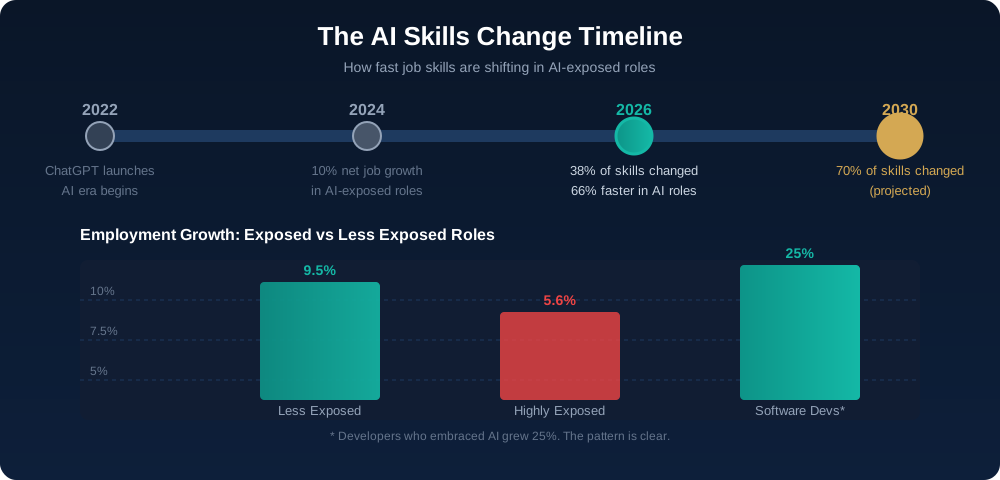
The reality is far more nuanced than doom-and-gloom headlines suggest—Jobs and Skills Australia's landmark study found generative AI has "a greater capacity to augment work than automate work," estimating only 13% of Australian jobs could be automated by 2050 while more than half could be augmented. The Reserve Bank reports only 4% of the workforce is highly exposed, with most firms expecting AI to be "labour-saving and productivity-enhancing" while transforming the types of roles and skills needed. It is the question keeping business owners, employees, and policymakers up at night. With headlines about mass redundancies at major Australian companies and bold predictions from global tech CEOs, the anxiety around AI and employment has never been higher. But here is the reality: the picture in Australia is far more nuanced than the doom-and-gloom narrative suggests. In late 2025, Jobs and Skills Australia released its landmark Generative AI Capacity Study, the first government report of its kind. The findings were clear: generative AI has "a greater capacity to augment work than automate work," especially in high-skilled occupations. The study estimated that around 13 per cent of Australian jobs could be automated by 2050, while more than half could be augmented by AI. Meanwhile, the Reserve Bank of Australia's November 2025 Bulletin reported that only about 4 per cent of the current Australian workforce is highly exposed to AI automation, with around 21 per cent facing medium-to-high exposure. The RBA surveyed over 100 medium-to-large firms and found that most anticipate AI investments to be "labour-saving and productivity-enhancing over the long term," but also expect "a substantial transformation of the types of roles and skills needed in the future." So yes, AI is reshaping Australian workplaces. But it is not a simple story of robots taking everyone's jobs.

Which jobs are most at risk in Australia?

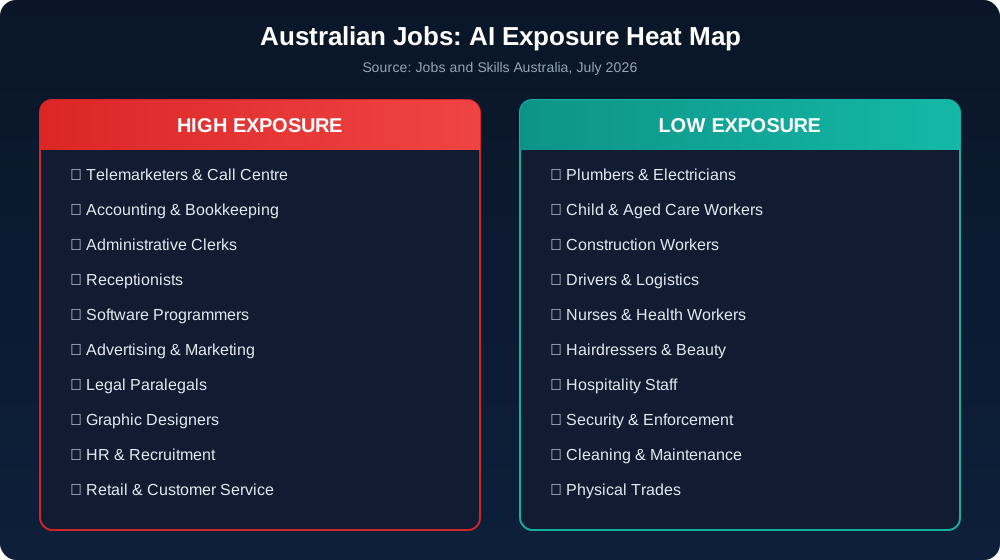
Roles facing the highest automation risk are office clerks, receptionists, bookkeepers, data entry operators, sales and marketing professionals, and programmers for routine coding tasks—essentially, any role where the core work can be described as "take this data and put it over there." Entry-level workers, older workers, First Nations Australians, people with disability, and women in administrative roles face disproportionate vulnerability. The Jobs and Skills Australia study identified the occupations most vulnerable to automation by generative AI. These tend to be roles heavy on routine cognitive tasks, things that AI can already do quickly and cheaply. Roles facing the highest automation risk include: - Office clerks and general administrative workers - Receptionists - Bookkeepers and accounting clerks - Data entry operators and record keepers - Sales, marketing, and public relations professionals - Business analysts - Programmers (for routine coding tasks) This aligns with what we have already seen play out at major Australian employers. The Commonwealth Bank made headlines in 2025 when it cut 45 roles due to AI, a decision it later reversed after public backlash. Telstra has signalled that AI will help shrink its workforce by 2030. NAB, ANZ, Westpac, and Bendigo Bank have all announced significant redundancies, though most have not explicitly attributed job losses to AI. The pattern is clear: roles that involve processing information, handling routine queries, or managing repetitive administrative tasks are the most exposed. If the core of your job can be described as "take this data and put it over there," AI is probably already doing it faster. Who faces disproportionate risk? The Jobs and Skills Australia report also highlighted that certain groups face greater vulnerability. Entry-level workers, older workers, First Nations Australians, and people with disability may face "disproportionate risks due to occupational concentration and digital access gaps." Women are also more exposed, as administrative roles traditionally dominated by women are among the most at-risk occupations.

What new jobs is AI creating in Australia?

Occupations projected to gain the most employment by 2050 include cleaners, nursing professionals, business administration managers, construction and mining labourers, and hospitality workers—roles requiring physical presence, human empathy, complex decision-making, or hands-on skills that AI cannot replicate. AI investment is also creating new categories like AI trainers, prompt engineers, data ethicists, and implementation specialists. Here is the part of the story that rarely makes headlines: AI is also creating jobs and driving growth in sectors across the economy. According to the Jobs and Skills Australia study, the occupations projected to gain the most employment by 2050 include: - Cleaners and laundry workers - Midwifery and nursing professionals - Business administration managers - Construction and mining labourers - Hospitality workers These are roles that require physical presence, human empathy, complex decision-making, or hands-on skills that AI simply cannot replicate. The Australian Bureau of Statistics reported that business expenditure on AI research and development grew by a staggering 142 per cent between 2021-22 and 2023-24, from $276.3 million to $668.3 million. That level of investment is creating entirely new categories of work: AI trainers, prompt engineers, data ethicists, AI implementation specialists, and more. Professor Janine Dixon, Director of the Centre of Policy Studies at Victoria University, whose research informed the Jobs and Skills Australia report, put it this way: "We may see a bit of net job loss, but the job losses that we're expecting from our study are not enormous. AI will also improve productivity, which improves incomes and improves consumption, so there will be a lot of opportunities elsewhere in the economy." The RBA's research supports this view, noting that "the labour-creating effects of past technologies have generally outweighed the labour-replacing effects in aggregate."

How are Australian small businesses actually using AI right now?

80% of Australian small businesses are using AI or planning to adopt it within two years, with 66% already using AI for problem-solving, marketing content, client communication, faster data access, and resource optimisation. 48% now see AI as important to daily operations, and 60% are optimistic about its potential for growth and efficiency. The BizCover Australian Small Business AI Report 2025 surveyed 965 small business owners and revealed a striking shift in attitudes. The headline finding: 80 per cent of Australian small businesses are either using AI or planning to adopt it within the next six months to two years. Two-thirds (66 per cent) are already using AI in some capacity. What are they using it for? - Problem-solving and decision support - Marketing content creation and campaign management - Client communication and customer service - Faster access to data for decision-making - Resource optimisation and productivity gains The Department of Industry, Science and Resources' AI Adoption Tracker for Q1 2025 found that 23 per cent of SMEs said AI was "definitely" providing faster access to accurate data, 20 per cent said it was "definitely" enhancing marketing engagement, and 18 per cent credited it with enhanced resource optimisation. Perhaps most telling: 48 per cent of small businesses now see AI as important to their daily operations, with 14 per cent considering it essential. And 60 per cent of small business owners are optimistic about AI's potential for growth and efficiency. At the same time, the report acknowledged real concerns. Nearly half (49 per cent) of respondents worry AI could harm creative abilities like copywriting and content creation. Privacy concerns and uncertainty about integration remain the main barriers to adoption.

How does AI augment rather than replace workers in trades, healthcare, and construction?

In trades, healthcare, and construction, AI is making workers more effective rather than replacing them—optimising scheduling, improving quoting accuracy, monitoring safety, reducing administrative burden, and supporting diagnosis while humans continue to provide the physical work, empathy, and clinical judgement that AI cannot replicate. Construction labourers and nursing professionals are among occupations projected to grow through 2050. This is where the conversation gets particularly relevant for Australian SMBs. In sectors like trades, healthcare, and construction, AI is not replacing workers. It is making them more effective.

Trades and construction

A plumber does not need to worry about ChatGPT taking their job. But AI is transforming how trade businesses operate behind the scenes: - Scheduling and dispatch: AI-powered tools optimise job scheduling, reducing travel time and increasing the number of jobs completed per day. - Quoting and estimation: Machine learning analyses historical project data to produce faster, more accurate quotes. - Safety monitoring: Computer vision on construction sites can detect safety hazards in real time, reducing workplace injuries. - Inventory management: Predictive algorithms ensure the right materials are on site when needed, cutting waste and delays. The Jobs and Skills Australia study confirmed that construction and mining labourers are among the occupations projected to gain employment by 2050. The physical, problem-solving nature of trade work makes it highly resistant to automation.

Healthcare

Australia's healthcare sector is experiencing growing demand driven by an ageing population, and AI is helping stretched professionals do more with less: - Diagnostic support: AI assists radiologists and pathologists by flagging anomalies in scans and test results, improving accuracy and speed. - Administrative burden reduction: AI handles appointment scheduling, medical record management, and insurance paperwork, freeing clinicians to focus on patient care. - Telehealth triage: AI-powered chatbots help patients assess symptoms before connecting them with the right professional. - Mental health support: AI tools provide preliminary screening and monitoring between appointments. Midwifery and nursing professionals are among the fastest-growing occupations in Australia. AI supports these roles without threatening them, because healthcare fundamentally requires human connection, empathy, and clinical judgement.

Hospitality

Even in hospitality, AI is proving to be a helpful assistant rather than a replacement. AI-driven tools handle reservation management, inventory ordering, and customer feedback analysis, while humans continue to deliver the personal service that defines the sector.

What should small business owners do NOW to prepare their team?

Practical steps include auditing workflows for AI opportunities, investing in upskilling (critical thinking, communication, adaptability), starting small and iterating, having honest conversations with your team about AI as empowerment rather than threat, seeking expert guidance, and reviewing hiring strategy for adaptability and digital literacy. The goal is to frame AI as removing tedious work, not removing people. If you run a small business in Australia, the question is not whether AI will affect your operations. It already is. The question is whether you will lead the change or be caught off guard. Here are practical steps you can take right now:

1. Audit your workflows for AI opportunities

Walk through every process in your business and ask: "Is there a repetitive, time-consuming task here that AI could handle?" Common candidates include data entry, invoice processing, email responses, social media scheduling, and basic customer enquiries.

2. Invest in upskilling, not just technology

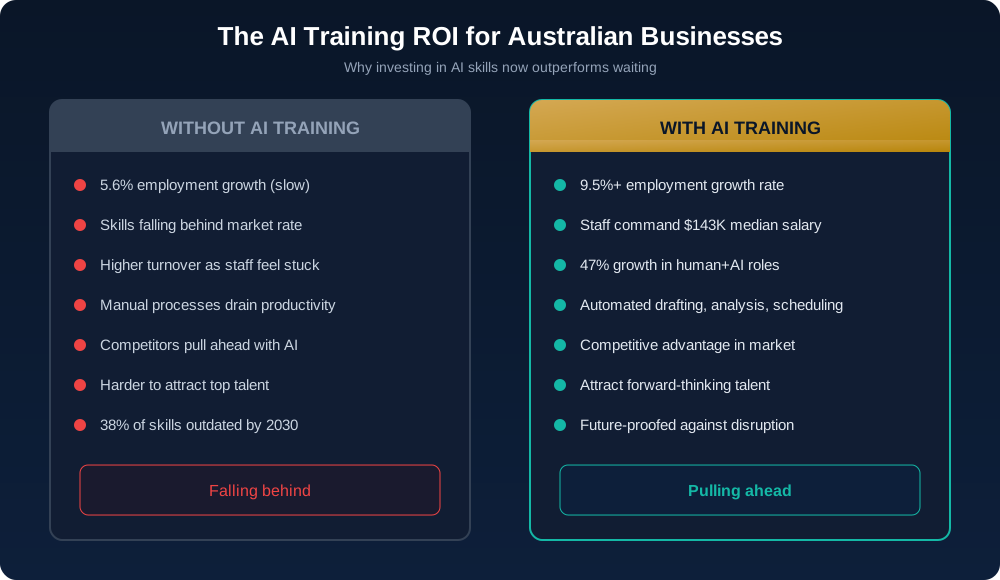
The Jobs and Skills Australia report emphasised that skills like critical thinking, communication, and adaptability are "essential" for the AI era. Before buying new software, invest in training your team to work alongside AI tools effectively. The human skills, creativity, problem-solving, relationship building, become more valuable as routine tasks get automated.

3. Start small and iterate

You do not need a six-figure AI strategy. Start with one or two tools that address your biggest pain points. Many AI solutions for small businesses are affordable and require minimal technical knowledge. Test, learn, and expand from there.

4. Have honest conversations with your team

Fear of AI is real, and it is often worse than the reality. Talk openly with your employees about how AI will be used in your business. Make it clear that the goal is to remove tedious work, not to remove people. Businesses that frame AI as a tool for empowerment rather than a threat to employment will find it far easier to drive adoption.

5. Seek expert guidance

Navigating AI adoption can feel overwhelming, especially for time-poor small business owners. Consultancies like Flowtivity work with SMBs to implement AI that supports their teams rather than replacing them. Getting the right advice early can save you from costly missteps and help you move faster than competitors who are still sitting on the fence.

6. Review your hiring strategy

Think about the skills your business will need in 12 to 24 months. The World Economic Forum and Australian government reports consistently highlight that demand is growing for people who can work with AI, interpret its outputs, and apply human judgement. Hiring for adaptability and digital literacy will serve you better than hiring for narrow technical skills that AI might soon handle.

What does the Australian Government say about AI and jobs?

The government approach is managed transition rather than resistance, with the AI Adoption Tracker monitoring uptake, the Generative AI Capacity Study providing evidence-based guidance, investment in digital skills training, and development of ethical AI frameworks. Minister Tim Ayres acknowledged potential displacement while emphasising that "going backwards leads to disinvestment and poorer outcomes." The Australian Government has been actively engaging with the AI workforce question. Minister for Industry, Innovation, and Science Tim Ayres acknowledged at the 2025 TechLeaders summit that generative AI may lead to "some displacement in the labour market," but stressed that "there's no going backwards, and that going backwards itself leads to disinvestment and poorer outcomes in terms of good quality jobs." Commissioner of Jobs and Skills Australia, Professor Barney Glover, added: "Adaptability will be critical for Australia to realise the potential benefits from AI, which will see new jobs emerge and existing jobs change." The government's approach appears to be one of managed transition rather than resistance. Key elements include: - The ongoing AI Adoption Tracker monitoring SME uptake across the country - The Generative AI Capacity Study providing evidence-based guidance - Investment in digital skills training through TAFE and university programmes - Development of an ethical AI framework for Australian workplaces For small business owners, this signals that government support for AI transition is likely to increase. Keeping an eye on grant programmes, training subsidies, and regulatory developments is well worth your time.

What can we learn from other countries?

Australia is not navigating this transition in isolation. Looking at comparable economies provides useful context: - United Kingdom: The UK government has positioned itself as an "AI-friendly" regulatory environment, with a focus on sector-specific guidance rather than blanket legislation. - Canada: Canada has invested heavily in AI research hubs and retraining programmes, particularly through its Pan-Canadian AI Strategy. - Singapore: Singapore's SkillsFuture initiative provides subsidised AI training for workers at all levels, a model Australia could learn from. The common thread across successful approaches is proactive investment in people alongside technology. Countries that treat AI as purely a cost-cutting tool risk hollowing out their workforce. Those that invest in augmentation and upskilling tend to see stronger economic outcomes.

Will AI replace my job? How to assess your own risk

Higher risk indicators include routine data processing, standardised outputs, clearly defined rule-based tasks, and working primarily with text/numbers; lower risk indicators include physical presence requirements, complex contextual decisions, relationship building, novel unpredictable situations, and creativity beyond pattern recognition. Most jobs sit in the middle—the sweet spot for augmentation where AI handles routine elements while you focus on distinctly human capabilities. If you are an employee reading this, here is a practical framework for assessing your own exposure: Higher risk indicators: - Your role involves mostly routine data processing or information handling - The outputs of your work are highly standardised - Your tasks can be clearly defined with rules and patterns - You work primarily with text, numbers, or structured data Lower risk indicators: - Your role requires physical presence and hands-on work - You make complex decisions that require contextual judgement - Your work involves building relationships and understanding emotions - You regularly deal with novel, unpredictable situations - Your role requires creativity that goes beyond pattern recognition Most people will find their job sits somewhere in the middle. That is actually the sweet spot for augmentation, where AI handles the routine elements while you focus on the work that requires distinctly human capabilities.

Frequently Asked Questions

Will AI cause mass unemployment in Australia?

The evidence suggests this is unlikely. The Jobs and Skills Australia Generative AI Capacity Study found that only about 13 per cent of jobs could be automated by 2050, while more than half will be augmented. The Reserve Bank of Australia notes that historically, the labour-creating effects of new technologies have outweighed the labour-replacing effects. Most experts expect a significant reshaping of jobs rather than mass job losses.

Which industries in Australia are most at risk from AI?

Clerical and administrative roles face the highest automation risk, according to Jobs and Skills Australia. Specific occupations include office clerks, receptionists, bookkeepers, data entry operators, and some sales and marketing roles. Industries like financial services and telecommunications are already seeing workforce changes, as demonstrated by announcements from CBA, Telstra, and the major banks.

How can small businesses in Australia start using AI?

Start with your biggest operational pain points. Common first steps include using AI for customer enquiries (chatbots), marketing content creation, invoice processing, appointment scheduling, and data analysis. The BizCover 2025 report found that 66 per cent of Australian small businesses are already using AI in some capacity. Begin small, measure results, and scale what works.

Is the Australian Government doing anything to protect workers from AI displacement?

Yes. The government has commissioned the Jobs and Skills Australia Generative AI Capacity Study, launched the AI Adoption Tracker to monitor business uptake, and is investing in digital skills training through TAFE and university programmes. Minister Tim Ayres has acknowledged potential displacement while emphasising the importance of proactive transition rather than resistance.

What skills should I develop to stay relevant in an AI-driven workplace?

Focus on skills that AI cannot easily replicate: critical thinking, complex problem-solving, emotional intelligence, creative thinking, communication, and adaptability. The ability to work effectively alongside AI tools, understanding their capabilities and limitations, is also increasingly valuable. Digital literacy across your industry's specific AI applications will give you a significant advantage. --- Explore more at Will AI Replace Me — honest resources about AI and Australian jobs. --- Explore more at Will AI Replace Me — honest resources about AI and Australian jobs.

Tags

AI Jobs
Future of Work
small-business
Career

Want AI insights for your business?

Get a free AI readiness scan and discover automation opportunities specific to your business.