On this page
- What Does AI Actually Mean for Construction Companies?
- How Are Australian Builders Using AI for Construction Estimating?
- Which AI Tools Help with Construction Project Management?
- How Is AI Changing Construction Drawings and Design?
- What Role Does AI Play in Construction Site Safety?
- Which Construction Companies Are Leading AI Adoption in Australia?
- How Can Builders Get Started with AI Without a Big Budget?
- What Are the Risks and Limitations of AI in Construction?
- How Much Does AI Cost for a Construction Company?
- Key Takeaways for Australian Builders in 2026
- Frequently Asked Questions
- Is AI being used in construction in Australia right now?
- How accurate is AI for construction estimating?
- What is the cheapest way for a builder to start using AI?
- Can AI replace construction project managers?
- Is AI construction software secure for commercial projects?
Last Updated: May 30, 2026 | 12 min read
By AJ Awan, Founder of Flowtivity. Former EY management consultant with 9+ years advising Australia's largest organisations on technology transformation, including construction and infrastructure clients.
Australian construction is a $160 billion industry running on razor-thin margins of 2-5%. That tension between massive revenue and slim profitability makes it the perfect candidate for AI adoption. In 2026, Australian builders are no longer asking whether AI applies to construction. They are asking how fast they can deploy it before competitors do.
This guide covers the six areas where AI is delivering measurable results for Australian construction companies right now: estimating, project management, drawings and design, site safety, field operations, and back-office automation. Every section includes real tools, real numbers, and practical guidance for builders ready to move beyond the pilot phase.
What Does AI Actually Mean for Construction Companies?
Artificial intelligence in construction refers to software systems that can learn from data, recognise patterns, and make predictions or recommendations without being explicitly programmed for every scenario. In practical terms, this means tools that can count bricks from a blueprint, predict when a crane will need maintenance, flag unsafe behaviour on a camera feed, or automatically generate a variation claim from site photos.
The key distinction is between generative AI (tools like ChatGPT that create content, summaries, and documents) and predictive AI (systems that forecast costs, delays, or risks from historical data). Australian builders are adopting both, but predictive AI is where the money is. A cost forecast that is 10% more accurate on a $20 million project saves $2 million. A safety prediction that prevents one serious incident saves lives and avoids six-figure legal exposure.
The most important factor for Australian builders is that AI tools now integrate with software they already use. Procore, Buildertrend, Autodesk Construction Cloud, and locally developed platforms like Aconex and MiaSol are all embedding AI features. You do not need to replace your tech stack. You need to activate what is already there.
How Are Australian Builders Using AI for Construction Estimating?
Construction estimating is the single biggest value opportunity for AI adoption in the Australian market. Traditional estimating involves manually measuring quantities from PDF plans, cross-referencing supplier pricing, and building spreadsheets that take days to complete. AI-powered takeoff tools reduce that process from days to hours, with higher accuracy.
[INFOGRAPHIC: The AI Estimating Workflow — A horizontal flow diagram on a dark navy background showing four stages: (1) Upload Plans (PDF/DWG) → (2) AI Auto-Detect (walls, doors, windows, fixtures) → (3) Quantities Generated (automated measurement with 95-98% accuracy) → (4) Cost Estimate Built (live supplier pricing, margin calculation). Each stage shown as a teal circle with a white icon. Gold arrows connect the stages. A footer note reads: "Traditional estimating: 3-5 days. AI-assisted estimating: 2-4 hours."]
Tools like Kreo Software (founded in Australia), Togal.AI, and Autodesk Takeoff use computer vision to automatically detect and measure building elements from architectural plans. Kreo reports that its AI can process a 50-page plan set and generate full quantities in under 30 minutes, a task that would take a senior estimator 2-3 days manually.
The accuracy story matters. Early AI takeoff tools achieved 85-90% accuracy, which was not good enough for tender submissions. Current generation tools consistently hit 95-98% accuracy on standard residential and commercial plans. That is within the margin of human error, which means the output can be trusted for preliminary estimates and, with a 30-minute review, for tender submissions.
For Australian builders specifically, the ROI calculation is straightforward. A mid-size builder running 20 tenders per year, each requiring 3-5 days of estimator time at $800-1,200 per day, spends $48,000-120,000 annually on estimating labour alone. AI estimating tools cost $200-500 per month. The payback period is under 3 months.
Read our detailed guide: AI Construction Estimating and Takeoffs: The Complete Guide for Australian Builders
Which AI Tools Help with Construction Project Management?
Construction project management is where AI delivers the most unexpected value. Most builders think of project management as scheduling and communication, but AI tools are now tackling the hidden cost centres: delay prediction, resource optimisation, and automated progress reporting.
Procore AI (used by many of Australia's top 100 builders) now includes predictive schedule analysis. The system analyses historical project data to identify activities that are likely to slip, often flagging risks weeks before a human project manager would notice the pattern. Procore reports that early adopters reduce schedule overruns by 12-18%.
Autodesk Construction Cloud uses AI to automatically link RFIs, submittals, and change orders to relevant drawing sheets. What used to require a document controller spending hours cross-referencing is now handled automatically. For a $50 million commercial project with 3,000+ RFIs, this saves an estimated 400-600 hours of admin time over the project lifecycle.
Buildertrend, popular with Australian residential builders doing 20-100 homes per year, has introduced AI-powered daily log generation. Site supervisors take photos and dictate notes. The AI structures them into standardised daily reports, flags incomplete tasks, and automatically updates the schedule. Builders using this feature report saving 45-60 minutes per day in admin time.
The pattern across all these tools is the same: AI is not replacing project managers. It is removing the data entry and pattern recognition burden so project managers can focus on decisions and relationships. The best analogy is spellcheck for construction management. It catches what you miss and speeds up what is tedious.
How Is AI Changing Construction Drawings and Design?
AI is transforming construction drawings in two distinct ways: automated drawing review and generative design. Both are gaining traction with Australian architecture firms and builders who design-build.
Automated drawing review uses AI to check plans for code compliance, coordination clashes, and constructability issues before they reach site. Autodesk Revit's generative design capabilities allow architects to specify parameters (building orientation, floor area ratio, material costs, energy performance) and generate hundreds of design options in minutes. The architect selects and refines the best options rather than starting from scratch.
BIM coordination has been the biggest winner. On large Australian projects, BIM models from structural, mechanical, electrical, and hydraulic engineers are now automatically clash-detected using AI. A typical $100 million commercial project generates 5,000-15,000 clashes between disciplines. AI tools can categorise these by severity, group related clashes, and suggest resolution approaches. What previously took a BIM manager 3-4 weeks now takes 3-4 days.
Generative AI for concept design is emerging fast. Tools like Finch 3D and Swapp can take a site plan and brief, then generate multiple building massing options that comply with local planning controls. For Australian builders doing design-construct, this means presenting clients with 10 viable concepts in the time it used to take to produce one.
The cost of late design changes on Australian construction projects is estimated at 5-12% of total project value. AI-assisted design review and clash detection directly reduce this cost by catching issues earlier in the design phase when changes are cheap.
What Role Does AI Play in Construction Site Safety?
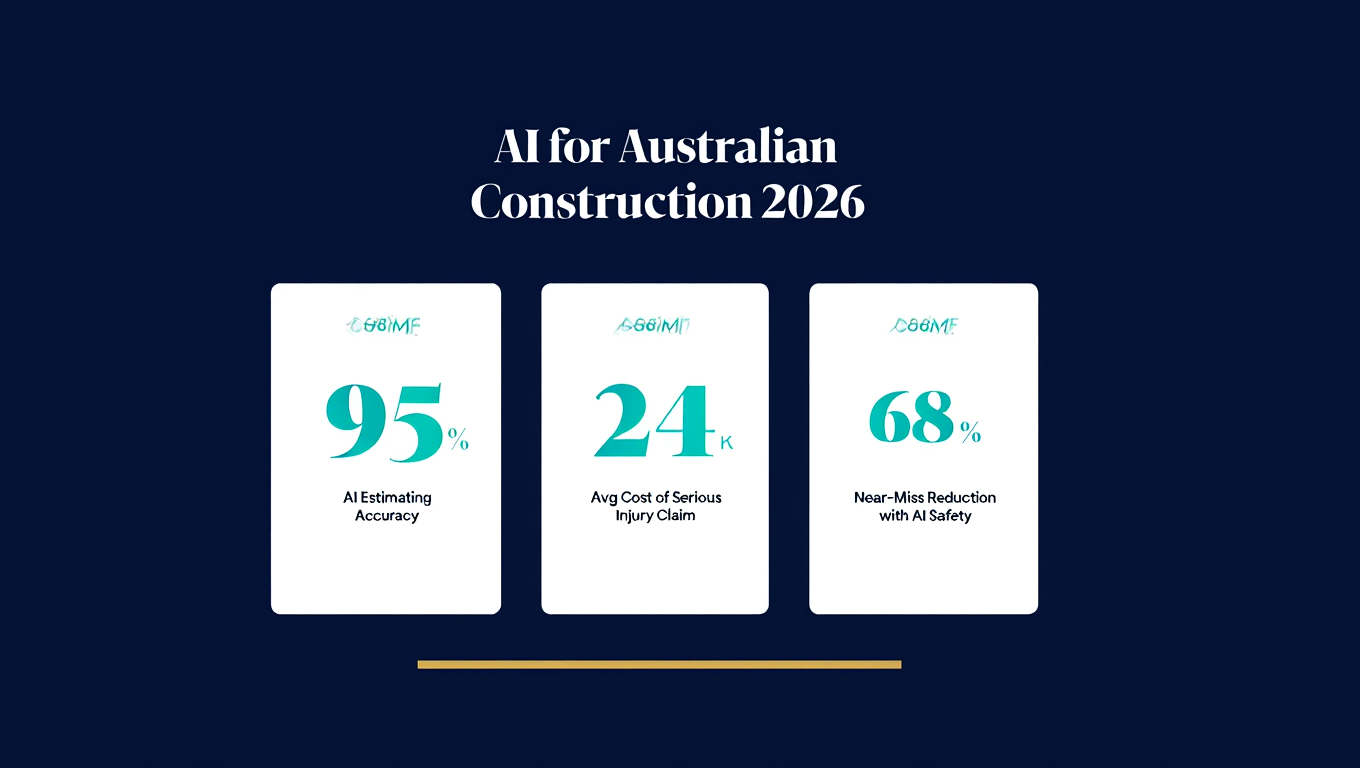
Site safety is where AI adoption has the strongest moral and financial imperative. Safe Work Australia data shows that the construction industry accounts for approximately 12% of serious workers' compensation claims despite representing about 8% of the workforce. Between 2003 and 2023, 491 construction workers died from work-related injuries in Australia. AI cannot fix every safety issue, but it addresses several of the highest-risk areas.
[INFOGRAPHIC: AI Safety Impact on Australian Construction Sites — Three-column layout on dark navy background. Column 1: Teal large number "68%" with label "Reduction in near-miss incidents reported by sites using AI camera monitoring (source: USP Safety)." Column 2: Teal large number "$240K" with label "Average cost of a serious workplace injury claim in Australian construction (source: Safe Work Australia)." Column 3: Teal large number "4 min" with label "Time for AI system to detect an unsafe act and alert the supervisor via SMS/app." Gold divider at top. White footer: "Prevention is cheaper than claims."]
AI-powered camera systems are the most deployed safety technology. Companies like Firetail AI and Ocucon provide camera-based monitoring that detects workers not wearing PPE (hard hats, high-vis vests, safety boots), unauthorised personnel in exclusion zones, unsafe scaffolding configurations, and vehicles operating too close to pedestrians. The systems alert site supervisors in real-time via mobile app or SMS.
Predictive safety analytics go beyond real-time monitoring. By analysing patterns across incidents, near-misses, weather data, task schedules, and workforce composition, AI systems can predict which activities on which days carry the highest risk. Several Australian tier-1 builders now use these predictions to schedule high-risk work during periods of lower risk (avoiding Friday afternoons, extreme heat days, or shift changes).
Drone-based site inspections powered by AI are replacing manual harness inspections of scaffolding, roofing, and structural steel. Drones capture high-resolution imagery that AI analyses for defects, corrosion, or structural movement. The safety benefit is twofold: fewer workers at height, and more thorough inspections than a human visual check can provide.
The financial case is clear. The average cost of a serious workplace injury claim in Australian construction exceeds $240,000 when you factor in direct costs (medical, rehabilitation, legal) and indirect costs (lost productivity, replacement labour, project delays, insurance premium increases). A safety camera system costs $15,000-40,000 per site to install and $500-1,500 per month to operate. One prevented serious incident pays for years of monitoring.
Which Construction Companies Are Leading AI Adoption in Australia?
Australian construction AI adoption is led by a mix of tier-1 builders, technology startups, and mid-size builders willing to experiment. The landscape in 2026 looks different from even two years ago because AI tools have moved from lab experiments to production deployments.
Tier-1 builders (Lendlease, Multiplex, John Holland, CPB Contractors, Laing O'Rourke) are investing heavily in AI for large project delivery. Lendlease has publicly discussed using AI for schedule optimisation on major projects. John Holland has deployed AI-powered safety monitoring across multiple infrastructure sites. These companies have the scale to justify dedicated AI teams and custom tool development.
The startup ecosystem is where the most innovative Australian construction AI companies operate:
- Kreo Software (Sydney): AI-powered takeoff and estimating, used by builders across Australia and expanding internationally
- MiaSol (Melbourne): AI for construction defect detection using image analysis
- Civil Planetary (Brisbane): AI-assisted civil engineering design and documentation
- Assignar (Sydney, now global): Workforce and equipment scheduling with AI optimisation, used by Australian infrastructure contractors
Mid-size builders (50-500 employees) are the fastest-growing adoption segment. These companies are large enough to benefit from AI efficiency gains but small enough that individual tool adoptions make a visible difference to profitability. A 100-person builder saving 15% on estimating time and 10% on project admin recovers 2-3 full-time-equivalent positions worth of capacity without hiring.
Government influence is accelerating adoption. Major Australian infrastructure projects (Inland Rail, Melbourne Metro Tunnel, Western Sydney Airport) now require BIM Level 2 as a minimum and increasingly expect AI-assisted design coordination. Builders who want to win government work need AI capability.
How Can Builders Get Started with AI Without a Big Budget?
The biggest misconception about AI in construction is that it requires a six-figure investment and a team of data scientists. In reality, most Australian builders can start seeing ROI from AI in under 30 days with tools that cost less than $500 per month.
Step 1: Start with estimating. This is the fastest path to measurable ROI. Sign up for a tool like Kreo, upload your last three plan sets, and compare the AI output against your manual estimates. You will see accuracy and speed gains immediately. Cost: $200-400/month.
Step 2: Automate daily reporting. If your site supervisors spend 45-60 minutes per day writing reports, switch to an AI-powered daily log tool. Buildertrend and Procore both offer this. The time savings compound fast: 1 hour per day times 5 supervisors times 48 working weeks equals 1,200 hours per year. Cost: often included in existing subscriptions.
Step 3: Add safety monitoring. For builders with active sites, deploy one AI safety camera on your highest-risk area. Most providers offer trial periods. The first time the system catches a worker without a hard hat in an exclusion zone, the value becomes obvious. Cost: $500-1,500/month per camera.
Step 4: Connect your tools with AI workflows. This is where platforms like Flowtivity come in. We help builders connect estimating tools, project management software, accounting systems, and communication platforms so data flows automatically between them. No more re-keying data from Procore into Xero, or copying schedule updates into client emails.
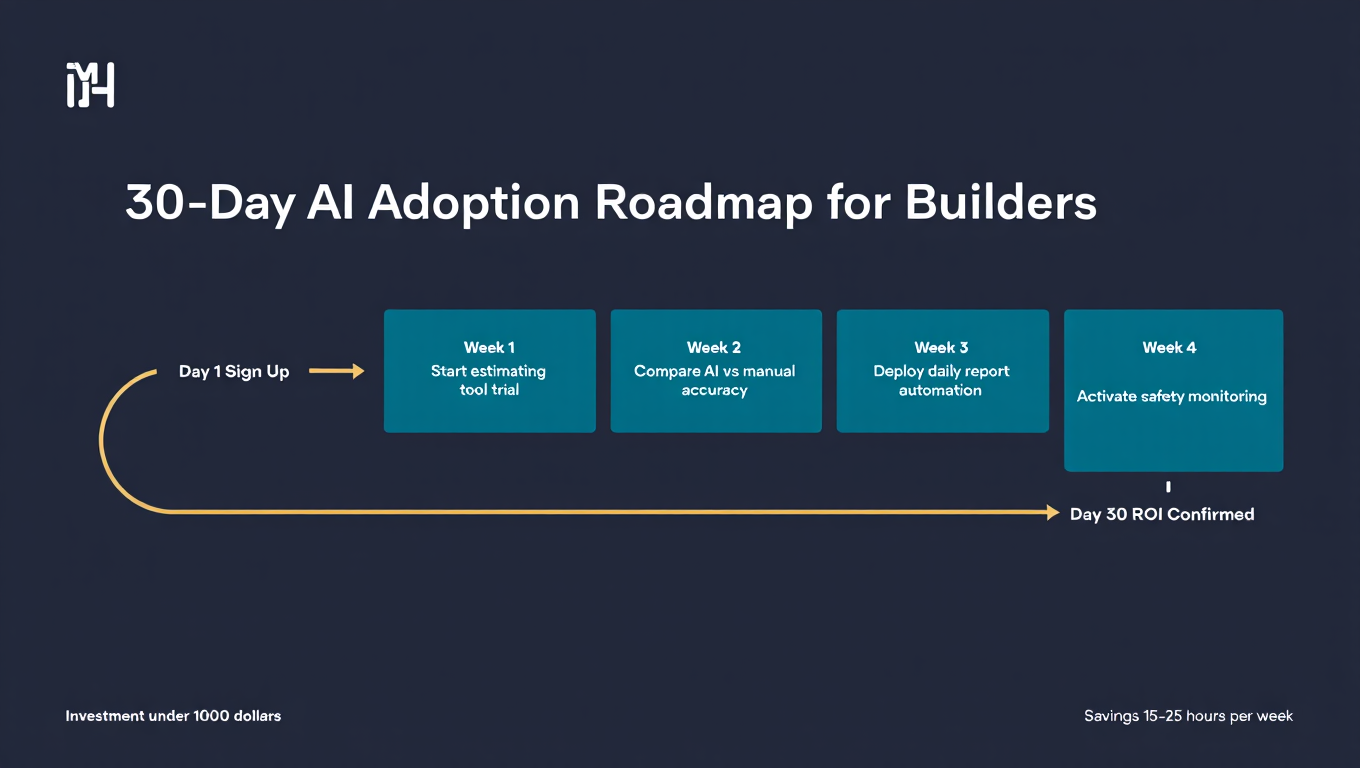
The key principle is to start with one tool, measure the result, and then expand. Do not try to AI-transform your entire business in one project. Pick the biggest pain point, solve it with AI, prove the ROI, and move to the next one.
What Are the Risks and Limitations of AI in Construction?
Honesty matters more than hype. AI in construction has real limitations that builders should understand before investing.
Data quality is non-negotiable. AI systems are only as good as the data they learn from. If your historical project data is incomplete, inconsistent, or spread across spreadsheets, emails, and filing cabinets, the AI output will reflect those gaps. Most Australian builders need to invest in data cleanup before they can fully benefit from predictive AI.
AI does not replace expertise. An AI takeoff tool can measure quantities faster than a human estimator, but it cannot interpret an ambiguous plan note, negotiate with a subcontractor, or make a judgement call about ground conditions. The builders who benefit most from AI are the ones who use it to amplify their expertise, not substitute for it.
Integration challenges remain real. Many Australian builders run a patchwork of software: accounting in Xero or MYOB, project management in Procore or a custom spreadsheet, estimating in Buildsoft or Cubicost, communication in WhatsApp or Teams. Getting these systems to share data reliably is still harder than it should be. This is gradually improving, but builders should budget time and possibly consulting support for integration work.
Privacy and security matter. Construction projects involve commercially sensitive pricing, client information, and sometimes government-classified details. Any AI tool you adopt needs to meet Australian privacy requirements and industry security standards. Ask vendors where data is stored, how it is encrypted, and who has access.
The skills gap is real but solvable. Most construction workers are not data scientists, and they should not need to be. The best AI tools for construction are designed for builders, not technologists. But there is still a learning curve, and builders should budget for training time when rolling out new tools.
How Much Does AI Cost for a Construction Company?
AI costs for construction companies range from $200/month for a single estimating tool to $50,000+/year for enterprise platforms with safety monitoring, predictive analytics, and custom integrations. Here is a breakdown by builder size:
Small builders (5-20 employees): Focus on estimating tools and daily report automation. Budget $300-600/month. ROI is typically achieved within 2-3 months through faster tender turnaround and reduced admin time.
Mid-size builders (20-200 employees): Add project management AI, safety monitoring, and workflow integration. Budget $1,500-5,000/month. ROI within 3-6 months through efficiency gains, reduced rework, and safety incident prevention.
Large builders (200+ employees): Full AI platform deployment including predictive analytics, BIM coordination, and custom integrations. Budget $50,000-200,000/year. ROI within 6-12 months through schedule optimisation, clash detection, and enterprise-wide efficiency gains.
The important insight is that AI costs are falling while construction labour costs are rising. A senior estimator in Australia earns $110,000-160,000 per year (plus super, leave, and overhead). An AI estimating tool that gives that estimator 40% more capacity costs $5,000 per year. The arithmetic is compelling.
Key Takeaways for Australian Builders in 2026
AI is production-ready, not experimental. The tools exist, they integrate with your current software, and they deliver measurable ROI within 3 months.
Start with estimating and safety. These are the two areas with the clearest financial case and the lowest barrier to entry.
Data quality is the foundation. Clean up your project data now. It will pay dividends across every AI tool you adopt.
You do not need a big team or big budget. A $500/month investment in the right tool, used consistently, can transform a builder's profitability.
The window for competitive advantage is now. In 2-3 years, AI will be table stakes. The builders who adopt early will have the data, the workflows, and the experience to outperform those who wait.
Frequently Asked Questions
Is AI being used in construction in Australia right now?
Yes. Australian builders from tier-1 companies like Lendlease and John Holland to mid-size residential builders are actively using AI for estimating, project management, safety monitoring, and design coordination. The adoption rate accelerated significantly in 2025-2026 as tools became easier to deploy and integrate with existing software.
How accurate is AI for construction estimating?
Current AI estimating tools achieve 95-98% accuracy on standard residential and commercial plans, which is within the margin of human error. Accuracy is highest on repetitive building types (volume residential, tilt-up commercial) and lower on complex one-off designs. Most estimators use AI for the initial takeoff and then review the output, resulting in a faster and more accurate final estimate.
What is the cheapest way for a builder to start using AI?
Sign up for an AI estimating tool like Kreo ($200-400/month) and run a side-by-side test against your manual process on 3-5 recent plans. Most builders see the value immediately and expand from there. If estimating is not your bottleneck, start with AI-powered daily reporting (often included in Procore or Buildertrend subscriptions you may already pay for).
Can AI replace construction project managers?
No. AI tools handle data processing, pattern recognition, and routine reporting, but project management requires relationship building, negotiation, judgement calls on ambiguous situations, and creative problem solving. AI makes project managers more effective by removing admin burden, not by replacing their core skills.
Is AI construction software secure for commercial projects?
Reputable AI construction tools (Procore, Autodesk, Kreo, Buildertrend) meet enterprise security standards including data encryption at rest and in transit, role-based access controls, and compliance with Australian privacy legislation. Always ask vendors about data residency (where servers are located), encryption standards, and whether your data is used to train their AI models.
One email a month, no noise
Practical AI notes for Australian businesses. Unsubscribe anytime.