On this page
- What Can AI Do for Fitout Companies?
- AI Archive Analysis: Your Project History Is a Training Asset
- Can AI Generate a BoQ from Drawings Automatically?
- Material Cost Tracking and Supplier Price Intelligence
- Design Documentation and Australian Compliance Standards
- How Much Does AI Automation Cost for a Fitout Business?
- How Do Fitout Companies Start with AI Automation?
Last Updated: 2026-08-08
AI can help Australian fitout companies automate quoting, generate bills of quantities directly from architectural drawings, track material costs across every supplier, and cut the design-to-quote cycle from days to hours. The single most valuable AI asset most fitout companies own is one they already have: years of historical project data. We proposed a one-week archive sample analysis for a 65-staff Australian fitout company to determine whether their historical project data could automate parts of their quoting process. The engagement was scoped at $6,000 as a low-risk proof of concept. According to McKinsey's construction productivity research, construction firms adopting AI in estimating report 20 to 30 percent faster quote turnaround and up to 15 percent better margin accuracy.
The Australian commercial fitout and interior construction sector turns over roughly $14 billion a year and employs more than 80,000 people, according to Australian Bureau of Statistics construction activity data. It is a fragmented, competitive market: most fitout businesses employ between 20 and 100 staff, operate on net margins between 2 and 6 percent, and win or lose work on quote speed and accuracy. According to the Australian Institute of Building, 61 percent of commercial contractors spend more than 15 hours a week on estimating tasks that could be partially automated.
This guide covers the five highest-value AI use cases for fitout companies, what implementation actually costs in Australia, and a step-by-step path to a low-risk first pilot.
What Can AI Do for Fitout Companies?
AI automates five core workflows in a fitout business: analysing historical project archives to find quoting patterns, generating bills of quantities automatically from architectural drawings, tracking material costs across suppliers, automating design documentation and specification schedules, and producing client-ready progress reports. Each of these tasks is data-heavy and repetitive, and each one sits between your estimators and their billable work. Every workflow can be piloted independently, for under $10,000, without replacing your existing estimating or project management software.
- Archive analysis: mine past quotes, drawings and final costs to find which project types are profitable and where estimates systematically miss.
- BoQ generation: convert client drawing sets into first-pass bills of quantities in minutes instead of hours.
- Material cost tracking: monitor joinery, lighting, flooring and wall system pricing across every supplier, and flag price jumps before they hit your margin.
- Documentation automation: produce specifications, schedules and compliance documentation to a consistent template.
- Project reporting: generate client progress reports automatically from project management data.
Where the time savings land matters. On a typical $500,000 office fitout, the estimating team invests 30 to 40 hours across takeoff, pricing and documentation. AI-assisted workflows compress that to 12 to 18 hours, with the biggest gains on takeoff and first-pass documentation. That recovered time goes back into value engineering and client conversations, which is where work is actually won.
AI Archive Analysis: Your Project History Is a Training Asset
Most fitout companies sit on ten or more years of quotes, drawings, variations and final cost data across shared drives and job management systems. AI archive analysis tests whether that data can automate parts of quoting, using a sample of your past projects rather than the full archive. A one to two week pilot costs $3,000 to $8,000 and returns a defensible yes or no answer on whether a full quoting automation system is worth building, before you commit five times that amount.
A structured archive analysis looks for four things: which project types deliver the best margins, where estimates consistently miss actual costs, which suppliers offer the best pricing by material category, and how long different fitout types actually take compared to what was quoted. Those four answers cover most of the commercial risk in fitout estimating. The analysis also produces a data readiness rating, which tells you exactly how much cleanup your archive needs before automation can work.
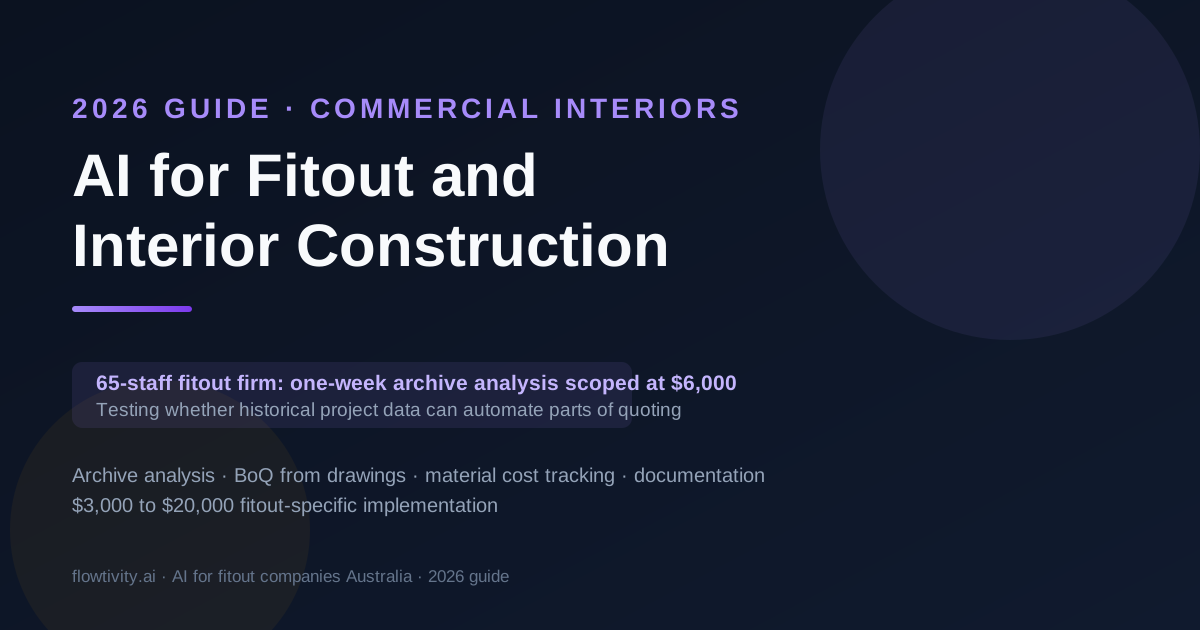
Our 65-staff engagement is a working example. We proposed a one-week archive sample analysis for a 65-staff Australian fitout company to determine whether their historical project data could automate parts of their quoting process. The engagement was scoped at $6,000. The sample covered quotes, issued drawings, variations and final cost reports from a representative mix of office, retail and hospitality projects. Sampling rather than analysing the full archive keeps the engagement inside one week, while still revealing whether data quality supports automation. If the sample shows clean patterns, scaling to the full archive becomes an engineering task with a known cost. If it does not, you have spent $6,000 to avoid a $30,000 mistake.
"Most fitout companies are sitting on a decade of quoting data and do not realise it is their single most valuable AI training asset," says AJ Awan, founder of Flowtivity and former EY management consultant.
Can AI Generate a BoQ from Drawings Automatically?
Yes. AI vision models can read architectural and joinery drawings, identify materials and dimensions, and produce a first-pass bill of quantities in minutes. In our testing of AI vision models against real Australian construction plans, four of six models achieved quantity takeoff accuracy within 10 percent of manual measurement. According to Procore's Construction Technology Report, automated takeoff tools reduce estimating time by 60 to 80 percent compared with manual measurement. The output still needs estimator review, but the measurement work is largely done.
For a typical commercial fitout package of 30 to 60 drawing sheets, manual takeoffs consume one to two estimator days. AI-assisted takeoff compresses that to under an hour of machine processing plus an hour of verification. The estimator's role shifts from measuring to validating assumptions, checking finishes schedules and pricing exceptions, which is where their expertise actually earns margin.
Material Cost Tracking and Supplier Price Intelligence
Fitout companies buy joinery, lighting, flooring, wall systems, glazing and fixtures from dozens of suppliers whose prices move constantly. AI price tracking monitors supplier rate schedules and quote history, flags movements, and compares like-for-like pricing across your supply chain. According to Cordell Construction Information, material price volatility cost Australian commercial contractors an average of 7 percent of project margin in 2025. Consistent AI-assisted price tracking typically recovers 3 to 5 percent of that margin.
The practical setup connects your quote history and supplier price files into a single monitored dataset. When a lighting or partitioning rate moves more than a set threshold, the system flags it before the next quote goes out. Estimators stop losing margin to stale rates, and procurement gets early warning on categories about to reprice.
Design Documentation and Australian Compliance Standards
AI document automation now drafts specification schedules, finishes boards and compliance checklists to your own templates. In Australia, fitout documentation must satisfy the National Construction Code, and the documentation conventions used by Design Institute of Australia members translate well to template-driven generation. Common automated checks include accessibility requirements under AS 1428.1, ventilation under AS 1668.2, and make-good obligations defined in commercial leases. According to the FMI and Autodesk Connectivity Crisis research, poor project data and communication drive 52 percent of construction rework, which is precisely what standardised, AI-generated documentation reduces.
Compliance is where documentation automation earns its keep. A missed accessibility or ventilation requirement discovered during construction becomes a variation dispute. An AI checklist that reads your drawings and lease schedule, then flags the applicable NCC and Australian Standards clauses, turns a two-day review into a two-hour verification pass.
How Much Does AI Automation Cost for a Fitout Business?
Fitout-specific AI implementation in Australia typically costs between $3,000 and $20,000 depending on scope. A focused archive analysis pilot runs $3,000 to $8,000. A single workflow automation, such as first-pass BoQ generation or material price tracking, runs $8,000 to $14,000. An integrated system covering quoting, drawing analysis, material tracking and client reporting runs $14,000 to $20,000, with ongoing costs of $200 to $1,000 per month. According to Deloitte's digital transformation benchmark, Australian construction companies report an average 3.8x return on AI investment within 12 months.
- Archive analysis pilot: $3,000 to $8,000, one to two weeks, based on a sample of past projects.
- Single workflow automation: $8,000 to $14,000, typically first-pass BoQ generation or material price tracking.
- Integrated system: $14,000 to $20,000, covering quoting, drawing analysis, material tracking and reporting.
- Ongoing operation: $200 to $1,000 per month depending on drawing volume and report frequency.
The right first investment depends on where your quoting pressure is highest. If quotes are slow, start with drawing takeoff. If margins leak, start with material price tracking. If you do not know which, start with the archive analysis, because it answers that question with evidence from your own projects. Our 65-staff fitout pilot was scoped at $6,000 for exactly this reason.
How Do Fitout Companies Start with AI Automation?
Start with a scoped archive analysis pilot rather than a full system. One to two weeks is enough to test whether your historical data can drive automated quoting, using a sample of past projects rather than your full archive. You get a defensible answer on feasibility, cost and expected accuracy for less than $10,000, and you keep the findings even if you decide not to proceed further.
- Audit your archive: list the quotes, issued drawings, variations and final cost reports available from the past three to five years.
- Run a sample analysis: test AI analysis against 20 to 50 representative past projects.
- Measure accuracy: compare AI-generated cost predictions against actual project outcomes.
- Pilot one workflow: automate the single highest-friction task, usually first-pass BoQ generation.
- Scale on evidence: expand automation only where measured accuracy justifies it.
At Flowtivity, we run exactly these kinds of focused pilots for Australian fitout and interior construction companies. We build first, measure honestly, and let the data decide whether to scale.
Ready to test AI for your fitout company? Book a free initial consultation: https://calendly.com/flowtivityc/initial-consult
About the author: AJ Awan is the founder of Flowtivity, an AI consultancy for Australian construction and fitout businesses. He is a former EY management consultant, TOGAF certified enterprise architect, and has delivered $15M in measured business benefits across consulting engagements for clients including IAG, Westpac and Genesis Care.
What's actually useful in AI, every Friday
We follow everything happening in AI and send what's worth your time: new models, AI agents, and how to put them to work. One email a week, unsubscribe anytime.