
On this page
- Key Takeaways
- What Is DeepSeek Harness?
- How Does the Everything Is a Plugin Architecture Work?
- What the Research Paper Actually Found
- How Fast Is Adoption Actually Moving?
- DeepSeek Harness vs Claude Code vs OpenAI Codex: How Do They Compare?
- What Do the V4-Pro Benchmarks Actually Measure?
- We Installed It: First-Hand Notes From Our Server
- How to Run DeepSeek Harness Locally
- What the API Pricing Change Means (Especially in Australia)
- Should Your Team Adopt DeepSeek Harness?
- Frequently Asked Questions
- Is DeepSeek Harness free and open source?
- Can DeepSeek Harness use Claude or GPT models?
- Does DeepSeek Harness work offline?
- Is DeepSeek Harness production ready?
- What is Cordis and why does it matter?
Last Updated: August 20, 2026
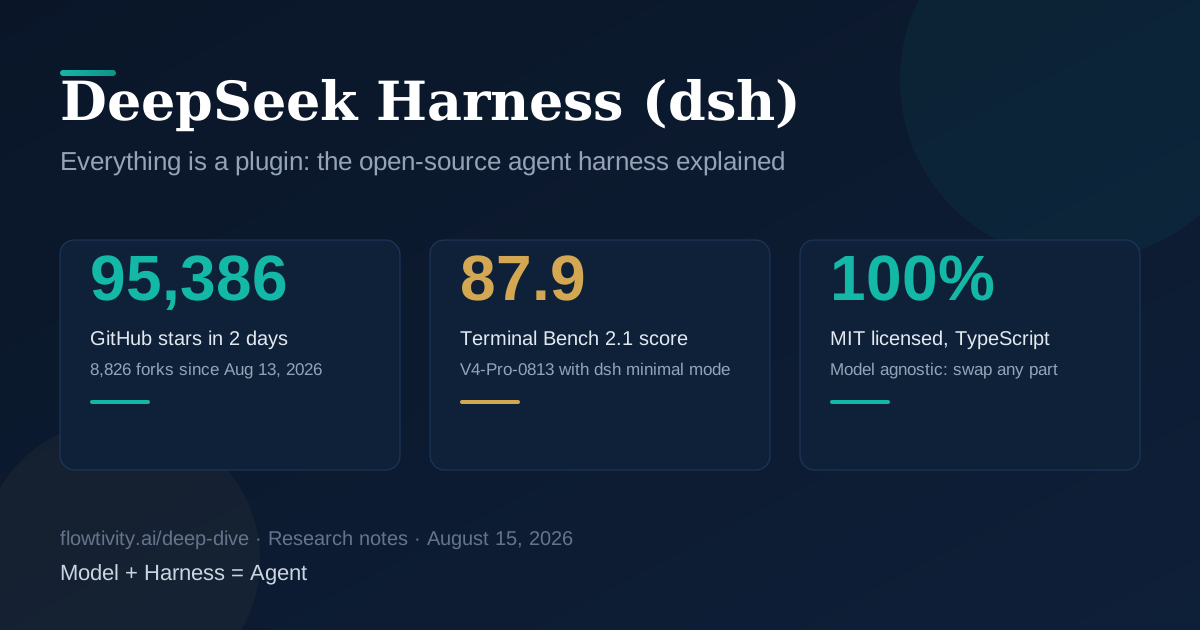
DeepSeek Harness, the open-source agent framework released by DeepSeek AI on August 13, 2026, passed 95,386 GitHub stars and 8,826 forks within roughly two days of publication, according to the GitHub API. That is one of the fastest adoption curves GitHub has ever recorded for a developer tool. The framework, known as dsh, applies one radical idea to AI agents: everything is a plugin, including the model adapter, the tool registry, the session log, the sandbox and the agent loop itself. We installed it on our own server, dug through the architecture documentation, and this guide breaks down what it is, how it works, what the benchmarks actually measure, and whether teams should care.
Prefer video? Here's our two-minute DeepSeek Harness breakdown, originally published on TikTok:
Key Takeaways
- What it is: DeepSeek Harness (dsh) is a free, MIT-licensed, TypeScript-based agent harness for building coding and workflow agents, launched August 13, 2026 in developer preview.
- The architecture: Every capability is a Cordis plugin: models, tools, skills, sessions, sandboxes, storage, loops, scheduling and UI. There is no privileged core to patch.
- Adoption: 95,386 stars and 8,826 forks within about two days, up from roughly 27,500 stars reported by VentureBeat on launch day.
- Benchmarks: DeepSeek reports V4-Pro-0813 scores of 87.9 on Terminal Bench 2.1, 74.1 on Toolathlon-Verified and 71.1 on DSBench-FullStack, tested using the Harness in minimal mode.
- Launch context: dsh shipped alongside the GA release of V4-Pro-0813 and a switch to peak/off-peak API pricing from August 16, 2026.
- The research: dsh's plugin architecture is formalised in an 88-page paper by researchers from Peking University and DeepSeek-AI, which proves that plugin removal and dependency changes are safe at the system level and validates the design on a production ecosystem of more than 4,000 plugins built over four years.
- Australian angle: Peak API windows (01:00 to 04:00 and 06:00 to 10:00 UTC) map to 11am-2pm and 4pm-8pm AEST, covering most of the local business day.
What Is DeepSeek Harness?
DeepSeek Harness is an open-source agent harness developed by DeepSeek AI and published at github.com/deepseek-ai/deepseek-harness on August 13, 2026. An agent harness is the layer that connects a language model to the real world: file systems, shell commands, tool calls, sessions, approvals and long-running workflows. Where Anthropic's Claude Code and OpenAI's Codex package that layer as commercial products with extension points, dsh makes the entire runtime composable. Its documentation states the principle plainly: every part of the product is a plugin, including the model adapter, the tool registry, the session log and the agent loop itself, so every part is replaceable from configuration. The project is written in TypeScript, ships under the MIT license, and starts with a single command: npx @deepseek-ai/dsh web, which serves a local browser UI on port 3080.
It is officially a developer preview. According to the repository README, "THERE WILL BE COMPATIBILITY-BREAKING CHANGES." That warning matters: this is a framework for agent builders to evaluate now, not a locked platform to bet production systems on this quarter.
How Does the Everything Is a Plugin Architecture Work?
dsh is built on Cordis, an open-source framework whose design is described in a research paper titled "A Programming Paradigm for Spatiotemporal Composability", published August 13, 2026 by researchers from Peking University and DeepSeek-AI. The paper formalises two properties: temporal composability, meaning a component's side effects fully revert when it is removed, and spatial composability, meaning components declare and reactively manage dependencies on each other. In practice, plugins contribute services, typed events and reversible effects to a shared context. When a plugin unloads, its registrations unwind automatically. There is no privileged core to patch: you extend dsh by mounting a plugin beside the others.
Three architectural concepts do most of the heavy lifting:
- Profiles and bundles. A running dsh instance is a plugin tree composed at boot from ordered layers. A profile (the shipped examples are
webandheadless) stacks bundles such as dsh-base, which contributes model adapters, tools, persistence, sandbox and approval policy. A bundle is a distribution format for config rows, and any row can be replaced by a patch file, which is how teams override behaviour without forking the code. - The session log. The append-only session event log is the single source of truth for what the model sees. The architecture documentation calls this invariant "model-visible means logged": anything that reaches a model request must be reconstructable from the log, and a runtime invariant asserts it. Forking, resuming, transcripts and telemetry all derive from this stream.
- Capability seams. A seam is a swappable capability with three roles: a service definition, a provider and a consumer. Because filesystem and subprocess providers share one execution world, pointing them at a remote sandbox moves Bash, PTY and LSP tools with them. The same interface covers subagent providers, from a fresh child agent to a delegated turn in another product.
The extension surface is unusually wide. According to the architecture documentation, adding a model provider means registering an adapter on ctx.llm, adding a model-facing capability means registering on ctx.tools, confining spawned processes means using a ctx.sandbox backend, and intercepting any request or tool call means listening to the agent or tools event waterfalls. Even session titles are a registerable provider.
What the Research Paper Actually Found
Most launch coverage treated "everything is a plugin" as a marketing line. It is more than that: it is a design with a formal calculus and proven system-level guarantees, set out in an 88-page paper, "A Programming Paradigm for Spatiotemporal Composability", by Yifan Shi (Peking University and DeepSeek-AI), Wei Zhang (DeepSeek-AI) and Tianyi Cui (Peking University), published the same day as the harness. The paper takes two classical type-theory concepts, effects and coeffects, and lifts them from compile-time analysis into runtime mechanisms. Effects describe how a program modifies its environment; coeffects describe what it requires from its environment. The paper's central move is to make the runtime itself operate on those structures directly, so the guarantees that type systems normally establish before execution continue to hold while components arrive and depart mid-run.
Five findings stand out.
- Plugin removal is provably clean. The paper's metatheory shows that reverting a component's tracked effects recovers the prior state exactly, that reverts compose in last-in-first-out order, and that interleaved effects at distinct keys are independent. The end result is a guarantee the authors call compositional recovery: remove a plugin, or a whole chain of them, and the system lands in precisely the state it would have occupied if those plugins had never been loaded.
- Dependency handling is reactive by construction. A component's dependencies are declared as a specification, and every context change is classified as activating, deactivating or neutral for that component. A plugin whose dependency is unavailable simply stays inactive until a provider appears, without erroring, and reconfiguring a provider reactivates only the dependents whose resolution actually changed.
- Existing plugin systems fail an audit the paper runs. Drawing on Visual Studio Code Marketplace data from June 2026, the paper reports that 87 of the top 100 VS Code extensions contain executable code and therefore cannot be removed without restarting the entire extension host, while only 7 declare dependencies on other extensions. The coarse-grained workaround, restarting processes or letting container orchestrators manage whole services, discards caches, connections and in-flight state with every cycle. That is the gap Cordis closes at the component level.
- The design carries a production-scale validation. The Koishi chatbot framework, built on Cordis, has run in production for over four years with more than 4,000 community-contributed plugins, hot-swapping plugins from a web console and re-applying edited plugins on save while preserving live connections elsewhere. The paper is careful about what this proves: an existence-and-adoption result in one ecosystem and one language, not a controlled performance comparison, and the work is a preprint rather than a peer-reviewed result.
- Self-evolving agents are the stated endgame. The paper's motivating examples and its conclusion both single out self-evolving agent harnesses, where an AI agent generates and replaces its own harness components continuously and with little human oversight, as the setting that most demands these guarantees. Read this way, the harness is not just a developer tool: it is the reference implementation of a theory of safe self-modification, with the agent loop itself just another replaceable component.
For teams evaluating dsh, the paper is worth reading for one further reason: its discussion of boundaries and compensation is refreshingly explicit about what revertibility cannot do. Effects the runtime can exclusively own and restore are tracked and recovered; emissions that cross the system boundary, such as bytes written to a shared file or messages sent on the wire, are not. The paper's answer is compensation, application-supplied undo actions such as deleting a file that was created or refunding a charge that was made, composed in the same order as inverses but not covered by the core metatheory. In other words: safe self-modification has a proven core, and a documented edge.
How Fast Is Adoption Actually Moving?
The GitHub API showed 95,386 stars and 8,826 forks for deepseek-ai/deepseek-harness as of August 15, 2026, roughly two days after the repository was created at 11:56 UTC on August 13. According to VentureBeat reporter Carl Franzen, the repository showed about 27,500 stars and 2,000 forks as of August 13, which means the star count more than tripled in the first day after launch. For comparison, it took DeepSeek's own V3/R1 model repositories weeks to reach similar numbers. Star counts are vanity metrics, not adoption metrics, and the repo itself warns they change rapidly, but a launch-day trajectory like this signals genuine developer curiosity rather than passive upvoting.
Community reaction in the first 48 hours, tracked across Reddit's r/LocalLLaMA and r/DeepSeek forums, clusters around a few themes. Enthusiasts describe the framework as "insanely flexible" and, in the words of one widely shared thread, potentially more interesting than the V4-Pro model launch itself. Skeptics note the trade-off: dsh behaves more like a framework than a product, with profiles, bundles and patch layers to understand before you get value, and some early testers report heavy token usage per task. On the practical side, one tester reported a 99% cache hit rate running V4-Flash inside dsh, which would dramatically cut effective costs, and community plugins for long-term memory, context compression and proactive scheduling were already appearing within a day.
DeepSeek Harness vs Claude Code vs OpenAI Codex: How Do They Compare?
On core coding-agent capabilities, the three products now overlap heavily: all three can read, edit and test a repository, run shell commands, maintain plans, delegate to subagents and enforce approval policies. The differences are in maturity, ecosystem depth and philosophy. Claude Code and OpenAI Codex are established commercial products with hosted background agents, GitHub-native workflows and broad IDE coverage. DeepSeek Harness is a two-day-old developer preview whose distinguishing bet is that every component, including the model, is replaceable. The table below summarises the comparison, adapted from VentureBeat's August 13 analysis plus the official repository documentation.
| Dimension | DeepSeek Harness | Claude Code | OpenAI Codex |
|---|---|---|---|
| Repo read, edit and test | Yes | Yes | Yes |
| Shell and dev tools | Yes | Yes | Yes |
| Planning and subagents | Yes | Yes | Yes |
| Permission and sandboxing | Yes, configurable via plugins | Yes, mature built-in system | Yes, granular controls |
| Primary interfaces | Local web UI, headless command, Python SDK | Terminal, VS Code, JetBrains, desktop, browser, mobile, Slack | CLI, IDE extension, desktop, web/cloud |
| Hosted background agents | Not offered | Yes | Yes |
| GitHub PR workflow | Not yet documented as finished | Yes, Actions and issue-to-PR | Yes, cloud tasks and PR fixes |
| Model choice | DeepSeek, Anthropic, OpenAI and custom endpoints | Primarily Claude | Primarily OpenAI models |
| Extensibility | Every component replaceable | Strong: skills, hooks, MCP, plugins | Strong: skills, MCP, custom agents |
| Maturity | Developer preview, breaking changes expected | Established commercial product | Established commercial product |
| License | MIT | Commercial with extensibility interfaces | CLI open source, cloud managed |
The strategic read: DeepSeek is no longer competing only on model intelligence and token prices. With Harness it moves into the layer that determines how models use tools, manipulate files, maintain sessions and execute long-running workflows, which is exactly the territory where Claude Code became a business. Notably, dsh is model-agnostic: the model is just another plugin, so you can run it against Anthropic or OpenAI endpoints, or local models through Ollama.
What Do the V4-Pro Benchmarks Actually Measure?
DeepSeek released the Harness alongside the general-availability version of V4-Pro-0813, a 1.6-trillion-parameter model with 49 billion parameters activated per token and a context window of up to one million tokens. According to DeepSeek's published benchmark table, V4-Pro-0813 scores 87.9 on Terminal Bench 2.1, 74.1 on Toolathlon-Verified, 71.1 on DSBench-FullStack and 67.2 on DSBench-Hard. Those are company-reported numbers, and DeepSeek's own table shows competitors leading some tests, with Fable 5 scoring 77.9 on Toolathlon-Verified and 77.2 on DSBench-FullStack.
The detail most coverage missed: for public code-agent tasks, DeepSeek states that V4-Pro-0813 was tested using the Harness in minimal mode. Some of the headline agent results are therefore not pure model benchmarks; they measure the model operating inside DeepSeek's own agent execution environment, the same software layer now released to developers. As DeepSeek's API site puts it: "The official version of DeepSeek-V4-Pro has been released, featuring significantly enhanced agent capabilities and support for the Responses API and Codex integration."
The launch also made reasoning effort an explicit deployment knob across V4-Pro and V4-Flash, with three levels: Non-think for routine tasks, Think High for complex problem-solving, and Think Max for difficult problems. That matters operationally because a coding agent can spend minimal reasoning on file reads and routine tool calls, then escalate when diagnosing a hard bug, which controls both latency and token spend.
We Installed It: First-Hand Notes From Our Server
We ran the official install path on one of our Linux servers (Node v22.23.1) within 48 hours of release. The honest early observations from a real first run: the install itself is a heavyweight download for a CLI tool, with the initial npx @deepseek-ai/dsh pull taking several minutes on a well-connected server before the CLI becomes responsive. This is a full application, not a lightweight script, so teams should expect a real footprint rather than a curl-sized utility. Once running, the documented flow is Settings, then Models, then paste a DeepSeek API key, pick a workspace directory, and the agent can immediately read and edit files, run commands and delegate work, with the web UI asking for approval on sensitive operations.
For teams that want local models, the same flow works against any OpenAI-compatible endpoint, and community guides published within the first day describe working Ollama and OpenRouter setups in under ten minutes. Our broader point from building agent stacks for clients: the decisive question for any harness is not the demo, it is what happens on day 30, when you need to swap a provider, isolate a runaway subprocess, or replay a session for an audit. dsh's design, with its logged-everything session model and reversible plugin effects, is the first open framework we have seen that treats those concerns as architecture rather than afterthoughts.
How to Run DeepSeek Harness Locally
Getting started takes three steps, all documented in the official quickstart guide:
- Install and launch. Install Node.js, then run
npx @deepseek-ai/dsh web. The command starts the Web UI at http://127.0.0.1:3080. - Configure a model. Open Settings, then Models, enter a DeepSeek API key and save. The model route becomes usable immediately without restarting the server, and other providers are covered in the model configuration guide.
- Choose a workspace and run a task. Click Choose workspace, add the project directory where you started dsh, select it, then start a session with a task like "Summarize this repository and identify its main packages."
A headless mode ships as a separate profile for one-shot runs with no server, and a Python SDK covers programmatic and benchmark usage through the jsonrpc-agent minimal variant.
What the API Pricing Change Means (Especially in Australia)
The same announcement carried a sharp reversal in DeepSeek's pricing trajectory. Current API prices, as listed in DeepSeek's documentation, are US$0.14 per million cache-miss input tokens and US$0.28 per million output tokens for V4-Flash, and US$0.435 input plus US$0.87 output for V4-Pro. Cache hits cost dramatically less at US$0.0028 and US$0.003625 respectively. Those rates already reflect a 75% cut from V4-Pro's April launch prices of US$1.74 and US$3.48.
From August 16, 2026 at 16:00 UTC, DeepSeek abandons flat pricing for peak and off-peak rates. Peak windows are 01:00-04:00 UTC and 06:00-10:00 UTC. Converted to AEST (UTC+10), those windows are 11am-2pm and 4pm-8pm, which is to say the heart of the Australian business day. Australian teams running agent workloads during work hours should assume peak rates apply to most of their usage, and schedule batch agent jobs overnight where possible. The 99% cache hit rates reported inside dsh matter here: with cache-hit input priced at a fraction of cache-miss, a harness that preserves prompt cache across long agent sessions can offset a meaningful share of the peak-rate increase.
Should Your Team Adopt DeepSeek Harness?
Adopt now if you are an agent builder or a team that already runs coding agents and wants an open, inspectable, fully customisable alternative to closed harnesses, or if you want agent infrastructure you can re-point at any model, including local ones, as prices shift. Watch from the sidelines if you need a stable production platform today: this is a v0.1 developer preview with explicit breaking-change warnings, no hosted background agents and an ecosystem that is days old. Our consulting view after a decade of enterprise architecture work: the pattern to bet on is not this specific repo, it is the architecture it legitimises, namely fully composable agent runtimes with auditable session logs and swappable everything. That is the direction every serious team's agent estate moves toward, and dsh just made it available to anyone for free.
Frequently Asked Questions
Is DeepSeek Harness free and open source?
Yes. DeepSeek Harness is MIT licensed, which permits commercial use, modification and redistribution. The software itself is free. You pay only for model API usage, and because the model adapter is a plugin you can point it at any OpenAI-compatible endpoint, including local models served through Ollama, which can reduce model costs to zero beyond your own hardware.
Can DeepSeek Harness use Claude or GPT models?
Yes. According to VentureBeat's launch analysis, Harness supports DeepSeek, Anthropic, OpenAI and custom OpenAI-compatible endpoints, because the model adapter is just another plugin. This is a deliberate contrast with Claude Code and Codex, which are optimised for their vendors' models.
Does DeepSeek Harness work offline?
The harness software runs locally and is fully open source, and it can be pointed at local model servers such as Ollama or any OpenAI-compatible endpoint on your network, so air-gapped operation is technically possible. Community setup guides published within the first day describe local configurations working in under ten minutes. You need network access only for the initial npm install and for whatever model endpoint you configure.
Is DeepSeek Harness production ready?
No. The repository explicitly labels it a developer preview and warns in capitals that there will be compatibility-breaking changes. Enterprise teams should treat it as an evaluation and prototyping platform now, with production adoption a decision to revisit after the API stabilises.
What is Cordis and why does it matter?
Cordis is the open-source framework underneath dsh, described in the paper "A Programming Paradigm for Spatiotemporal Composability" published August 13, 2026. It formalises revertible effects, where every context transformation carries a tracked inverse, and reactive coeffects, where context changes notify components against declared specifications. For practitioners, the payoff is that plugins can be added and removed cleanly at runtime, which is what makes an everything-is-a-plugin agent runtime tractable rather than chaotic.
Flowtivity builds and operates AI agent systems for growing businesses. If you are weighing open harnesses like dsh against managed options for your team's workflows, we do this daily. Reach out via flowtivity.ai.
One email a month, no noise
Practical AI notes for Australian businesses. Unsubscribe anytime.


