
On this page
Last Updated: 16 July 2026
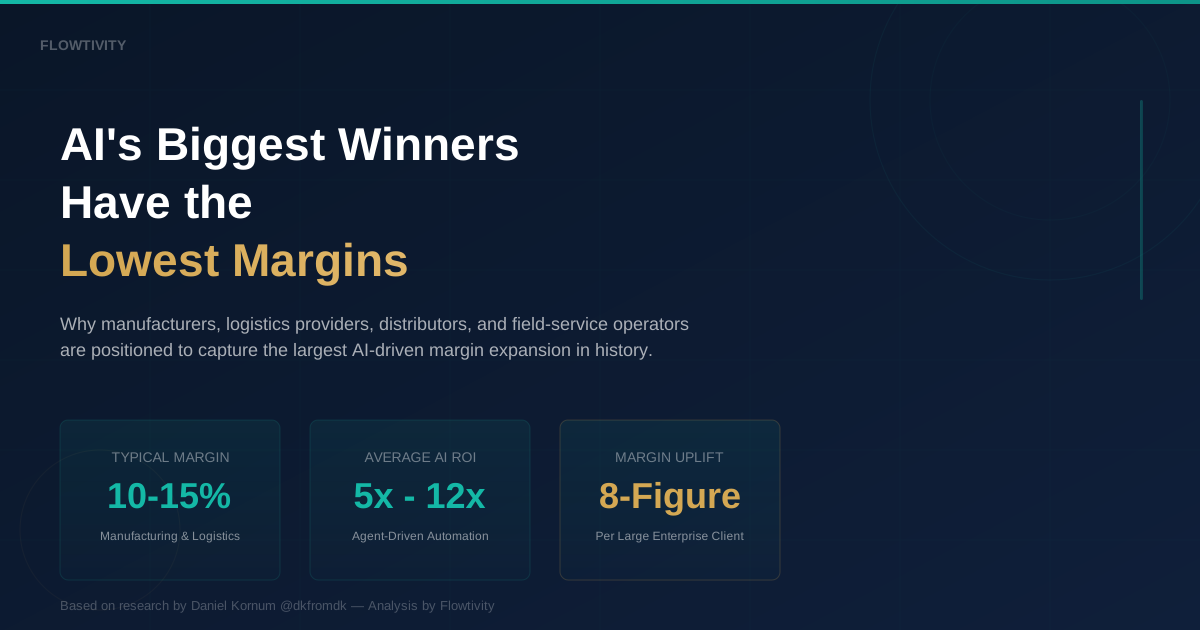
The biggest winners of AI are not the companies with the most engineers, the largest data teams, or the highest software budgets. They are the companies with the lowest margins. Manufacturers operating on 8% margins, trucking carriers running at 5%, distributors scraping by at 12%. These are the businesses that stand to gain the most from AI. According to Daniel Kornum, founder of Varick Agents, a company running on single-digit margins can double profits by cutting just 8% of operating costs. No high-margin SaaS business can claim that same leverage.
Why Low-Margin Businesses Hold the Greatest AI Opportunity
According to Daniel Kornum (@dkfromdk), the perception that AI primarily benefits software companies and tech-forward enterprises is a fundamental misconception. The businesses with the most to gain are those that have historically generated the weakest returns: manufacturers, logistics providers, distributors, staffing firms, and field-service operators.
In our dual DGX Spark setup running DeepSeek V4 Flash at approximately 60 tok/s with 1M context, we have seen firsthand how local AI inference changes the cost calculus for these businesses. When you do not need to pay per-token API fees, the economic equation flips entirely. AI becomes infrastructure, not a line item.
The Infrastructure Mindset: AI as Operating Layer, Not Software
The million-dollar lesson from real AI deployments is that in order to engineer value from AI into a business, you need to sell AI as infrastructure. Software asks the employee to adopt a tool. Infrastructure changes the operating layer underneath the employee. According to Kornum, the best AI deployments make agents part of the operating layer of the company, layered on top of existing systems, inboxes, files, approvals, and workflows where work already happens today.
If accounts payable runs through NetSuite, email, PDFs, and spreadsheets, the agent should run across all of them. It should extract the invoice, match it to the purchase order, flag the exception, prepare the approval, and route the issue to the right person only when judgment is needed. It should then learn from approval feedback to refine its behaviour over time. Value should be realised without an employee adopting and using a new system. It should be engineered into the AI deployment.
Three Forces Driving the Opportunity
Kornum identifies three converging forces that make this the largest margin expansion opportunity in AI:
1. Economic Incentive. Low-margin businesses have the strongest economic incentive because small margin improvements create massive profit increases. A manufacturer on 8% margins that cuts 8% of operating costs doubles its profits. The same cost reduction for a 40% margin SaaS company only increases profits by 20%. The leverage is asymmetric and it overwhelmingly favours low-margin operators.
2. Cost Structure. These businesses have large labour and coordination-heavy cost structures that AI is uniquely suited to reduce. Manufacturing requires coordinating hundreds of workers across shifts and supply chains. Logistics requires routing, scheduling, and exception handling at a scale that humans cannot optimise. AI agents that automate coordination work directly attack the largest cost driver in these businesses.
3. Operational Inefficiency. These industries operate in environments where becoming even slightly more efficient can change the competitive position of the company. According to research cited by Kornum, many low-margin businesses run on thin, single-digit margins that have not budged for decades precisely because they could not afford the software or headcount to improve them. AI changes that equation entirely.
The Market Is Looking in the Wrong Place
The market has focused on software companies, tech-forward enterprises, and knowledge workers because those companies adopt tools faster and have the budgets to experiment. But the largest profit impact may come from the businesses that are least likely to describe themselves as AI companies.
These are not obvious AI winners because they do not look like AI companies from the outside. But that is exactly why the opportunity is so large. Their margins are thin because their operations are heavy. Their operations are heavy because labour has to be coordinated. And AI is the first technology that can remove a meaningful amount of that coordination work without requiring the entire workforce to change how it works.
Comparison: AI Impact by Business Type
According to analysis by Varick Agents and Flowtivity, the leverage of AI-driven cost reduction varies dramatically by business type:
| Business Type | Typical Margin | Profit Impact from 8% Cost Cut | AI Adoption Incentive |
|---|---|---|---|
| Manufacturing | 6-10% | +80-133% profit increase | Extreme |
| Logistics / Trucking | 3-8% | +100-267% profit increase | Extreme |
| Staffing Agencies | 10-15% | +53-80% profit increase | High |
| Field Service | 8-12% | +67-100% profit increase | High |
| Distribution | 8-15% | +53-100% profit increase | High |
| SaaS / Software | 40-80% | +10-20% profit increase | Moderate |
What This Means for Your Business
If you run a low-margin business, AI is not a luxury. It is the most powerful margin expansion tool available. The businesses that deploy AI agents as infrastructure into their operating layer will quietly widen their margins while competitors struggle to maintain theirs.
"The million-dollar lesson we have learned," says Kornum, "is that in order to engineer value from AI into a business, you need to sell AI as infrastructure." The employee should still know what happened, and the process owner should still be able to pause the workflow, change a rule, approve an exception, or pull a person back in when needed. But the value should not depend on someone remembering to use the AI every day.
The next wave of AI winners will come from putting agents behind the workflows of low-margin businesses and letting the savings show up quietly in the operating model. The biggest AI opportunity is hiding in the least obvious place.
If your business wants similar results, akin to manufacturing and logistics clients who have seen 8-figure margin uplifts, contact Flowtivity to explore how AI agents can transform your operating layer.
What's actually useful in AI, every Friday
We follow everything happening in AI and send what's worth your time: new models, AI agents, and how to put them to work. One email a week, unsubscribe anytime.
