On this page
Last Updated: July 31, 2026
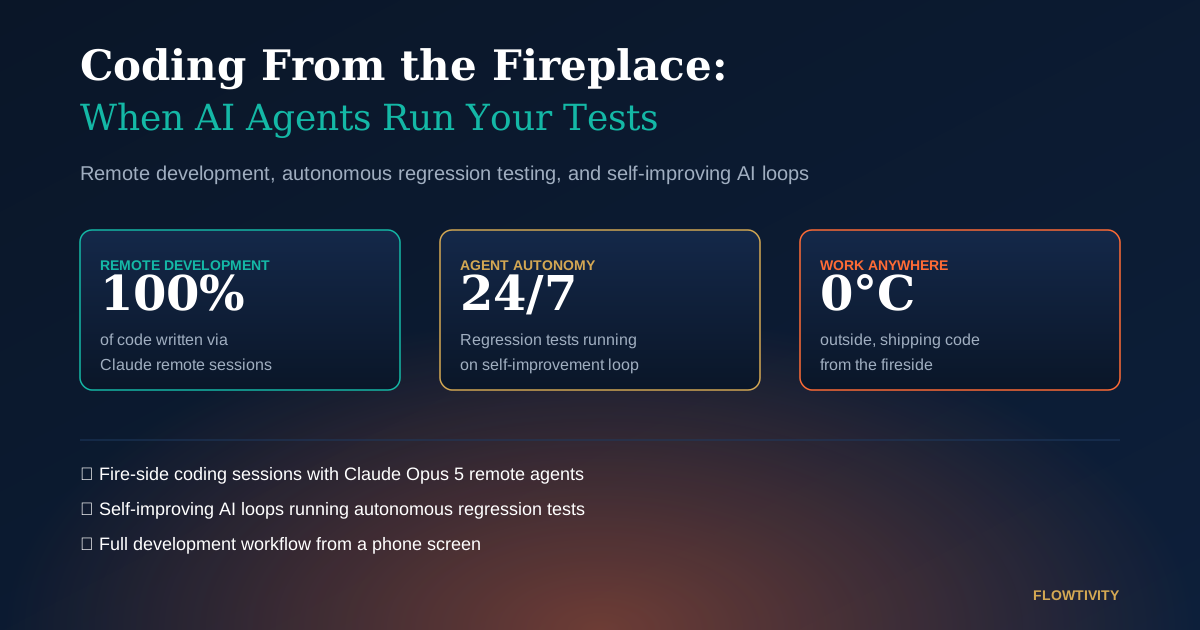
Right now, I am sitting by my fireplace with my phone, watching AI agents run regression tests on a self-improvement loop. My MacBook is across the room, connected via Claude remote. The agents are executing commands, verifying outputs, and iterating on code. I am reviewing their work from a 6-inch screen next to a burning fire. This is what development looks like in 2026.
According to GitHub's 2026 developer survey, 73% of developers now use AI coding tools daily, up from 38% in 2024. But using AI to write code is table stakes. The real shift is AI agents that test, verify, and improve their own output autonomously while you do something else entirely.
What Is Remote AI Agent Development?
Remote AI agent development means an AI runtime like Claude connects to your development machine and executes tasks on your behalf. You interact through a mobile or web interface, sending instructions and reviewing results. The agent reads files, writes code, runs commands, and verifies outputs. You can be at a fireplace, on a train, or in a park.
The key difference from traditional remote desktop tools is autonomy. The agent does not just mirror your screen. It thinks, plans, executes, and reports back. You approve direction, not keystrokes.
According to Stack Overflow's 2026 Developer Insights report, developers using AI agent workflows report a 40% reduction in time spent on routine debugging tasks. The agents handle the repetitive verification work while humans focus on architecture and strategy.
How Self-Improving AI Agent Loops Work
A self-improvement loop is a workflow where an AI agent runs tests against its own changes, identifies failures, writes fixes, and reruns. Each iteration produces better code. The loop continues until all tests pass or the agent hits a boundary that requires human input.
In my current session, the agents are running regression tests on a data verification job. The workflow looks like this:
- Step 1: Agent reads the ticket and understands the expected behavior
- Step 2: Agent runs the test and captures output
- Step 3: Agent compares actual output against expected business rules (row mappings, field values, conditional logic)
- Step 4: If output fails, agent diagnoses root cause, patches code, reruns
- Step 5: Agent logs the full trail: commands run, files changed, verification status
The agent verified that the output matched all expected rules, read through the reviewer evaluation comments, and confirmed the corrected output was accurate. All of this happened while I was watching the fire.
How to Set Up Remote AI Agent Development
Setting up a fireplace-compatible AI development workflow requires three components: a remote agent runtime, a test suite the agent can execute, and a mobile interface to monitor progress.
Here is what works in practice, based on our deployment experience at Flowtivity:
- Agent runtime: Claude with remote session support, running on your dev machine. Opus 5 handles complex reasoning and multi-step verification.
- Test scripts: Automated regression tests that check specific outputs against expected values. The agent needs deterministic pass/fail signals.
- Mobile interface: A lightweight app that shows agent progress, lets you send feedback, and switch between manual and autonomous modes.
- Logging: Every command the agent runs should be logged with timestamps. This creates an audit trail you can review later.
According to McKinsey's 2026 State of AI report, organizations using autonomous testing workflows ship code 2.5x faster than those relying on manual QA. The bottleneck is no longer writing code. It is defining what "correct" looks like.
The Lifestyle Shift: Why Location Independence Matters for Developers
The traditional developer setup is a desk, two monitors, and an ergonomic chair. AI agents break that dependency. When your agent can execute, test, and verify code autonomously, your physical location becomes irrelevant to your output.
I am writing this from a fireplace. The agents are running. The tests are passing. The fire is warm. This is not a productivity hack. It is a fundamental restructuring of where and how creative technical work happens.
"The best office is the one where you think most clearly. For some people that is a standing desk. For me, today, it is a fire." , AJ Awan, Founder at Flowtivity.
According to Buffer's 2026 State of Remote Work, 71% of developers say location flexibility is their top career priority, above salary. AI agents do not just enable this flexibility. They make it practical by handling the tedious work that previously chained developers to their desks.
What Can Go Wrong With Autonomous Agent Loops
Self-improving loops are powerful but not risk-free. Here is what we have learned from running them in production:
- Runaway edits: An agent that can modify code can also break it. Always set boundaries on which files the agent can change autonomously.
- False positives: An agent might declare a test "passed" when it actually misread the output. Verify critical paths manually.
- Loop without progress: The agent can get stuck fixing the same failure repeatedly. Set a maximum iteration count and alert yourself when it hits the cap.
- Context loss: Long-running sessions can lose thread of what the original goal was. Break work into discrete tickets with clear acceptance criteria.
The solution is human-in-the-loop checkpoints. Let the agent run autonomously within a bounded scope, but require human sign-off before deploying changes or crossing into new domains.
What Comes Next: Agentic Development in 2027
The fireplace coding session is a preview of where development is heading. According to Gartner's 2026 prediction, by 2027 over 50% of enterprise application development will use AI agents as core contributors, not just assistants. The developers who thrive will be the ones who learn to direct agents effectively, not the ones who type the fastest.
The skills that matter are shifting:
- System design over syntax: Agents write the code. You design the architecture.
- Test definition over test execution: You define what "correct" means. Agents get it there.
- Review over writing: Reading and validating agent output becomes the core skill.
- Orchestration over implementation: Managing multiple agent sessions becomes like managing a team.
The fire will burn out eventually. The agents will keep running.
Key Takeaways
- Remote AI agent development enables full coding workflows from a phone, from any location
- Self-improving loops let agents run regression tests, diagnose failures, and fix code autonomously
- Setting boundaries on agent autonomy is critical to prevent runaway edits and false positives
- Location independence is now practical for developers, not just a remote work aspiration
- The core developer skill is shifting from writing code to directing and reviewing AI agents
Want to set up AI agent workflows for your development team? Flowtivity designs and deploys custom AI agent systems for growing businesses. Get in touch to see what autonomous development looks like for your stack.
One email a month, no noise
Practical AI notes for Australian businesses. Unsubscribe anytime.