
On this page
Last Updated: July 8, 2026
A small, purpose-built AI model trained on expert judgment just outperformed GPT, Claude, and Gemini on real-world financial tasks at 1/14th the cost. The frontier model era isn't over, but the assumption that bigger always wins is officially dead.
What Happened: Custom AI Beats Frontier Models at Bridgewater
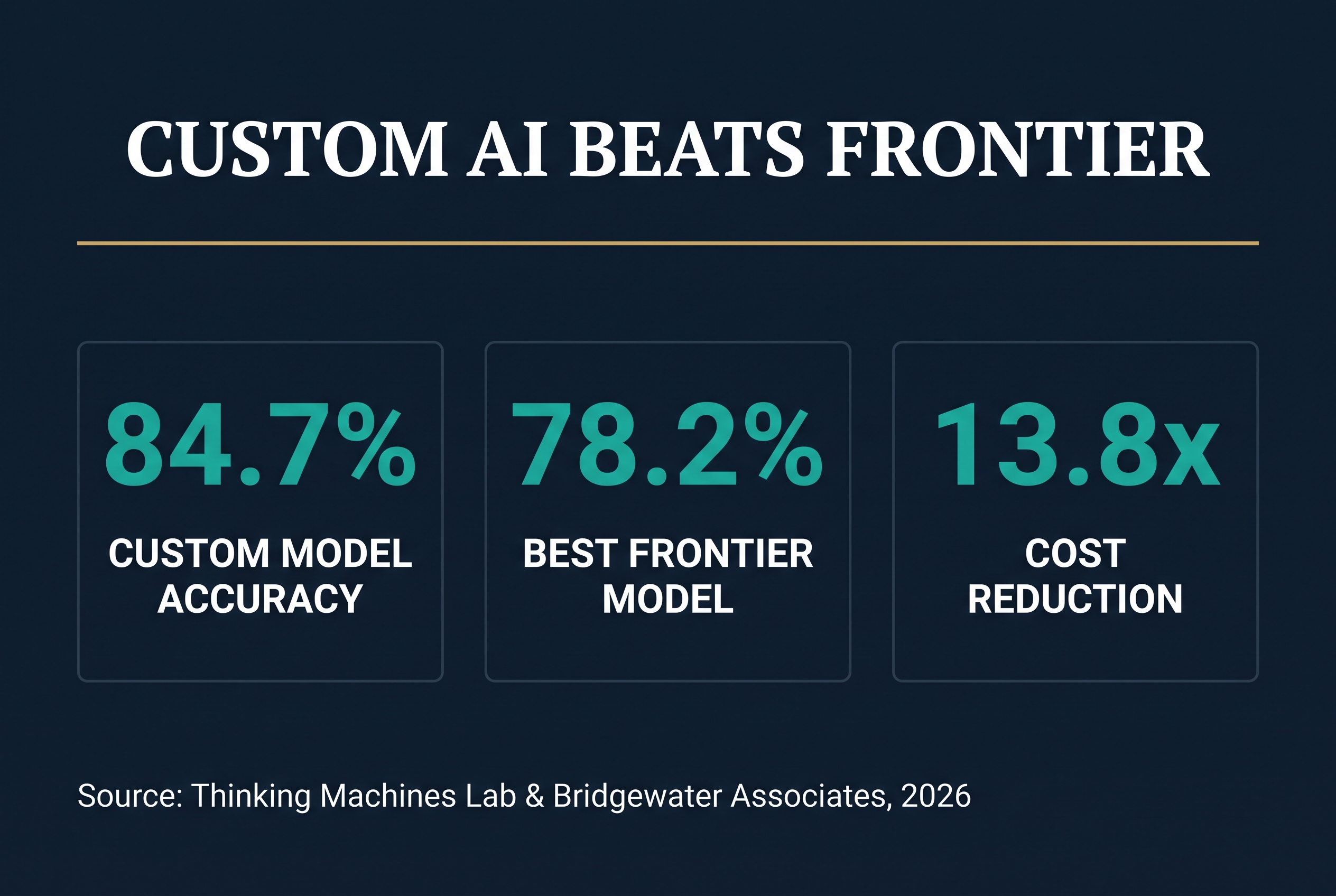
Mira Murati's Thinking Machines Lab (TML) and Bridgewater Associates — the world's largest hedge fund — published research in June 2026 showing that a custom-trained model can replicate expert investor judgment more accurately and cheaply than any frontier AI. They trained Alibaba's open-source Qwen3-235B on Bridgewater's proprietary expert-labeled data using TML's Tinker platform. The result: 84.7% accuracy on six financial information-filtering tasks, beating the best frontier model's 78.2% while costing 13.8x less per inference.
The key insight is that frontier models like GPT, Claude, and Gemini are generalists by design. When a task requires domain-specific judgment, the kind built from years of professional experience, a smaller model fine-tuned on expert data consistently wins. Bridgewater's investors couldn't fully articulate their decision process in words, but fine-tuning let the model learn that tacit knowledge directly from examples.
The Six Tasks Where Frontier Models Failed
The research evaluated models on six information-filtering tasks drawn from real investor workflows:
- Financial Article Relevancy — Classifying whether an article matters to a C-suite investment professional
- Central Bank Document Relevancy — Identifying whether a central bank document signals future interest rate changes
- Generic Document Relevancy — Determining if a research document answers a specific investor question
- Ad Hoc Content Labeling — Distinguishing boilerplate content from issue-specific analysis in research documents
- Document Truncation — Identifying where boilerplate content begins in a document
- Email Truncation — Identifying where boilerplate content begins in an email
Frontier model performance was shockingly poor. With basic prompts, GPT, Claude, and Gemini variants averaged ~50% accuracy — literally a coin flip on tasks that professional investors find trivially easy. Even with expert-crafted prompts, the best frontier models only reached the mid-70s, falling short of the 80% threshold Bridgewater requires for daily production use.
The example the researchers gave is instructive: a Financial Times article about Trump insisting Greenland is his is technically about geopolitics and finance, but no serious investor would flag it as relevant. An article about Trump threatening new China tariffs, however, is immediately relevant. Frontier models can't reliably tell the difference because they lack the contextual judgment that experienced investors apply unconsciously.
How Fine-Tuning Produced a Superior Model
The training process at Bridgewater reveals important lessons for any organization considering custom AI. The approach wasn't just "throw data at a model." It involved careful data curation, clever training techniques, and multiple iterations.
Dataset quality was the foundation. Initial training data sourced from non-expert labelers produced poor results; the labels themselves were often wrong. Rather than re-labeling everything with expensive experts, the team devised a smart verification scheme: they trained a model on the noisy data, then only sent examples where the model disagreed with its own training set to human experts for re-labeling. This caught labeling errors efficiently without the cost of full expert review.
The training recipe had three key innovations:
- Interleaved batching: Training on one task per batch in round-robin order, rather than mixing tasks or training sequentially. This improved accuracy by 12.1% over fully mixed batches, likely because it reduced catastrophic forgetting between tasks.
- CISPO loss with asymmetric clipping: A specialized loss function that replaced standard importance sampling, improving accuracy by 10.1%. This is a technical choice that reflects how rapidly the fine-tuning field is evolving beyond textbook RLHF.
- On-policy distillation with self-promotion: The model distilled knowledge from its own best checkpoints as a teacher, but only promoted a checkpoint to teacher status when it hit a new validation accuracy high. This gave a further 3.1% gain over using a frozen base model as teacher.
The base model was Qwen3-235B, an open-source model from Alibaba that has been widely studied in academic literature for fine-tuning. Training was done on TML's Tinker platform, which handles GPU infrastructure and lets teams focus on the training recipe rather than DevOps.
The Cost Equation: 13.8x Cheaper Than Frontier Models
The economics of custom AI may matter more than the accuracy gains. Bridgewater's custom model costs 13.8x less per task than frontier alternatives, a staggering difference that transforms the math of AI deployment.
For a hedge fund processing thousands of documents daily, this isn't a marginal optimization. It's the difference between an AI system that's a nice experiment and one that can run at scale across the entire organization. Bridgewater explicitly noted that as they plan to deploy more specialized models for more tasks, cost is a critical consideration.
The finding also challenges the pricing power of frontier model providers. If a custom model can be built for a specific domain at a fraction of the inference cost while outperforming on accuracy, the value proposition of paying premium API rates for generalist models weakens considerably for specialized use cases.
What This Means for the AI Industry
The assumption that the frontier would steamroll smaller, specialised models is broken. This research provides hard numbers showing that the future of AI in the enterprise isn't one giant model that does everything. It's many specialized models that each do one thing exceptionally well.
Murati framed the project as "experts improving AI that empowers experts." This is a powerful framing that should resonate with any organization that has accumulated domain expertise. The knowledge inside your team's heads, the judgment that's hard to write down in a manual or encode in a prompt, is exactly what makes a custom model superior.
Several broader trends this research confirms:
- Open-source models are closing the gap fast. Qwen3-235B is freely available. The competitive advantage now lies in training data and fine-tuning expertise, not in model ownership.
- Fine-tuning infrastructure is maturing. Platforms like Tinker make it feasible for non-Google, non-OpenAI teams to train production-quality models without managing GPU clusters.
- Domain expertise is becoming an AI asset. Organizations with deep, proprietary expertise and the labeled data to prove it have a structural advantage in the custom AI era. This is the "differentiated intelligence" vision Murati described.
- Frontier models aren't improving fast enough on specialized tasks. The research found that GPT 5.4 costs 43% more than 5.2 but is only marginally more accurate on these tasks. Spending more on bigger models yields diminishing returns for domain-specific work.
What This Means for Growing Businesses
You don't need to be Bridgewater to benefit from this approach. The core lesson applies to any business with specialized workflows:
Start with the judgment, not the model. The reason Bridgewater's custom AI works isn't the model architecture. It's the expert-labeled training data. What decisions do your experienced staff make that are hard to articulate but consistently correct? That tacit knowledge is your AI training dataset.
Don't wait for frontier models to get better at your domain. If GPT, Claude, and Gemini are at 50-78% accuracy on tasks specific to your industry today, there's no guarantee they'll reach 85% tomorrow. A custom model can get there now, using your team's expertise.
The cost math works at smaller scales too. You don't need Bridgewater's volume to see ROI. If your team spends hours each day on information filtering, document classification, or any repeated judgment task, a custom model that costs 10x less per query while being more accurate pays for itself quickly.
Platforms like Tinker democratize access. You don't need a GPU cluster or an ML engineering team of fifty. The infrastructure for fine-tuning open-source models is becoming as accessible as cloud computing itself.
The Bottom Line
The era of "just use GPT for everything" is ending. Not because frontier models are bad. They're remarkable general-purpose tools. But for specialized, high-stakes work where expert judgment matters, custom models built on your own data are demonstrably superior in both accuracy and cost.
Bridgewater and Thinking Machines Lab just proved it with numbers. The question for every business is: what's your equivalent of the investor's judgment that no generalist AI can replicate?
This article is based on research published by Thinking Machines Lab and Bridgewater Associates in June 2026. Read the full research paper.
One email a month, no noise
Practical AI notes for Australian businesses. Unsubscribe anytime.


