On this page
- GLM-5.2: The Open-Source AI Model That's Beating GPT-5.5 and Chasing Claude Opus 4.8
- What Is GLM-5.2 and Why Does It Matter?
- The Benchmark Results: How GLM-5.2 Compares
- What Makes GLM-5.2's Architecture Different?
- Flexible Thinking Modes: A Practical Innovation
- API Pricing and Coding Plans
- Running GLM-5.2 Locally: The Unsloth Quantization Story
- GLM-5.2 vs the Competition: When to Choose What
- What This Means for Australian Businesses
- Frequently Asked Questions
- How much does GLM-5.2 cost to use?
- Can GLM-5.2 really run locally on consumer hardware?
- Is GLM-5.2 actually better than GPT-5.5?
- What license is GLM-5.2 released under?
- What is IndexShare and why is it important?
Last Updated: July 13, 2026
GLM-5.2: The Open-Source AI Model That's Beating GPT-5.5 and Chasing Claude Opus 4.8
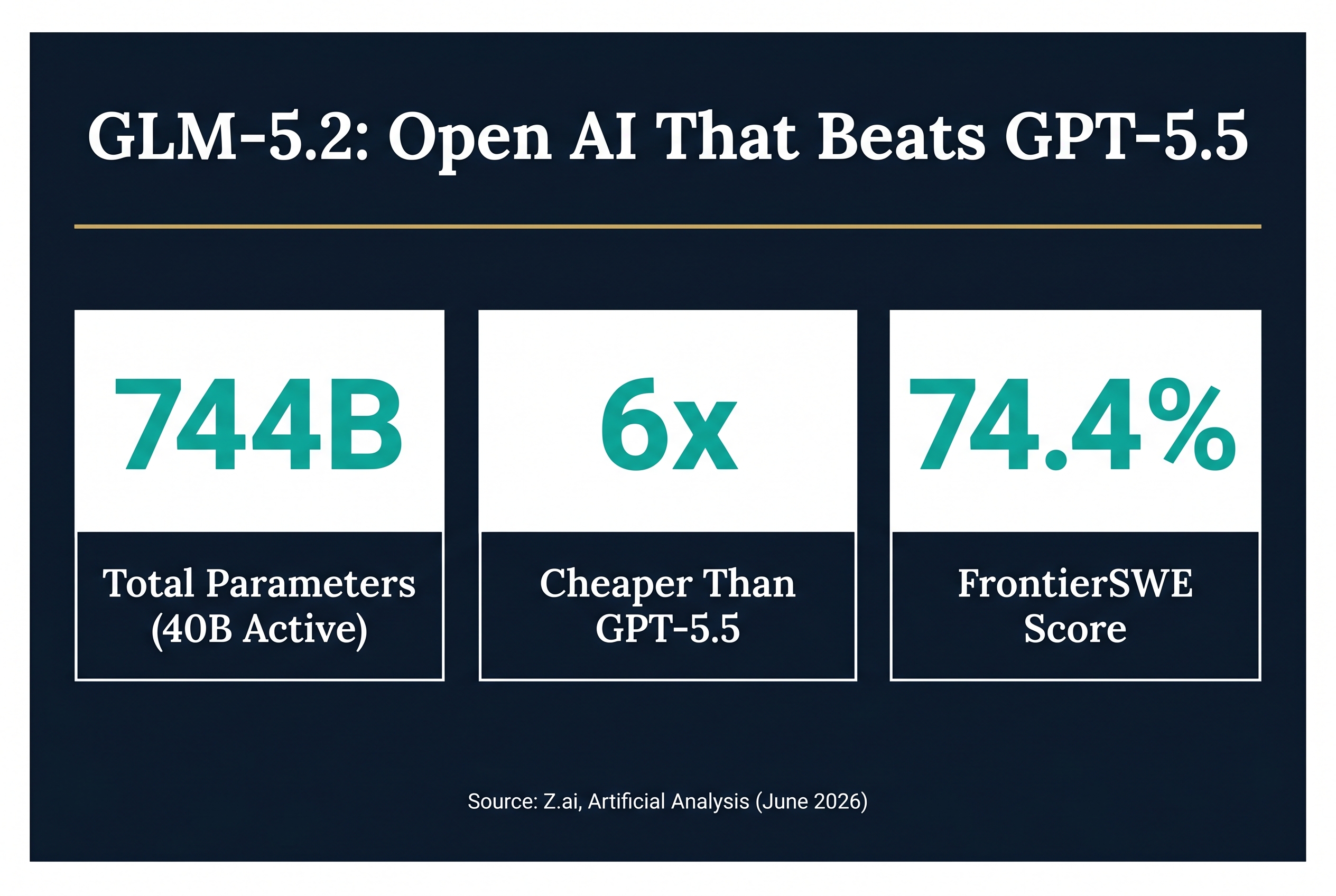
A 744-billion-parameter open-weight model from Z.ai just beat GPT-5.5 on multiple long-horizon coding benchmarks — at one-sixth the cost. GLM-5.2 is the strongest open model ever released, and it changes the calculus for any business evaluating AI infrastructure in 2026.
What Is GLM-5.2 and Why Does It Matter?
Answer: GLM-5.2 is Zhipu AI's 744B-parameter Mixture-of-Experts model, MIT licensed, that achieves state-of-the-art open-source scores on coding benchmarks including 81.0 on Terminal-Bench 2.1 and 62.1 on SWE-bench Pro.
GLM-5.2 is Z.ai's latest open-weight large language model, released on June 16, 2026 under an unrestricted MIT license. It features 744 billion total parameters with approximately 40 billion active parameters per token (via Mixture-of-Experts), a 1-million-token context window, and architectural innovations that make it competitive with — and in several categories better than — frontier proprietary models from OpenAI and Anthropic.
This matters because the gap between open and closed AI models has been closing rapidly, but GLM-5.2 represents something new: an open model that doesn't just "get close" to the frontier — it matches or exceeds it on specific, important benchmarks. For businesses, this means the build-vs-buy calculus for AI infrastructure has fundamentally shifted. You can now download a frontier-class model, fine-tune it on your data, and run it on your own hardware without compromising meaningfully on capability.
The Benchmark Results: How GLM-5.2 Compares
Answer: GLM-5.2 achieves the highest open-source scores on Terminal-Bench 2.1 (81.0) and SWE-bench Pro (62.1), outperforming GPT-5.5 on most coding benchmarks while costing roughly 1/6th as much.
GLM-5.2 consistently ranks as the highest-scoring open-weight model across third-party evaluations. On the Artificial Analysis Intelligence Index v4.1 — which aggregates 9 evaluations including GDPval, Terminal-Bench, Humanity's Last Exam, and GPQA Diamond — it scores 51, making it the leading open-weights model. More importantly, it trades blows with proprietary leaders on the benchmarks that matter most for real engineering work.
Long-horizon coding (the headline results):
- FrontierSWE: 74.4% — just 1% behind Claude Opus 4.8 (75.1%) and ahead of GPT-5.5 (72.6%)
- PostTrainBench: 34.3% — dramatically outscoring GPT-5.5's 25.0%
- SWE-Marathon: 13.0% — second only to Claude Opus 4.8, beating GPT-5.5 (12.0%)
- SWE-bench Pro: 62.1 — decisively beating GPT-5.5 (58.6) and predecessor GLM-5.1 (58.4)
Agentic and tool-use benchmarks:
- MCP-Atlas (tool usage): 77.0 — ahead of GPT-5.5 (75.3), just behind Claude Opus 4.8 (77.8)
- Humanity's Last Exam (with tools): 54.7 — ahead of GPT-5.5 (52.2), trailing Claude Opus 4.8 (57.9)
- Terminal-Bench 2.1: 81.0 — a massive jump from GLM-5.1's 63.5, within reach of Claude Opus 4.8 (85.0)
Creative and design capabilities:
- Design Arena: First place with an ELO score of 1360, beating even Claude Fable 5
- Code Arena (Frontend): Effectively #1 at Max effort level, ahead of Claude Opus 4.7 Thinking
The pattern is clear: GLM-5.2 excels at complex, multi-step tasks that require sustained reasoning over long contexts. That's exactly where most enterprise AI value is being generated in 2026.
What Makes GLM-5.2's Architecture Different?
GLM-5.2 introduces a breakthrough called IndexShare — an optimization to sparse attention that reduces per-token compute by 2.9x at the full 1-million-token context length. This is the single biggest reason a 744B model can run at all on accessible hardware.
How IndexShare works:
Standard sparse attention mechanisms (like DeepSeek Sparse Attention, which GLM-5.2 builds on) use a lightweight "indexer" component to identify which tokens matter most before performing full attention calculations. Normally, every transformer layer runs its own indexer — that's computationally expensive when you're processing a million tokens.
IndexShare shares one indexer across every four transformer layers. The top-k token indices selected by the first layer's indexer get reused by the next three layers. This means 75% of layers skip the expensive indexing step entirely, while still maintaining the quality of adaptive attention patterns.
Mixture-of-Experts efficiency:
The MoE architecture means only ~40B of the 744B parameters activate per token. This ratio (roughly 5.4% activation) is what makes GLM-5.2 dramatically cheaper to run than a dense model of equivalent size. The router dynamically selects which expert subnetworks are relevant for each token, providing high capacity without proportional compute cost.
Multi-Token Prediction (MTP):
GLM-5.2 includes an upgraded MTP layer for speculative decoding that boosts accepted token length by up to 20% during inference. In practical terms, this means faster output generation without quality degradation — a meaningful improvement for latency-sensitive applications.
Flexible Thinking Modes: A Practical Innovation
One of GLM-5.2's most practical features is its three selectable thinking modes. Unlike most models where reasoning depth is fixed, GLM-5.2 lets you trade compute for intelligence explicitly:
- Non-thinking mode: Fastest, for straightforward tasks where reasoning overhead is wasteful
- High thinking mode: Balances performance and latency, effectively halving token output compared to Max mode while sacrificing only a few benchmark points
- Max thinking mode: Peak intelligence, utilizing nearly 85k output tokens per complex task
This is not a gimmick. The data shows that High mode delivers roughly 95% of Max mode's intelligence at approximately 50% of the token cost. For any business running AI in production — where token costs compound across millions of API calls — this knob is a genuine cost optimization lever.
You can toggle between these modes via API parameters (reasoning_effort: "high" or "max") or disable thinking entirely (enable_thinking: false). In Unsloth Studio, it's a simple UI toggle.
API Pricing and Coding Plans
Answer: GLM-5.2 API costs approximately $2-3 per million tokens, significantly undercutting GPT-5.5 and Claude Opus 4.8. Self-hosted options approach zero marginal cost.
GLM-5.2 is available through Z.ai's API and GLM Coding Plan, with pricing that dramatically undercuts Western proprietary models.
API pricing (per million tokens):
- Input: $1.40 (standard), $0.26 (cached)
- Output: $4.40
For comparison, GPT-5.5 costs $5.00 input / $30.00 output, and Claude Opus 4.8 costs $5.00 input / $25.00 output. GLM-5.2 is roughly 6x cheaper than GPT-5.5 for equivalent workloads.
GLM Coding Plan tiers (billed annually):
- Lite: $12.60/month — lightweight iteration on small repositories
- Pro: $50.40/month — day-to-day development on mid-sized repos (5x Lite usage)
- Max: $112.00/month — heavy workloads, dedicated resources during peak hours (20x Lite usage)
The Coding Plan supports out-of-the-box integration with major agentic coding tools including Claude Code, OpenClaw, Cline, Kilo Code, Crush, and Factory. This is a deliberate play to embed GLM-5.2 into developer workflows rather than competing as a chatbot.
Third-party hosting options:
OpenRouter offers GLM-5.2 at even lower rates ($0.95 input / $3.00 output), and the model is available on Featherless, Requesty, and other inference platforms. This ecosystem breadth matters — it means you're not locked into Z.ai's infrastructure.
Running GLM-5.2 Locally: The Unsloth Quantization Story
Answer: GLM-5.2 can run locally via Unsloth's Dynamic GGUF quantization on high-end GPUs, or via Colibri's disk-streaming engine on machines with 25GB RAM and fast NVMe storage.
This is where things get remarkable. The full GLM-5.2 model in BF16 precision is 1.51 terabytes — completely impractical for local deployment. But Unsloth's Dynamic 2.0 GGUF quantizations compress it to runnable sizes with surprisingly manageable accuracy loss.
Quantization options and hardware requirements (RAM + VRAM combined):
- 1-bit (UD-IQ1_S): 223 GB — fits on a 223GB+ RAM machine
- 2-bit (UD-IQ2_M): 245 GB — fits on a 256GB unified memory Mac or 1x24GB GPU + 256GB RAM with MoE offloading
- 3-bit: 290-360 GB
- 4-bit (UD-Q4_K_XL): 372-475 GB — considered "mostly lossless"
- 5-bit (UD-Q5_K_XL): 570 GB — effectively lossless
- 8-bit: 810 GB — near full precision
Accuracy retention at compressed sizes:
- Dynamic 1-bit: ~76.2% top-1 accuracy while being 86% smaller
- Dynamic 2-bit: ~82% accuracy while being 84% smaller
- Dynamic 4-bit and above: Essentially lossless
The key insight from Unsloth's analysis: "76% accuracy" does NOT mean the model produces wrong answers 24% of the time. It means the model's token probability distribution differs from the original by that margin — mostly affecting filler words and phrasing variations, not factual accuracy. For "What is the capital of France?", Paris remains 100% Paris at 1-bit. The variation is in whether the model says "I will now create a novel" vs "The novel is below" vs "What genre would you like?"
Running it in practice:
Unsloth Studio provides the easiest path — search for GLM-5.2, download your preferred quant, and run. It handles MoE offloading and multi-GPU detection automatically. For more technical users, llama.cpp offers direct command-line inference with configurable temperature, top-p, and thinking mode settings.
The practical implication: a 256GB Mac Studio (M2 Ultra with 192GB unified memory + additional RAM) can run a 2-bit quantized GLM-5.2 locally. That's a frontier-class open model running entirely on consumer-accessible hardware with no API calls.
GLM-5.2 vs the Competition: When to Choose What
Answer: GLM-5.2 is ideal for agentic coding tasks where open-weight access and cost efficiency matter. GPT-5.5 offers broader ecosystem support. DeepSeek V4 offers faster inference for production deployment.
Choose GLM-5.2 when:
- You need maximum context length (1M tokens) for large codebase analysis
- Cost optimization is critical (6x cheaper than GPT-5.5)
- You want to self-host for data sovereignty or compliance
- Your work involves long-horizon, multi-step engineering tasks
- You need flexibility between thinking modes for different workload types
- You want MIT-licensed weights for fine-tuning and commercial use
Choose Claude Opus 4.8 when:
- You need the absolute highest benchmark scores on most categories
- Your work demands the strongest general reasoning capability
- You're already embedded in Anthropic's ecosystem
- Budget is not a primary constraint
Choose GPT-5.5 when:
- You need OpenAI ecosystem integration (Azure OpenAI, Copilot, etc.)
- Your team is already building on OpenAI's API surface
- You need the strongest brand recognition for client-facing AI features
Choose Gemini 3.1 Pro when:
- You need deep Google Workspace integration
- Multimodal capabilities (especially video) are critical
- You're building on Google Cloud Platform
The honest assessment: GLM-5.2 doesn't win every category. Claude Opus 4.8 leads on raw intelligence in most benchmarks. But GLM-5.2's combination of top-tier performance, dramatically lower pricing, MIT-licensed open weights, and 1M context makes it the best value proposition for teams that need frontier capability without frontier lock-in.
What This Means for Australian Businesses
Answer: Australian businesses can deploy GLM-5.2 locally on DGX Spark clusters or VPS instances for privacy-critical workloads, with no per-token API costs and full model access.
From my perspective as an AI consultant working with growing Australian businesses, GLM-5.2 represents a meaningful shift in what's possible.
For the first time, a business that needs frontier-class AI coding and reasoning can realistically consider self-hosting rather than paying $35/M tokens to US providers. The combination of MIT licensing, Unsloth's quantization work, and Z.ai's aggressive API pricing creates options that simply didn't exist six months ago.
Practical scenarios where this matters:
- A construction firm with sensitive project data that can't route through overseas APIs can run GLM-5.2 locally on a high-end workstation
- A software company with a large codebase can use the 1M context window for whole-repository analysis at a fraction of Claude or GPT pricing
- A growing team can prototype on the $12.60/month Coding Plan and scale to self-hosted inference when volume justifies it
- Any business with specific domain needs can fine-tune GLM-5.2's open weights on proprietary data — something impossible with closed models
The open-source AI gap isn't just closing. For many use cases, it's already closed. GLM-5.2 proves that the question is no longer "can open models compete?" but "why are you still paying 6x more for marginally better results?"
Frequently Asked Questions
How much does GLM-5.2 cost to use?
GLM-5.2 API pricing is $1.40 per million input tokens and $4.40 per million output tokens from Z.ai directly. Third-party providers like OpenRouter offer it even cheaper at $0.95/$3.00. The GLM Coding Plan starts at $12.60/month for individuals. This makes GLM-5.2 roughly 6x cheaper than GPT-5.5 ($5.00/$30.00) and 5x cheaper than Claude Opus 4.8 ($5.00/$25.00) for equivalent workloads.
Can GLM-5.2 really run locally on consumer hardware?
Yes, through Unsloth's Dynamic 2.0 GGUF quantization. The 2-bit quant (239GB) fits on a 256GB unified memory Mac or a system with one 24GB GPU and 256GB RAM using MoE offloading. The 1-bit quant fits on 223GB of RAM. While these aren't "consumer" specs in the laptop sense, they're achievable on high-end workstations and Mac Studio configurations that many development teams already own or can purchase.
Is GLM-5.2 actually better than GPT-5.5?
On several specific benchmarks, yes. GLM-5.2 beats GPT-5.5 on SWE-bench Pro (62.1 vs 58.6), FrontierSWE (74.4% vs 72.6%), PostTrainBench (34.3% vs 25.0%), MCP-Atlas (77.0 vs 75.3), and Design Arena. However, GPT-5.5 still leads on Terminal-Bench 2.1 (84.0 vs 81.0) and general reasoning tasks. The more accurate framing is that GLM-5.2 is competitive with GPT-5.5 — winning some, losing some — while being dramatically cheaper and fully open.
What license is GLM-5.2 released under?
GLM-5.2 uses the MIT license, which is one of the most permissive open-source licenses available. You can download, modify, fine-tune, and use the model commercially without restrictions. There are no royalties, no attribution requirements beyond the license text, and no restrictions on field of use.
What is IndexShare and why is it important?
IndexShare is an architectural innovation in GLM-5.2 that shares one attention indexer across every four transformer layers, rather than computing a separate indexer for each layer. This reduces per-token compute by 2.9x at the full 1M context length, which is what makes the model's massive context window practical for real-world use. Without IndexShare, running attention across a million tokens would be computationally prohibitive.
One email a month, no noise
Practical AI notes for Australian businesses. Unsubscribe anytime.