On this page
- What Is Grok 4.5 and Why Does It Matter?
- How Much Does Grok 4.5 Cost vs Fable 5?
- Token Pricing Comparison (per 1M tokens)
- Per-Task Cost on Coding Agent Index
- How Does Grok 4.5 Compare on Benchmarks?
- Benchmark Scores at a Glance
- What About the Hallucination Problem?
- The Bigger Picture: The Cost of Intelligence Is Plummeting
- What This Means for Businesses Building With AI
- Frequently Asked Questions
Last Updated: July 9, 2026
AI models are getting cheaper fast. Grok 4.5 from SpaceX's xAI division arrived July 2026 with a simple proposition: near-frontier performance at a fraction of what Anthropic charges for Fable 5. The implications go beyond a price war. They signal a structural shift in what "intelligence" costs, and who can afford to build with it.
What Is Grok 4.5 and Why Does It Matter?
Grok 4.5 is xAI's first model trained specifically for coding and agentic tasks, released July 8, 2026. It was trained on tens of thousands of Nvidia GB300 GPUs using data from Cursor, the AI code editor SpaceX acquired for $60 billion in stock just weeks prior. The model targets developers who need autonomous coding agents that can work across large codebases for extended periods.
The key detail is not the benchmark score. It is the price. Grok 4.5 costs $2 per million input tokens and $6 per million output tokens. That positioning puts it on the Pareto frontier for performance versus cost, meaning no other model delivers more capability per dollar at this tier.
How Much Does Grok 4.5 Cost vs Fable 5?
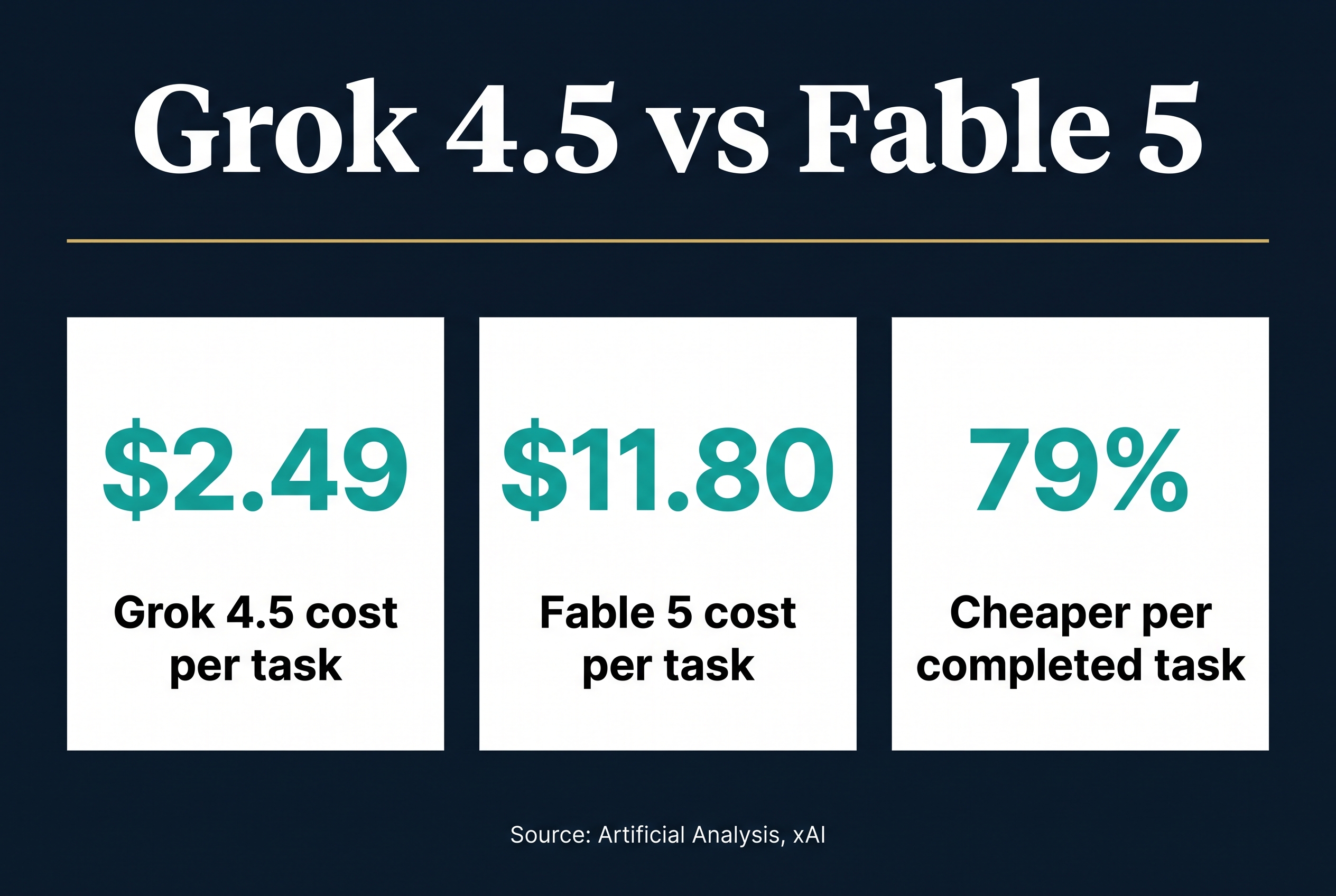
Grok 4.5 is dramatically cheaper than Fable 5 across every pricing dimension. Per million input tokens, Grok 4.5 costs $2 compared to Fable 5's $10. Per million output tokens, Grok 4.5 costs $6 compared to Fable 5's $50. On actual completed tasks measured by Artificial Analysis, Grok 4.5 in Grok Build costs $2.49 per task while Fable 5 in Claude Code costs $11.80 per task, making Grok 4.5 roughly 79% cheaper per task.
The cost advantage compounds because Grok 4.5 is also more token-efficient. It averages 1.9 million tokens per Coding Agent Index task. Fable 5 uses 7.2 million tokens for the same work. GPT-5.5 sits in the middle at 6.2 million. This means Grok 4.5 is not just cheaper per token, it also needs fewer tokens to finish the job.
Token Pricing Comparison (per 1M tokens)
- Grok 4.5: $2 input / $6 output
- Claude Opus 4.8: $5 input / $25 output
- GPT-5.5 / GPT-5.6: $5 input / $30 output
- Claude Fable 5: $10 input / $50 output
Per-Task Cost on Coding Agent Index
- Grok 4.5 (Grok Build): $2.49 per task, 1.9M tokens used
- GPT-5.5 (Codex): $5.07 per task, 6.2M tokens used
- Fable 5 (Claude Code): $11.80 per task, 7.2M tokens used
Artificial Analysis measured Grok 4.5 at $0.49 per completed task on its Intelligence Index, calling it "nearly 90% cheaper than the models ahead of it on our leaderboard."
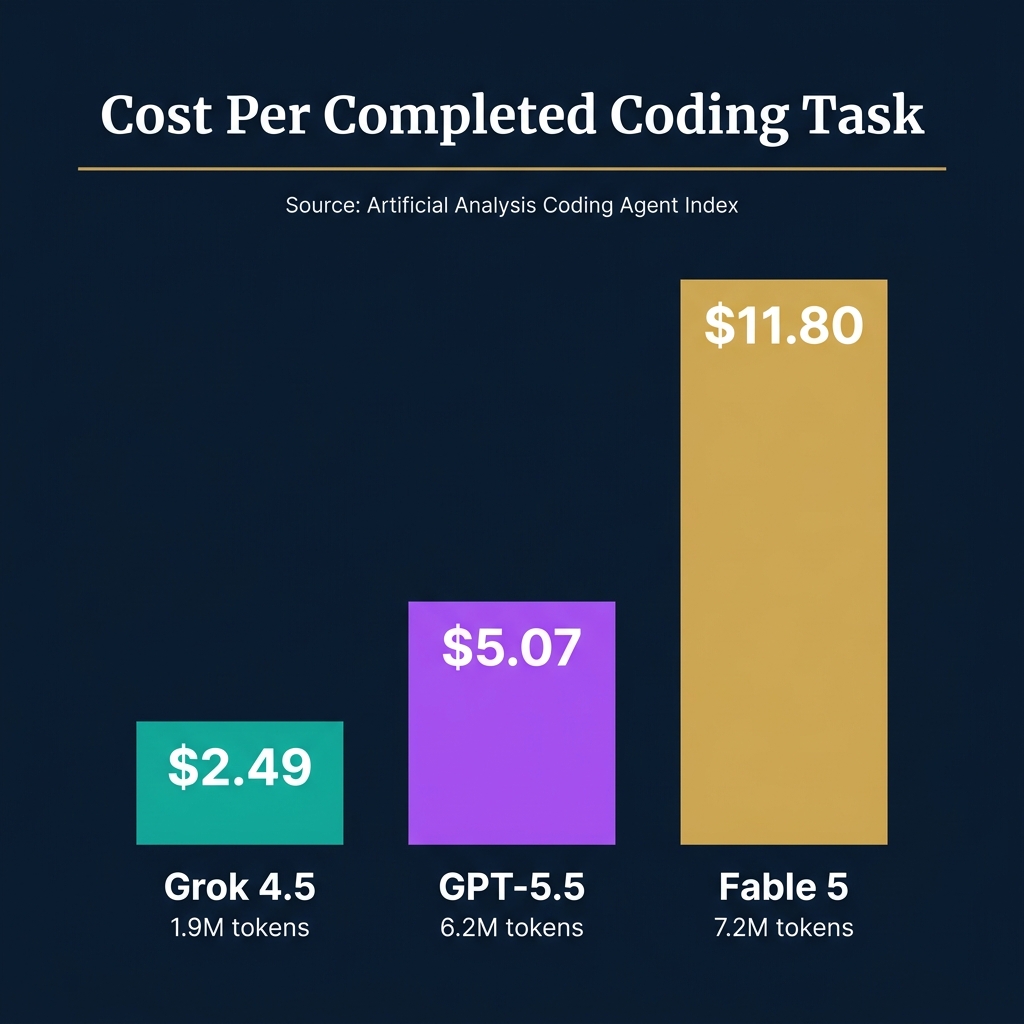
Figure 2: Per-task cost on the Coding Agent Index. Grok 4.5 uses 1.9M tokens per task vs Fable 5's 7.2M. Source: Artificial Analysis
Figure 2: Per-task cost on the Coding Agent Index. Grok 4.5 uses 1.9M tokens per task vs Fable 5's 7.2M. Source: Artificial Analysis
How Does Grok 4.5 Compare on Benchmarks?
Grok 4.5 ranks fourth on Artificial Analysis's Intelligence Index, behind Fable 5, GPT-5.5, and Claude Opus 4.8. It shows a 16-point improvement over Grok 4.3 and outperforms all open-weight models and Google's Gemini lineup. The gaps on raw capability are real but narrow, particularly on agentic and coding tasks.
On the SWE Marathon benchmark, which tests long-horizon software engineering, Grok 4.5 achieved 29.0% resolution rate, surpassing both Claude Opus 4.8 (26.0%) and Fable 5 (24.0%). On Terminal Bench 2.1, which measures complex command-line tasks, Grok 4.5 scored 83.3%, nearly matching GPT-5.5 (83.4%) and trailing Fable 5 (84.3%) by a single point.
The gaps widen on harder benchmarks. On DeepSWE 1.1, which tests real GitHub issue resolution, Grok 4.5 hits 53% compared to GPT-5.5 at 67% and Fable 5 at 70%. On SWE Bench Pro, Grok 4.5 scores 64.7% while Fable 5 reaches 80.4% with max settings.
Benchmark Scores at a Glance
- SWE Marathon: Grok 4.5 = 29.0%, Opus 4.8 = 26.0%, Fable 5 = 24.0%
- Terminal Bench 2.1: Grok 4.5 = 83.3%, GPT-5.5 = 83.4%, Fable 5 = 84.3%
- DeepSWE 1.1: Grok 4.5 = 53%, GPT-5.5 = 67%, Fable 5 = 70%
- SWE Bench Pro: Grok 4.5 = 64.7%, Opus 4.8 = 69.2%, Fable 5 = 80.4%
- Coding Agent Index: Grok 4.5 = 76, GPT-5.5 = 76, Fable 5 = 77
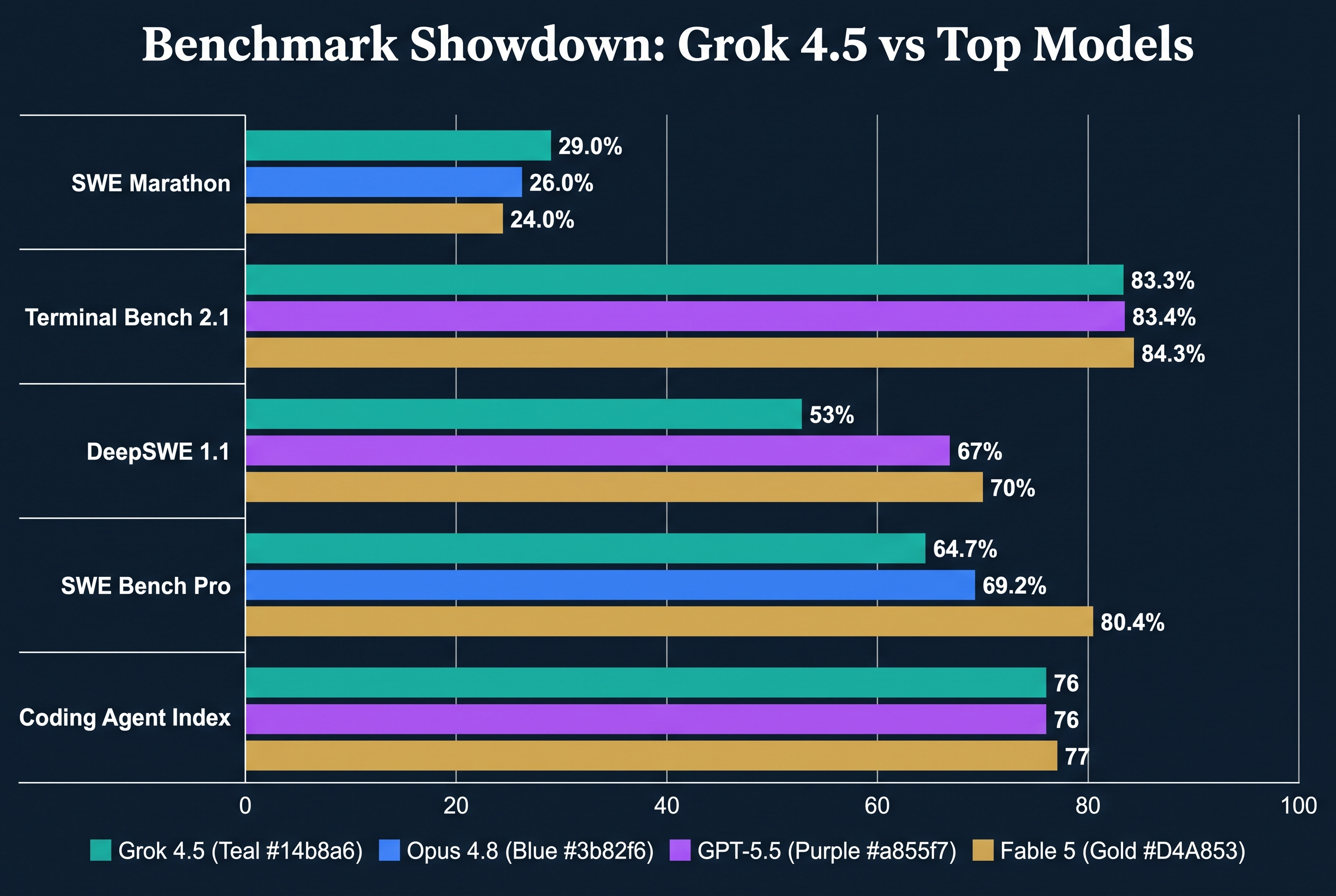
Figure 1: Grok 4.5 (teal) vs GPT-5.5 (purple), Opus 4.8 (blue), and Fable 5 (gold) across key coding benchmarks. Source: Artificial Analysis
Figure 1: Grok 4.5 (teal) vs GPT-5.5 (purple), Opus 4.8 (blue), and Fable 5 (gold) across key coding benchmarks. Source: Artificial Analysis
What About the Hallucination Problem?
Grok 4.5 has a serious weakness. While its accuracy on the AA-Omniscience Index improved from 35% to 52% over the previous generation, its hallucination rate jumped from 25% to 54%. The model knows more but is also more confident when it is wrong. This is a meaningful risk for production deployments where reliability matters more than raw capability.
Fable 5 does not have this problem to the same degree. Anthropic has invested heavily in alignment and safety, and Fable 5's hallucination rates remain lower across comparable evaluations. For businesses deploying AI in customer-facing or regulated contexts, this gap could outweigh the cost savings.
This is the classic tradeoff in AI adoption. Cheaper models that hallucinate more can be production-ready for internal tooling, code suggestions, and low-stakes tasks. For anything customer-facing, financial, or medical, the premium models remain the safer choice.
The Bigger Picture: The Cost of Intelligence Is Plummeting
The Grok 4.5 vs Fable 5 comparison is one data point in a much larger trend. Per-token prices for AI models have fallen approximately 99.7% since the GPT-3 era. In March 2023, GPT-4 launched at $30 per million input tokens. By mid-2026, capable models are available for under $2 per million input tokens.
But total enterprise AI spending is rising, not falling. The FinOps Foundation's 2026 report shows 73% of enterprises exceeded their AI budget projections. The reason is volume. Agentic workflows, where models work autonomously across multiple steps consuming tokens continuously, increase per-task token usage by 50 to 500 times compared to simple chatbot interactions.
This creates a paradox that defines the current AI market. Unit costs are collapsing, but total bills are exploding. The companies that win will be the ones who manage the total cost of agentic workflows, not just the per-token price. Smart model routing, where cheaper models handle routine steps and expensive models are reserved for complex decisions, can reduce costs by up to 85% while maintaining 95% output quality.
What This Means for Businesses Building With AI
The practical takeaway for any business deploying AI in 2026 is straightforward. You no longer need to commit to a single model. The cost structure now supports a portfolio approach.
Use Grok 4.5 for: Internal coding assistance, bulk code generation, agentic workflows where cost-per-task matters, high-volume tasks where slight quality tradeoffs are acceptable.
Use Fable 5 for: Complex reasoning tasks, customer-facing applications, regulated industries, situations where hallucination risk is unacceptable, and problems requiring the absolute highest capability.
Use a hybrid routing approach for: Production systems where you want Fable-level quality on hard problems but Grok-level costs on easy ones. Route queries dynamically based on complexity.
The cost of intelligence is not just about price per token. It is about the total cost of getting reliable work done. Grok 4.5 changes the economics for high-volume use cases. Fable 5 remains the premium choice when quality is non-negotiable. The smartest engineering organizations will use both.
Frequently Asked Questions
Is Grok 4.5 better than Fable 5?
Grok 4.5 is not better than Fable 5 on overall benchmarks. Fable 5 ranks higher on the Artificial Analysis Intelligence Index and outperforms Grok 4.5 on harder coding benchmarks like DeepSWE and SWE Bench Pro. However, Grok 4.5 is significantly cheaper per task and competitive on agentic coding workloads, making it a better choice for cost-sensitive deployments.
How much cheaper is Grok 4.5 than Fable 5?
Grok 4.5 is roughly 80-90% cheaper than Fable 5 depending on the metric. Per million tokens, Grok 4.5 costs $2 input and $6 output, while Fable 5 costs $10 input and $50 output. Per completed coding task, Grok 4.5 costs $2.49 compared to Fable 5's $11.80.
What is the hallucination rate of Grok 4.5?
Grok 4.5 has a 54% hallucination rate on the AA-Omniscience Index, up from 25% in the previous generation. This means the model is confident but wrong more than half the time on certain knowledge tasks. This is a significant concern for production deployments requiring factual accuracy.
Should I switch from Fable 5 to Grok 4.5?
Switching depends on your use case. For high-volume coding tasks where cost matters and slight quality tradeoffs are acceptable, Grok 4.5 is worth testing. For customer-facing applications, complex reasoning, or regulated contexts, Fable 5 remains the safer choice. The best approach is often a hybrid model routing strategy using both.
What does the cost of intelligence trend mean for AI adoption?
Per-token AI costs have fallen 99.7% since 2023, but total enterprise AI spending is rising because agentic workflows consume far more tokens. The key optimization is not just choosing cheaper models but managing total workflow cost through smart routing, caching, and architecture decisions.
About the author: AJ Awan is the founder of Flowtivity, an AI consultancy helping growing businesses build with AI. He is a former EY management consultant with TOGAF certification and 9+ years of experience delivering $15M+ in measurable business benefits.
One email a month, no noise
Practical AI notes for Australian businesses. Unsubscribe anytime.