On this page
- Why waiting out the economy is the most expensive strategy in 2026
- What do AI agents actually do for a growing business?
- AI is here. The gap is deployment, not technology
- The Flowtivity methodology: Discover, Design, Deploy
- What does it cost, and what does waiting cost?
- Why spring 2026 is the window to act
- How to start this month
Last Updated: 6 September 2026
Spring starts in September in Australia, and with it comes the question every business owner is chewing on: where is the economy actually heading? The honest answer is that nobody knows. According to the Reserve Bank of Australia's official cash rate series, the RBA raised the cash rate three times between February and May 2026, taking it from 3.60 percent back to 4.35 percent, where it has stayed through August. If you are waiting for clarity before you invest, you are not being careful. You are paying for delay in admin hours, slow quotes, and missed leads, quarter after quarter. A second group of owners has stopped deliberating entirely. They are partnering with Flowtivity to build AI agents that watch, decide, and act inside their workflows, removing the constraints that macro uncertainty makes feel permanent. Here is what the data says, how our deployment methodology works, and why September 2026 is the window to move.
Why waiting out the economy is the most expensive strategy in 2026
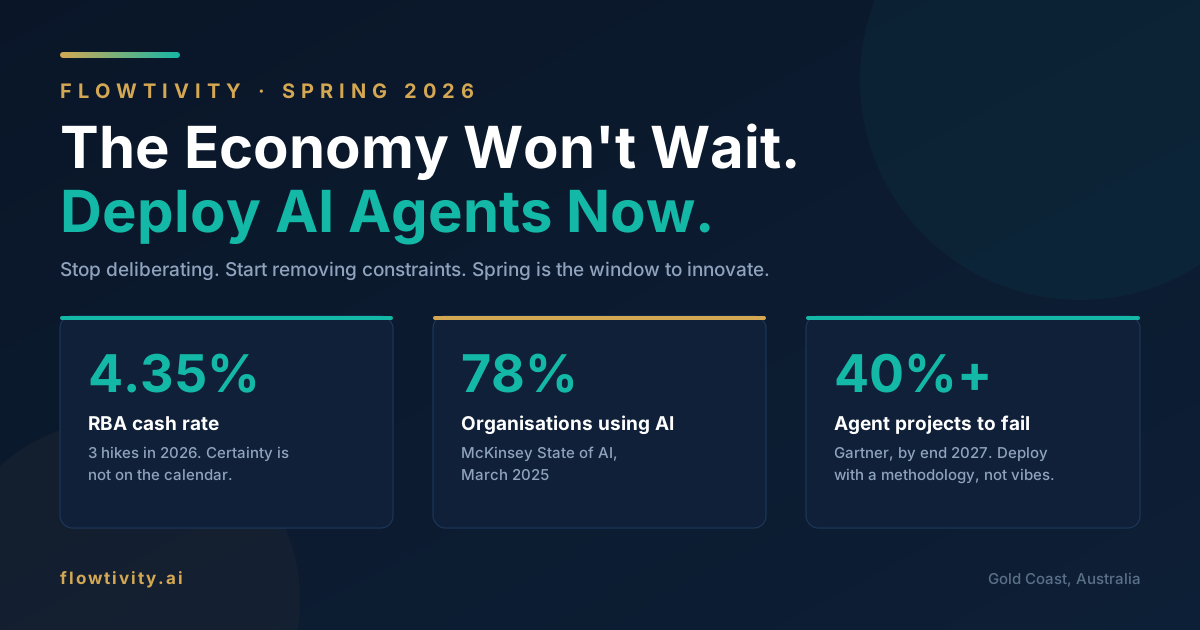
Waiting is not a neutral position. It is an active cost. The Reserve Bank of Australia's cash rate series shows three consecutive quarter-point hikes in February, March, and May 2026, lifting the target from 3.60 percent to 4.35 percent, the same level as the 2023 and 2024 peak, with holds in June and August. That is not a backdrop that resolves itself on a predictable schedule. Business owners who paused investment 12 months ago waiting for certainty are now waiting in a more expensive environment than the one they paused in.
Meanwhile the cost of internal friction keeps running. Every hour a coordinator spends copy-pasting between systems, every afternoon lost reconciling a 231-line estimate, every lead that goes cold while it sits in an unwatched inbox is paid for at today's wage rates, at today's interest rates. The businesses that came through past cycles strongest did not out-predict the economy. They used the pressure to remove the constraints inside their own four walls, so when conditions turned they were faster and cheaper to run than their competitors.
What do AI agents actually do for a growing business?
An AI agent is software that watches your systems, makes decisions against rules you define, and takes action without a person pressing buttons. Unlike basic automation, an agent handles variation: it can work out what an email is actually asking, prepare a client-ready draft in your team's voice, and route the edge cases to a human. In practice, agents remove entire categories of repetitive work rather than shaving seconds off tasks.
This is not theoretical for us. An allied health practice in Victoria runs a Flowtivity inbound email triage agent that has processed around 1,750 emails and prepared 930 threaded drafts since launch, with every draft waiting for a human before anything is sent. A national renovation contractor uses an estimate-review agent so a 231-line estimate becomes a client-ready workbook in one step instead of an afternoon of copy-paste. A clinic gave each doctor roughly 3 hours per week back through automated patient reporting and reduced admin overhead by around 25 percent while keeping reports personalised. Different industries, one pattern: the constraint was never the economy, it was the manual work sitting inside the workflow.
AI is here. The gap is deployment, not technology
The technology debate is over. According to McKinsey's State of AI report from March 2025, 78 percent of organisations now use AI in at least one business function, up from 55 percent two years earlier. The scarce resource is no longer access to models. It is the discipline to deploy them against a real workflow, with the process redesigned around them, and the team trained to run them.
According to Gartner's March 2025 predictions, over 40 percent of agentic AI projects will be cancelled by end 2027, and 33 percent of enterprise software will include agentic AI by 2028, up from under 1 percent in 2024. Read those two numbers together and the picture is blunt: agents are becoming the default fabric of business software, and most do-it-yourself deployments will fail along the way. The failures are rarely model failures. They are scope failures, skipped discovery, no measurement, and no adoption plan. That is exactly why a methodology matters more than a tool subscription.
The Flowtivity methodology: Discover, Design, Deploy
We move businesses from deliberation to production agents in three steps, with education, automation, and agents delivered under one roof so your team gains capability while the systems go live.
- 1. Discover and define. We start by listening. Together we map your key processes, pains, and goals, then identify high impact, low effort opportunities where AI removes friction fast.
- 2. Design and build. We design a clear AI roadmap and build the workflows or agents that support it. You get simple diagrams, not just technical documents, so everyone can see what changes.
- 3. Deploy and support. We integrate into your existing tools, train your team, and measure performance. As your business evolves, we refine and extend the automations.
"The economy is not going to send you an invitation. The real constraint on most businesses is not the macro cycle, it is the manual work sitting inside their own workflows, and that is the one thing you can actually fix this quarter," says AJ Awan, founder of Flowtivity, former EY management consultant and TOGAF certified enterprise architect whose engagements have delivered an average of $15 million in business benefits.
What does it cost, and what does waiting cost?
Yes, deploying agents costs money, and pretending otherwise would be dishonest. The useful question is payback speed. One Flowtivity deployment built around Claude Cowork cut a client's manual data entry by 50 percent within four weeks, connected their existing apps, trained the team to full independence, and paid for itself in under two months. Waiting has a price tag too, it just never appears on an invoice: it shows up as wage hours spent on work a machine should do, quotes that arrive a day after the competitor's, and capacity that never gets freed for growth.
| Daily reality | The old way | With Flowtivity agents |
|---|---|---|
| Client emails | Manually read, sorted, and answered | Agent triages around the clock and drafts replies in your voice |
| Quotes and estimates | An afternoon of copy-paste and checking | 231-line estimate becomes a client-ready workbook in one step |
| Reporting | Hours of admin per staff member weekly | 3 hours per week returned to each doctor, admin overhead down about 25 percent |
| Approvals and updates | Chasing people across tools | Agents watch, decide, and act inside your existing systems |
Why spring 2026 is the window to act
September is the first quarter of the 2027 financial year in Australia, budgets are fresh, and the spring reset energy is real. But the deeper reason is compounding. Gartner's projection that agentic AI goes from under 1 percent of enterprise software in 2024 to 33 percent by 2028 describes a curve that is already bending. Teams that start now get a full cycle of learning, measurement, and refinement before agents become table stakes. Teams that wait will buy the same technology later, at the same price, with none of the accumulated capability and all of the competitive catch-up.
That is the real argument for acting this spring. The economy will do what it does. The RBA will meet again and you will not control the outcome. What you control is whether your business still runs on manual effort this time next year, and whether your competitors spent the intervening quarters building agents while the window was open. Yes, it will cost you. Now is the time to innovate. Do not be late.
How to start this month
Pick one workflow that reliably burns hours every week, such as inbox triage, quoting, onboarding, or reporting. Map it end to end, agree on a measurable success metric, and run a focused four week pilot with a partner who redesigns the workflow rather than bolting a chatbot onto it. If you want that done for you, book a Flowtivity discovery session and we will show you the highest impact, lowest effort opportunities in your business before you commit to anything.
One email a month, no noise
Practical AI notes for Australian businesses. Unsubscribe anytime.