
On this page
Last Updated: May 10, 2026
Running AI agents in a business used to mean bolting a chatbot onto your website and hoping for the best. In 2026, agents read emails, modify databases, communicate with clients, and make decisions that affect real people. The question is no longer whether you need agent governance. It is which framework fits your business.
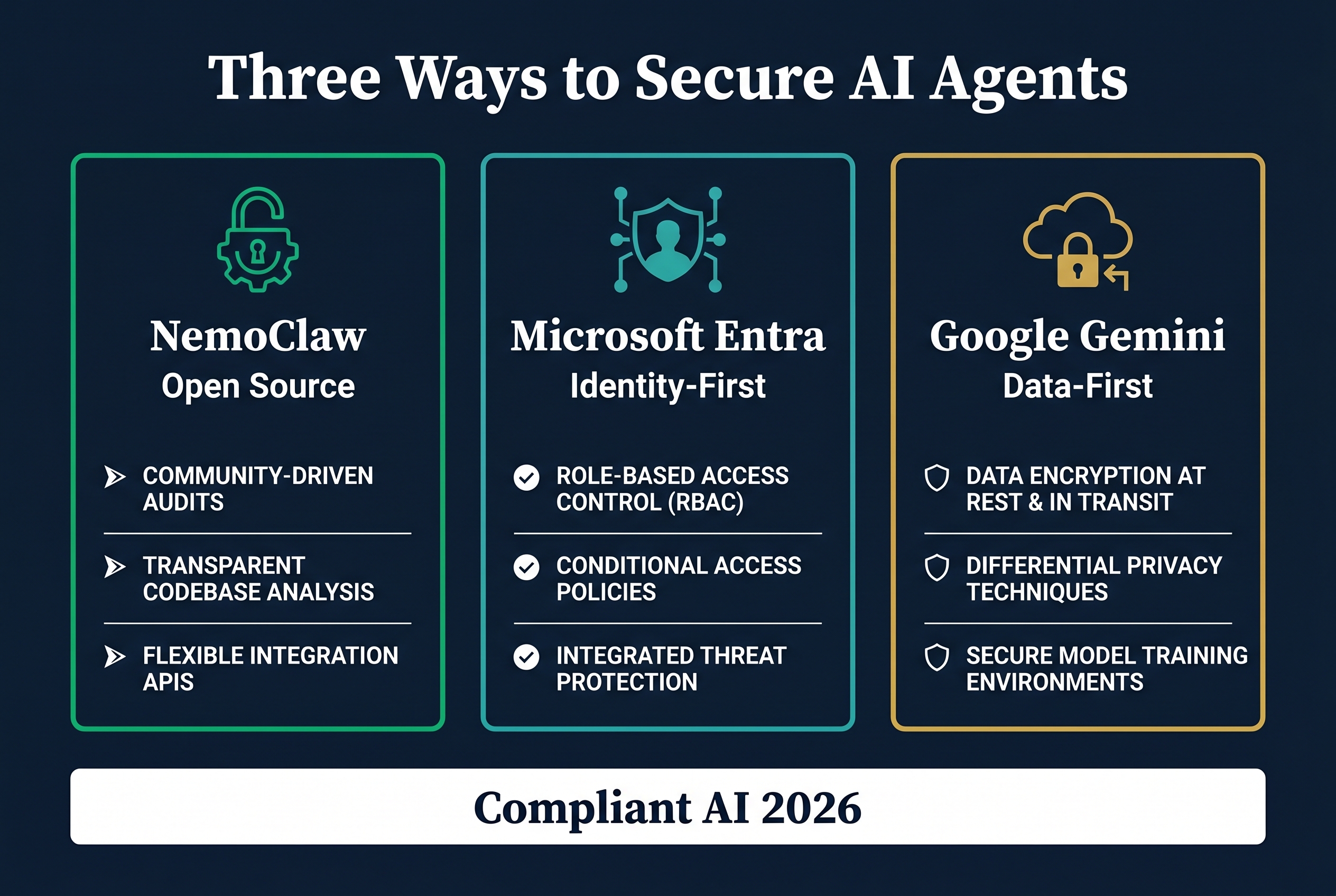
Three platforms have emerged as the leading approaches to compliant, enterprise-safe AI agents. NVIDIA's NemoClaw brings open-source, hardware-agnostic agent orchestration with built-in compliance. Microsoft's Agent Framework 1.0 went production-ready in April 2026 with full .NET and Python support, multi-provider model access, and native Entra ID integration. Google's Gemini Enterprise Agent Platform (formerly Vertex AI) protects agents through data loss prevention, 200+ model access, and HIPAA compliance. Each solves a different part of the problem.
This is Part 2 of our 3-part series on AI compliance for Australian businesses. [Part 1 covered the regulatory landscape: NIST AI RMF, ISO 42001, and the Privacy Act amendments.] [Part 3 provides a practical architecture checklist for building audit-ready AI.]
What Is NVIDIA NemoClaw?
NVIDIA NemoClaw is an open-source AI agent framework announced at GTC 2026 on March 16. It is built on NVIDIA's existing NeMo framework and NIM microservice layer, wrapping them into a production-ready enterprise agent platform.
NemoClaw emerged partly in response to security incidents in the open-source agent space. When OpenClaw, the popular local agent framework, was found to have an unsecured database that allowed anyone to impersonate any agent on the platform, several large technology companies including Meta moved to ban it from corporate machines entirely. NemoClaw is NVIDIA's enterprise-safe answer to that chaos.
The key distinction: NemoClaw is open-source and hardware-agnostic. Unlike the other two platforms, you can run it on NVIDIA, AMD, Intel, or even CPU-only setups. There is no vendor lock-in, no forced cloud dependency, and no per-token pricing. You own the entire stack.
Core capabilities:
- Kernel-level sandbox with deny-by-default security posture
- Out-of-process policy engine that compromised agents cannot override
- Multi-agent collaboration with supervisor and worker agent hierarchies
- Built-in audit logs where every agent action is logged, every tool call is traceable, and audit trails meet SOC 2 and SOX requirements
- Permission controls with granular tool access management
- Privacy-first design with full data control and no forced cloud dependency
- Tool integration with native support for browsers, code execution, databases, and APIs
- Compliance auditing baked into the platform rather than bolted on after the fact
For Australian businesses that want to run agents on their own hardware (which is exactly what DGX Spark enables), NemoClaw is the natural orchestration layer. It gives you the compliance controls of an enterprise platform without the enterprise price tag or the vendor dependency.
What Is Microsoft Agent Framework 1.0?
Microsoft Agent Framework 1.0 reached General Availability on April 3, 2026. It is a production-ready, open-source SDK for building AI agents and multi-agent workflows in both .NET and Python.
This is not a new experiment. It is the convergence of two of Microsoft's most successful AI projects: Semantic Kernel and AutoGen. Between them, the predecessor projects accumulated more than 75,000 GitHub stars. The framework has been through months of release candidates, community feedback, and real-world validation with enterprise customers before hitting version 1.0.
Core capabilities:
- Multi-provider model support with first-party connectors for Microsoft Foundry, Azure OpenAI, OpenAI, Anthropic Claude, Amazon Bedrock, Google Gemini, and Ollama (local models)
- Multi-agent orchestration with sequential and parallel workflows out of the box
- Middleware pipeline that lets you intercept, transform, and extend agent behaviour at every stage: content safety filters, logging, compliance policies, custom logic, all without modifying agent code
- Entra ID integration for agent identity management, tying agent permissions to human roles via Role-Based Access Control
- A2A and MCP interoperability so agents can communicate across different runtimes and platforms
- Stable APIs with long-term support commitment — Microsoft has committed to full backward compatibility going forward
- Cross-language parity between .NET and Python, so teams can use whichever language fits their stack
The middleware pipeline is particularly important for compliance. It means you can add content safety filters that block sensitive data from leaving your organisation, logging middleware that captures every agent action for audit purposes, and compliance policies that enforce regulatory requirements, all as pluggable components that do not require modifying the agent itself.
For Australian businesses already running Microsoft 365, this framework is powerful because it integrates with your existing identity infrastructure through Entra ID. When Jane from accounting launches an agent, it operates within Jane's role-based permissions, not a generic service account. When Jane's role changes or she leaves, the agent's access changes automatically.
The Ollama connector also matters for businesses building private AI infrastructure. You can run the same Microsoft Agent Framework with local models on DGX Spark hardware, getting the governance benefits without cloud API costs.
What Is Gemini Enterprise Agent Platform?
Google's Gemini Enterprise Agent Platform (formerly Vertex AI) is Google Cloud's comprehensive platform for developers to build, scale, govern, and optimise enterprise-ready agents. It provides access to 200+ generative AI models including Gemini 3, Anthropic's Claude, Gemma, Llama, Imagen, and more through its Model Garden.
The platform leads with data protection rather than identity or architecture. Built-in Data Loss Prevention (DLP) monitors model inputs and outputs in real time, automatically detecting and redacting sensitive information before it reaches the AI model and again before the response reaches the user.
Core capabilities:
- 200+ models in Model Garden including Gemini 3, Claude, Gemma, Llama, Imagen, Lyria, Chirp, and Veo
- Agent Studio for developing, testing, and deploying agents with multimodal prompting
- Native DLP with continuous visibility into model inputs and outputs
- HIPAA compliance through Google's Business Associate Agreement (BAA)
- FedRAMP High authorisation for government workloads
- Prompt injection mitigation with layered defence strategy
- Data residency controls ensuring data stays in specified regions (including australia-southeast1 for Australian businesses)
- Automatic blocking of sensitive data from unauthorised training pipelines
- Agent governance via the Gemini Enterprise app for registering, managing, and governing custom-built agents
The data residency point matters for Australian businesses subject to the Privacy Act. Gemini Enterprise Agent Platform allows organisations to specify that data must remain in Australian data centres (australia-southeast1 region), supporting compliance with Australian data sovereignty requirements.
For health sector organisations, this is compelling. The combination of 200+ model access, HIPAA BAA coverage, automatic health data redaction, and regional data residency addresses the most stringent compliance requirements directly.
The Three-Way Comparison
Each platform leads with a different security philosophy. Understanding these philosophies is the key to choosing the right one.
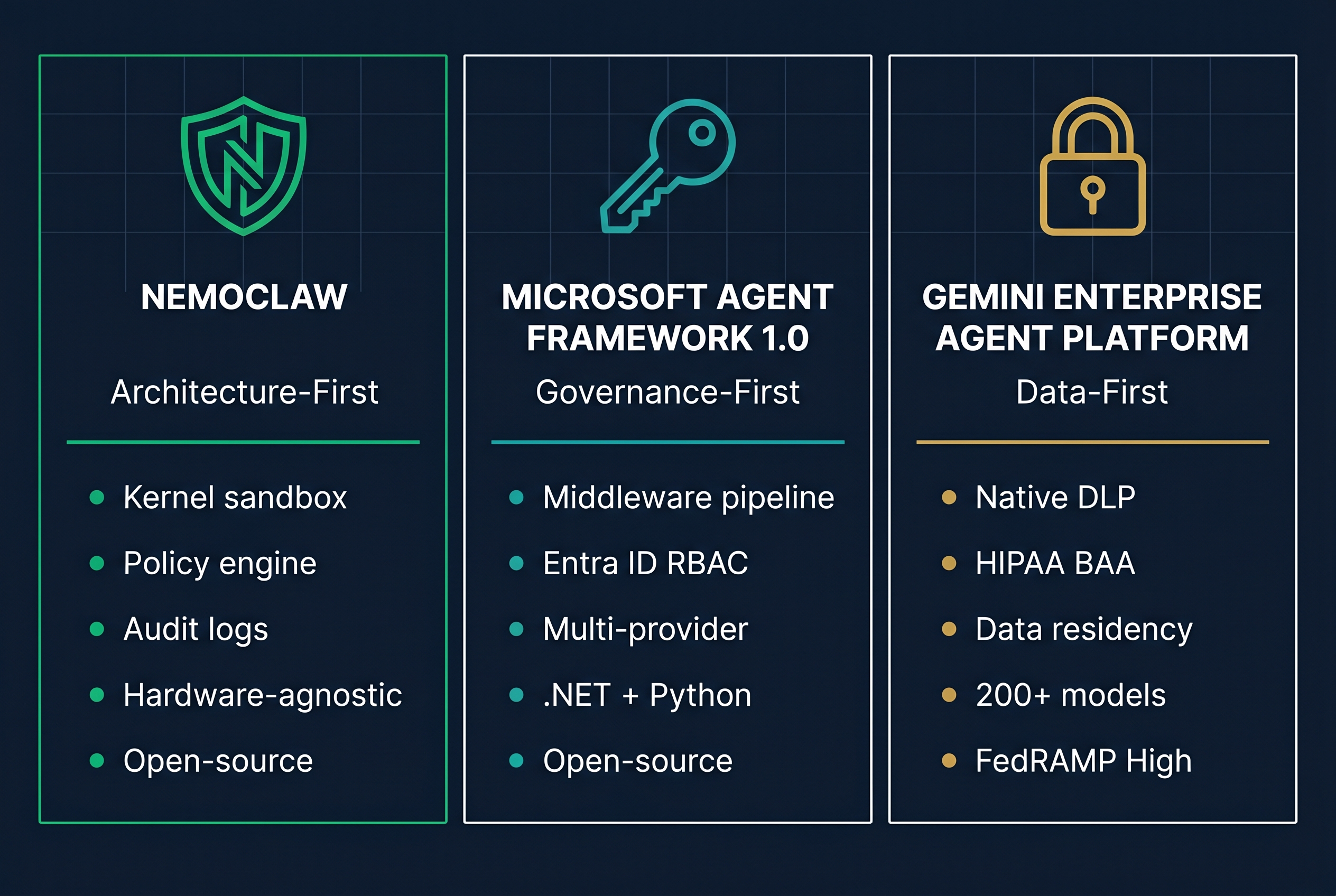
NemoClaw: Architecture-first. Security is built into the agent runtime itself. The kernel-level sandbox prevents agents from executing unauthorised operations at the lowest level. The out-of-process policy engine means even a compromised agent cannot bypass security controls. Audit logging is not optional, it is structural. This is the "secure by design" approach.
Microsoft Agent Framework 1.0: Governance-first. Security comes from the middleware pipeline and identity integration. Every stage of agent execution passes through pluggable middleware where you enforce content safety, compliance, and logging policies. Entra ID ties agent permissions to human roles. The multi-provider approach means you are not locked into one model vendor. This is the "govern everything" approach.
Gemini Enterprise Agent Platform: Data-first. Security comes from protecting the data itself regardless of who or what accesses it. DLP scans content before and after AI processing across 200+ models. Sensitive information is automatically redacted or blocked. Agent governance tools let you register, manage, and monitor all deployed agents. This is the "protect the payload" approach.
Which Platform Should Australian Businesses Choose?
The answer depends on your infrastructure, industry, and risk profile.
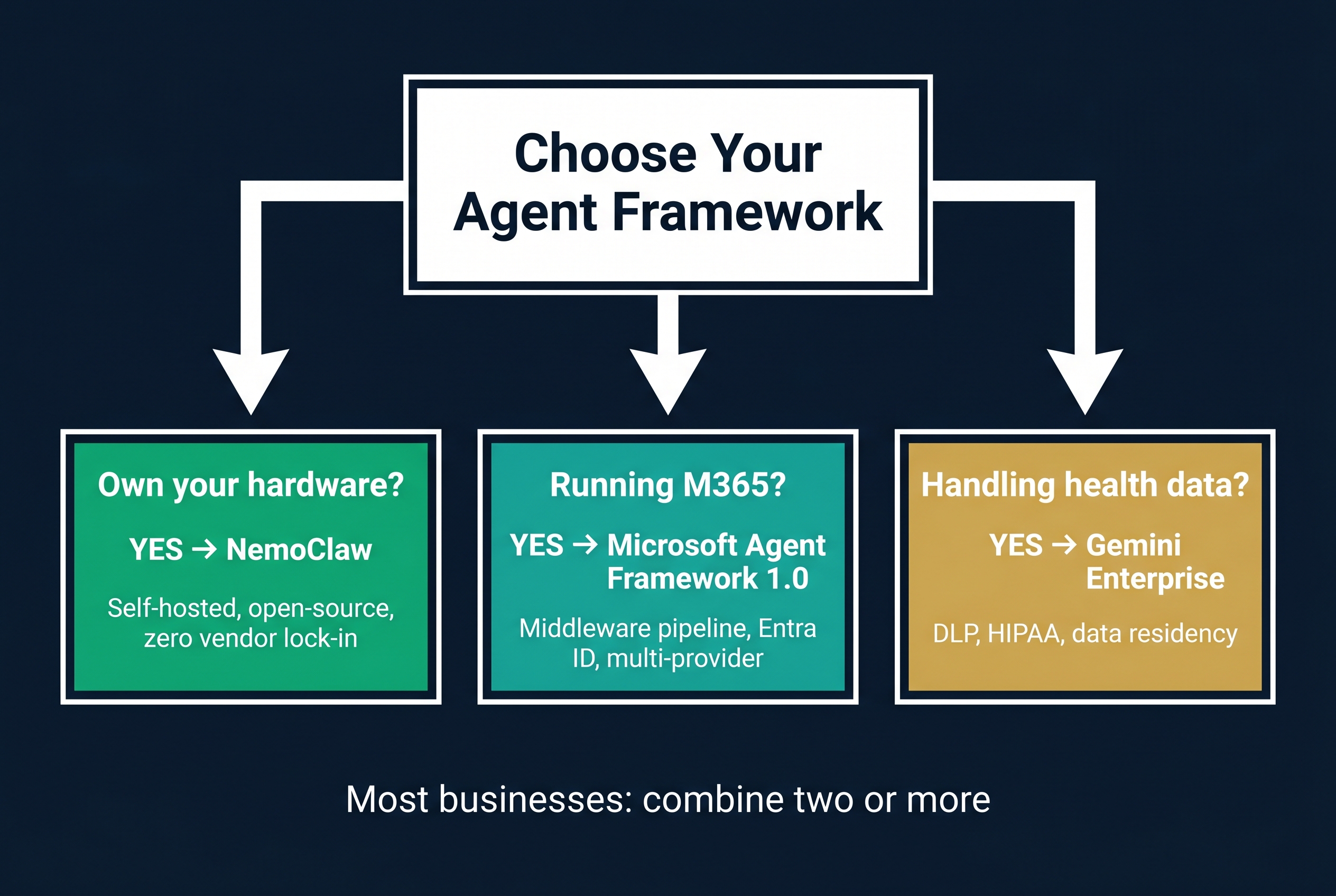
Choose NemoClaw if: You want to run agents on your own hardware, avoid vendor lock-in, and need open-source compliance controls you can audit yourself. This is the best option for businesses building private AI infrastructure (DGX Spark, on-premises servers) and want full control over their agent stack. For businesses targeting ISO 42001 certification, NemoClaw's built-in audit logging and permission controls provide a strong foundation.
Choose Microsoft Agent Framework 1.0 if: Your business runs on Microsoft infrastructure (.NET, Azure, M365) and you want the most mature, production-tested agent SDK available. The middleware pipeline gives you compliance controls without custom engineering. The multi-provider model support means you can switch between OpenAI, Claude, Gemini, and local models without rewriting agents. For businesses with development teams already skilled in .NET or Python, this is the fastest path to production agents.
Choose Gemini Enterprise Agent Platform if: You handle health data, sensitive personal information, or operate in a regulated industry where data leakage is the primary risk. The automatic DLP, HIPAA compliance, 200+ model access, and data residency controls solve the hardest compliance problems directly. For primary health organisations and health consultancies, this is the clear choice.
Choose a combination if: Most real-world deployments will use more than one. Use NemoClaw for locally-hosted agents on your own hardware, Microsoft Agent Framework 1.0 for cloud agents that need M365 integration and multi-provider model access, and Gemini Enterprise Agent Platform's DLP layer for any processing involving health data. The three platforms address different layers of the security stack. They are complementary, not competing.
Cost Comparison
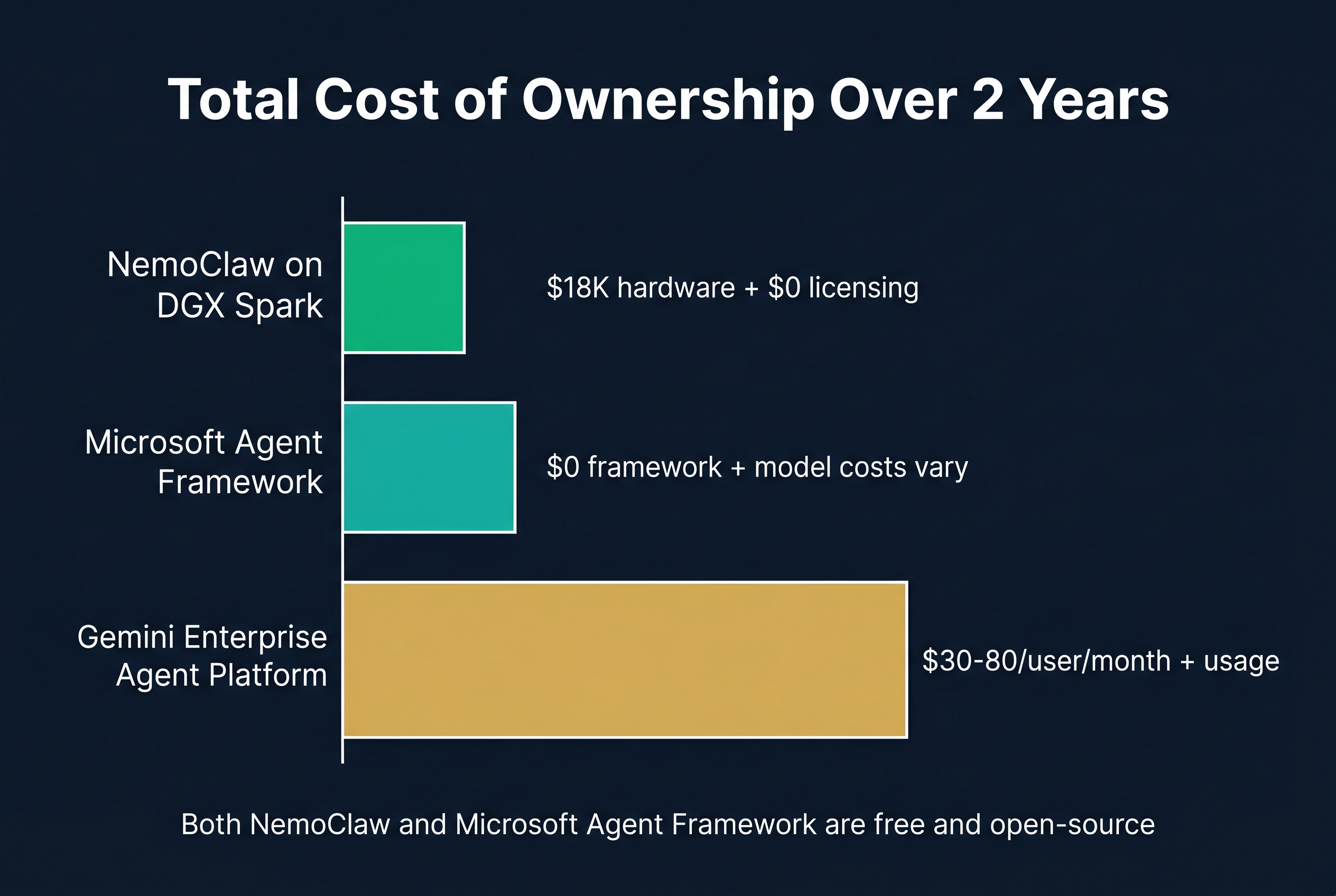
NemoClaw: Free and open-source. You pay for the hardware it runs on and engineering time to deploy and maintain it. No licensing fees, no per-token costs for the framework itself.
Microsoft Agent Framework 1.0: Free and open-source SDK. You pay for the cloud models you connect to (Azure OpenAI, etc.) or nothing if you connect to local models via Ollama. Entra ID integration requires Entra ID P2 licensing, which most enterprises already have.
Gemini Enterprise Agent Platform: New customers get up to $300 in free credits. After that, priced per user per month for the platform, plus usage-based pricing for AI processing. The DLP, Model Garden (200+ models), and compliance features are included. HIPAA BAA coverage requires a separate agreement.
For cost-conscious businesses, both NemoClaw and Microsoft Agent Framework 1.0 are free open-source frameworks. The cost difference is in what you run them on. NemoClaw on self-hosted DGX Spark hardware with local open-source models gives you the lowest total cost of ownership. Microsoft Agent Framework 1.0 with local models via Ollama achieves a similar outcome if you prefer the Microsoft ecosystem.
The Practical Three-Layer Architecture
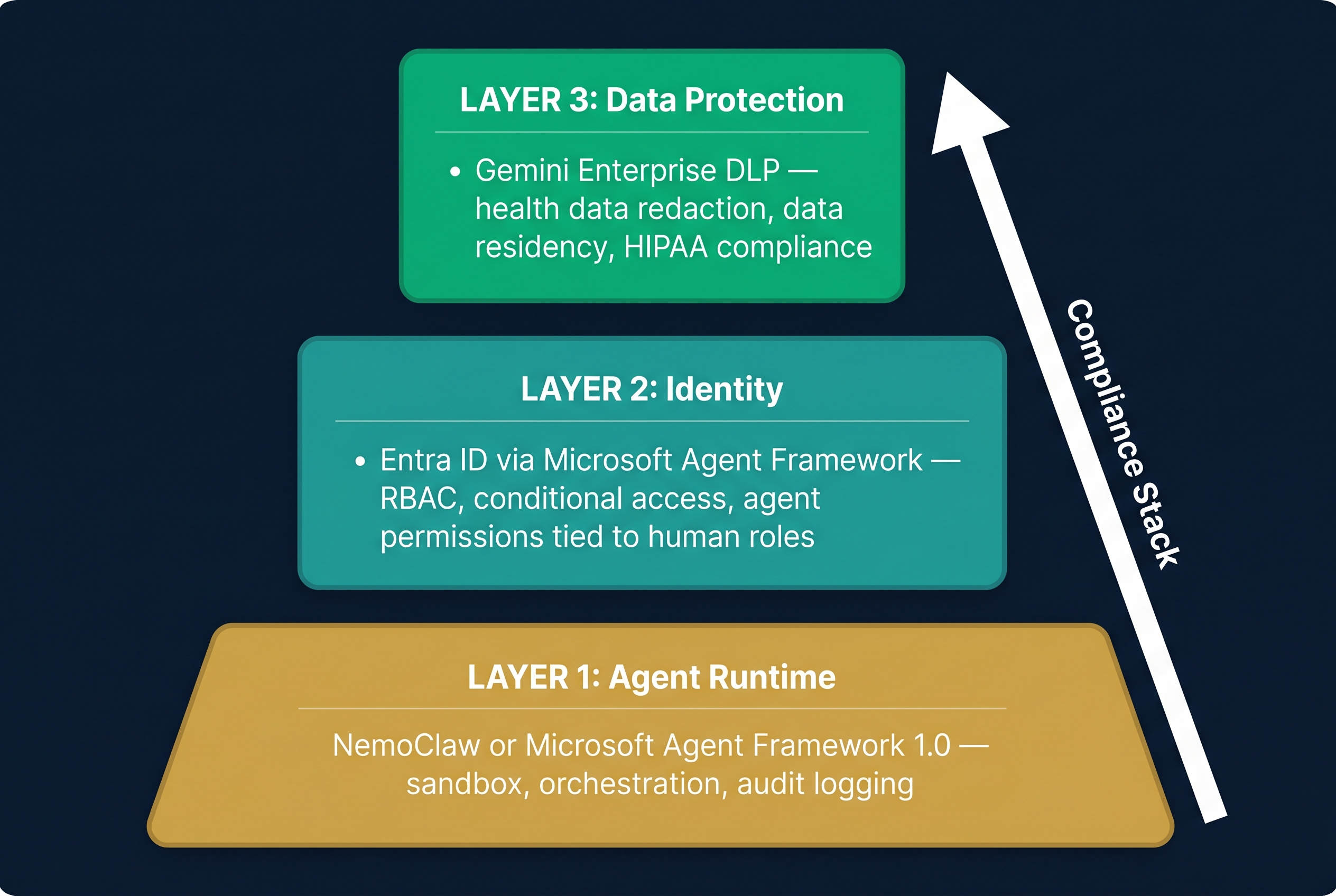
For Flowtivity's clients, especially those in health and professional services, we recommend a layered approach:
Layer 1: Agent runtime (NemoClaw or Microsoft Agent Framework 1.0). Choose based on your team's skills and existing stack. NemoClaw if you want hardware-agnostic simplicity. Microsoft if you want .NET/Python middleware extensibility and Entra ID integration. This layer provides the sandbox, orchestration, and audit logging.
Layer 2: Identity (Entra ID via Microsoft Agent Framework). For agents that interact with M365 services, Entra ID ensures agents operate within your existing identity and access framework. This is included automatically if you choose the Microsoft framework.
Layer 3: Data protection (Gemini Enterprise Agent Platform DLP). For any agent processing that involves health data or sensitive personal information, route through Gemini Enterprise Agent Platform's DLP layer. This adds automatic redaction and data residency controls that the other two layers do not provide.
This three-layer architecture satisfies NIST AI RMF (risk management through the policy engine or middleware), ISO 42001 (certifiable management system through audit logging and governance), and the Privacy Act (transparency and data sovereignty through DLP and residency controls).
The Bottom Line
There is no single right answer. The best platform depends on what you are protecting (architecture control, governance, or data), what infrastructure you already have, and what industry you operate in.
What is non-negotiable is that you choose something. Running AI agents without a security framework in 2026 is not a risk. It is a liability. The Privacy Act amendments take effect in December 2026. ISO 42001 is appearing in tender requirements. NIST alignment is becoming expected in enterprise procurement.
The businesses that win will be the ones that treat agent security as architecture, not afterthought.
This is Part 2 of 3. Read [Part 1: AI Regulation in Australia] and [Part 3: Building Audit-Ready AI Architecture].
About the author: AJ Awan is the founder of Flowtivity, an Australian AI consultancy specializing in workflow automation and AI agent deployment for growing businesses. With 9+ years of consulting experience including 6 years at EY, AJ helps companies build compliant AI agent architectures that work within their existing systems and processes.
One email a month, no noise
Practical AI notes for Australian businesses. Unsubscribe anytime.


