On this page
- What Is Qwen-AgentWorld?
- The Seven Domains: One Model, Seven Worlds
- How Qwen-AgentWorld Was Trained
- Stage 1: Continual Pre-Training (CPT)
- Stage 2: Supervised Fine-Tuning (SFT)
- Stage 3: Reinforcement Learning (RL)
- Training Data: 10 Million Real Trajectories
- AgentWorldBench: A New Evaluation Standard
- The Five Evaluation Dimensions
- Benchmark Results: Qwen-AgentWorld vs the Frontier
- The Two Paradigms: How World Modeling Transforms Agent Training
- Paradigm 1: Decoupled Environment Simulator (Controllable Sim RL)
- Paradigm 2: Agent Foundation Model (LWM Warm-Up)
- What This Means for the Future of Agent Development
- Technical Details: Running Qwen-AgentWorld
- The Bigger Picture: World Models as the Next Frontier
- Frequently Asked Questions
- What is Qwen-AgentWorld?
- How does Qwen-AgentWorld compare to GPT-5.4 and Claude Opus 4.8?
- What is the fictional-world construction finding?
- Is Qwen-AgentWorld open source?
- What are the two paradigms for how world modeling enhances agents?
Last Updated: June 24, 2026
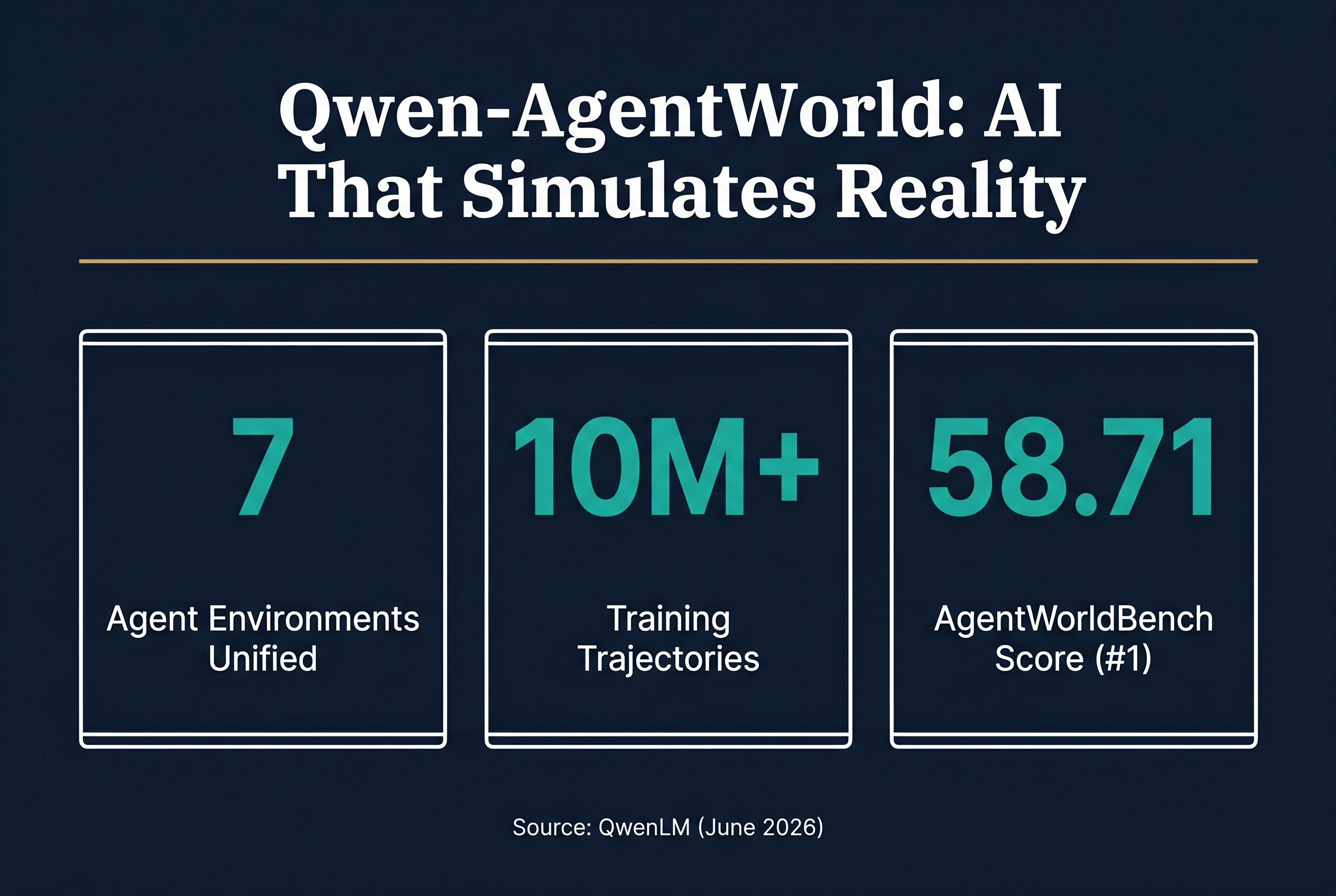
Alibaba's Qwen team just released something genuinely new: a language model trained not to act in environments, but to model them. Qwen-AgentWorld simulates 7 different agent environments — MCP, Search, Terminal, SWE, Web, OS, and Android — within a single model. It beats GPT-5.4 and Claude Opus 4.8 at environment simulation, and the implications for agent training are profound.
What Is Qwen-AgentWorld?
Qwen-AgentWorld is the first language world model (LWM) that simulates agent environments across seven distinct domains within a single model. Released on June 24, 2026 by Alibaba's Qwen team, it comes in two sizes: Qwen-AgentWorld-35B-A3B (MoE, 35B total / 3B active, 256K context) and Qwen-AgentWorld-397B-A17B. Both are open-sourced under Apache 2.0.
The core idea is deceptively simple. Every major AI lab is training models to be better agents — better at taking actions in environments. Qwen asked a different question: what if we train models to model the environments themselves? Instead of learning to use a search engine, the model learns to predict what a search engine would return. Instead of learning to run terminal commands, it learns to predict terminal output.
This matters because environment simulation is the bottleneck for agent training at scale. Training agents in real environments is slow, expensive, and limited by API rate limits, safety constraints, and the sheer diversity of real-world scenarios. A model that can accurately simulate any environment — a search engine, a terminal, a web browser, an Android phone — removes that bottleneck entirely.
The Seven Domains: One Model, Seven Worlds
Qwen-AgentWorld unifies seven agent interaction domains that have historically required separate, specialized systems:
- MCP (Multi-agent Control Problems / Tool Calling): Simulates tool-use environments including API calls, function execution, and multi-step tool workflows
- Search: Simulates search engine results pages, including web search, document retrieval, and information extraction
- Terminal: Simulates Linux terminal environments — command execution, file system navigation, process management
- SWE (Software Engineering): Simulates software development environments — code execution, test suites, build systems, repository operations
- Android: Simulates Android device interactions — app navigation, UI element interaction, screen state transitions
- Web: Simulates web browsing — page loading, DOM interactions, form submission, navigation flows
- OS: Simulates operating system environments — file management, system configuration, multi-application workflows
Before Qwen-AgentWorld, no single language world model covered all seven domains. This unification matters because it enables cross-domain knowledge transfer. A model that understands how terminal commands produce output can leverage that understanding when simulating SWE environments. A model that grasps web navigation patterns can apply similar reasoning to Android UI interactions.
How Qwen-AgentWorld Was Trained
The training pipeline is a three-stage process that builds environment modeling capability from the ground up. This is what makes Qwen-AgentWorld a "native" world model — environment simulation isn't bolted on after general training; it IS the training objective from day one.
Stage 1: Continual Pre-Training (CPT)
The CPT stage injects general-purpose world modeling capabilities into the model. Training data comes from two sources: state transition dynamics (records of how environments respond to actions) and augmented professional corpora (domain-specific text about how each environment works).
This means the model learns not just the statistical patterns of language, but the causal structure of environments — what happens when you run ls -la in a directory with these files, what a search engine returns for this query given this index, what an Android screen looks like after tapping this button.
Stage 2: Supervised Fine-Tuning (SFT)
SFT activates next-state-prediction reasoning. The model is trained on examples where, given an action and interaction history, it must predict the exact environment response. This is analogous to training a language model to predict the next token — but instead of predicting text, it's predicting environment state transitions.
The model learns to generate what the environment would output, formatted correctly for each domain. A terminal command produces terminal output. A search query produces a results page. A UI action produces a screen state description.
Stage 3: Reinforcement Learning (RL)
RL sharpens simulation fidelity through a hybrid rubric-and-rule reward framework. The model is rewarded for producing environment responses that are format-correct, factually accurate, internally consistent, realistic, and high-quality.
This three-stage approach — knowledge injection, capability activation, fidelity sharpening — is a clean separation of concerns that maps to how humans learn environments: study how they work (CPT), practice predicting outcomes (SFT), then refine through feedback (RL).
Training Data: 10 Million Real Trajectories
The model was trained on more than 10 million real-world interaction trajectories across the seven domains. These trajectories were collected from real agent deployments — actual tool calls, search queries, terminal sessions, code executions, and UI interactions. This grounds the model's simulations in reality rather than synthetic approximations.
AgentWorldBench: A New Evaluation Standard
Alongside the model, Qwen released AgentWorldBench — a comprehensive benchmark for evaluating language world models. It was constructed from real-world interactions of 5 frontier AI models on 9 established agent benchmarks.
The Five Evaluation Dimensions
Every predicted environment response is scored on five dimensions:
- Format: Does the response follow the correct structural format for this environment?
- Factuality: Is the content factually correct given the environment state?
- Consistency: Is the response internally consistent across multiple turns?
- Realism: Does the response look like what a real environment would produce?
- Quality: Overall quality of the simulation
Scores are normalized to a 0-100 scale, with the overall score being the mean across all five dimensions and all seven domains.
Benchmark Results: Qwen-AgentWorld vs the Frontier
The results on AgentWorldBench are striking. Qwen-AgentWorld-397B-A17B achieves the highest overall score of 58.71, outperforming every frontier proprietary model tested:
Top performers on AgentWorldBench (overall score):
- Qwen-AgentWorld-397B-A17B: 58.71 (1st place)
- GPT-5.4: 58.25
- Claude Opus 4.6: 57.80
- Claude Opus 4.8: 56.59
- Qwen-AgentWorld-35B-A3B: 56.39
- Claude Sonnet 4.6: 56.04
- Gemini 3.1 Pro: 54.57
- Qwen3.5-397B-A17B: 54.74 (base model without LWM training)
- DeepSeek-V4-Pro: 52.97
- Kimi K2.6: 53.42
- GLM-5.1: 51.31
The 35B model shows a +8.66 point improvement over its base model (Qwen3.5-35B-A3B, which scores 47.73) — demonstrating that the world model training pipeline adds dramatic capability on top of the same architecture.
Domain-by-domain highlights (397B model):
- SWE: 68.49 — highest of any model tested
- MCP: 68.24 — second only to GPT-5.4 (70.10)
- OS: 67.89 — second only to Claude Opus 4.6 (70.20)
- Search: 37.82 — highest of any model tested
- Terminal: 57.73 — second only to Claude Opus 4.8 (59.18)
Qwen-AgentWorld wins outright in SWE and Search — domains where precise state tracking and factual accuracy are paramount.
The Two Paradigms: How World Modeling Transforms Agent Training
This is where the research gets genuinely exciting. Qwen investigated two complementary paradigms for how environment modeling capability enhances agents — and both produced results that challenge conventional assumptions about how agents should be trained.
Paradigm 1: Decoupled Environment Simulator (Controllable Sim RL)
In this paradigm, Qwen-AgentWorld serves as a standalone environment simulator for agentic RL training. Instead of training agents against real environments (which are slow, expensive, and limited in diversity), agents train against Qwen-AgentWorld's simulations.
The fictional-world construction result is the headline finding:
Agents trained in fully invented, self-consistent fictional search environments generalize BETTER to real search tasks than agents trained in real search environments.
- WideSearch F1 Item: Qwen3.5-35B-A3B-SFT scored 34.02. With controlled Sim RL using fictional worlds: 50.31. That's a +16.29 point improvement.
- WideSearch F1 Row: Improved from 13.72 to 24.21 (+10.49).
This is counterintuitive. Training in made-up worlds produces agents that perform better in the real world. The explanation is that fictional environments force agents to actually use their tools rather than relying on parametric memory. When a search environment contains only real facts, agents can cheat by recalling answers from training data instead of genuinely searching. In fictional environments, every fact is invented and internally consistent — agents MUST use the search tool to find answers, which builds genuine tool-use competence.
Controllable perturbations also beat real training:
In MCP environments, controlled simulation with targeted perturbations (injecting edge cases and error conditions) produced dramatic improvements:
- MCPMark: Improved from 21.5 to 33.8 (+12.3) with controlled Sim RL
- Tool Decathlon: Improved from 32.4 to 36.1 (+3.7)
Zero-shot generalization to entirely new environments:
Agents trained using Qwen-AgentWorld as a simulator generalized zero-shot to OpenClaw (an out-of-distribution agent framework):
- Claw-Eval: 65.4 → 69.7 (+4.3)
- QwenClawBench: 47.9 → 55.0 (+7.1)
Paradigm 2: Agent Foundation Model (LWM Warm-Up)
The second paradigm is even more surprising. Using world-model RL training as a warm-up for general agent capability — not as a simulator, but as a foundation.
The process: take a base model, train it to predict environment states (single-turn, non-agentic prediction), then measure whether this improves downstream multi-turn agentic tasks.
It does. Dramatically.
Improvements from LWM RL warm-up (Qwen3.5-35B-A3B):
- Terminal-Bench 2.0: 33.25 → 39.55 (+6.30)
- SWE-Bench Verified: 64.47 → 67.86 (+3.39)
- SWE-Bench Pro: 42.18 → 47.42 (+5.24)
- WideSearch F1 Item: 33.38 → 46.17 (+12.79)
- Claw-Eval: 53.60 → 64.88 (+11.28)
- QwenClawBench: 39.76 → 49.43 (+9.67)
- BFCL v4: 62.29 → 71.25 (+8.96)
The gains span in-domain tasks (Terminal, SWE, Search) and out-of-domain tasks (Claw-Eval, QwenClawBench — entirely different agent frameworks). This means that learning to predict environments makes you better at acting in them, even without any agent-specific fine-tuning.
Why this works: Understanding how environments respond to actions is a deeper form of knowledge than simply memorizing action sequences. A model that knows what a terminal will output for any command understands terminals at a structural level. A model that merely learned to execute commands through trial and error may have surface-level competence without deep understanding.
What This Means for the Future of Agent Development
Qwen-AgentWorld validates a paradigm shift in how we think about AI agent training. The current consensus is that agents improve by doing — more interactions, more environments, more real-world experience. Qwen-AgentWorld suggests that agents also improve by understanding — by building a mental model of how environments work, not just how to act in them.
For agent developers, the practical implications are immediate:
- Sim RL with fictional environments can replace or supplement real-environment training, dramatically reducing cost and increasing diversity
- LWM warm-up is a new training stage that improves any agent model, regardless of its downstream task
- Environment simulation enables rapid prototyping and testing without rate-limited or unsafe real environments
- The open-source release (Apache 2.0) means any team can build on this foundation
For businesses building AI systems, the strategic implications are significant:
- Agent training costs can drop substantially when simulation replaces real-environment interaction
- Fictional environment construction enables domain-specific agent training without exposing real data
- The cross-domain transfer results suggest that general-purpose agent capability is improving faster than expected
- Open-source availability means these techniques aren't locked behind proprietary APIs
Technical Details: Running Qwen-AgentWorld
The 35B-A3B model is designed for practical deployment:
- Architecture: MoE with 35B total parameters, ~3B active per token
- Context window: 256K tokens
- Inference frameworks: SGLang and vLLM with tensor parallelism
- Deployment: Standard OpenAI-compatible API endpoint
- Fine-tuning: Supported via Swift, Llama-Factory, and Unsloth
Domain-specific system prompt templates are provided for all seven environments, making it straightforward to use Qwen-AgentWorld as an environment simulator for specific use cases.
The 397B-A17B model represents the frontier version, achieving the highest AgentWorldBench scores. Both models are available on HuggingFace and ModelScope.
The Bigger Picture: World Models as the Next Frontier
Qwen-AgentWorld sits at the intersection of two major trends in AI research: agentic systems and world models. The combination is more powerful than either alone.
Language models have gotten very good at generating text. They've gotten reasonably good at using tools. But they've been fundamentally limited by their lack of environmental understanding — they don't truly know what happens when you run a command, click a button, or submit a form. They pattern-match based on training data.
World models change this. A model that can predict environment state transitions has, in a meaningful sense, learned the causal structure of those environments. It understands consequences. And as Qwen-AgentWorld demonstrates, this understanding transfers to better agent performance — even in environments the model has never seen.
The fictional-world result is the most provocative finding. If agents trained in invented environments generalize better than those trained in real ones, it suggests that the future of agent training won't look like the present. Instead of deploying agents in real environments and hoping they learn, we'll construct elaborate fictional training worlds — fully controllable, infinitely diverse, and specifically designed to build genuine competence rather than surface-level pattern matching.
That's not an incremental improvement. It's a different paradigm entirely.
Frequently Asked Questions
What is Qwen-AgentWorld?
Qwen-AgentWorld is a language world model released by Alibaba's Qwen team on June 24, 2026. It simulates 7 agent environments (MCP, Search, Terminal, SWE, Web, OS, Android) within a single model. Unlike standard LLMs trained to generate text or use tools, Qwen-AgentWorld is trained to predict how environments respond to actions — making it an environment simulator rather than an agent.
How does Qwen-AgentWorld compare to GPT-5.4 and Claude Opus 4.8?
On AgentWorldBench, Qwen-AgentWorld-397B-A17B scores 58.71 overall, beating GPT-5.4 (58.25), Claude Opus 4.8 (56.59), and Gemini 3.1 Pro (54.57) at environment simulation. It ranks first in SWE and Search domains specifically. The smaller 35B-A3B model scores 56.39, still beating Claude Opus 4.8.
What is the fictional-world construction finding?
Qwen-AgentWorld can generate fully invented, internally consistent search environments for agent training. Agents trained in these fictional worlds generalize better to real search tasks than agents trained in real search environments — because fictional environments prevent agents from cheating with parametric memory and force genuine tool use. WideSearch F1 Item improved by +16.29 points using this technique.
Is Qwen-AgentWorld open source?
Yes. Both model weights (35B-A3B on HuggingFace and ModelScope) and the AgentWorldBench evaluation benchmark are released under Apache 2.0 license. The 397B-A17B model results are documented in the paper, with the 35B model available for download and deployment.
What are the two paradigms for how world modeling enhances agents?
First, as a decoupled environment simulator: Qwen-AgentWorld serves as a controllable, scalable simulation environment for agentic RL training, supporting fictional-world construction and targeted perturbations that surpass real-environment training. Second, as an agent foundation model: world-model training acts as a warm-up that improves downstream agent performance across 7 benchmarks, including out-of-domain tasks, with gains up to +12.79 points.
One email a month, no noise
Practical AI notes for Australian businesses. Unsubscribe anytime.