
On this page
- Structured Knowledge Extraction: How Hypergraphs Are Transforming What LLMs Can Do With Your Data
- What Is Structured Knowledge Extraction?
- Why This Matters Now
- From Knowledge Graphs to Hypergraphs: Why the Upgrade Matters
- The Limitation of Knowledge Graphs
- Hypergraphs Solve This
- HyperGraphRAG: The Research Backing
- Hyper-Extract: The Framework Making It Accessible
- What It Does
- The Three-Layer Architecture
- Key Features That Matter for Business
- Real-World Use Cases for Australian Businesses
- Construction: Site Reports to Structured Data
- Allied Health: Treatment Records to Knowledge Hypergraphs
- Professional Services: Contract Analysis at Scale
- Financial Services: Earnings Reports to Risk Graphs
- How Hyper-Extract Compares to Other Tools
- The Strategic Implication: Structured Extraction Is the New ETL
- Getting Started with Hyper-Extract
- The Takeaway for Business Leaders
Structured Knowledge Extraction: How Hypergraphs Are Transforming What LLMs Can Do With Your Data
Last Updated: June 26, 2026
Every business sits on a mountain of unstructured text: contracts, emails, medical records, site reports, meeting notes, financial filings. Until now, extracting structured knowledge from that text required custom pipelines, domain-specific NER models, and armies of data engineers. A new generation of LLM-powered extraction frameworks is changing that. This guide covers how structured extraction works, why hypergraphs represent a fundamental leap beyond knowledge graphs, and what it means for businesses sitting on unstructured data.
What Is Structured Knowledge Extraction?
Structured knowledge extraction is the process of transforming unstructured or semi-structured text into machine-readable, strongly-typed data structures. Instead of an LLM generating free-form prose, it outputs entities, relationships, attributes, and hierarchies that conform to a predefined schema.
The key breakthrough is that modern LLMs (GPT-4o, Claude Sonnet, Qwen, GLM) now support native structured output through JSON schema enforcement and function calling. This means you can define a Pydantic model or JSON schema, feed the LLM a document, and get back data that is guaranteed to match your schema. No parsing. No regex. No post-processing.
Why This Matters Now
- Native schema support is built into every major LLM provider (OpenAI, Anthropic, Gemini, Mistral, Alibaba Bailian)
- Constrained decoding can enforce schema compliance at the token level during generation
- Open-source models like DeepSeek-R1, Qwen3.5, and GLM-4.5 now rival proprietary models on extraction tasks
- Frameworks like Hyper-Extract package the entire workflow into CLI tools with 80+ domain templates
The result: what used to take a data engineering team six weeks now takes one command.
From Knowledge Graphs to Hypergraphs: Why the Upgrade Matters
The Limitation of Knowledge Graphs
Traditional knowledge graphs use binary edges. Each edge connects exactly two entities: Company A -- acquired --> Company B. This works for simple relationships but breaks down when reality is more complex.
Consider a medical record: "Patient John was prescribed Medication X by Dr. Smith on March 15 for Condition Y, resulting in improved symptoms." A binary graph forces you to either:
- Create separate edges for each pair (John-Medication, John-Dr. Smith, John-Condition), losing the combined context
- Create a single edge with many attributes, which is really just a hyperedge in disguise
This is the semantic fragmentation problem. Binary graphs lose the relational context that makes the information meaningful.
Hypergraphs Solve This
A hypergraph allows hyperedges that connect an arbitrary number of entities simultaneously. The entire medical scenario above becomes a single hyperedge connecting Patient, Medication, Doctor, Date, Condition, and Outcome in one n-ary relationship.
This is not a theoretical improvement. It directly affects:
- Query accuracy: "What medications was John prescribed for Condition Y?" returns precise results because the full relationship is preserved
- Reasoning quality: LLMs receive richer context when hyperedges maintain complete relational facts
- Hallucination reduction: Grounded, structured retrieval from hypergraphs significantly reduces fabricated answers in RAG systems
HyperGraphRAG: The Research Backing
The concept received major academic validation with HyperGraphRAG (NeurIPS 2025), which demonstrated that retrieval-augmented generation using hypergraph structures consistently outperforms both standard RAG and knowledge graph RAG across medicine, agriculture, computer science, and law. The key finding: n-ary relations preserved through hyperedges provide richer, more accurate context to LLMs, leading to improved answer relevance and reduced hallucinations, especially in complex multi-hop reasoning scenarios.
Hyper-Extract: The Framework Making It Accessible
Hyper-Extract is an open-source CLI and Python framework that packages structured knowledge extraction into a single command. Created by Yifan Feng, a researcher pioneering hypergraph computation and knowledge representation, it is the first tool to make hypergraph extraction accessible without a research lab.
What It Does
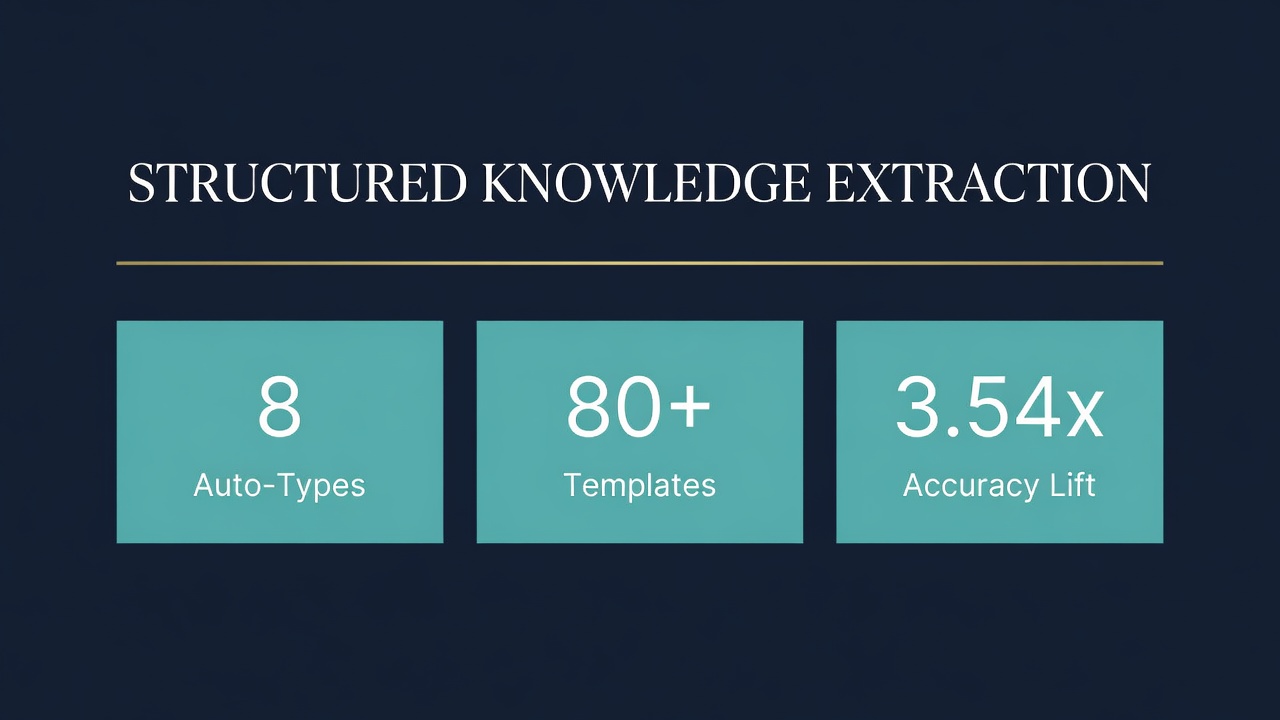
Hyper-Extract transforms any document into one of eight strongly-typed data structures:
- AutoModel - Structured summaries with typed fields
- AutoList - Collections of items (entities, facts, records)
- AutoSet - Deduplicated collections
- AutoGraph - Entity-relationship networks (standard knowledge graph)
- AutoHypergraph - Multi-entity relationships via hyperedges
- AutoTemporalGraph - Time-based relationships
- AutoSpatialGraph - Location-based relationships
- AutoSpatioTemporalGraph - Combined time and space context
The Three-Layer Architecture
Hyper-Extract separates concerns into three layers that can be used independently or combined:
Layer 1: Auto-Types define what structure you want. You pick from eight types based on what your data looks like and what queries you need to run. A biography becomes a graph. A financial report becomes a hypergraph linking companies, executives, metrics, and risk factors.
Layer 2: Methods define how to extract. The framework supports 10+ extraction engines including GraphRAG, LightRAG, Hyper-RAG, KG-Gen, and Cog-RAG. Each has different trade-offs in accuracy, cost, and speed.
Layer 3: Templates provide ready-to-use configurations. 80+ YAML templates cover Finance, Legal, Medical, Traditional Chinese Medicine, Industry, and General domains. No code required. You point the CLI at a document and a template, and it handles the rest.
Key Features That Matter for Business
Incremental Evolution: You can feed new documents to an existing knowledge base without reprocessing everything. This means your knowledge graph grows as new reports, contracts, or records arrive.
Local Deployment: Supports vLLM for fully on-premise processing. Qwen3.5-9B with bge-m3 embeddings runs locally. No data leaves your machine. This is critical for healthcare, legal, and financial use cases where data sovereignty is non-negotiable.
MCP Server Integration: Exposes extracted knowledge to Claude Desktop, IDE agents, and any MCP-compatible tool. Your knowledge base becomes queryable by the AI tools your team already uses.
Obsidian Export: Turns any extracted graph into an Obsidian vault with Markdown notes linked by wikilinks. For teams that live in note-taking tools, this bridges the gap between structured data and human-readable knowledge.
Multi-Provider Support: Works with OpenAI (GPT-4o, GPT-5), Anthropic (Claude Opus, Sonnet, Haiku), Alibaba Bailian (Qwen, DeepSeek-R1), and local vLLM deployments. You are not locked into one provider.
Real-World Use Cases for Australian Businesses
Construction: Site Reports to Structured Data
A construction company generates hundreds of site reports per week: handwritten notes, voice memos, photo annotations, safety incidents. Each contains entities (workers, equipment, locations, materials), temporal data (when things happened), and spatial data (where on site).
Hyper-Extract approach: Feed all reports through a Spatio-Temporal Graph template. The output is a queryable knowledge base where you can ask "What safety incidents involved the crane on Level 3 between March and May?" and get a precise, sourced answer.
- Template: Custom industry template with safety/compliance schema
- Verification: Schema validation on every extracted field
- ROI: Reduces manual report processing from hours to minutes per report
Allied Health: Treatment Records to Knowledge Hypergraphs
Allied health practices maintain detailed clinical notes. Each patient interaction involves multiple entities: patient, clinician, treatment modality, body region, outcome measure, date. These are inherently n-ary relationships that binary graphs cannot represent faithfully.
Hyper-Extract approach: Use the AutoHypergraph type with a custom medical template. Each treatment session becomes a hyperedge connecting all relevant entities. The practice can then query outcomes across patients, treatments, and time periods with full context preserved.
- Template: Medical domain template
- Deployment: Local vLLM for privacy compliance
- ROI: Enables outcomes-based research and reporting that was previously manual
Professional Services: Contract Analysis at Scale
Law firms and consulting practices process thousands of contracts. Each contains parties, obligations, deadlines, jurisdictions, risk clauses, and financial terms. Extracting these into a structured format enables contract comparison, risk auditing, and deadline tracking.
Hyper-Extract approach: Use the Legal domain template with AutoGraph or AutoHypergraph for multi-party contracts. The extracted knowledge base links every clause to its source document, enabling instant retrieval of "all contracts with automatic renewal clauses over $50,000 in NSW jurisdiction."
- Template: Legal domain template
- Method: GraphRAG or KG-Gen for high-accuracy extraction
- ROI: Contract review time reduced by 70-90%
Financial Services: Earnings Reports to Risk Graphs
Investment firms analyse earnings reports, ASX filings, and regulatory disclosures. Each document contains companies, executives, financial metrics, risk factors, and forward-looking statements with complex interdependencies.
Hyper-Extract approach: Use the Finance/earnings_graph template. Extract a hypergraph where a single hyperedge connects a company, its revenue figure, the risk factors cited, the executive who referenced them, and the quarter reported. This preserves the full context that a simple entity list would lose.
- Template: Finance/earnings_graph
- Output: Queryable risk-factor graph across the ASX
- ROI: Analysts query relationships, not just keywords
How Hyper-Extract Compares to Other Tools
- GraphRAG: Supports knowledge graphs and temporal graphs. No hypergraph support. No domain templates. No CLI tool.
- LightRAG: Knowledge graphs only. No temporal, spatial, or hypergraph. No templates.
- KG-Gen: Knowledge graphs only. Research-focused, no production tooling.
Hyper-Extract is the only framework that supports all of: Knowledge Graphs, Temporal Graphs, Spatial Graphs, Hypergraphs, domain-specific templates, an interactive CLI, and multi-language extraction. This is not a marginal improvement. It is a category-defining tool.
The Strategic Implication: Structured Extraction Is the New ETL
For two decades, businesses built ETL pipelines (Extract, Transform, Load) to move structured data between systems. The data was already structured; the challenge was format conversion and schema mapping.
LLM-powered structured extraction is the new ETL for unstructured data. The input is a PDF, an email, a voice transcript. The output is typed, queryable, schema-conformant data that integrates directly with your existing databases, data warehouses, and business intelligence tools.
This changes the economics of knowledge work:
- Documents become databases: Every contract, report, and record becomes a queryable data source
- Domain expertise scales: A clinician's knowledge is encoded in extraction templates, not re-learned by every new analyst
- Compliance becomes automated: Schema validation on extraction means every output is auditable and traceable to its source
- Local deployment is viable: Open-source models on a single GPU can handle most extraction tasks without cloud costs
The businesses that adopt structured extraction first will have a compounding advantage: cleaner data, faster insights, and knowledge bases that grow smarter with every document processed.
Getting Started with Hyper-Extract
If you want to try it:
# Install the CLI
uv tool install hyperextract

# Configure your API key (OpenAI, Anthropic, or Bailian)
he config init -k YOUR_API_KEY

# Extract a knowledge graph from any document
he parse document.pdf -t general/academic_graph -o ./output/

# Query the extracted knowledge
he search ./output/ "What are the key findings?"

# Visualize the graph
he show ./output/

# Export to Obsidian vault
he export obsidian ./output/ -o ./vault/
The framework is Apache-2.0 licensed, security-assessed by MseeP.ai, and actively maintained with regular releases.
Repository: github.com/yifanfeng97/Hyper-Extract Documentation: yifanfeng97.github.io/Hyper-Extract PyPI: pypi.org/project/hyperextract
The Takeaway for Business Leaders
The ability to convert unstructured text into structured, queryable knowledge is no longer a research project. It is a production-ready capability with open-source tooling, domain templates, and proven results across industries.
The question is not whether your business has unstructured data. It does. The question is whether you are letting it sit in folders and inboxes, or turning it into a competitive asset.
Structured knowledge extraction is how you turn documents into databases. Hypergraphs are how you preserve the relationships that make that data actually useful. And frameworks like Hyper-Extract are how you do it without a team of data scientists.
Start with one document type. Pick a template. Run one command. See what comes out.
Want to see how structured extraction could work for your business? Get in touch with Flowtivity for a prototype built on your real data.
Research referenced: HyperGraphRAG (NeurIPS 2025, arXiv:2503.21322); HyperG: Hypergraph-Enhanced LLMs for Structured Knowledge (SIGIR 2025, arXiv:2502.18125); Hyper-Extract by Yifan Feng (GitHub).
What's actually useful in AI, every Friday
We follow everything happening in AI and send what's worth your time: new models, AI agents, and how to put them to work. One email a week, unsubscribe anytime.


