
On this page
Last Updated: 22 September 2026
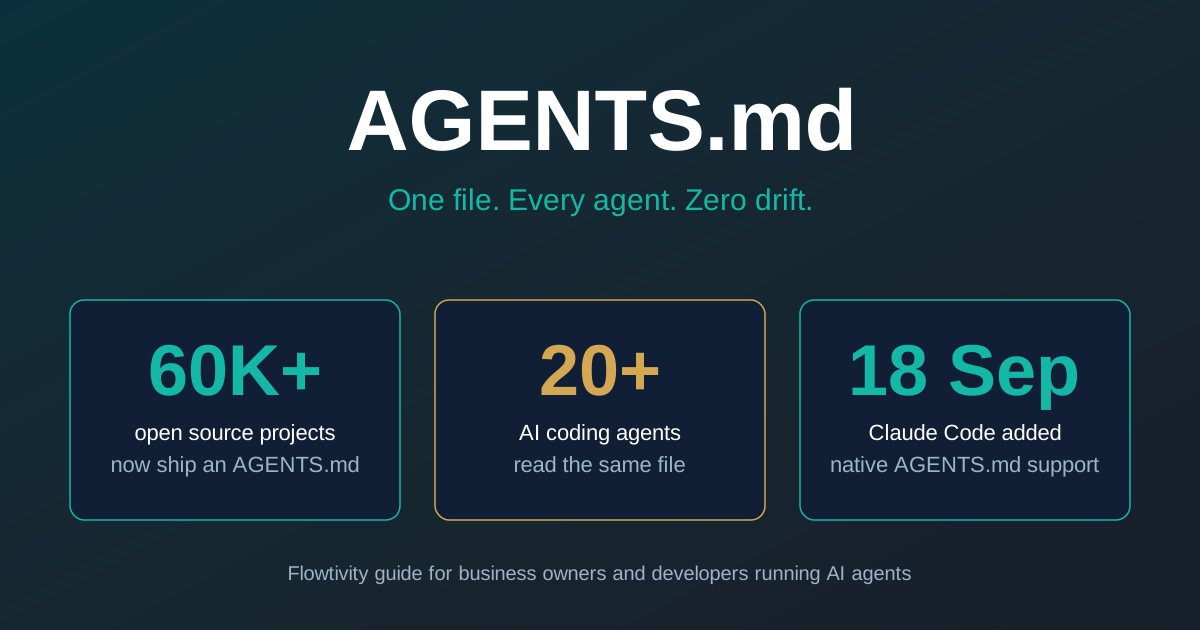
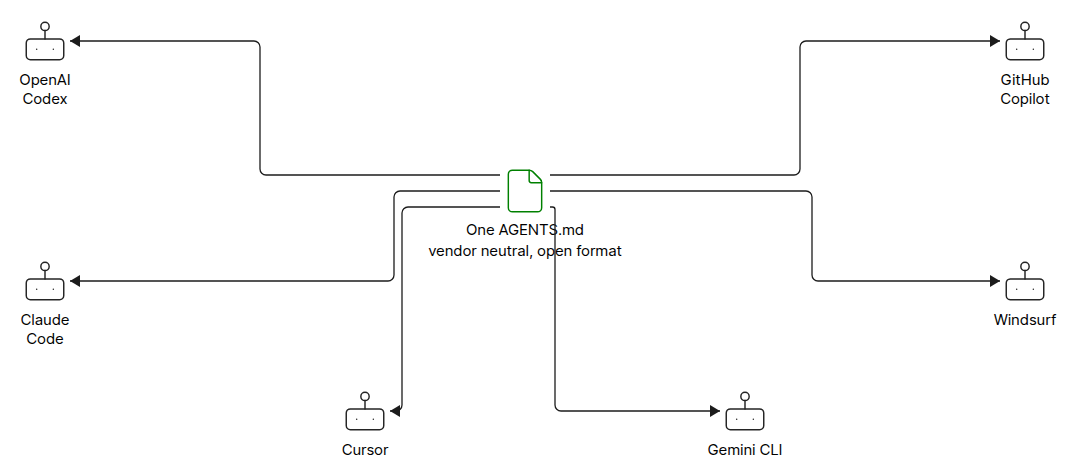
Yes, your business needs one AGENTS.md file, and the case just got stronger. On 18 September 2026, Claude Code became the latest major coding agent to read AGENTS.md, so the same open rulebook now governs OpenAI Codex, Claude Code, Cursor, GitHub Copilot and Gemini CLI. According to the AGENTS.md specification site, more than 60,000 open source projects already ship one, and it is a README for agents: a predictable place that tells any AI agent how to build, test and behave in your codebase. For a business running several agent tools, one file replaces the pile of vendor-specific instruction files, and it is the cheapest guardrail you can buy, about 15 minutes of writing for consistent agents and far fewer rogue actions.
What Is AGENTS.md and Why Does It Matter?
AGENTS.md is a simple, open format for guiding coding agents. It is a plain markdown file at your repository root that holds setup commands, code style rules, testing instructions and PR conventions, and nearly every mainstream coding agent now reads it, which means one file can control the behaviour of your whole agent fleet.
Think of it as a README for agents. A README explains a project to humans. AGENTS.md explains it to the machines that write code for you. According to the specification site, the format was created as a neutral alternative to proprietary files: "Rather than introducing another proprietary file, we chose a name and format that could work for anyone." That decision is why adoption exploded. Codex from OpenAI, Jules from Google, Cursor, GitHub Copilot, Gemini CLI, Windsurf, Devin, Junie from JetBrains, Aider, opencode and more than 20 tools in total read the same file.
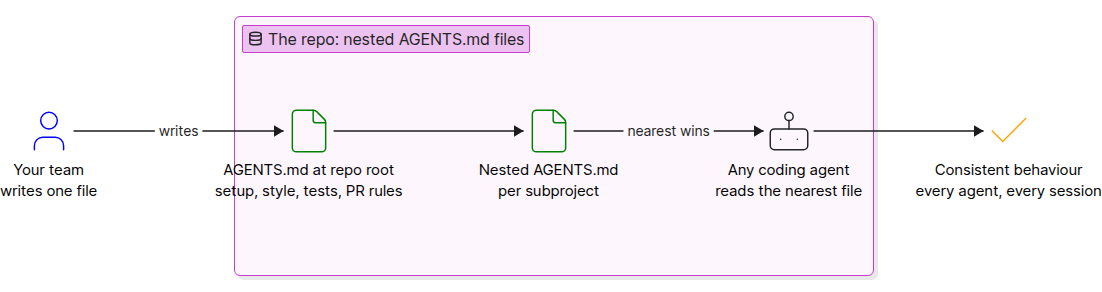
The spec also describes nested files. You can drop an AGENTS.md inside any subproject, and agents read the nearest one. The closest file takes precedence, so subproject rules stay close to the code they govern.
What Changed on 18 September 2026?
Anthropic shipped AGENTS.md support in Claude Code version 2.1.277 on 18 September 2026, announced by Claude Code team member Thariq. If a folder has no CLAUDE.md, Claude Code now checks for and uses AGENTS.md instead, so teams finally have one instruction file that works across Anthropic, OpenAI and Google tools.
This was the last big holdout. Claude Code is the most popular agent harness in the world, and it already had CLAUDE.md, its own instruction file. For months, teams running Claude Code, Cursor and Codex side by side maintained two or three overlapping rulebooks that drifted out of sync. According to explainx.ai's analysis of the release notes, the change is a small, practical fix for that real annoyance. The detail matters: according to the change log coverage from runtimewire, the behaviour is a fallback, not a replacement. If CLAUDE.md exists, it still wins. If it does not, AGENTS.md runs the show.
For business owners this is the signal to consolidate. The vendor files can stay for the vendor that needs them, but your single source of truth can now be one open file that every agent reads.
What Should Your AGENTS.md Contain?
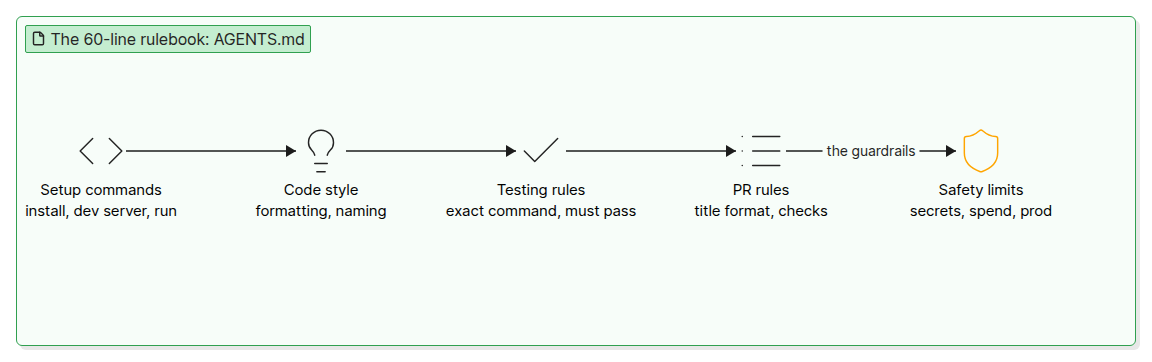
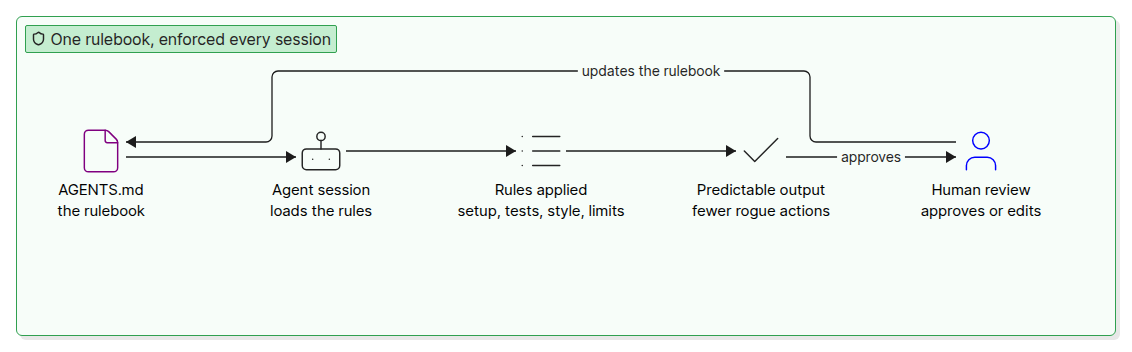
Five sections cover 90 percent of the value: setup commands, code style, testing instructions, PR rules and safety limits. Keep the file under 100 lines, keep every command copy-pasteable and keep the limits explicit, because the agent reads them at the start of every session and will follow them exactly as written.
Here is the skeleton we use with clients:
- Setup commands: install dependencies, start the dev server, run the app.
- Code style: language mode, formatting, naming, what not to touch.
- Testing instructions: the exact test command, the lint command, and the rule that nothing merges unless the suite is green.
- PR instructions: title format, required checks, reviewer expectations.
- Safety limits: no secrets, no production data, no unauthorised deploys, spend caps for agents that pay for tokens.
That last section is where the guardrails live, and it is the reason this file matters for business owners as much as developers. Every agent that charges by the token in your account, and every agent with write access to your repos, is now bound by a rulebook you can edit in one place.
How One File Stops Rogue Agents
An instruction file is your cheapest control surface. When every agent session starts by reading the same rulebook, drift between agents disappears, and the limits you set are enforced before the agent acts rather than after it breaks something. That is what a guardrail is: a rule applied at the start of every run.
Our own setup is a live example. At Flowtivity, our workspace ships a single AGENTS.md that defines the startup ritual, the memory convention and the safety rules for every session. We run multiple agent harnesses against our dual DGX Spark stack serving DeepSeek V4 Flash at roughly 60 tokens per second, and each harness reads the same file before it does anything. Consistency across tools is not a project, it is a byproduct.
The stakes are real. According to OpenAI's model guidance for its API, models can be more sensitive to instructions contained in files such as AGENTS.md, and OpenAI explicitly recommends auditing skills and other files accessible to your model for instructions that could influence its behaviour. That cuts both ways: the same instruction channel that stops an agent from deploying to production can, if left unwatched, be the channel that gets hijacked. Keep the file short, keep it yours and review it like code.
AGENTS.md vs CLAUDE.md vs .cursorrules
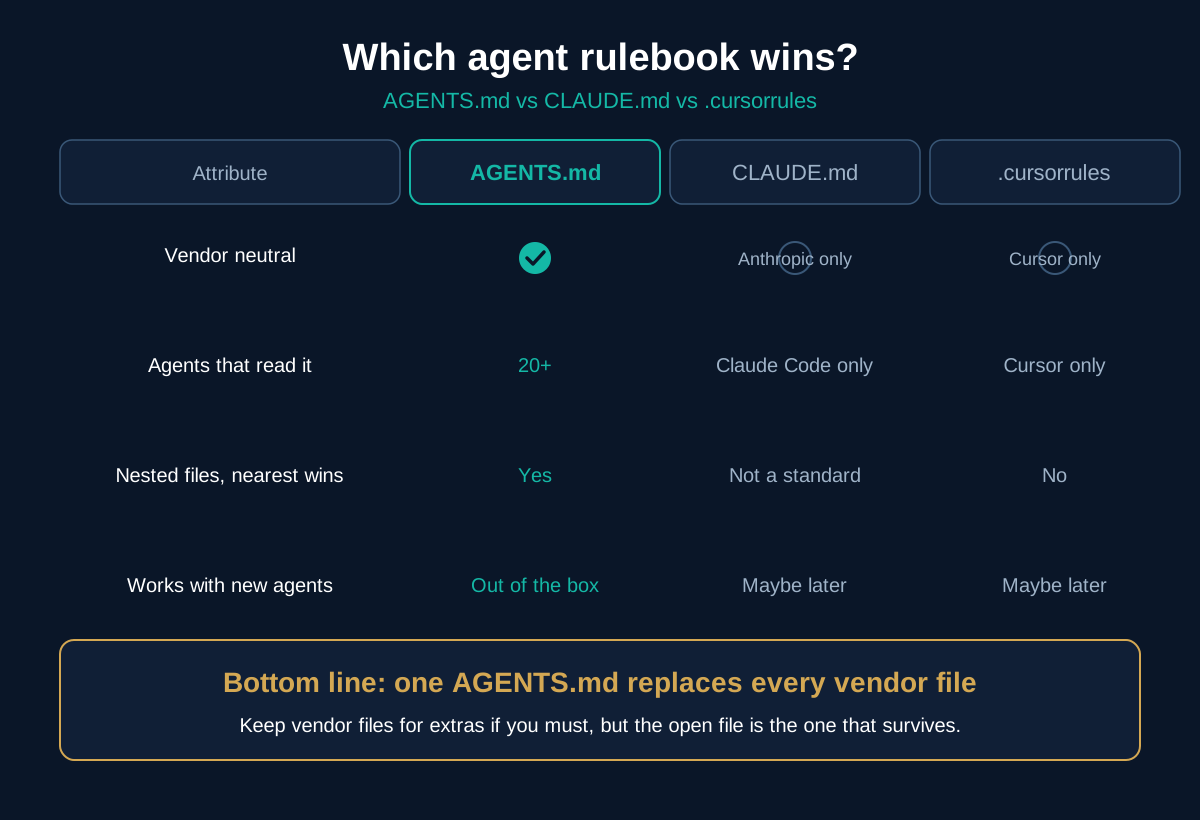
AGENTS.md wins on portability, and the vendor files win on nothing except depth inside their own tool. If you run more than one coding agent, the open file is the only one worth maintaining. CLAUDE.md still wins inside Claude Code when both files exist, but the vendor file adds nothing a well written AGENTS.md cannot carry.
| Attribute | AGENTS.md | CLAUDE.md | .cursorrules |
|---|---|---|---|
| Vendor neutral | Yes, open format | Anthropic only | Cursor only |
| Agents that read it | 20+ | Claude Code | Cursor |
| Nested files, nearest wins | Yes | Not a standard | No |
| Works with new agents | Out of the box | Maybe later | Maybe later |
| Survives vendor switch | Yes | No | No |
Should Your Business Adopt AGENTS.md?
Adopt it if you run more than one coding agent, and it takes about 15 minutes. The file costs nothing, it is read by every major tool and it turns inconsistent agent behaviour into a solved problem while local and cloud models churn underneath. The only maintenance is keeping the commands in it current.
The practical case is simple. Agent tools change every quarter. Models change every quarter. A plain markdown instruction file that every harness agrees to read does not change unless you change it. In our client work, the file becomes the onboarding doc too: a new developer or a new agent starts from the same 60 lines. If you are building with local AI on your own hardware, the same file governs your locally hosted models, so the rulebook follows the workload, not the vendor.
Start small, and start today. Write the file, commit it, then watch the same setup run through Codex, Claude Code and Cursor without a single instruction rewrite.
Frequently Asked Questions About AGENTS.md
AGENTS.md is an open instruction file read by 20+ agents, Claude Code joined on 18 September 2026, it beats vendor files on portability, it works with the local models you host yourself and nested files give subprojects tailored rules while the root file holds company-wide ones. The short answers are below, with the nuance for each.
One email a month, no noise
Practical AI notes for Australian businesses. Unsubscribe anytime.


