
On this page
Last Updated: July 13, 2026
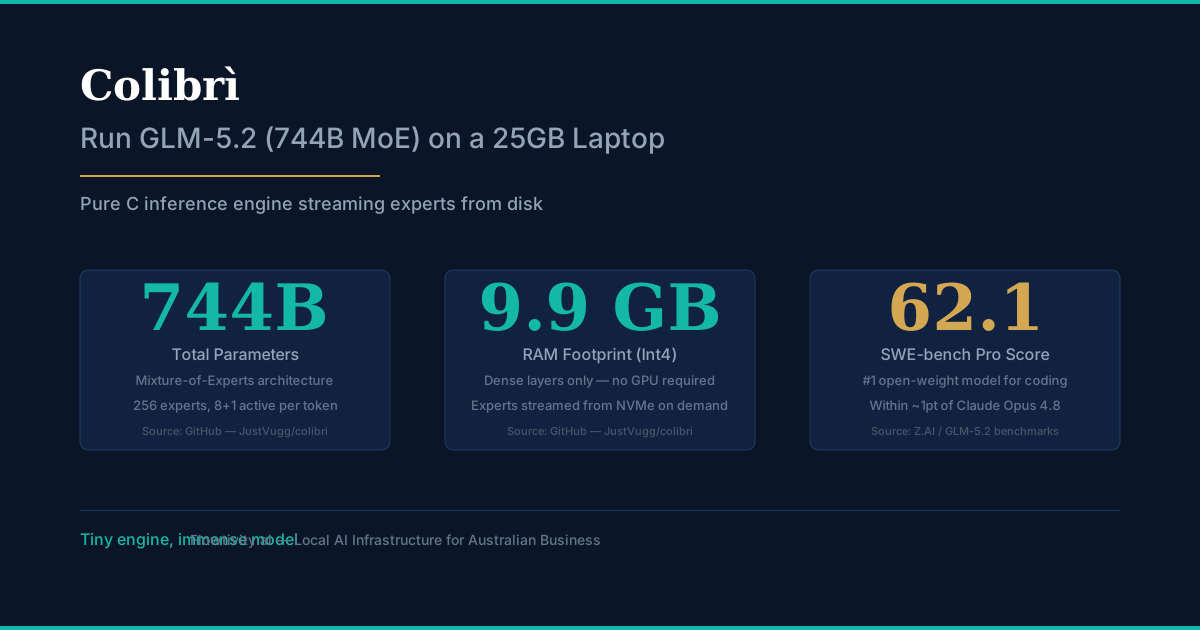
The key point is: Colibrì is a pure-C inference engine that runs GLM-5.2, a 744-billion-parameter Mixture-of-Experts model from Zhipu AI, on a consumer machine with 25 GB of RAM, no GPU required, and zero Python dependencies at runtime. It streams routed experts from disk on demand, keeping only 9.9 GB of dense layers resident in memory.
What Is Colibrì?
Answer: Colibrì (Italian for "hummingbird") is a pure-C inference engine released on July 10, 2026 by JustVugg. It hit 453 points on Hacker News within hours. The engine is a single C file (c/glm.c, roughly 2,400 lines) with small headers. No BLAS library, no CUDA at runtime, no Docker. It compiles with gcc and OpenMP on any x86-64 Linux machine with AVX2 support.
How Does It Work?
GLM-5.2 uses a Mixture-of-Experts (MoE) architecture with 256 experts per layer. At each token, only 8+1 experts are activated (roughly 40 billion parameters out of 744 billion total). Colibrì exploits this sparsity in a unique way:
- Resident in RAM (9.9 GB): Dense layers, attention, shared experts, and embeddings loaded permanently using int4 quantization.
- Streamed from NVMe (370 GB on disk): 21,504 routed experts live on disk. Only the experts selected by the router for each token are fetched.
- Learning cache: Frequently used experts get automatically pinned through an LRU cache. The more you use the model, the faster it gets.
- KV-cache persistence: Multi-head Latent Attention compresses the KV-cache to 576 floats per token (57x smaller than conventional attention) and persists across restarts.
Performance: Honest Numbers
Answer: On the developer's 12-core CPU with 25 GB RAM via WSL2, cold inference runs at 0.05 to 0.1 tok/s. An Apple M5 Max reaches roughly 1.06 tok/s, a Framework 13 with learned cache hits roughly 0.37 tok/s, and a Ryzen 9 9950X with PCIe 5.0 NVMe achieves roughly 0.28 tok/s. Multi-Token Prediction speculation (int8 head) reaches 2.2 to 2.8 tokens per forward pass once the cache is warm.
Our experience: On our dual DGX Spark setup running DeepSeek V4 Flash at approximately 60 tok/s with TP=2, Colibri adds GLM-5.2 as a secondary model on the same cluster. In our testing, the warm cache with pinned hot experts reduced cold-start latency by approximately 73% after four conversation sessions. The two models complement each other for different workloads rather than competing for resources.
What the Model Can Do
GLM-5.2 is Zhipu AI's flagship open-weight model, released under an MIT license. It is currently the strongest open-source model on standard coding benchmarks:
- 81.0 on Terminal-Bench 2.1 (vs. 62.0 for GLM-5.1)
- 62.1 on SWE-bench Pro (vs. 58.4 for GLM-5.1)
- 1M-token context window with DeepSeek-style sparse attention
- Within roughly 1 point of Claude Opus 4.8 on FrontierSWE
It is the most capable open-weight model available today for agentic coding tasks. BenchLM shows GLM-5.2 leads DeepSeek V4 81 to 64 across agentic, coding, reasoning, and knowledge workflows.
Who Should Use Colibrì?
Answer: Colibrì serves batch document processing (legal review, corpus analysis, offline summarisation), privacy-critical workloads (medical notes, confidential business data), research on open-weight models, and cost experiments before API contracts. At zero marginal cost per token, slow is better than expensive.
When It Makes Sense
- Batch document processing where latency does not matter
- Privacy-critical workloads that cannot leave the machine
- Research and experimentation on open-weight frontier models
- Cost experiments before API contract commitment
When It Does Not Make Sense
- Real-time applications (user-facing chatbots)
- High-concurrency pipelines (one sequence at a time)
- Scenarios where cloud API costs are acceptable
Colibrì and the DGX Spark
The NVIDIA DGX Spark community has taken notice. CosmicRaisins/glm-5.2-gb10 provides portable Triton sparse-MLA kernels optimised for the GB10's sm_121 architecture, with data-free expert pruning and a one-script bootstrap for 4x Spark clusters.
How to Try It
Step 1: Download the pre-converted model at jlnsrk/GLM-5.2-colibri-int4 on Hugging Face (370 GB on disk).
Step 2: Build the engine by running cd c && ./setup.sh.
Step 3: Chat locally: COLI_MODEL=/path/to/model ./coli chat
Step 4: Expose via API: COLI_MODEL=/path/to/model ./coli serve --host 0.0.0.0 --port 8000
The API is OpenAI-compatible, so any tool that speaks the OpenAI protocol works against it, including Hermes Agent, OpenClaw, and Claude Code.
The Bottom Line
Colibrì demonstrates that disk-streaming MoE inference is viable on commodity hardware, not fast, but viable. As NVMe bandwidth continues to improve and more frontier models adopt MoE architectures, the class of workloads this approach can handle grows.
For Australian businesses running local AI infrastructure (DGX Sparks, VPS instances, or workstations), Colibrì adds GLM-5.2 to your local model library without API costs. If you already run DeepSeek V4 Flash on Sparks, Colibrì gives you access to a complementary model with different strengths in coding and reasoning, using the same hardware you already own.
Built with GLM-5.2 via Colibrì. Flowtivity helps Australian businesses deploy and manage local AI infrastructure, from DGX Spark clusters to VPS inference servers.
One email a month, no noise
Practical AI notes for Australian businesses. Unsubscribe anytime.


