On this page
Last Updated: August 21, 2026
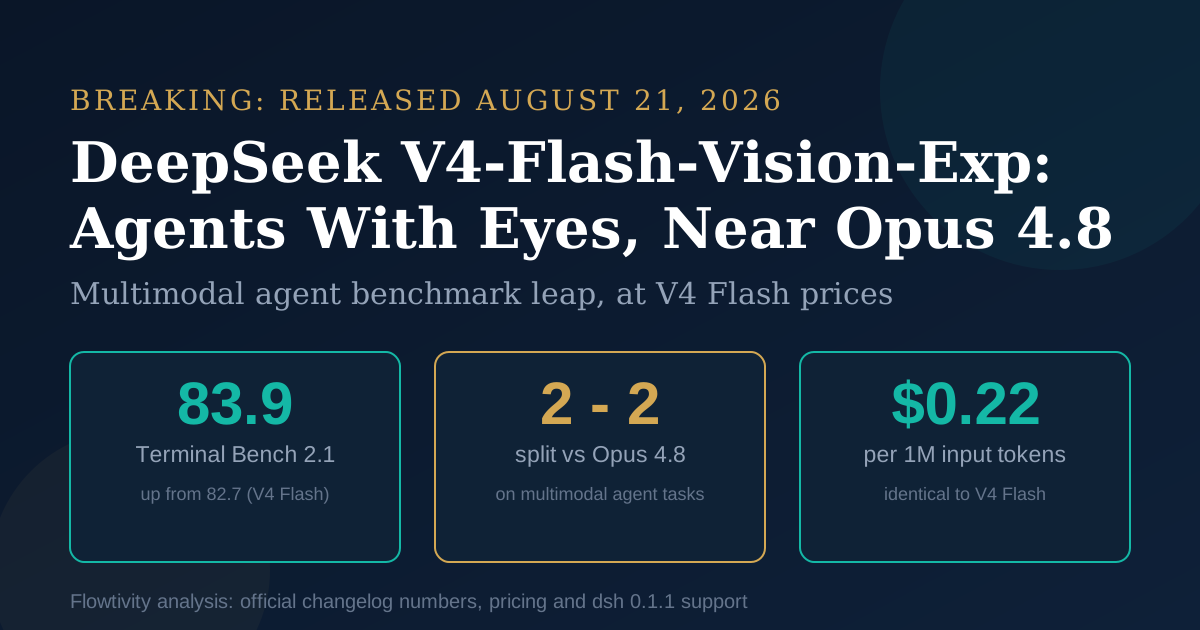
DeepSeek just gave its bargain agent model eyes, and the timing is wild: one day after we shipped a Fireflies.ai clone with text-only V4 Flash on the dsh harness, the company released DeepSeek-V4-Flash-Vision-Exp, an experimental multimodal model that keeps V4 Flash's text skills and adds image understanding. According to DeepSeek's official changelog dated August 21, 2026, the model scores 83.9 on Terminal Bench 2.1, 59.3 on DeepSWE and 63.6 on DSBench-Hard, and on agent benchmarks that require visual understanding it lands "close to Opus-4.8". The pricing page shows it costs the same as V4 Flash: $0.22 per 1M input tokens off-peak, with a 1M token context and 2500 concurrent requests allowed. Here is what the numbers actually say, and what it means if you run agents.
What Is DeepSeek-V4-Flash-Vision-Exp?
V4-Flash-Vision-Exp is an experimental vision-language model on the DeepSeek API platform, called with model='deepseek-v4-flash-vision-exp', that matches V4-Flash on text and adds image input. According to the official changelog, pure-text capabilities for agents, reasoning and world knowledge are "on par with the official DeepSeek-V4-Flash", and the leap shows up specifically on agent benchmarks that require visual understanding. It supports thinking mode, tool calls, JSON output, the Responses API and even the Anthropic-compatible API endpoint, with a 1M token context and up to 384K output tokens. The only feature gap versus its text sibling: FIM completion is not supported. At launch it is an API-platform release; no separate open-weights download was announced, which matters if you were hoping to run it on local hardware like our dual DGX Spark setup.
The Benchmarks: A Text Model That Now Sees
Across every public benchmark in the changelog, Vision-Exp beats the text-only V4-Flash-0731 checkpoint it descends from, and closes most of the remaining gap to Opus 4.8. The biggest movers are agentic coding and multimodal tasks: DeepSWE jumps from 54.4 to 59.3 and NL2Repo from 54.2 to 57.7. According to DeepSeek's changelog methodology note, the code-agent text tasks were run using the DeepSeek Harness minimal mode at max effort with topp=0.95 and temperature=1.0, which is a refreshingly reproducible setup for a vendor benchmark.
| Benchmark | V4-Flash-0731 (text) | V4-Flash-Vision-Exp | Change |
|---|---|---|---|
| Terminal Bench 2.1 | 82.7 | 83.9 | +1.2 |
| NL2Repo | 54.2 | 57.7 | +3.5 |
| DeepSWE | 54.4 | 59.3 | +4.9 |
| DSBench-Hard | n/a | 63.6 | new |
| AutomationBench (Public) | n/a | 25.7 | new |
| ApexBench (Pass@1) | n/a | 36.5 | new |
| Agents' Last Exam | n/a | 27.3 | new |
| Chartography | n/a | 64.3 (p0.95) / 63.3 (p1.0) | new |
| ZeroBench (Pass@5) | n/a | 35.0 | new |
The comparison everyone actually wants is against Anthropic's Opus 4.8, released May 28, 2026. On Terminal Bench 2.1, Vision-Exp's 83.9 sits just under Opus 4.8's 85.0. On DeepSeek's published multimodal agent comparison, the two models split 2-2 across four tasks: Opus takes CyberGym, the DeepSeek model takes Toolathlon. "Close to Opus 4.8" is marketing, but a 2-2 split on vision agent tasks at a tenth of the price is engineering. For deeper background on why Flash's benchmark profile was already punching above its weight, see our earlier breakdown of the V4-Flash agent benchmarks that beat its own Pro model.
Pricing: Frontier Eyes at Flash Prices
According to DeepSeek's pricing page, Vision-Exp is billed identically to V4-Flash: $0.22 per 1M input tokens off-peak ($0.44 peak) on cache miss, $0.007 to $0.014 on cache hit, and $0.66 to $1.32 per 1M output tokens. Peak hours are 01:00 to 04:00 and 06:00 to 10:00 UTC; everything else is off-peak, meaning Australia's business day largely lands in the cheap window. Images are converted into tokens based on their dimensions and billed as input tokens together with your text. The concurrency limit is 2500, five times the 500 allowed on V4 Pro.
| Feature (per DeepSeek pricing page) | V4-Flash | V4-Flash-Vision-Exp | V4-Pro |
|---|---|---|---|
| Input, cache miss (off-peak / peak per 1M) | $0.22 / $0.44 | $0.22 / $0.44 | $0.66 / $1.32 |
| Output (off-peak / peak per 1M) | $0.66 / $1.32 | $0.66 / $1.32 | $1.98 / $3.96 |
| Context / max output | 1M / 384K | 1M / 384K | 1M / 384K |
| Image input | No | Yes | No |
| Concurrency limit | 2500 | 2500 | 500 |
For scale: an Opus-class frontier model typically runs $5 to $15 per 1M input tokens. Vision agents that screenshot their way through workflows burn a lot of input tokens, so the price per screenshot matters more than the price per word.
What It Means for the dsh Harness
DeepSeek Harness v0.1.1-rc.1 shipped the same day with out-of-the-box support, so dsh agents can see from day one. According to the v0.1.1-rc.1 release notes, the DeepSeek adapter adds the new model, and the release also lands a genuinely important security fix: confined processes can no longer escape Bubblewrap sandbox restrictions through /proc/pid/root. Smaller touches include multiline answers for ask_user_question, more precise cache-hit display at 99.x%, and responsive Markdown tables. This builds on v0.1.0-rc.8 from August 19, which already added native image requests so commands like /goal and /plan can take image input, plus Claude Code and Codex subagents as installable profile bundles.
Here is the personal part. Yesterday I ran a 46 minute dsh session where V4 Flash built a Fireflies.ai clone as a Cordis plugin in 109 steps, all text, all terminal. The moment a model like that gains vision, the same harness can read dashboards, interpret UI screenshots and drive visual workflows, not just parse logs. "It's the AI cheat code," says AJ Awan, founder of Flowtivity, describing the dsh plus V4 Flash stack; the vision variant extends that from coding agent to general operator. We documented that session in our dsh personal experience report, and it is the clearest preview of why this release matters: the harness layer is already built for images.
How to Use V4-Flash-Vision-Exp
Call it through any OpenAI-compatible client pointed at https://api.deepseek.com, with images passed as content blocks. Three input methods are supported according to the Vision guide: base64 data URLs for local files, public https URLs (max 8192 characters, 32 MiB per image, 60 second fetch window), or the Files API for uploads you reuse. The minimal Python looks like this:
from openai import OpenAI

client = OpenAI(api_key="YOUR_KEY", base_url="https://api.deepseek.com")

r = client.chat.completions.create(

  model="deepseek-v4-flash-vision-exp",

  messages=[{"role": "user", "content": [

    {"type": "text", "text": "What is in this image?"},

    {"type": "image_url", "image_url": {"url": "https://example.com/shot.png"}}

  ]}])
Supported formats are JPEG, PNG, GIF and WebP, detected from file content rather than the file name, and the total request body limit is 48 MiB. If you already run Claude Code, GitHub Copilot or OpenCode, DeepSeek's docs note these tools can use DeepSeek as a backend model directly, no code required.
Should You Switch Your Agents to It?
If your agents only touch text and code, stay on deepseek-v4-flash; if they touch screens, charts or documents, Vision-Exp is now the best value multimodal agent API we have tested numbers for. The caveats are real: it is explicitly experimental, FIM completion is unsupported, and there is no open-weights release yet, so our DGX Spark boxes stay on the text model for now. But the direction is unmistakable. In our own stack we already treat the model layer as a per-job choice, running GLM-5.3 for operations (see GLM-5.3 vs DeepSeek V4 Pro) and V4 Flash for local builds. Vision-Exp adds a third lane: visual computer-use agents at $0.22 per 1M input tokens. That is the kind of pricing where you stop prototyping multimodal agents and start scheduling them.
For the full harness landscape this lands in, including how dsh's everything-is-a-plugin approach stacks against TrueForge and Claude Managed Agents, see our harness comparison. And if you want a multimodal agent workflow built around your business, that is exactly what we do: book a discovery call with Flowtivity.
One email a month, no noise
Practical AI notes for Australian businesses. Unsubscribe anytime.