
On this page
Last Updated: September 21, 2026
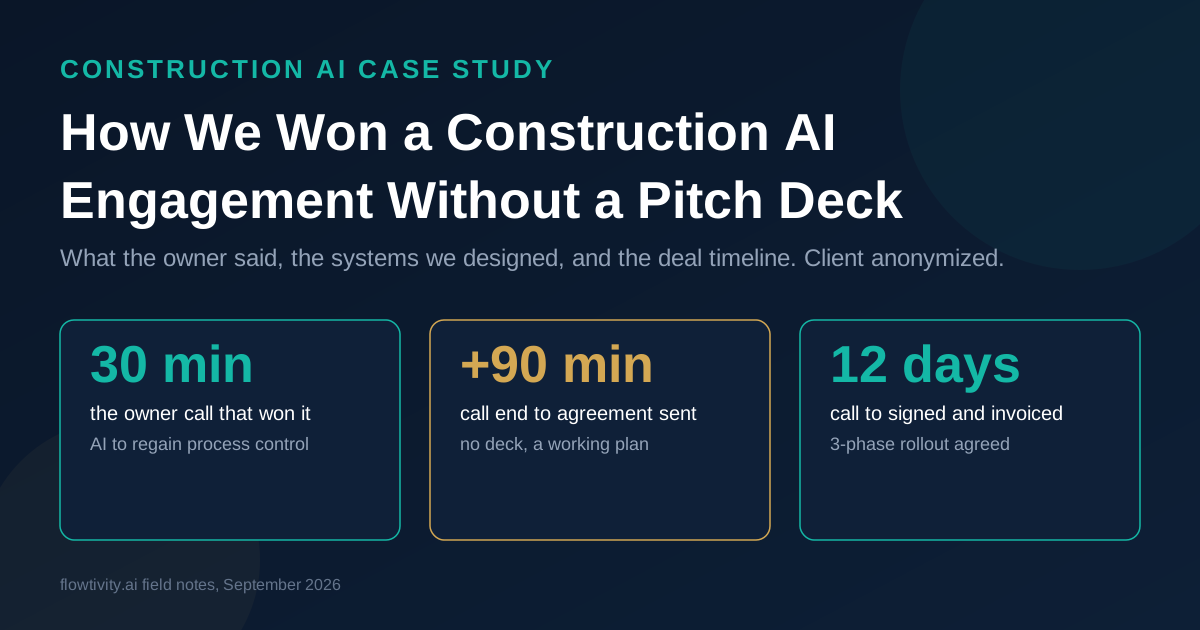
Twelve days ago we sat in a 30-minute call with the owner and finance lead of an established Australian building company. Last night the signed agreement came back, the amendment was confirmed and the kickoff invoice went out in the same hour. No pitch deck was opened at any point in the deal. According to our AI notetaker's recap of that call, 39 questions were asked and 12 action items were detected in 30 minutes, and the agreement went out 90 minutes after the call ended. What actually won the work was not persuasion. It was a shared framing of what AI is for, a phase-one system the staff could veto, and a plan that named its own risks. This is the anatomy of that deal, with the client anonymized, because the playbook matters more than the name.
What the owner said in the room
The owner of a building company that has survived decades of construction cycles does not get excited by demos. They get excited by control. Four positions from that recorded conversation shaped everything that followed, and we paraphrase them from the meeting notes. First, AI is a tool to regain process control: the goal was not fewer staff but a tighter grip on a business that had outgrown its spreadsheets. Second, the point of automation is to lift mundane tasks off people, so staff spend their time where judgment matters. Third, the team could handle roughly ten times the volume of repetitive work with AI drafting and staff overseeing the outputs. Fourth, and this is the line we keep coming back to, cultural acceptance decides whether any of it works. Technology that the team rejects is shelf-ware with an invoice attached.
None of that is the standard AI buyer persona of 2026. No headcount reduction math, no futuristic roadmap. According to the meeting recap, the conversation spent more time on process control and staff workload than on model choice, which is exactly the right order to build a business on.
The system: an agent that drafts, never sends
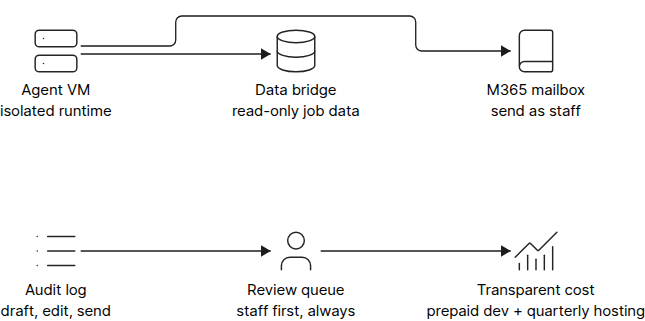
The phase-one system is a client update agent, and its entire logic fits one sentence: read the job data, draft the status email, hand it to a human. The agent connects to the company's job management platform through a secured, read-only bridge, assembles each client's stage, schedule and site notes into a plain-language update, and drops the draft into a staff review queue. Staff approve, edit or reject. Approved emails go out through the staff member's own Microsoft 365 mailbox, so the client experiences a person, not a bot.
The design rule that made the owner comfortable is the veto. The AI never sends. A malformed or wrong status update is impossible to ship without a human pressing the button, which converts the scariest AI failure mode into a queue item somebody deletes. That single control did more for deal velocity than any capability list could.

How we de-risked it before asking them to sign
Construction companies sign things when the risks are named. The integration landscape here has a supported side and an unsupported side: the job management platform exposes a proper REST API, while parts of the estimating and data build have no formal support at all. We put that split in writing, scoped phase one to run on the supported surface, and carried the unsupported parts as a managed risk with process controls around them. That is the EY-trained habit: an architecture is not finished until its failure modes have names.
| Risk | How we handled it | Why it mattered |
|---|---|---|
| AI sends a wrong update to a client | Human review queue on every draft, no direct send path | Converts the worst failure into a deleted queue item |
| Source system corruption | Read-only data bridge, agents cannot write back | The job management platform stays the single source of truth |
| Agents touching the client network | Isolated virtual servers, separate from company infrastructure | Blast radius of any agent fault stays outside the business |
| Cost surprises after signing | Prepaid development plus quarterly hosting, no per-email metering | Usage growth does not grow the bill |
| Unsupported data interfaces | Scoped to supported APIs first, process controls on the rest | Phase one stands on solid ground, risk is deliberate |
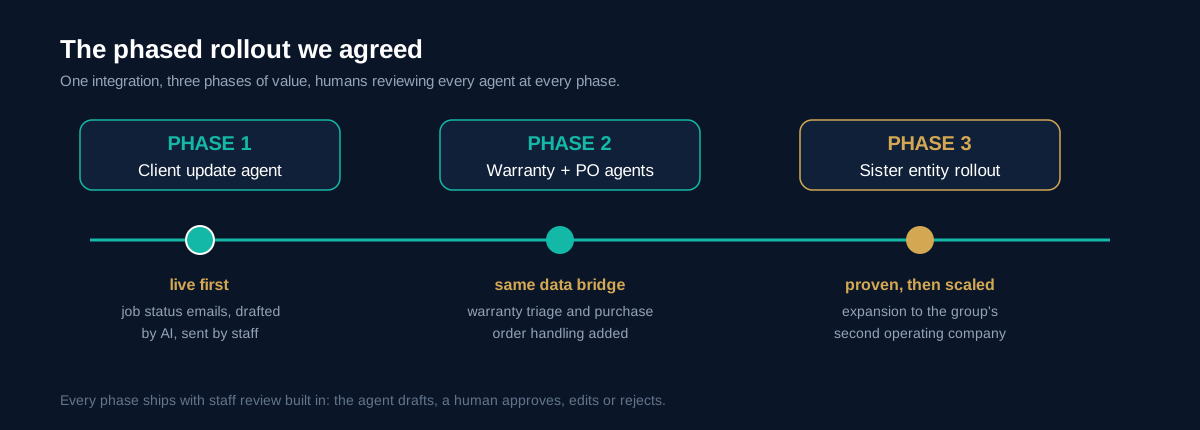
The phased rollout: one bridge, three phases of value
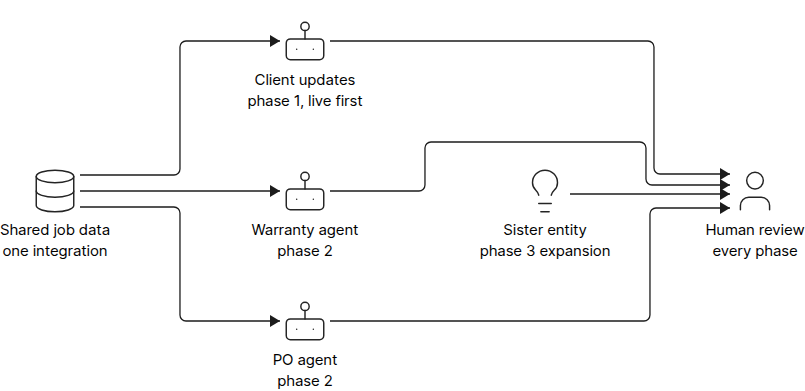
The rollout plan agreed on the call is deliberately boring in the best way. Phase one ships the client update agent and nothing else, because client communication is where the pain is sharpest and the proof is fastest. Phase two adds warranty triage and purchase order agents on the same data bridge, so the integration is built once and every new agent is incremental. Phase three extends the proven stack to the group's sister entity. Every phase carries the same control: the agent drafts or recommends, a human decides. Phasing caps the cost of being wrong and lets trust compound on evidence instead of promises.
How the deal actually closed
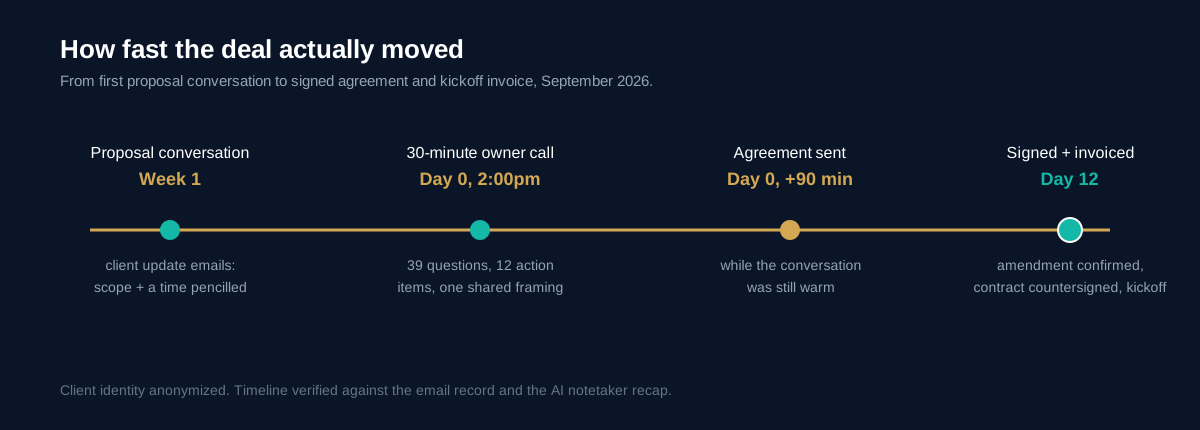
The timeline is the quiet showpiece of this engagement. A proposal conversation in week one pencilled a time. The 30-minute owner call happened on day zero at 2:00pm. The agreement was sent at 3:54pm the same afternoon, 90 minutes after the call ended, because the scope was already concrete enough to paper. Day twelve brought the signed agreement back, we amended one commercial term for tax reasons, and the client's reply was three words: amend is fine. The countersigned contract and the kickoff invoice went out within the hour. According to the email record, the entire deal from owner conversation to invoiced engagement took twelve days, and the fastest-moving part was the client, not us.
Four lessons for selling AI to established companies
Strip the specifics and the playbook generalizes. One: lead with a boring process win, a status email, not transformation. Boring is budgetable. Two: put the veto in the staff's hands by design, not as a concession. The owner's cultural acceptance point is won or lost in the review queue. Three: phase the value and name the exit. A plan that can stop after phase one without wreckage is a plan an owner can sign in one meeting. Four: speed of follow-through is the pitch. The agreement arriving while the conversation was still warm said more about what working with us would feel like than any credential could.
There is also a lesson about what not to do. We did not lead with model choice, agent counts or benchmarks. The meeting spent its 39 questions on process, people and control, and the systems above are the answer to those questions. In the automation stacks we build at Flowtivity for growing businesses, roughly ten decision and drafting calls run for every one that needs a human's judgment, and the engagement wins when the humans keep the judgment. That ratio is the whole product.
One email a month, no noise
Practical AI notes for Australian businesses. Unsubscribe anytime.


