
On this page
- What did Microsoft announce with Copilot as an AI OS?
- What does Copilot cost per user, and where do fees creep?
- Where does your data reside when you build on Copilot?
- What does owning your AI stack look like in practice?
- Copilot vs owning your AI stack: the side-by-side comparison
- Which path should your business choose?
- Frequently asked questions
Last Updated: September 27, 2026
Key takeaways:
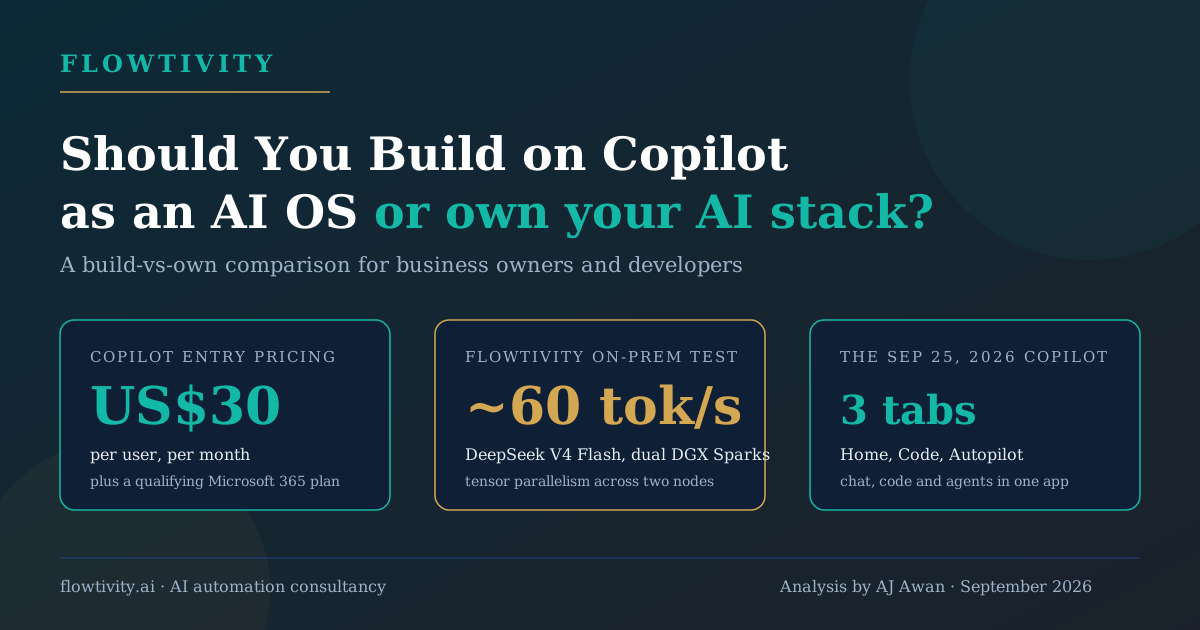
- Microsoft's September 25, 2026 update consolidates chat, code and always-on agents into a single Copilot app, an explicit push to make Copilot the operating system for enterprise work.
- Microsoft's published pricing lists Microsoft 365 Copilot at US$30 per user per month on top of a qualifying Microsoft 365 plan, with agent consumption billed separately.
- Build on Copilot when your data can live in the Microsoft 365 tenant boundary, your users already pay for Microsoft 365, and deployment speed beats differentiation.
- Own your AI stack when data sovereignty, cost control at volume or deep customisation outrank time to market, which is the common position for Australian businesses with residency expectations.
- Open-weight models such as DeepSeek V4 (MIT license), Llama and Qwen run on hardware you control; Flowtivity's dual NVIDIA DGX Sparks run DeepSeek V4 Flash at roughly 60 tokens per second.
- The honest answer is that most businesses end up hybrid: Copilot for generalist office work, an owned stack for sensitive or high-volume workloads.
What did Microsoft announce with Copilot as an AI OS?
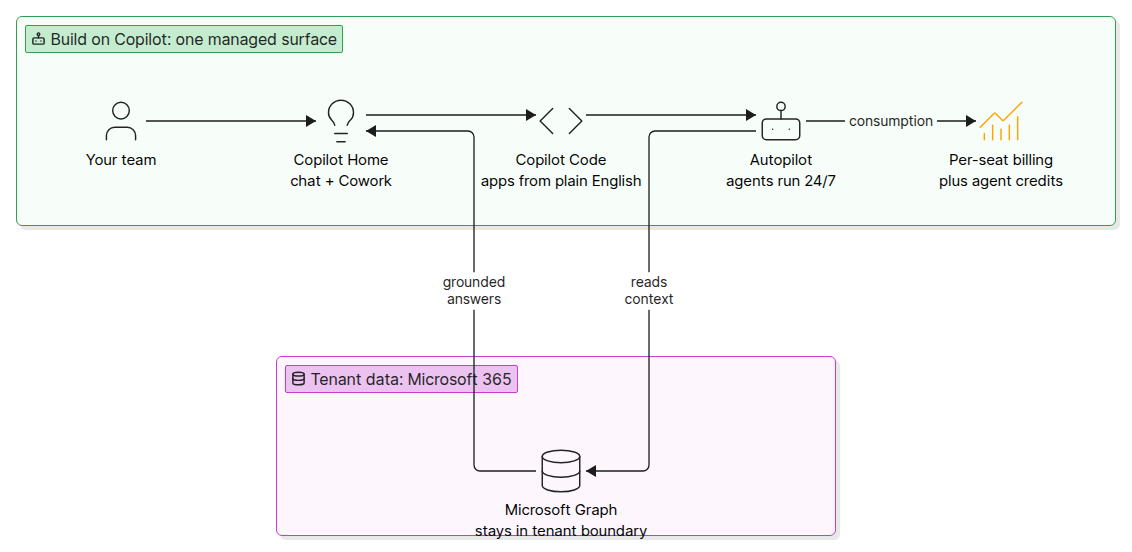
On September 25, 2026, Microsoft rebuilt Copilot from a chat assistant into a consolidated platform: Home combines chat with Cowork, Code builds applications from natural-language prompts, and Autopilot runs agents that keep working without prompting. According to Chosun Ilbo's business desk, Microsoft integrated chat, code and always-on agents into Copilot with the declared aim of making it the operating system for enterprise work. That framing matters: Microsoft is asking businesses to treat Copilot as core infrastructure, not a peripheral tool.
According to French tech commentator Korben, the new Copilot merges chat, code and autonomous agents into a single application organised around three tabs: Home, Code and Autopilot. According to CNBC's September 25, 2026 report, Microsoft is positioning the update to challenge Anthropic's Claude by combining coding capabilities with a tool for building agents that take on work. According to TechSpot, Home and Code enter Microsoft's Frontier program in the coming weeks while Autopilot reaches private preview at the end of the month. Wire-reported launch remarks from Satya Nadella add the vendor's own caveat: AI is not a human replacement, and value comes from combining human capital with token capital.
What does Copilot cost per user, and where do fees creep?
The seat price is only the entry ticket. Microsoft's published pricing lists Microsoft 365 Copilot at US$30 per user per month on top of a qualifying Microsoft 365 base plan, and agent consumption is billed separately through Copilot Studio messages and credits, with rates Microsoft has adjusted over time. For a 50-person team that is US$18,000 per year before a single agent runs, and 500 seats pass US$180,000. Autopilot-style agents that run 24/7 multiply metered usage, so the billing curve bends upward exactly when agents become most useful.
Where does your data reside when you build on Copilot?
Copilot data stays inside Microsoft's boundary, not yours. Microsoft added Microsoft 365 Copilot to its EU Data Boundary commitments in the Product Terms in March 2024, and Microsoft's published guidance gives Australian tenants an equivalent commitment that M365 core workload data does not leave the AU tenant geography. That is a vendor promise enforced through contract, not infrastructure you can audit with your own eyes. You also cannot choose the underlying model, pin model weights, air-gap the system or decide where inference physically happens. If a contract requires data to remain on your premises, Copilot cannot satisfy it.
What does owning your AI stack look like in practice?
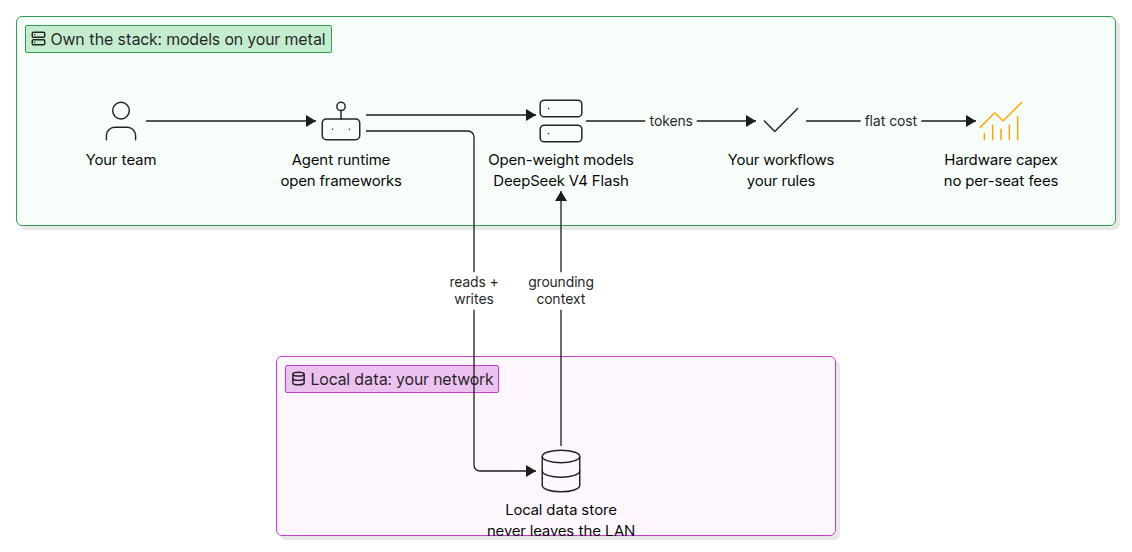
Owning the stack means running open-weight models on hardware you control. DeepSeek's V4 ships as open-weight mixture-of-experts models under the MIT license, and families such as Meta's Llama and Alibaba's Qwen can be downloaded and deployed in-house, removing per-seat fees and model-choice restrictions entirely. In Flowtivity's own lab, two NVIDIA DGX Spark units running DeepSeek V4 Flash with tensor parallelism sustain roughly 60 tokens per second, enough for responsive single-user agent workflows. Every prompt, token and trace stays on the local network. We have deployed similar on-prem stacks for clients, and the pattern holds: hardware is capex, and the marginal cost per token is close to electricity.
Copilot vs owning your AI stack: the side-by-side comparison
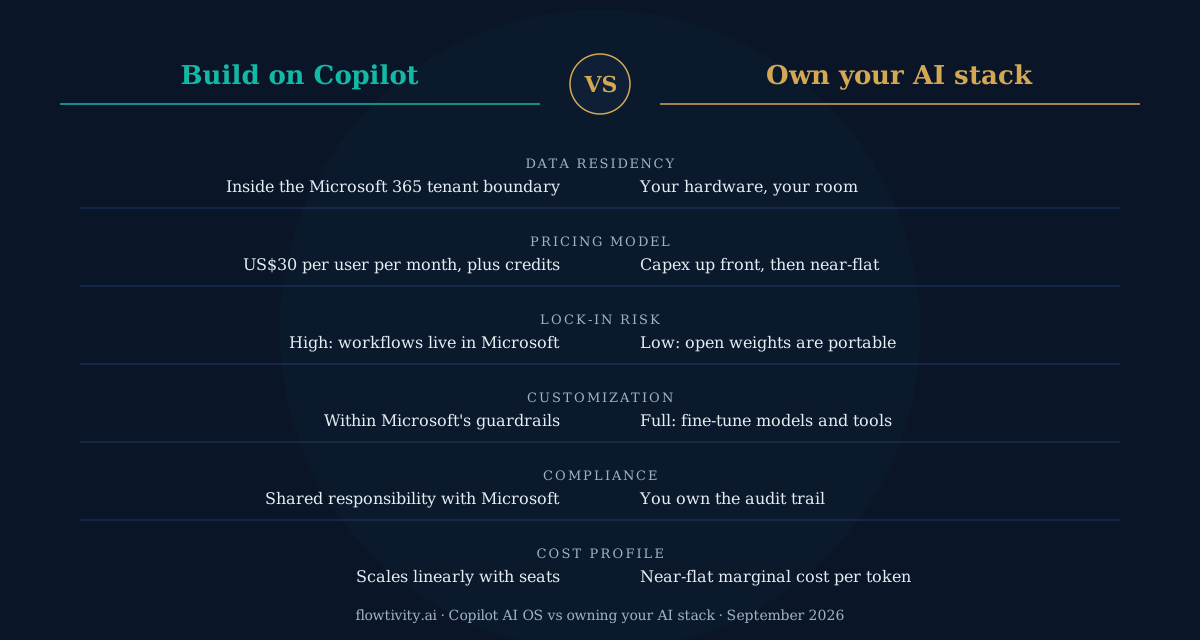
The two paths differ most on the attributes that surface only after a year of use: who holds the data, how the bill scales, and what happens when requirements change. The table below compares the concrete attributes, using Microsoft's published pricing and data-boundary commitments on one side and the properties of an owned open-weight stack on the other. Read it per workload rather than per business, because most organisations will end up using both lanes for different jobs.
| Attribute | Build on Copilot | Own your AI stack |
|---|---|---|
| Data residency | Processed inside the Microsoft 365 service boundary, with EU Data Boundary commitments in the Product Terms since March 2024 and AU tenant-geography commitments per Microsoft guidance | Your hardware: prompts, weights and traces physically stay on premises or in your private cloud |
| Pricing model | US$30 per user per month plus a qualifying base plan, plus separate agent consumption via Copilot Studio credits | Hardware capex plus power and ops; no per-seat fees and no metered agent credits |
| Lock-in risk | High: workflows, memory and integrations live in Microsoft's ecosystem and formats | Low: open weights (MIT-licensed DeepSeek V4) and open agent frameworks are portable |
| Customization | Within Microsoft's guardrails: Copilot Studio agents, connectors and admin controls | Full control: fine-tune models, choose any orchestration, modify tooling |
| Compliance | Shared responsibility model; inherits Microsoft certifications but limits your audit scope | You own the audit trail end to end, including air-gapping and model provenance |
| Cost profile | Scales linearly with seats and accelerates with 24/7 agent consumption | Front-loaded capex, then near-flat marginal cost per token |
Which path should your business choose?
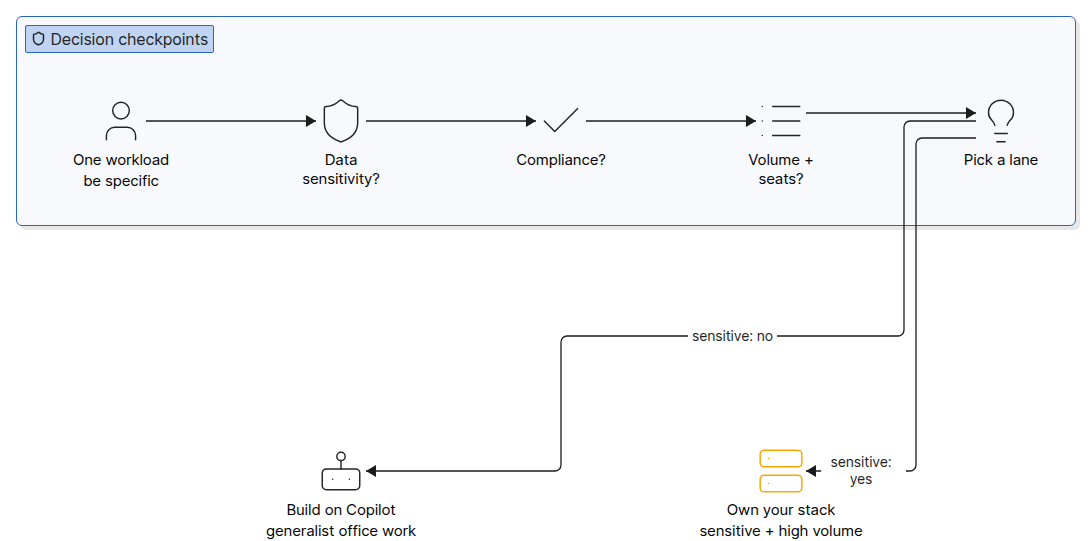
Decide per workload, not per business. Walk three checkpoints: how sensitive is the data, what compliance rules bind it, and what token volume and seat count it will carry. Sensitive data with residency clauses points to an owned stack regardless of convenience. Generalist office work on already-paid Microsoft 365 seats points to Copilot, because deployment takes days and the tenant boundary is adequate. High-volume, repetitive token workloads favour owning the stack, since metered consumption compounds while hardware cost is flat. Most businesses we advise land on a hybrid of the two lanes.
Frequently asked questions
These are the questions business owners and developers actually raise when weighing Copilot against an owned stack, answered briefly here and expanded by the schema above for answer engines. Start with your most sensitive workload, because that single answer eliminates one lane quickly, and the remaining comparison becomes a straightforward cost and customisation exercise.
- Is Microsoft Copilot safe for business data? Data is processed inside the Microsoft 365 service boundary under Microsoft's commitments, but it is a vendor promise, not your infrastructure.
- How much does Microsoft Copilot cost per user? US$30 per user per month on top of a qualifying base plan, plus separately billed agent consumption.
- Can I run AI models on-premise instead of using Copilot? Yes: DeepSeek, Llama and Qwen open weights run on your own hardware, and DeepSeek V4 Flash reaches about 60 tokens per second on Flowtivity's dual DGX Sparks.
- What is the difference between Copilot agents and building your own AI agents? Copilot agents live inside Microsoft's billing and guardrails; owned agents let you choose model, framework and data store, with hardware costs instead of seat fees.
- Is Copilot worth it for a small business? Often yes for generalist office work, until sensitive data, high token volume or deep customisation tips the math toward owning the stack.
One email a month, no noise
Practical AI notes for Australian businesses. Unsubscribe anytime.


