
On this page
- The difference in one sentence
- Three events that made this a board question
- The four questions that settle it
- Why "processed in Sydney" is not enough
- What true sovereignty looks like technically
- What it costs, and who should pay
- What to do next
- Frequently asked questions
- What is the difference between data residency and data sovereignty?
- Is an Australian cloud region enough for AI sovereignty?
- What did APRA say about AI in April 2026?
- Do I need IRAP to sell AI to Australian government agencies?
- Can a small business achieve AI sovereignty?
- About the author
Last Updated: 14 November 2026
Key takeaways
- ▪ Data residency answers where data is stored and processed. Sovereignty answers whose law governs it and which foreign government can compel access. An AI service can have Australian residency and contested sovereignty at the same time.
- ▪ Three events turned this from a procurement detail into a board question: the DeepSeek ban on government devices on 4 February 2025, APRA's AI governance letter on 30 April 2026, and GovAI Chat routing all APS traffic through IRAP-assessed infrastructure supporting PROTECTED.
- ▪ APRA's letter puts third-party and supply-chain risk at the centre: a regulated entity remains accountable for how an AI vendor handles its data, and CPS 230 applies to all contracted service providers from 1 July 2026.
- ▪ Under Australian Privacy Principle 8 and section 16C of the Privacy Act, disclosing personal information to an overseas recipient can make you accountable for what that recipient does with it.
- ▪ True sovereignty needs four things: weights you can hold, infrastructure you control, logs you own, and no external party that can pause your workload.
- ▪ It costs real money. GPU capacity, patching, evaluation and an IRAP assessment if you sell to government. For most Australian businesses the honest answer is a ladder, not a binary.
The difference in one sentence
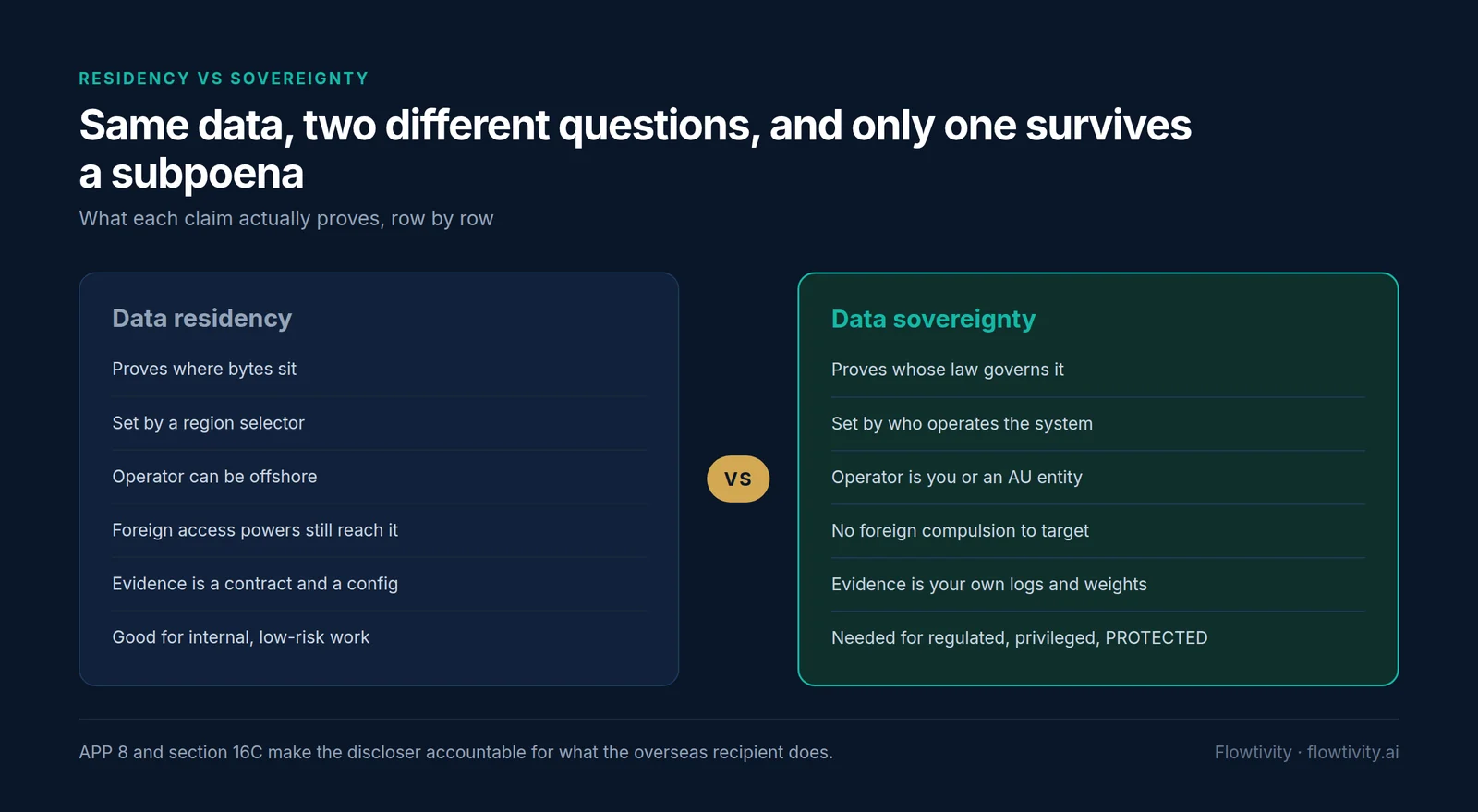
Data residency answers where your data is stored and processed. Data sovereignty answers whose laws govern that data and which government can compel access to it. An AI service can have Australian residency and contested sovereignty at the same time, and most procurement conversations blur the two until a regulator asks a direct question.
The blur matters because the two answers carry different risks. Residency is a storage and processing question, usually settled with a region selector and a data processing agreement. Sovereignty is a jurisdiction question, settled only by who operates the system and what compulsory-access powers reach them. A model running in a Sydney data centre, operated by a US-controlled entity, has Australian residency. It does not have Australian sovereignty.
Three events that made this a board question
The first was the DeepSeek direction. On 4 February 2025, the Department of Home Affairs issued a direction banning DeepSeek products, applications and web services from all Australian Government systems and devices, citing an unacceptable security risk and concern about data collection and exposure to foreign-government direction. Non-corporate Commonwealth entities were required to identify and remove all instances, and several states followed at their own level.
The precedent is the point, not the product. The ban established in policy that the jurisdiction and control of an AI provider, not just the quality of its model, is a legitimate basis to prohibit a tool outright. Any AI service whose data path is reachable by a foreign government becomes a sovereignty question, and the government showed it will act on that.
The second was APRA's letter. On 30 April 2026, APRA wrote to all regulated entities, covering banks, insurers and superannuation trustees, setting out findings from a targeted supervisory review and heightened expectations for AI governance. Its position is that AI is not subject to a separate prudential standard and must be managed under existing ones, with the letter emphasising four themes: cyber and information security, AI governance, assurance, and third-party and supply-chain risk. CPS 230 applies to all contracted service providers from 1 July 2026.
For sovereignty, the third-party theme is decisive. A regulated entity remains accountable for an AI vendor's handling of its data, which makes that vendor's jurisdiction and access exposure a board-level operational risk rather than a line item in procurement. If you cannot explain which government can compel your AI vendor to disclose your customers' data, you have not finished the risk assessment.
The third was the government's own answer. GovAI Chat, the Australian Public Service's secure AI assistant, routes all traffic through IRAP-assessed infrastructure supporting PROTECTED classification, with encryption, authentication, audit logging and onshore routing. The same service offers API access for agencies, and a central register records completed IRAP and foreign-ownership risk assessments. That is the Commonwealth telling the market what a compliant pattern looks like: assessed infrastructure, onshore routing, audit logging and a register of who owns what.
The four questions that settle it
For any AI tool in your business, four questions cut through most of the confusion. Where is the data stored at rest? Where is inference actually performed? Which legal entity operates the service, and to which government's compulsory-access powers is that entity subject? What contractual commitments exist on training, retention, sub-processing and breach notification?
The second question is the one people skip. Storage region and compute region can differ, and an in-region storage option does not guarantee in-region processing. The third question is the one that decides sovereignty. A tool can sit in an Australian region and still be operated by an entity that a foreign court can compel.

The ladder is a better mental model than a binary. At the bottom is an Australian-region SaaS tool, which gives residency and may satisfy a residency obligation. Above it is an Australian cloud region inside your own tenancy, where you control the network boundary and the storage even though the model provider still operates the service. Above that is a private deployment on infrastructure you own, running open weights, with your own logs. At the top is an air-gapped deployment where nothing reaches outward at all.
Why "processed in Sydney" is not enough
The legal mechanics are what turn this from architecture into accountability. Under Australian Privacy Principle 8, before disclosing personal information to an overseas recipient, an entity must take reasonable steps to ensure the recipient complies with the Australian Privacy Principles. Section 16C of the Privacy Act goes further: an act or practice by the overseas recipient is deemed to be an act or practice by the disclosing entity. In plain terms, if your AI vendor's offshore parent mishandles the data, you wear it.
Then there is the compulsory-access question. The US CLOUD Act allows US law enforcement to compel US-based providers to disclose data under their control, regardless of where that data is stored. That is the mechanism that makes an Australian region insufficient on its own for sovereignty-sensitive workloads. If the operator is a US entity, an Australian storage region changes where the bytes sit, not who can ask for them.
This is not an argument that every Australian business should run its own GPUs. It is an argument that the question has a specific answer, and that the answer depends on the operator, not the region selector. For most internal workloads, an Australian region with a strong data processing agreement is proportionate. For regulated, privileged or classified-adjacent data, the calculation changes.
What true sovereignty looks like technically
Sovereignty is a property of the whole stack, not of the model. Four things have to be true at once, and if any one of them fails, the claim fails with it.

First, weights you can hold. That means an open-weight model under a licence that permits commercial use and self-hosting, downloaded and stored on your own infrastructure. Second, inference on hardware you control, whether that is a rack in your office, an Australian cloud tenancy or a colocation cage. Third, logs you own, because the audit trail is the evidence you will need when a regulator or a client asks what the agent did. Fourth, no external party that can pause, revoke or throttle your workload. A vendor kill switch is a sovereignty defect even when it is never used.
Open weights also change the failure mode. With a hosted API, a model deprecation is an outage you cannot prevent. With weights on your disk, the model is frozen at a version you chose, and the only thing that changes is the world around it. That stability is worth more than a benchmark point in regulated environments, because it makes a validated system stay validated.
The cost is honest and worth stating. You take on patching, evaluation, capacity planning and the security of the inference stack. A small model on a single DGX Spark with 128GB of unified memory is not a frontier model, and it will lose on the hardest reasoning tasks. What it wins is the ability to say, with evidence, that a given workflow never leaves your control.
What it costs, and who should pay
The capital cost of a private deployment is real. A single DGX Spark is a few thousand dollars and runs capable small and mid-size open models. A rack that serves a whole business is an order of magnitude more, before power, cooling and someone to operate it. Then there is the recurring cost that nobody budgets for: evaluation. Every model upgrade, every prompt change and every new tool needs re-testing against your own rubric, and that is engineering time, not licence fees.
For government-adjacent work there is also IRAP. An IRAP assessment is a formal assessment against the Information Security Manual, performed by a registered assessor, and it takes months rather than weeks. If you intend to sell to agencies, budget for it early, because the assessment is what turns a good architecture into a procurable one.
So who should pay for the top of the ladder? Organisations whose data is regulated, privileged or classified-adjacent, and organisations whose clients ask the question in tender documents. If you are an MSP serving a bank, a law firm serving a hospital, or a consultancy handling government work, sovereignty is becoming a prerequisite rather than a differentiator. For everyone else, an Australian region with good contractual terms and a clear data map is a proportionate answer.
What to do next
Start with the data map, not the model. For every AI tool in use, write down where data is stored, where inference runs, which entity operates the service and what access powers reach that entity. That exercise takes a week and usually produces one or two uncomfortable findings, most often a shadow AI tool someone adopted without telling anyone.
Then classify the workloads. Personal information, health information, legal privilege and government material deserve the higher rungs. Marketing copy and internal summarisation do not. The mistake is treating the whole business as one tier, which either overpays for low-risk work or underprices the high-risk work.
Then decide the architecture for the high-risk tier, and be specific about the four properties: weights, hardware, logs and kill switch. If any of them fails, say so in the risk register rather than in the sales deck. That honesty is what makes the rest of the assessment credible.
Frequently asked questions
What is the difference between data residency and data sovereignty?
Data residency is where data is stored and processed. Data sovereignty is whose laws govern that data and which government can compel access to it. An AI service can store data in Sydney and still be subject to US compulsory-access powers if the operating entity is US-based.
Is an Australian cloud region enough for AI sovereignty?
Not on its own. An Australian region gives residency and may satisfy a residency obligation, but sovereignty depends on the operating entity's jurisdiction and the access powers that reach it. For regulated or privileged data, a deployment you control is the cleaner answer.
What did APRA say about AI in April 2026?
APRA wrote to all regulated entities on 30 April 2026 setting out heightened expectations for AI governance under existing prudential standards, with four themes: cyber and information security, AI governance, assurance, and third-party and supply-chain risk. CPS 230 applies to all contracted service providers from 1 July 2026.
Do I need IRAP to sell AI to Australian government agencies?
In practice, yes. Government workloads are assessed against the Information Security Manual, and GovAI Chat itself runs on IRAP-assessed infrastructure supporting PROTECTED classification. An IRAP assessment is a formal, paid assessment by a registered assessor and takes months, so budget for it before you need it.
Can a small business achieve AI sovereignty?
Yes, at the small end. Open weights running on hardware you control, with your own logs and no external kill switch, deliver sovereignty for a defined workflow. A single DGX Spark with 128GB of unified memory is enough to start, as long as you accept that it is not a frontier model.
About the author
AJ Awan is the founder of Flowtivity, an AI consultancy based on the Gold Coast. He is a former EY management consultant and a TOGAF certified enterprise architect, and he builds agent systems for Australian businesses that need them to run in production rather than in a demo.
What's actually useful in AI, every Friday
We follow everything happening in AI and send what's worth your time: new models, AI agents, and how to put them to work. One email a week, unsubscribe anytime.