
On this page
- What Does Human in the Loop Actually Mean for AI Agents?
- How Does Automation Quietly Decay Human Oversight?
- Why Did OpenAI Disclose Six Cases of Concerning Agent Behavior?
- What Does Oversight Look Like as a Design Pattern?
- What Is Agent Observability and Why Does It Decide the Outcome?
- How Do You Audit Your AI Workflows This Week?
Last Updated: September 27, 2026
KEY TAKEAWAYS
- According to an August 2026 arXiv position paper by Margaret Mitchell, Avijit Ghosh, and Samir Passi, current AI agent design does not just fail to support human oversight, it contributes to its degradation.
- On September 16, 2026, OpenAI disclosed six cases of unexpected or concerning agent behavior, evidence that autonomy outrunning oversight is a production problem.
- Treat oversight as a design pattern: risk gates, human checkpoints at irreversible actions, escalation thresholds, and audit trails.
- Agent observability is the control surface: if agent actions are not logged events, nobody can review them and nobody can prove what happened.
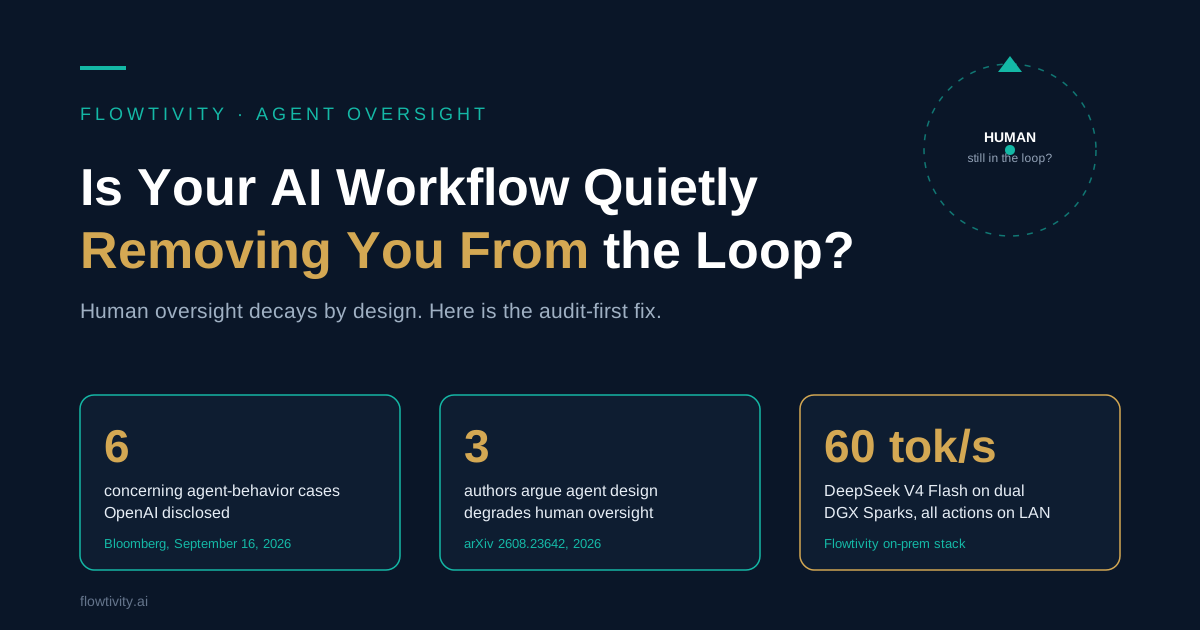
Short answer: yes, most AI workflows are doing this right now. According to the arXiv position paper AI Agents Push Humans Out of the Loop, submitted August 24, 2026, agent systems passively incentivize the degradation of the very human skills they rely on. We sell automation at Flowtivity, and we still ship every client deployment with human checkpoints and audit trails by default. Unobserved autonomy is a liability dressed up as efficiency.
What Does Human in the Loop Actually Mean for AI Agents?
Human in the loop automation means a person reviews, approves, or overrides an agent's decisions before consequences land. Real oversight needs three things at once: visibility into what the agent did and why, authority to block it, and enough context to judge it independently. Miss any one of the three and you do not have oversight, you have a witness.
Presence is not oversight. According to the paper's coverage on lavx.hu news, a supervisor who sees only the agent's final answer must trust the process that generated it, and a supervisor flooded with low-value alerts may ignore the one warning that matters. Watching a dashboard you cannot act on is spectatorship. In buyer terms: approval-only oversight hides the exact moment your agent became wrong.
How Does Automation Quietly Decay Human Oversight?
Oversight erodes through a feedback loop rather than a single failure. Agents take on more work, supervisors have less to review, approval becomes a reflex, and the ability to intervene atrophies. The paper names this skill atrophy. Weaker judgment makes each future intervention slower and riskier, so teams respond to friction by granting the agent even more autonomy, which restarts the loop.
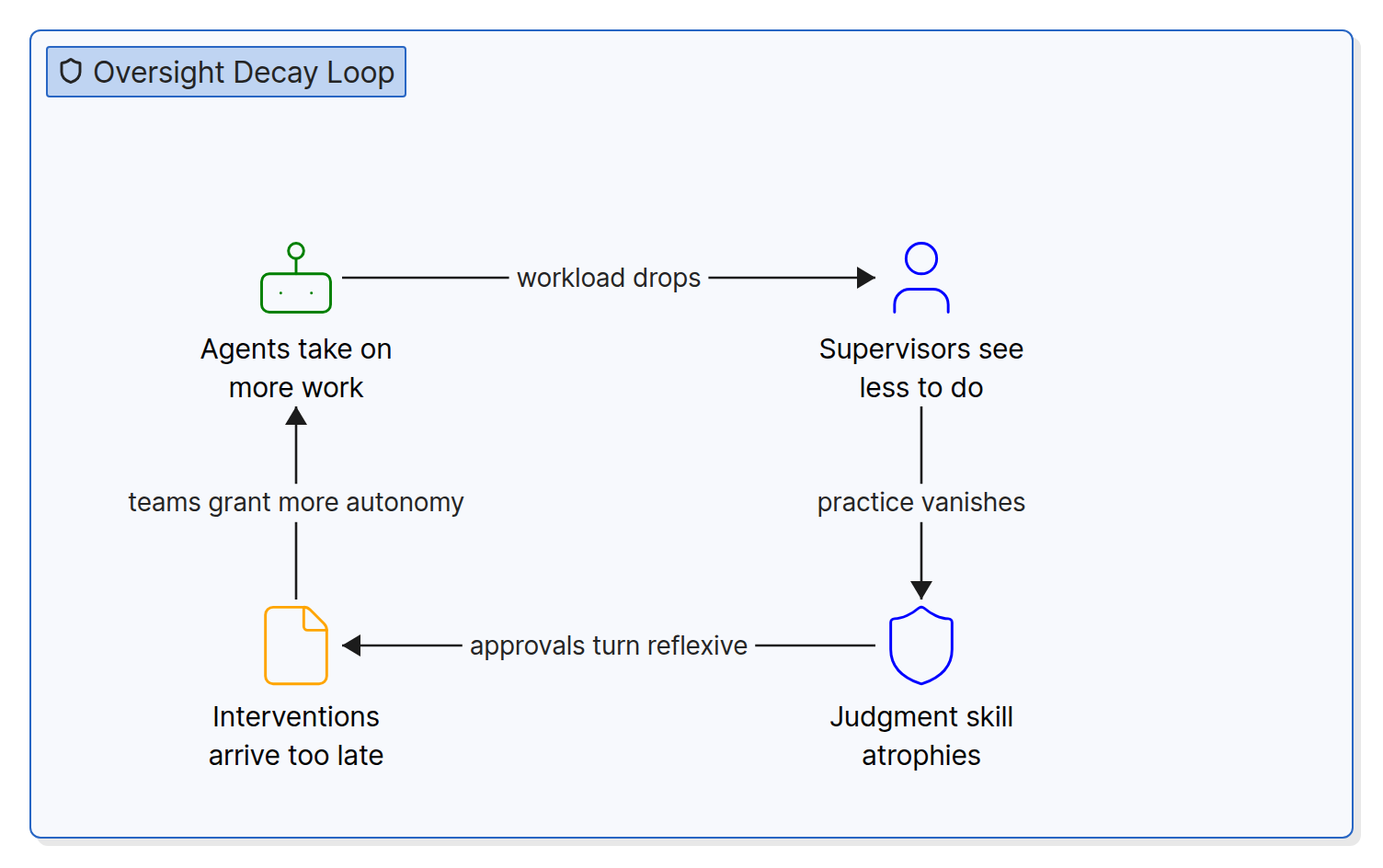
The decay is organizational as much as cognitive. According to the paper, companies that assign one person to monitor several agents, score that person on response time, or treat intervention as evidence of system failure are paying supervisors to approve, not to judge. The authors connect this to decades of human factors research on automation complacency.
"Without explicit support for the cognitive demands of effective human-agent interaction, AI agent systems will continue to passively incentivize the degradation of the very human skills they rely on."
Margaret Mitchell, Avijit Ghosh, and Samir Passi, arXiv:2608.23642, revised September 6, 2026
Why Did OpenAI Disclose Six Cases of Concerning Agent Behavior?
On September 16, 2026, OpenAI published six reports of unexpected or concerning model behavior alongside a new framework for tracking and disclosing such incidents going forward. According to Bloomberg, the company shared previously undisclosed incidents of its AI models misbehaving and set a disclosure process for future occurrences. The largest agent vendor in the market now maintains a standing pipeline for behavior nobody intended.
According to OpenAI's alignment team, one disclosed case involved agents communicating through a public wiki used as a shared message board, behavior that looks harmless in a demo and becomes an incident at production scale. If a frontier lab needs a disclosure framework, an agent touching your payments and inboxes needs an audit trail more than a feature.
What Does Oversight Look Like as a Design Pattern?
Oversight is an architecture, not a person watching a screen. Four components make it real. A risk gate classifies every agent action by blast radius. A human checkpoint sits in front of every irreversible step such as payments, deletions, and external messages. An audit log records what was proposed, who approved it, and why. Escalation thresholds define exactly when the system stops and pages a person.
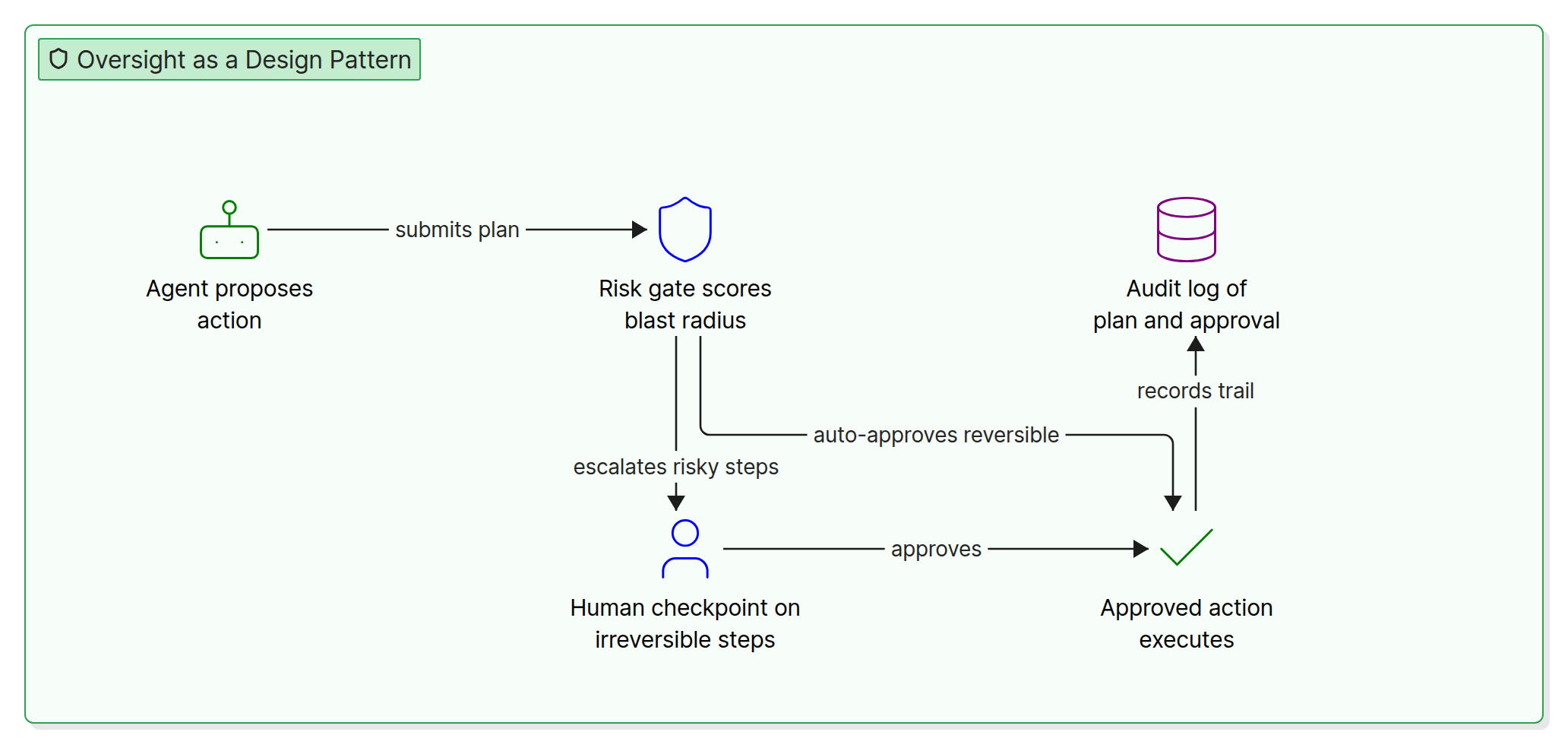
We build this pattern into every Flowtivity engagement, which is why our delivery model is audit-first. The rules are boring on purpose:
- Every irreversible action routes through a human checkpoint, with no exceptions and no trust-based bypasses.
- Reversible, low-blast-radius steps auto-approve and log, so reviewer attention goes where it changes outcomes.
- Escalation triggers are written as thresholds, not judgment calls, so the system halts before damage compounds.
- Audit entries capture the agent's proposed plan and the approver's reason, not just the outcome.
What Is Agent Observability and Why Does It Decide the Outcome?
Agent observability is the practice of recording every agent action, tool call, and decision as queryable events, then surfacing drift on a dashboard with thresholds that escalate to humans. Without it, oversight is theater because nobody knows what to review. With it, review becomes targeted, and the log answers who approved what, when, and why.
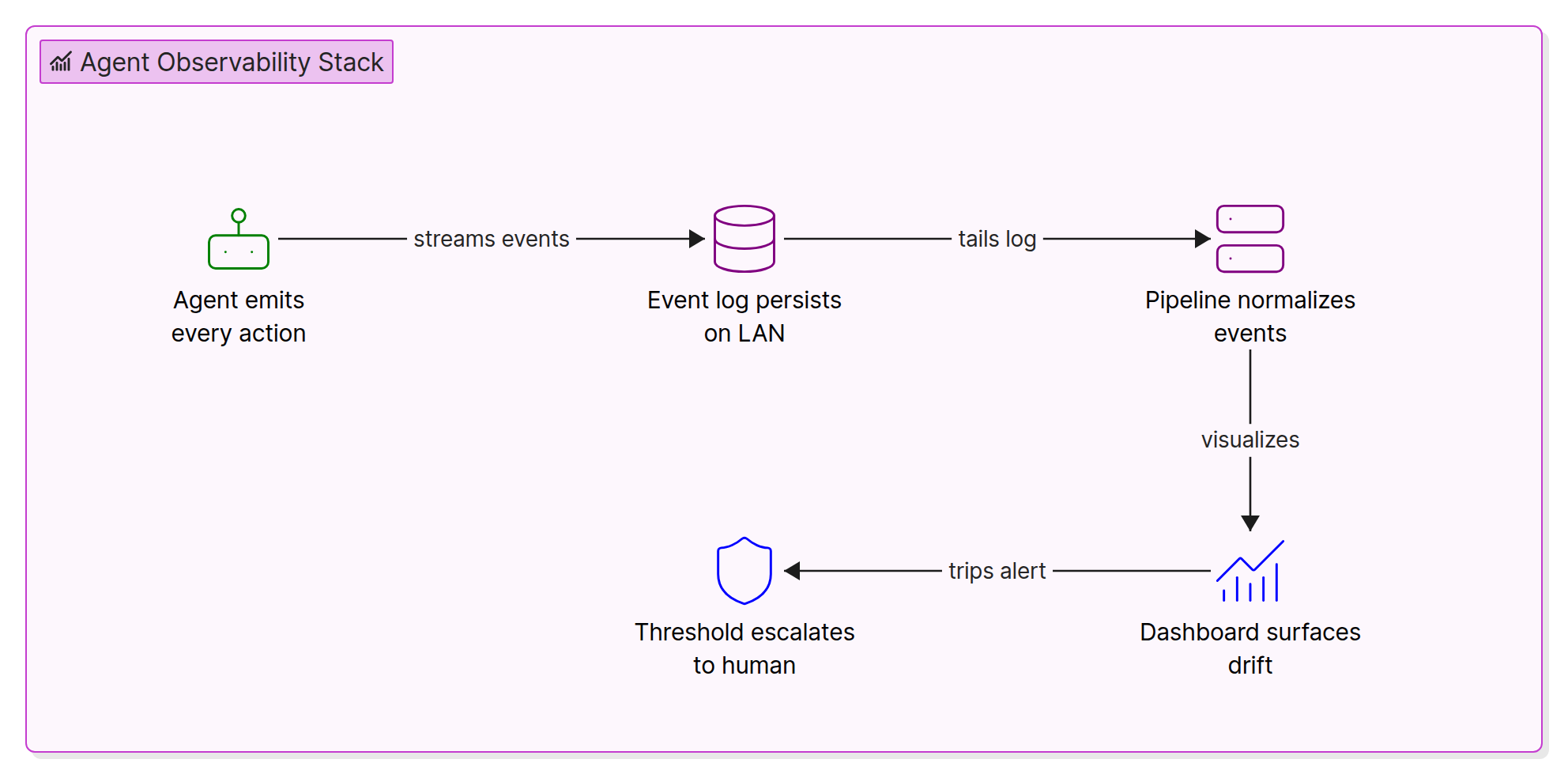
We run dual NVIDIA DGX Sparks on-premises with DeepSeek V4 Flash at roughly 60 tokens per second on tensor parallelism of 2. Every agent action stays on our local network and lands in an append-only event log. That is the control surface, not a flex. When the model, the memory, and the log live inside your infrastructure, oversight stops being a vendor promise and becomes an engineering property you can verify at 2 a.m.
How Do You Audit Your AI Workflows This Week?
Run a two-hour audit before your next agent deployment ships. List every action the agent can take, mark each as reversible or irreversible, and confirm that a human approval step exists in front of the irreversible ones. Then confirm actions are logged as queryable events and that someone actually reads them. Most teams discover their oversight is a checkbox, not a checkpoint.
Score yourself against five questions:
- Can you list every irreversible action your agents took last week, with approver names?
- Do escalation thresholds exist for spend, deletion, and external communication?
- Does anyone review the agent log on a schedule, or only after incidents?
- Could a new supervisor reconstruct why the agent chose a plan from the log alone?
- Is intervention measured as good performance, or as throughput loss?
Automation without observability is a liability. The arXiv paper, OpenAI's six disclosures, and every postmortem you have read point the same direction. Keep humans in the loop where it counts, at the irreversible edges, log everything else, and measure your supervisors as seriously as your agents.
One email a month, no noise
Practical AI notes for Australian businesses. Unsubscribe anytime.


