On this page
Last Updated: July 25, 2026
Jensen Huang Made His First X Post. The Message Was a Warning to Washington.
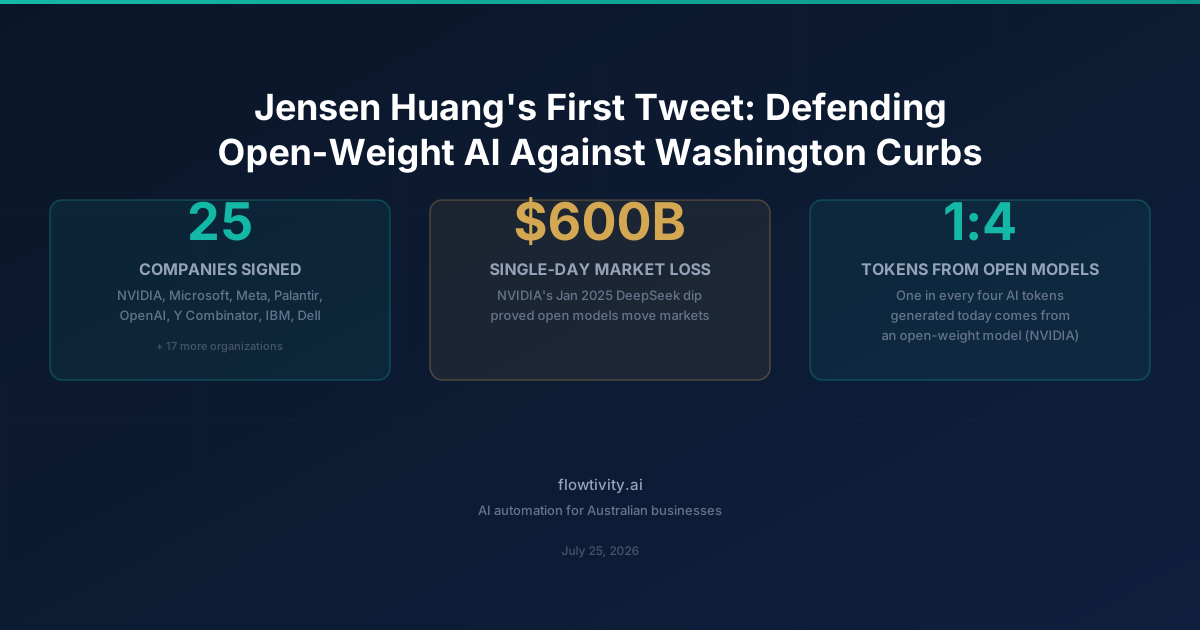
On July 24, 2026, NVIDIA CEO Jensen Huang posted to X for the very first time. His debut was not a product launch or a keynote highlight. It was a policy letter arguing that open-weight AI models are essential to American innovation and national security. The post, shared alongside a PDF signed by 25 organizations including NVIDIA, Microsoft, Meta, OpenAI, and Y Combinator, landed in a political environment where the Trump administration is actively considering restrictions on Chinese AI models such as Moonshot AI's 2.8 trillion parameter Kimi K3.
"AI will transform every industry, power every company, and be built by every country," Huang wrote. "Open models strengthen safety and cybersecurity, accelerate innovation and diffusion, and enable sovereignty." Huang's framing explicitly rejects the binary of open versus closed, stating the world needs both frontier closed models and frontier open models.
According to a report by Business Insider, the letter frames the open-weight debate as a direct parallel to the open-source software revolution of the 1980s. "Open source did more than lower the cost of software; it created a shared foundation of knowledge on which generations of American engineers and entrepreneurs built their institutional sovereignty," the signatories wrote.
What the Open-Weight AI Letter Actually Argues
The coalition letter, titled "Open Weights and American AI Leadership," makes five core claims about why premature restrictions would hurt the United States more than they would buy safety. According to explainx.ai's analysis of the full letter text, the signatories argue that open-weight models provide access and cost discipline for startups and universities, create competition across model developers, clouds, chips, and applications, enable customer sovereignty and data control, strengthen security by giving defenders comparable tools to attackers, and improve safety through broad community red-teaming and evaluation.
The distillation debate sits at the center of the controversy. Earlier in the week, Treasury Secretary Scott Bessent suggested the US could sanction companies that engage in what he called "unlawful extraction" of value from closed models. The White House Office of Science and Technology Policy director Michael Kratsios publicly accused Moonshot AI of developing Kimi K3 by distilling from Anthropic's Fable 5.
The letter pushes back: "Unlawful efforts to extract value from closed models raise legitimate concerns," the signatories wrote. "Those concerns should be addressed through targeted legal and commercial frameworks rather than sweeping restrictions on techniques that play an important role in AI innovation." In other words, punish the bad actors, not the technique.
Who Signed and Who Sat Out Matters
The 25 signatory organizations read as a cross-section of the American AI stack. NVIDIA provides the hardware. Microsoft and Meta provide the hyperscale platforms and open-weight models. Palantir and CrowdStrike bring the national security and cybersecurity angles. Y Combinator and a16z represent the startup pipeline. According to the full list published by Microsoft, signatories included American Innovators Network, Andreessen Horowitz, Arcee AI, Arena, Black Forest Labs, Box, Cisco, Cohere, CrowdStrike, Dell Technologies, DoorDash, Emergence Capital, Fireworks AI, GitHub, Hugging Face, IBM, The Linux Foundation, Mariana Minerals, Meta, Microsoft, Mistral, Mozilla, NVIDIA, OpenAI, Palantir, Palo Alto Networks, Perplexity, Reflection, Replit, ServiceNow, Telnyx, and Y Combinator.
OpenAI was notably absent from the initial version of the letter, but was added by Friday evening. OpenAI CEO Sam Altman said he was "glad to see the support for open-weight models" and expressed his desire for the US to win in both open-source and proprietary AI.
Two major players did not sign: Anthropic and Google. Both companies compete directly with Chinese open-weight models through their proprietary offerings. Anthropic's Fable 5 is widely considered the leading closed frontier model, while Google's Gemini competes at scale. According to Geo News, the letter is specifically a response to Moonshot AI's Kimi K3, which was unveiled on July 16 with 2.8 trillion parameters and will be available for download and customization.
Elon Musk was not a signatory but amplified the message publicly, replying to Huang's post: "Jensen is right. This has my full support."
Why This Moment Matters for Open-Weight AI
The timing of the letter is significant for three reasons. First, the US government explicitly embraced open-source AI models in its AI Action Plan in 2025, positioning them as a strategic asset. Restricting them now would represent a significant policy reversal. Second, NVIDIA's own market history demonstrates how much open models can move markets; the company's $600 billion single-day market loss in January 2025, triggered by the open-source DeepSeek model release, showed investors that open-weight competition is a real market force.
According to Tom's Hardware, NVIDIA CEO Jensen Huang stated at CES 2026 that one in every four AI tokens generated today comes from an open model. "Weights that anyone can download get served from enterprise clusters, regional clouds, and edge devices," Huang said. This statistic underscores that open-weight AI is not a fringe movement. It is already handling 25% of global AI inference.
Third, the letter navigates a policy minefield. On one side, proponents argue that open models are essential for American competitiveness. On the other, companies like Anthropic face a genuine competitive threat from Chinese open models that match or exceed their proprietary systems. The letter's key insight is that the response should not be blanket restrictions but targeted frameworks that preserve the innovation ecosystem.
What This Means for Builders and Businesses
For startups, university researchers, and businesses running AI on their own infrastructure, the letter represents a critical defense of the right to download, inspect, and modify frontier AI models. In our dual DGX Spark setup running DeepSeek V4 Flash at approximately 60 tokens per second, we rely heavily on open-weight models for custom fine-tuning and sovereign deployment. The open-weight ecosystem allows businesses to keep data on their own infrastructure while accessing frontier capability, rather than being locked into proprietary APIs with opaque pricing.
According to the New Stack's coverage, the coalition letter warns that "premature restrictions on open models stifle competition or drive innovation overseas." For Australian businesses evaluating AI investments, the stakes are especially high. Open-weight models make local, sovereign AI deployment feasible without relying on US-based cloud providers or Chinese model makers.
The letter offers a path forward: expanded compute access for startups, investment in shared training assets, a plural frontier ecosystem with both open and closed models, and strengthened application layers for sovereign use. These are not abstract policy goals; they directly affect whether a small team in Brisbane can fine-tune a frontier model on local data without paying per-token fees to a US hyperscaler.
The Bottom Line
Jensen Huang's first X post was not a vanity metric. It was a coordinated, strategic intervention in the most consequential AI policy debate of 2026. Y Combinator reposted Huang's thread, which accumulated millions of views within hours. Satya Nadella backed the same message on the same day. The coalition represents the hardware vendor, the hyperscaler, the open-weight champion, and the startup pipeline all speaking with one voice.
The question now is whether Washington will heed the industry's warning or move to restrict the very technology it championed just one year ago. The next 30 to 60 days will determine the regulatory trajectory for open-weight AI for the rest of the decade. Builders who depend on open models should be watching closely, and they should be making their voices heard.
One email a month, no noise
Practical AI notes for Australian businesses. Unsubscribe anytime.


