On this page
- What is JEV-as-a-Judge and why does it matter for eval costs?
- How much does an LLM judge actually cost?
- Where does JEV match GPT-6, and where does it fall behind?
- How does the confidence cascade keep 99% accuracy at 57% of the cost?
- What breaks the cascade, and how do you validate it?
- What JEV-as-a-Judge means for your AI stack in 2026
- Frequently asked questions
- What is JEV-as-a-Judge and should you use a cheap judge for LLM evals?
- How much cheaper is JEV than GPT-6 as an LLM judge?
- What is a judge cascade and how much accuracy does it keep?
- Where does a decision-only judge fail?
- What should you check before adding JEV to an eval pipeline?
Last Updated: September 26, 2026
Key takeaways
A Carnegie Mellon study found that JEV, a decision-only judge from TypeSafe AI, matches GPT-6 within 3 points on ordinary preference and factuality evals while costing 277 times less and answering 12 times faster.
The recommended pattern is a cascade: accept the cheap judge's verdict when it is confident, escalate only the uncertain 35 to 50% to a frontier model.
On 510 held-out pairs, that cascade kept 99% of GPT-6's accuracy at 57% of the cost.
Decision-only judges fall 9 to 20 points behind on derivation checking and on elaborately written wrong answers, so escalation thresholds need local validation.
Confidence is a routing signal, not a certificate: on style-adversarial pairs it stops separating right from wrong entirely.
What is JEV-as-a-Judge and why does it matter for eval costs?
Every team running LLM evaluations at scale hits the same wall: the judge is the most expensive part of the loop. According to a new Carnegie Mellon study (Yubo Li, Yidi Miao, Ramayya Krishnan and Rema Padman, arXiv 2609.26550, September 2026), the fix is not a better prompt on your frontier model. It is a two-stage cascade built around JEV, TypeSafe AI's decision-only judge, that keeps 99% of GPT-6's judging accuracy at 56.8% of its fee. The counter-intuitive headline: for most judgment calls, a tiny specialist you have never heard of is statistically indistinguishable from the most expensive model on the market, as long as you know when to escalate.
The study compares JEV against sixteen generative and reward-model judges across preference (RewardBench), evidence-grounded factuality (HaluEval), answer adjudication, and adversarial correctness tasks (JudgeBench, RM-Bench), with blinded human adjudication on 183 disagreement items. The pattern that emerges is an operating envelope, not a blanket verdict: decision-only judging is enough for a large class of work, and confidence scores can map exactly where it stops being enough.
How much does an LLM judge actually cost?
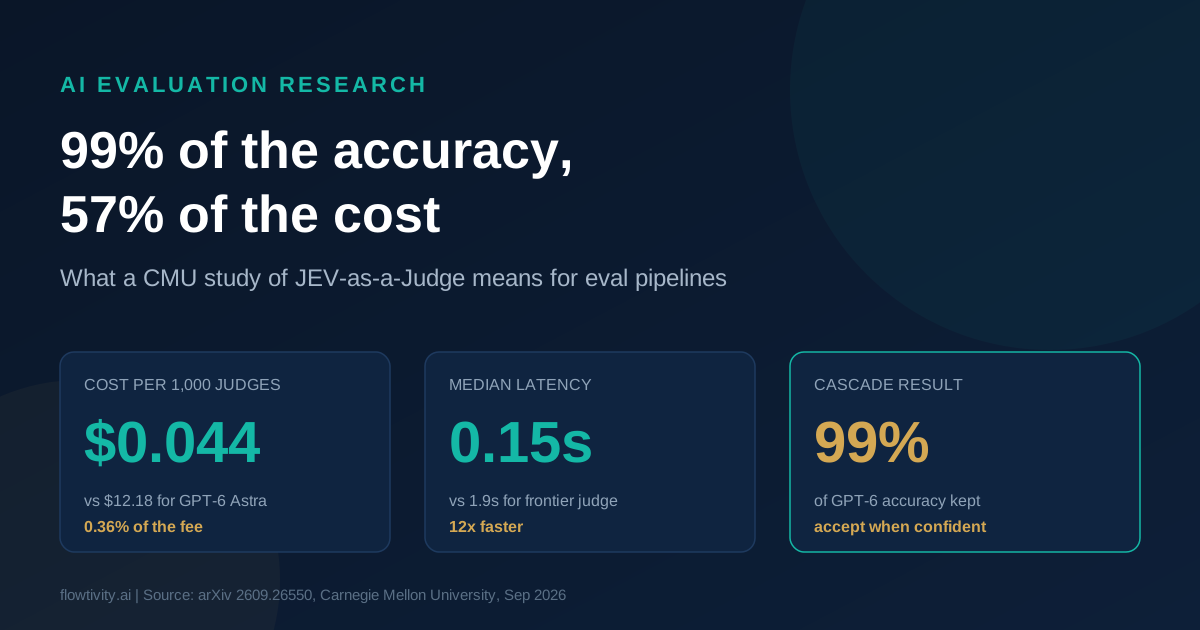
According to the paper's measured fee panel, GPT-6 Astra costs $12.182 per 1,000 judgments at a median 1.885 seconds. JEV costs $0.044 per 1,000 judgments at 0.152 seconds. That is not a rounding difference: it is 277 times cheaper and 12 times faster. JEV's pricing is $0.042 per million input tokens with output free, because output is a verdict and label probabilities, not prose. There is no reasoning text to pay for because JEV never generates any. When evaluation runs across thousands of responses per model revision, that gap decides whether your eval loop costs coffee money or a consulting retainer.
In our own automation work at Flowtivity, the economics rhyme: the highest-volume AI jobs in a growing business are classification-shaped, not prose-shaped. Judging which email is urgent, which lead is hot, or which revision is correct is a decision task, and paying frontier-model prose prices for it is the same mistake the paper documents in eval pipelines.
Where does JEV match GPT-6, and where does it fall behind?
The comparison is against GPT-6, the strongest judge tested in the study.
| Benchmark | JEV | GPT-6 | Gap |
|---|---|---|---|
| RewardBench (preference) | 92.2% | 93.5% | -1.3 pts |
| HaluEval (factuality) | 87.5% | 86.7% | +0.8 pts |
| Answer adjudication | 94.0% | 96.7% | -2.7 pts |
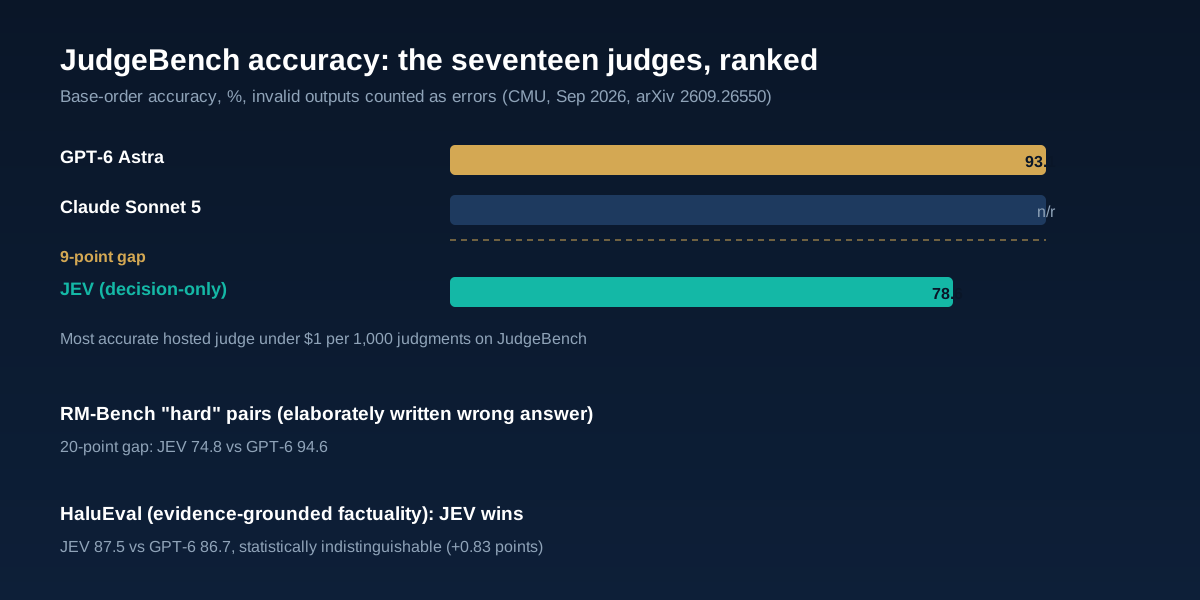
| JudgeBench (derivation checking) | 78.6% | 93.1% | -14.5 pts |
| RM-Bench hard pairs (style-adversarial) | 74.8% | 94.6% | -19.8 pts |
| Reference-free prose | unreliable for every judge tested | n/a | |
Both orders of the table matter. On ordinary preference and evidence-grounded factuality, JEV is within 3 points of the frontier judge at 0.36% of the fee, and it is the most accurate hosted judge under $1 per 1,000 judgments on JudgeBench. On tasks requiring derivation checking or resistance to elaborately written wrong answers, the gap stretches to 9 to 20 points, because a verdict-only signal cannot re-derive the reasoning it is grading. And no judge tested, expensive or cheap, is reliable on reference-free prose.
How does the confidence cascade keep 99% accuracy at 57% of the cost?
The mechanism is the paper's core contribution. JEV returns label probabilities with every verdict, and those probabilities turn out to be honest: its errors concentrate where its confidence is low. Pooled across tasks, JEV is right on 47.7% of low-confidence judgments and 99.1% of maximum-confidence ones, while GPT-6 barely moves across the same bins. The gap between the two judges lives almost entirely where JEV says it is unsure.
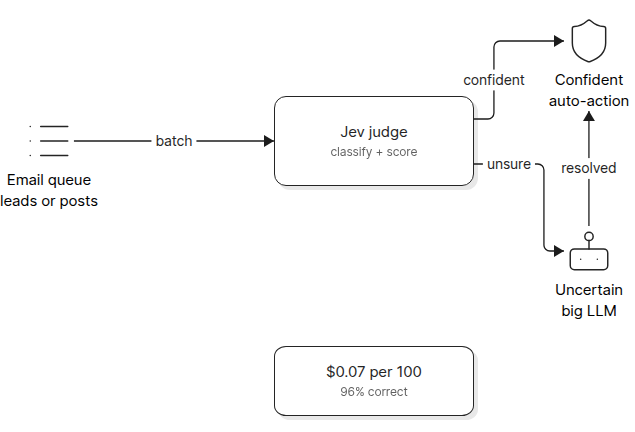
So the study builds a frozen cascade: judge each preference pair in both orders with JEV, average the aligned probability, accept the verdict if confidence is at or above 0.9, escalate everything else to GPT-6. On the 510-pair held-out test, the cascade accepts 53.7% of pairs, scores 92.5% against GPT-6's 93.1%, and spends 56.8% of the full-frontier fee. Escalating the same share of items at random loses more than a point and a half; the confidence signal captures half the achievable gain.
What breaks the cascade, and how do you validate it?
The envelope has edges, and the authors mark them honestly. On RM-Bench hard pairs, where the wrong answer is the more elaborately written one, JEV is confidently wrong on a third of its high-confidence judgments, and the cascade's accuracy retention degrades accordingly. On reference-free prose, confidence carries no signal at all. The threshold does not transfer universally either: a policy tuned for GPT-6 lost 2.35 points with GPT-5.6 as the fallback, beyond its tolerance.
The paper's checklist, which doubles as an implementation guide: judge pairs in both orders and average the aligned probability; fit the escalation threshold on a local selection set with a two-point accuracy tolerance, then re-check on held-out data because thresholds did not transfer for every fallback; count invalid outputs as errors when comparing judges; treat confidence as an escalation signal, not a certificate; and run a small local validation before stretching the envelope to a new workload. A usable verdict, a correct decision, and reliable uncertainty are three different things, and each has to be checked.
What JEV-as-a-Judge means for your AI stack in 2026
Three practical readings. First, if you run evals over generated content, a decision-only first stage is now the default architecture, not the budget option: frontier judging only earns its price on the subset your cheap judge flags as uncertain. Second, the same cascade shape extends beyond evals into operations, which is the pattern we build most at Flowtivity: a cheap decision layer routes and triages everything, and the expensive model sees only the hard tail. Third, the honest limits are a procurement checklist: any vendor selling you confidence scores should be able to demonstrate calibration on your data, not on theirs.
The authors put it best: a usable verdict, a correct decision, and reliable uncertainty are three different things. The cascade works because JEV delivers all three on the workloads tested, and tells you when it stops.
Frequently asked questions
What is JEV-as-a-Judge and should you use a cheap judge for LLM evals?
According to a Carnegie Mellon study (arXiv 2609.26550, September 2026), yes for most judgments. JEV, TypeSafe AI's decision-only judge, stays within 3 percentage points of GPT-6 on ordinary preference and factuality evals at 0.36% of the cost: $0.044 per 1,000 judgments and 0.15s median latency versus $12.18 and 1.9s. The study recommends accepting confident verdicts and escalating only uncertain ones to a frontier model.
How much cheaper is JEV than GPT-6 as an LLM judge?
277 times cheaper. JEV costs $0.044 per 1,000 judgments at 0.152s median latency; GPT-6 Astra costs $12.182 per 1,000 at 1.885s, according to the CMU study's measured fee panel (arXiv 2609.26550). JEV charges $0.042 per million input tokens with output free.
What is a judge cascade and how much accuracy does it keep?
A cascade accepts the cheap judge's verdict when its confidence is at or above a threshold (0.9 in the CMU study) and sends the rest to a frontier model. On 510 held-out preference pairs, the JEV-to-GPT-6 cascade scored 92.5% against GPT-6's 93.1%, keeping 99% of the accuracy at 56.8% of the fee.
Where does a decision-only judge fail?
On judgments requiring derivation checking or rejection of an elaborately written wrong answer, gaps reach 9 to 20 points: JudgeBench 78.6% vs 93.1% and RM-Bench hard pairs 74.8% vs 94.6%. Reference-free prose grading defeated every judge tested. Confidence also stops separating right from wrong on style-adversarial pairs, so validate any cascade on your own workload.
What should you check before adding JEV to an eval pipeline?
The CMU authors' checklist: judge preference pairs in both orders and average the aligned probability; set the escalation threshold on a local selection set because it did not transfer for every fallback model; count invalid outputs as errors when comparing judges; treat confidence as an escalation signal, not a certificate; and run a small local validation before trusting the cascade on a new workload.
One email a month, no noise
Practical AI notes for Australian businesses. Unsubscribe anytime.