
On this page
- What is StepFun Step 5 Preview?
- How much does Step 5 Preview cost?
- What is cost per intelligence, and why does it matter now?
- How does Step 5 compare with the 2026 frontier field?
- Why can StepFun sell frontier intelligence for $1?
- What does cheaper intelligence mean for business workflows?
- Should you switch to Step 5 Preview now?
Last Updated: September 21, 2026
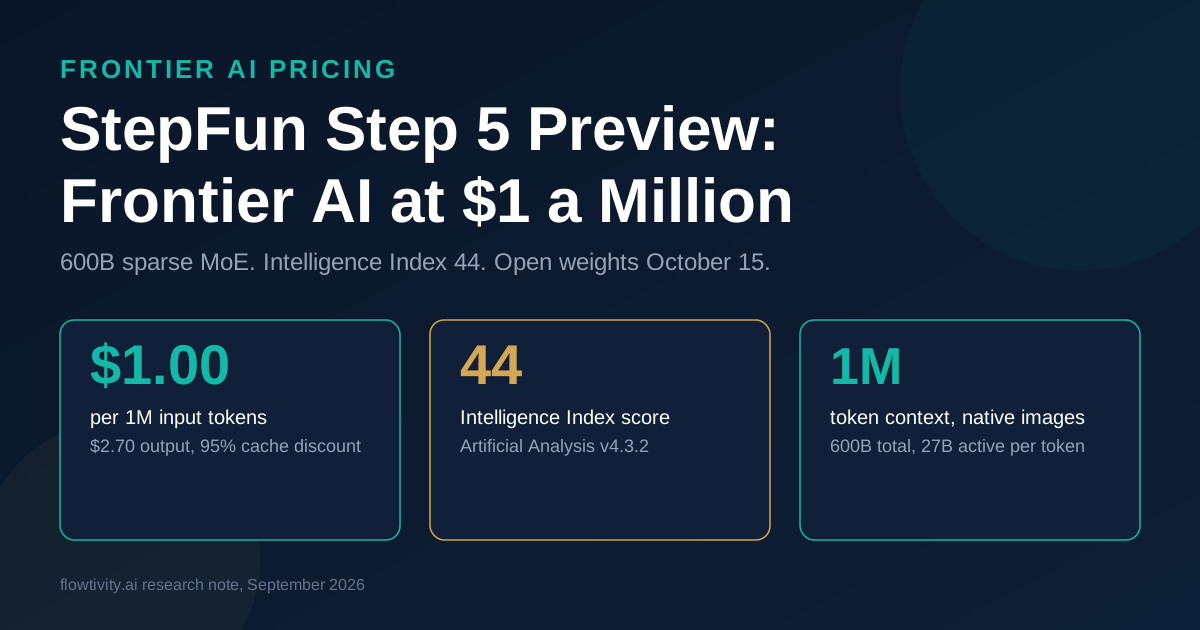
StepFun released Step 5 Preview on September 20, 2026, and the numbers that matter are $1.00 per million input tokens and $2.70 per million output, for a 600 billion parameter sparse mixture-of-experts model that scores 44 on the Artificial Analysis Intelligence Index. According to AI Weekly, that score matches Kimi K3 Max and comes at roughly one seventh the price of GPT-5.6 Sol. The model carries a 1 million token context window, native image input and a 95 percent prompt cache discount, with open weights announced for October 15. This is what the cost per intelligence conversation is really about: the price of a unit of capability just dropped again, and this guide breaks down the ratio, the comparison table and what it means for any business running AI workflows.
What is StepFun Step 5 Preview?
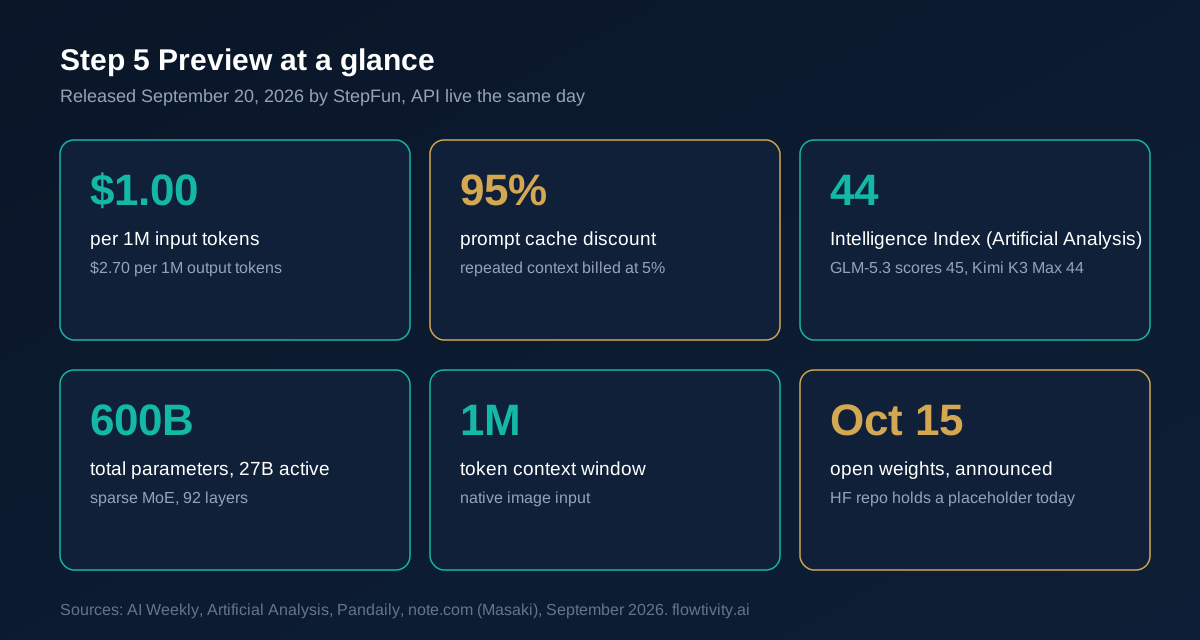
Step 5 Preview is a sparse mixture-of-experts model with roughly 600 billion total parameters and only 27 billion active per token, arranged in 92 layers, with a 1 million token context window and native image input. StepFun positioned it for long-horizon agentic work, meaning software engineering, coding agents and financial analysis where a model holds a large codebase or document set in context and works through many steps without forgetting. The API opened on launch day through the StepFun platform under the model name step-5-preview, which is unusually fast for a flagship announcement.
The company behind it matters for context. StepFun, founded in Shanghai in April 2023 by former Microsoft engineers and backed by Tencent, is counted among China's six AI Tiger companies, and Bloomberg reported in February 2026 that it is preparing a Hong Kong IPO. Its recent open-weight record is credible: Step 3.5 Flash shipped in February 2026 as a 196 billion parameter model with 11 billion active under Apache 2.0, and Step 3.7 Flash followed in May 2026. According to Wikipedia and Hugging Face listings, those releases beat some DeepSeek and Moonshot peers on efficiency benchmarks, which is the pattern Step 5 extends.
How much does Step 5 Preview cost?
Step 5 Preview is priced at $1.00 per million input tokens, $2.70 per million output tokens, with cached input billed at a 95 percent discount. Full open weights are announced for October 15, 2026, and the Hugging Face repository currently holds only a placeholder file, so the API is the only way to run it today. Against GLM-5.3 from Z.ai at $1.26/$3.96, that is about 21 percent cheaper on input and 32 percent cheaper on output. The catch is verification: according to Masaki, author of a daily AI newsletter on note.com, the Intelligence Index figure comes from third-party trackers and independent hands-on verification has not yet landed.
What is cost per intelligence, and why does it matter now?
Cost per intelligence is the ratio between what a model charges and the capability it independently delivers. The practical method: take a blended price per million tokens using a 3:1 input to output mix, then divide by the Artificial Analysis Intelligence Index, which aggregates 10 evaluations including Terminal-Bench 4.0, SciCode and Humanity's Last Exam under version 4.3.2. Artificial Analysis itself publishes a cost per Intelligence Index task metric for exactly this comparison. For Step 5 Preview the blended price is $1.43 per million tokens, so 44 points of intelligence cost about 3.2 cents per point. For GLM-5.3 it is $1.94 blended over 45 points, or 4.3 cents per point. Same tier of capability, about a quarter cheaper per unit delivered.

| Model | Input $/M | Output $/M | Intelligence Index | Blended $/M | Cost per point |
|---|---|---|---|---|---|
| Step 5 Preview | $1.00 | $2.70 | 44 | $1.43 | $0.032 |
| GLM-5.3 (Z.ai) | $1.26 | $3.96 | 45 | $1.94 | $0.043 |
| GPT-5.6 Sol | ~7x Step 5 blended | top tier | ~$10 | ~$0.20+ | |
| Claude Opus 5 | $5.00 | $25.00 | top tier | $10.00 | |
| DeepSeek V4.1 Flash | $0.003 cached off-peak | Sol-class claims |
Blended price assumes a 3:1 input to output mix. GPT-5.6 Sol and Claude Opus 5 index scores were not published in the sources used, so their cost per point cells stay open rather than guessed. Sources: AI Weekly, Artificial Analysis, note.com, tech-insider.org, VentureBeat, September 2026.
How does Step 5 compare with the 2026 frontier field?
Step 5 Preview is not the smartest model available. According to OfficeChai, Claude Fable 5.1 and GPT-6 Astra are tied for first on the Artificial Analysis Intelligence Index as of early September, GPT-5.6 Sol leads SWE-bench Verified at 96.2 percent per tech-insider.org, and Grok 4.6 matched Sol for third place on Artificial Analysis in August per VentureBeat. Step 5 sits one point below GLM-5.3 in the 44 club with Kimi K3 Max. But the battleground has moved. "The number that matters in StepFun's announcement today is not in the benchmarks. It is in the pricing table," reports Eastern Herald. OpenAI cut GPT-5.6 Luna by 80 percent and Sol by 20 to 33 percent during July and August, DeepSeek shipped V4.1 Flash with a $0.003 cached off-peak input rate on September 10, and StepFun answered nine days later with a dollar.
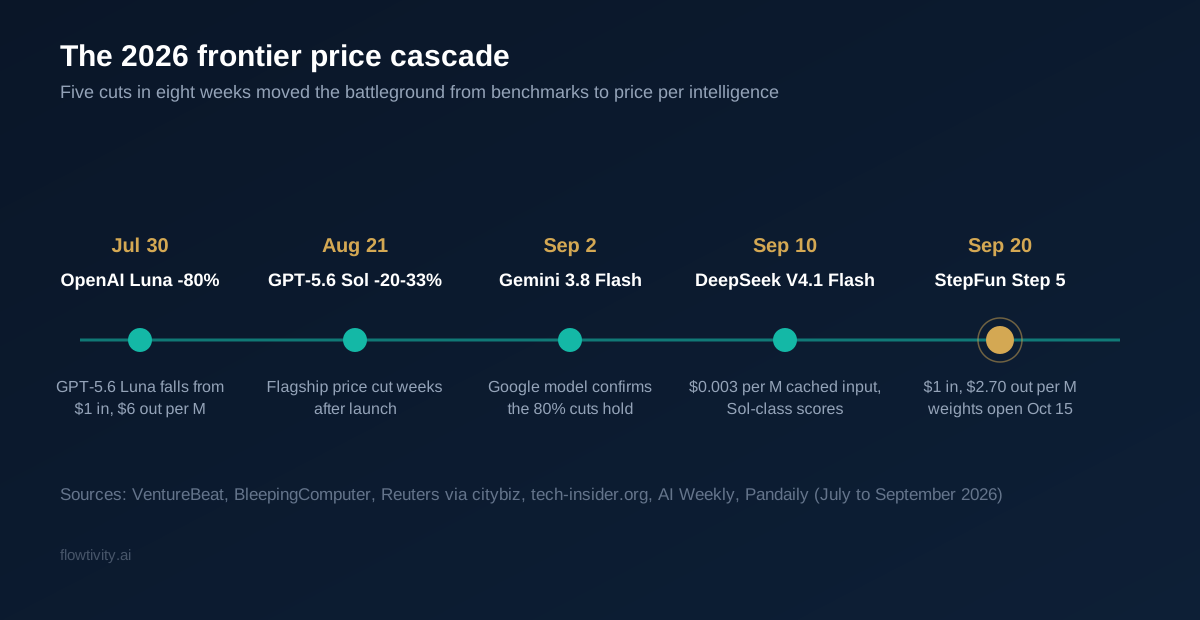
"The battlefield has moved from a duel of capability to a contest of price," writes Masaki on note.com, translating the strategy most Chinese frontier labs are now running: match the top tier within a point or two, then win on price and openness. Step 5 Preview is that playbook with a two-stage release: paid API first, free weights announced for October 15.
Why can StepFun sell frontier intelligence for $1?
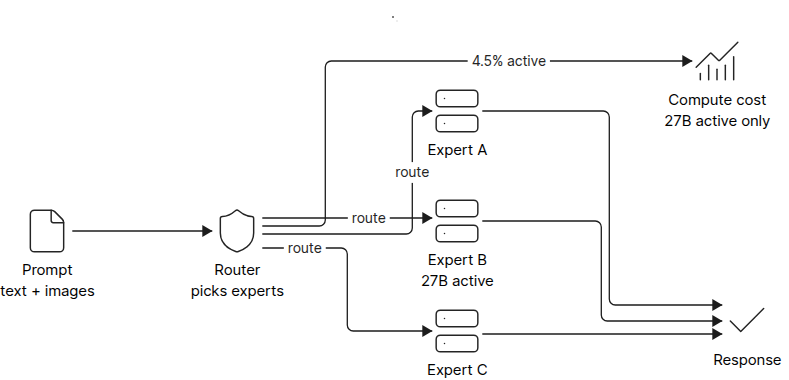
The architecture is the answer. A sparse mixture-of-experts model activates about 4.5 percent of its 600 billion parameters per token, so the serving cost tracks 27 billion active parameters, not the full weight. Add the 95 percent prompt cache discount for the repeated context that dominates long agent runs, and the marginal cost of a token in an agentic workflow lands far below the sticker price. StepFun is also scaling for an IPO with Tencent backing and a domestic chip alliance, so aggressive pricing doubles as market share acquisition. The open question Masaki flags honestly: whether this is a sustainable cost structure or a war of attrition funded by capital markets is not yet knowable from outside.
What does cheaper intelligence mean for business workflows?
For agentic workloads the price cut compounds. Consider a document-analysis agent that loads 200,000 tokens of context and writes 20,000 tokens of output per run. On Step 5 Preview that run costs $0.254. On GLM-5.3, the model our own agent stack at Flowtivity runs on daily, it costs $0.331. On Claude Opus 5 at $5/$25 it costs $1.50. Rerun it ten times a day through a 22-day month and Step 5 lands at about $56 against $330 on Opus 5, and once the prompt cache absorbs the repeated context, the Step 5 bill drops toward $14 a month. The ratio matters more than the absolute number: when cost per intelligence falls by half, the set of workflows that justify AI expands, experiment volume rises, and the constraint moves from model budget to workflow design and data quality.
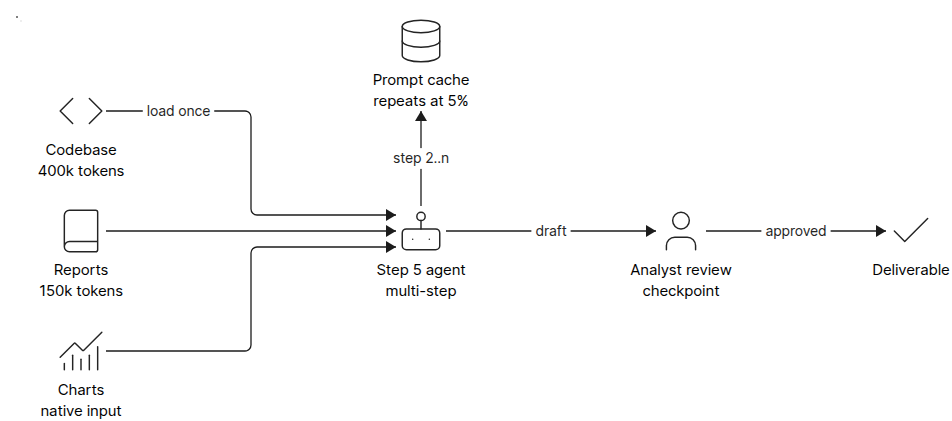
The first-hand check we ran for this post: the agent that researched and drafted it operates on GLM-5.3, one intelligence point above Step 5 Preview at a fifth higher input price. That is the size of the gap the new release is exploiting, and it is why the decision now belongs on the invoice, not the benchmark chart.
Should you switch to Step 5 Preview now?
The disciplined answer is a five-step evaluation, not a blind migration. Pull two weeks of API logs to profile your real token mix, reprice that workload on Step 5 rates, pilot it in parallel on your own tasks, wait for the October 15 weights plus independent benchmark verification, then decide. Three cautions from the source material: the Intelligence Index score is third-party tracker data pending replication, the open weights date is announced rather than shipped, and regional availability of the StepFun API is not yet documented for all markets, which matters for Australian data handling. The rational posture for most teams is routing: cheap, near-frontier models like Step 5 for volume work, premium models reserved for the hard 10 percent of tasks.

The cost per intelligence curve is doing to AI spend what cloud pricing did to compute: every quarter, the same dollar buys more capability. Step 5 Preview is the sharpest single move in that direction this month, and October 15 is the date the market gets to check the math.
One email a month, no noise
Practical AI notes for Australian businesses. Unsubscribe anytime.


