
On this page
- The Short Answer
- What Is Harness Engineering in AI?
- Why Meta Needed a Harness: Days-Long Training Runs and Fragile Systems
- The Three Harness Designs Inside Auto-RecSys
- The Two Loops That Make the System Smarter Over Time
- The Results: 4.0 Fixes Down to 0.5
- The Real-World Lesson: Failure Knowledge Compounds
- How to Apply Harness Engineering in Your Business
- Frequently Asked Questions
- What is harness engineering in AI?
- What is Meta's Auto-RecSys?
- What is cognitive-procedural separation?
- How much did the harness improve reliability?
- Can a business without Meta's resources apply this?
- The Takeaway: Your Playbook Is the Asset
Last Updated: 12 September 2026
The Short Answer
Harness engineering is the craft of building the scaffolding around an AI model: its memory, tools, scripts, checkpoints, and written playbooks, so it can run long, complex work reliably instead of answering one prompt at a time. According to Meta's Auto-RecSys paper (arXiv 2609.10922), an engineered harness let autonomous agents run 31 iterations of experiments on recommendation models whose training takes days, cutting operational failures from 4.0 per iteration to 0.5 and reducing hands-on human time from hours or days to minutes. The striking part is what did not change: the model. Every gain came from the harness around it.
"Harness engineering is a top skill right now," says Elvis Saravia, founder of dair.ai, in his post on X that introduced the paper to practitioners. This article explains what the Meta team built, what the numbers say, and how a business of any size can apply the same pattern.
What Is Harness Engineering in AI?
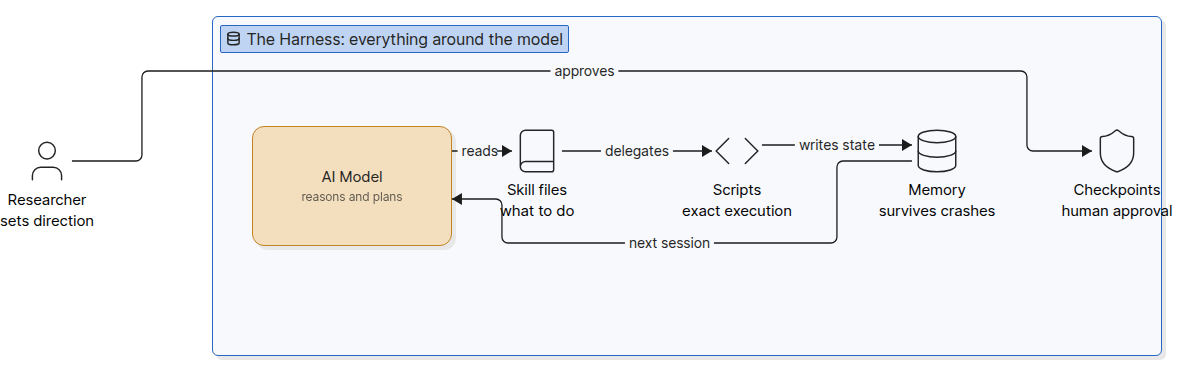
Harness engineering is the design of the layer that surrounds a language model so it can do real work. According to the Auto-RecSys paper, an agent harness is "the software and context layer surrounding a language model, including its tools, APIs, memory, validators, execution loops, and feedback channels." In plain terms: the model is the engine, and the harness is everything that turns an engine into a vehicle, the gearbox, the brakes, the dashboard, and the maintenance log.
Most teams focus on choosing a better model. The Auto-RecSys evidence points somewhere else. Meta kept its models fixed and engineered the wrapper, and reliability improved several times over. The harness is also where operational knowledge lives: what works, what failed, and why, written in files the AI reads every time it starts a task.
Why Meta Needed a Harness: Days-Long Training Runs and Fragile Systems
Meta's recommendation models operate at a scale that breaks the usual "try, test, learn" loop. According to the paper, a single model change can require days of training and monitoring, a typical research cycle spans three to seven days, and each run can consume hundreds of GPU-hours. Jobs fail for reasons that have nothing to do with the idea being tested: preemption, checkpoint corruption, stale data, package version mismatches, and hardware instability. Configurations run to thousands of lines. Agent sessions die mid-task, and servers restart mid-training.
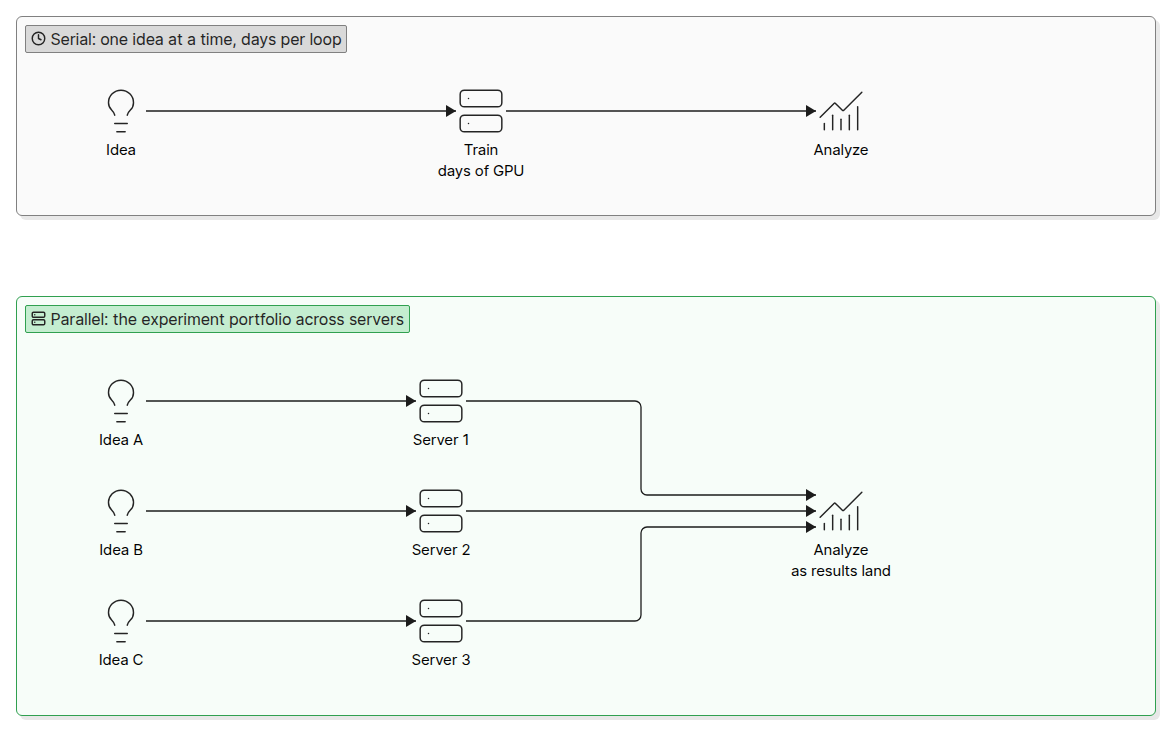
That produces two hard problems. First, long feedback loops: serial iteration is too slow when each experiment takes days, so multiple ideas must run in parallel. Second, system complexity: every failure is expensive, so execution must be recoverable, and operational knowledge must accumulate instead of being rediscovered, and paid for, over and over.
The Three Harness Designs Inside Auto-RecSys
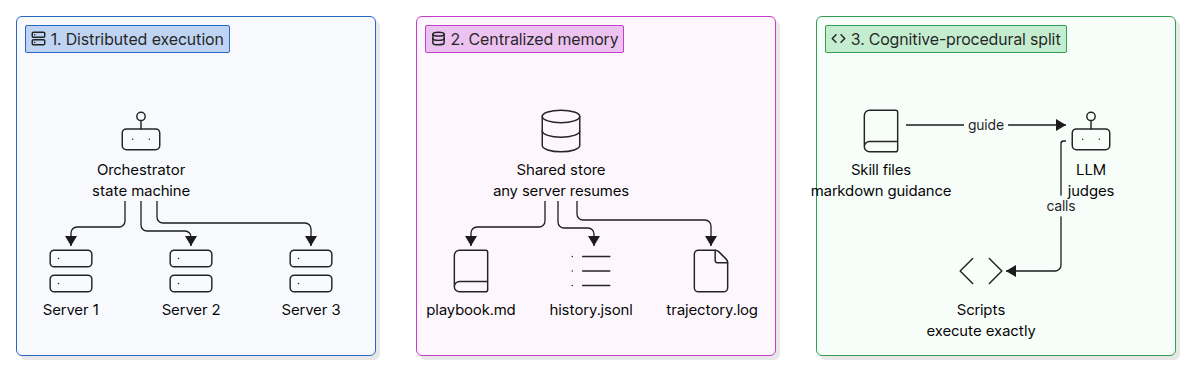
Auto-RecSys rests on three harness designs. Distributed asynchronous execution runs many experiment ideas in parallel across servers, each tracked by its own state file. Centralized cross-server memory stores experiment states, playbooks, and histories in a shared layer, so any session on any server can resume work after a crash or restart. Cognitive-procedural separation splits the system in two: natural-language skill files guide the AI's reasoning, while deterministic scripts enforce operational correctness for state changes, API calls, and file operations.
| Harness design | What it does in Auto-RecSys | What it looks like in a business |
|---|---|---|
| Distributed asynchronous execution | Runs a portfolio of ideas in parallel, each with an isolated state file, so one failure never blocks the others | Run several pilots at once, knowing one flop does not sink the program |
| Centralized cross-server memory | Persists state, playbooks, and histories so work survives session crashes and server restarts | Ops knowledge that survives staff turnover, laptop crashes, and tool switches |
| Cognitive-procedural separation | Natural-language skill files guide reasoning; deterministic scripts execute state changes and API calls | The AI decides what to do; scripts guarantee it happens exactly as intended |
| Dual evolution loops | Playbooks record failures and fixes; results feed the next round of ideas | SOPs that update themselves, plus a test log that steers strategy |
Per-idea state isolation is a subtle but powerful detail. According to the paper, an idea whose training job fails after hours of GPU time affects only its own state file and never blocks or corrupts the ideas running alongside it. The paper is blunt about why reasoning and execution are separated: LLM reasoning is flexible but imprecise, while state management requires exactness, because a single wrong field in a JSON state file can corrupt an entire experiment lifecycle.
The Two Loops That Make the System Smarter Over Time
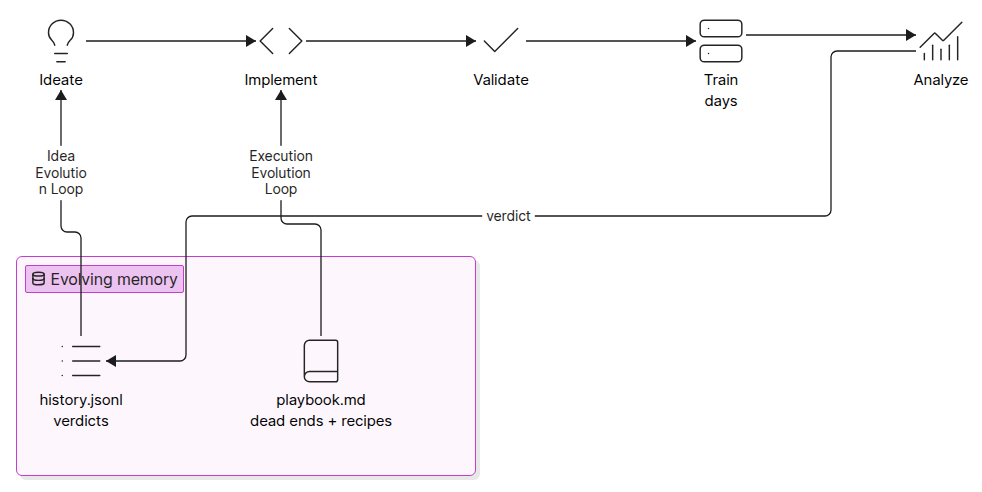
Auto-RecSys improves through two feedback loops. The Execution Evolution Loop distills every completed run into a per-model playbook: dead ends record what failed, why, and the fix, pipeline recipes record step-by-step procedures that worked, and submission configs pin infrastructure parameters learned by trial and error. The Idea Evolution Loop appends every experiment verdict to an append-only history, so future ideation deduplicates against past attempts, prunes directions that keep failing, and combines partial wins into stronger compound ideas. One loop gets better at doing, the other gets better at choosing.
The playbook is plain markdown the agent reads at the start of every session. It records six categories of knowledge: key files, configuration conventions, the exact validation command, the submission recipe covering hardware, entitlements and package versions, dead ends, and proven strategies. The paper's language is memorable: dead ends are the system's "scar tissue," and proven strategies are its "muscle memory."
The dead-end entries pair each error with its remedy, which is what enables self-healing. After three failed jobs on one GPU generation, the system recorded it as a dead end and selected a stable generation automatically ever after. It did the same with a package version mismatch and an expired checkpoint, applying known fixes instead of escalating to a human. Structure transfers too: once the first model's playbook matured, onboarding a new model meant filling in a template rather than starting from zero, a mechanism the paper calls one-shot transfer playbook creation.
The Results: 4.0 Fixes Down to 0.5
Across 31 analyzed iterations on one production recommendation model, major operational fixes per iteration fell from 4.0 early on to 1.3 once the playbook stabilized (iterations 5 to 20), according to the paper. At iteration 21 the baseline architecture changed, wiping out hard-won assumptions, and five consecutive iterations needed operational recovery. Then the system re-learned: the post-transition phase (iterations 26 to 31) averaged 0.5 fixes per iteration, with 5 of its 6 iterations requiring no operational fix at all, better than before the change.
The mature playbook held 49 dead ends and 17 error-fix patterns, and had crystallized a pipeline with 9 pinned submission parameters. Human effort fell from hours or days of active involvement per idea to minutes in human-in-the-loop mode. According to the paper, the attention that once covered a single idea now covers more than a dozen, running in parallel.
Two anecdotes stand out. The system discovered its own monitoring agents were dying silently after roughly three to five hours because each polling cycle accumulated tool results until the context window overflowed, so it designed and deployed a cron-based replacement where every tick starts with a fresh prompt. And after one experiment failed four times at the publish step, it rewired its own workflow to skip the failing step, and the next attempt ran clean on the first try.
Why does this work? Because errors are categorical, not random. According to the paper, each failure category, such as GPU hardware instability, missing resource tags, or build date parameter mistakes, appears in one or two phases, gets recorded as a dead end, and then disappears from phases where the playbook has absorbed the fix.

The Real-World Lesson: Failure Knowledge Compounds
The transferable lesson for any organization: most operational failures repeat in categories, and a written record of each failure plus its fix converts every mistake into permanent infrastructure. The asset that compounds is the playbook, not the model. Models get replaced every few months, while a well-kept playbook makes every successor model smarter on day one.
We learned this the hard way at Flowtivity. In early outreach work, our AI assistant sent 23 emails on a task where 3 were intended, and one contact received three duplicate emails in a week. The fixes were not better prompts. They were harness rules: confirm scope before any batch operation, dedupe against the contact database before every send, and never send to unverified role addresses. Those rules now live in the assistant's persistent memory and workflow scripts, and the same class of failure has not recurred. That is a playbook entry doing exactly what Meta's dead-end catalog does at industrial scale.

How to Apply Harness Engineering in Your Business
You can apply harness engineering to one repeated workflow without Meta's budget. Define the workflow's states, write a markdown playbook with validated steps and documented failures, split judgment from execution, make every run recoverable, and gate risky steps behind human approval, loosening the gates as the playbook matures. Total setup for a first workflow is typically two to four hours.
- Map one workflow into states. Pick a process you repeat weekly, such as quote intake, content production, or invoice chasing, and write down its states, for example: intake, prepare, review, execute, analyze. Auto-RecSys tracks every idea through ideating, implementing, validating, training, and analyzing. States make progress visible and failures locatable.
- Write the playbook in markdown. Five sections cover it: key systems and files, validated commands or steps, dead ends written as DO NOT entries with the fix, proven strategies, and pinned parameters such as template IDs and version numbers. The AI reads this file at the start of every task.
- Split judgment from execution. Let the AI plan, draft, and diagnose, and let scripts do the sending, writing, and updating. For most businesses the equivalent of "one wrong JSON field" is a wrong merge tag or the wrong recipient list. Scripts make that class of error structurally impossible.
- Design for recovery. Save state after each step, keep an append-only log of actions, and make writes atomic so a crash mid-step never corrupts finished work. The goal is resume, not restart. Auto-RecSys assumes any session can die at any moment, and so should your workflows.
- Add human checkpoints, then loosen them. Start in interactive mode: a human approves the plan, the output, and the send. Auto-RecSys uses checkpoints such as idea selection, code review, training submission, and results review, and moves toward autonomous operation only as playbook confidence grows. Earn autonomy with evidence.

Frequently Asked Questions
What is harness engineering in AI?
Harness engineering is the practice of designing the layer around a language model, its tools, memory, scripts, validators, and playbooks, so it can execute long, complex, multi-step work reliably. Meta's Auto-RecSys paper defines the agent harness as "the software and context layer surrounding a language model, including its tools, APIs, memory, validators, execution loops, and feedback channels."
What is Meta's Auto-RecSys?
Auto-RecSys is an autonomous research system from Meta, published on arXiv as 2609.10922 in September 2026. It runs multi-day experiments on industry-scale recommendation models using parallel execution, centralized memory, and self-updating markdown playbooks, cutting operational fixes from 4.0 to 0.5 per iteration across 31 iterations.
What is cognitive-procedural separation?
It is a design pattern where natural-language skill files guide an AI's reasoning and decisions while deterministic scripts handle state changes, API calls, and file operations. The AI provides judgment and flexibility, and the scripts guarantee operational exactness.
How much did the harness improve reliability?
According to the paper, major fixes per iteration fell from 4.0 to 1.3 as the playbook stabilized, then to 0.5 after a baseline architecture change, with 5 of the final 6 iterations needing zero operational fixes. The playbook accumulated 49 dead ends and 17 error-fix patterns.
Can a business without Meta's resources apply this?
Yes. The core ingredients are markdown files, scripts, and discipline: a playbook recording validated steps, dead ends with fixes, and proven strategies, plus human checkpoints that loosen over time. Any workflow you repeat weekly qualifies.
The Takeaway: Your Playbook Is the Asset
The teams that win with AI agents over the next two years will not be the ones with exclusive model access. They will be the ones whose operational knowledge is written down in a form their AI reads, so every failure is paid for once and every success becomes reusable. According to Meta's Auto-RecSys results, a fixed model plus a maturing playbook cut operational failures by roughly 87 percent. Your version can start this week, with one workflow, one markdown file, and a growing list of dead ends you will never pay for twice.
About the author. AJ Awan is a former EY management consultant, TOGAF certified enterprise architect, and founder of Flowtivity, an AI consultancy that designs agent harnesses and automation for growing businesses.
One email a month, no noise
Practical AI notes for Australian businesses. Unsubscribe anytime.