On this page
- Key takeaways
- The verdict: build the decision point, buy the dashboard
- Why every enterprise vendor shipped a control plane this month
- What an AI agent control plane actually is
- The four layers a mid-market business actually needs
- Buy versus build: where the money actually goes
- The lock-in question nobody asks in the demo
- What to do in the first 30 days
- The Flowtivity play: four ways we can help
- Frequently asked questions
- Do I need a control plane if I only run two or three agents?
- What is the difference between a control plane and an observability platform?
- Can I build one with open source components?
- How much does an enterprise agent control plane cost?
- Will a control plane slow my agents down?
- Takeaways
Last Updated: 19 November 2026
Key takeaways
- ▪ Most mid-market Australian businesses should build the enforcement point and buy only the reporting layer, because the decision point is where lock-in lives.
- ▪ A control plane is four things: agent identity, a policy decision point, a tool gateway that enforces the decision, and an evidence store.
- ▪ Microsoft, Appian, Zenity and Cogent Security all shipped agent governance capability in the week of 17 November 2026, turning governance into a priced product tier.
- ▪ Building the core costs roughly A$45,000 across 45 person-days, using our arithmetic on a loaded day rate of A$1,000.
- ▪ Appian, Zenity and Cogent all quote pricing privately, so decide on switching cost and enforcement ownership rather than a licence number you cannot see.
- ▪ If an agent can move money, change a record or email a customer, it needs an enforcement point before it touches real work.
Most mid-market Australian businesses do not need to buy an AI agent control plane. They need to build the enforcement point and buy, at most, the reporting layer on top. That verdict sharpened this week: Microsoft launched an AI Transparency Initiative with more than 40 organisations on 17 November 2026, Appian shipped control plane capabilities the same day, and Zenity and Cogent Security added agent policy layers within 48 hours. Appian's own study puts measurable AI value at just 16% of organisations. Building the core takes about 45 person-days, or roughly A$45,000 at a loaded day rate of A$1,000. Skipping it leaves an agent holding production credentials with nothing between its intent and the action.
The verdict: build the decision point, buy the dashboard
Build the layer that decides whether an action is allowed, and buy the layer that reports on it. The decision point is small, well understood and cheap to own, and it is the one component you never want a vendor holding on your behalf. Reporting, anomaly detection and executive dashboards are genuinely hard to build well, so buying those is rational. Get the split wrong and you either overpay for a policy engine you could have written in a sprint, or you hand a third party authority over your agents.
The category consolidated fast. A year ago a control plane was a slide in a security deck. This week it is a product line with a press release, a keynote and a partner ecosystem. That is good news because the tooling is real, and bad news because enterprise governance products arrive with per-agent or per-seat licensing, which scales with exactly the thing you are trying to encourage.
The quieter risk is architectural. If a vendor owns the decision point, every new agent, tool and model route needs approval inside that vendor's product. Our posts on runtime governance, open source observability, least privilege and human in the loop each cover one slice. This post is the buy versus build call above all four.
Why every enterprise vendor shipped a control plane this month
The land grab happened because buyers could no longer answer a basic audit question: what did the agent do, under whose authority, with which credentials? Microsoft says existing controls can observe activity around a model but cannot reconstruct what happened between a request and an outcome. Appian argues safety controls cannot tell you whether an agent produced useful work. Zenity says catching a problem after the fact is already too late. Three vendors, three entry points, one admission that observability alone is not governance.
Microsoft's 17 November announcement matters most because it is standards work, not a product launch. It expands participation in NIST's SI Agent Standards Initiative, collaborates with more than 40 organisations including Accenture, Adobe, KPMG, Mastercard and Volvo Cars, and folds the resulting evidence into Microsoft AI, Foundry and Copilot. The principle is that greater autonomy requires greater transparency. For an Australian buyer the implication is that agent evidence is heading toward a portable, cross-provider format, which weakens the case for a proprietary audit trail.
Appian's release is the most useful to read as strategy. Its control plane tracks agents and keeps them in bounds, orchestrates them alongside people and rules inside deterministic processes, and optimises them against process KPIs. Sanat Joshi, Executive Vice President of Product Management, is candid that safety concerns are driving demand for control planes that enforce permissions, guardrails and model access. Appian then argues those controls cannot prove business value, and positions process as the differentiator. That is a fair pitch, and a clear signal that the safety layer is now table stakes.
Zenity's expansion covers Copilot Studio, Copilot Cowork, Agent Builder, Microsoft Foundry, Claude Enterprise in Microsoft 365 and GitHub Copilot, with runtime findings streamed to Sentinel. Read the detail: the initial Sentinel integration covers supported Copilot Studio and Foundry agents only, narrower than the headline list. Zenity raised US$125 million in August 2026, so it can keep expanding. Cogent's DefenseOS, reported by SiliconANGLE on 17 November, uses Agent Policies to turn how an enterprise works into rules, and Agent Automations to run recurring security work on a schedule.
What an AI agent control plane actually is
A control plane is the set of components that decide what an agent may do and enforce that decision at the moment of action. It is not a monitoring tool and not a prompt filter. The four parts are distinct: an identity layer giving each agent its own credentials and delegated authority, a policy decision point that evaluates a proposed action against rules, a tool gateway sitting between the agent and the target system that blocks anything refused, and a telemetry store recording the decision and the outcome. Only the gateway can stop an action.
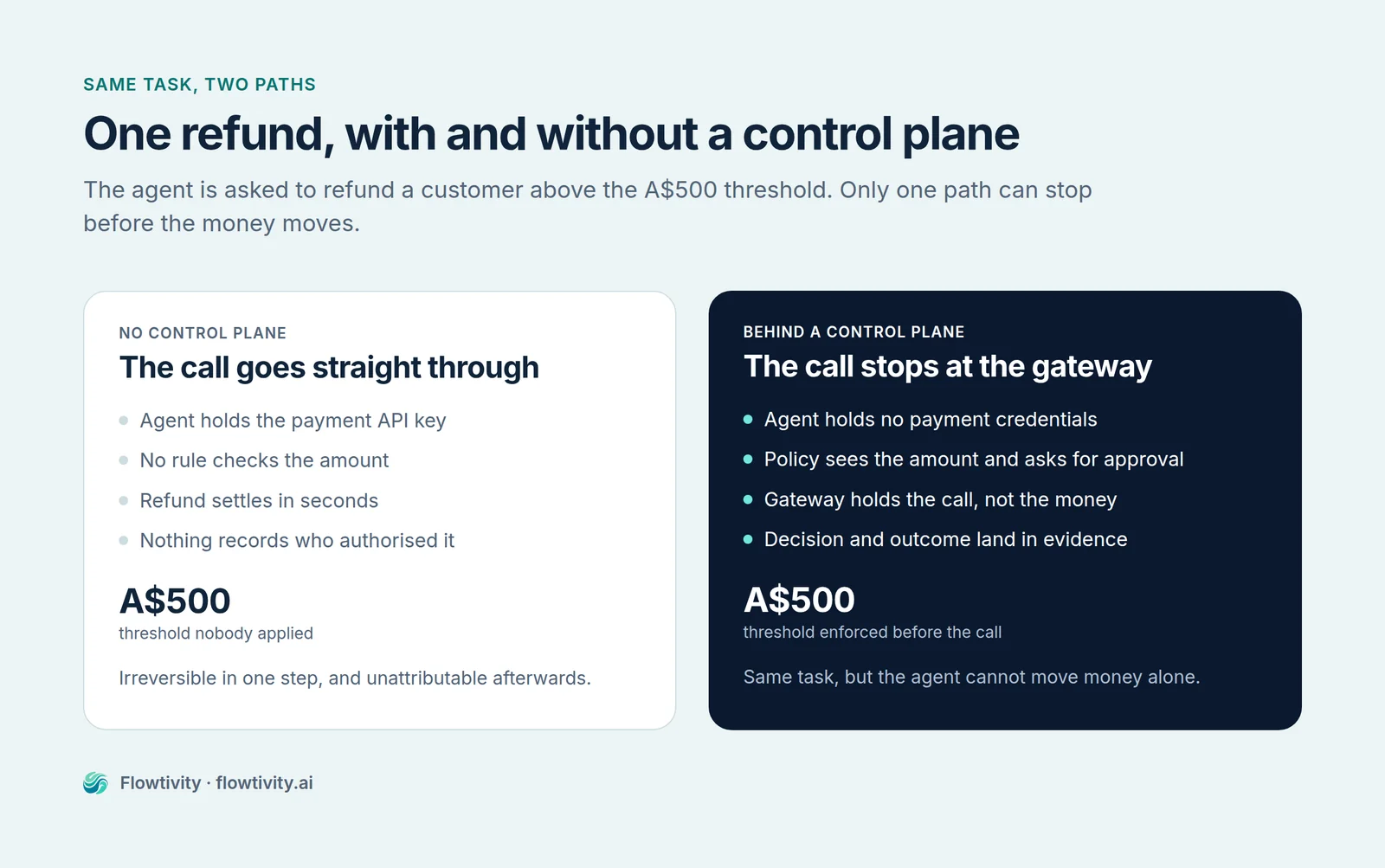
The distinction vendors blur most is between the decision point and the gateway. A policy decision point is a function: it takes a subject, action, resource and context, and returns allow, deny or require approval. It is stateless and cheap. A tool gateway is the enforcement surface: it holds the credentials, proxies the call, applies the decision and writes the audit record. If a product gives you a policy editor but routes tool calls around it, you have a dashboard. The test is simple: disable the vendor UI and see whether the agent can still call the tool.
The runtime is where the agent loop executes, and its controls are step limits, token budgets, allowed model lists and sandbox boundaries, the territory covered in our post on sandboxing agents before production. Telemetry is the fourth piece and the one vendors lead with because it demos well. Telemetry answers what happened. It does not answer what is permitted. An agent that quietly exports a customer list produces beautiful traces, and those traces are the post-mortem, not the control.
The four layers a mid-market business actually needs
Four layers are enough for a business running five to fifty agents. First, agent identity: a distinct workload identity per agent, scoped credentials and a recorded delegation chain showing which human authorised which capability. Second, a policy decision point with a small, readable rule set covering data class, tool, amount, environment and time. Third, a tool gateway every consequential call must pass through, holding the credentials rather than the agent. Fourth, an evidence store keeping the decision, inputs and outcome for the retention period your auditor expects.
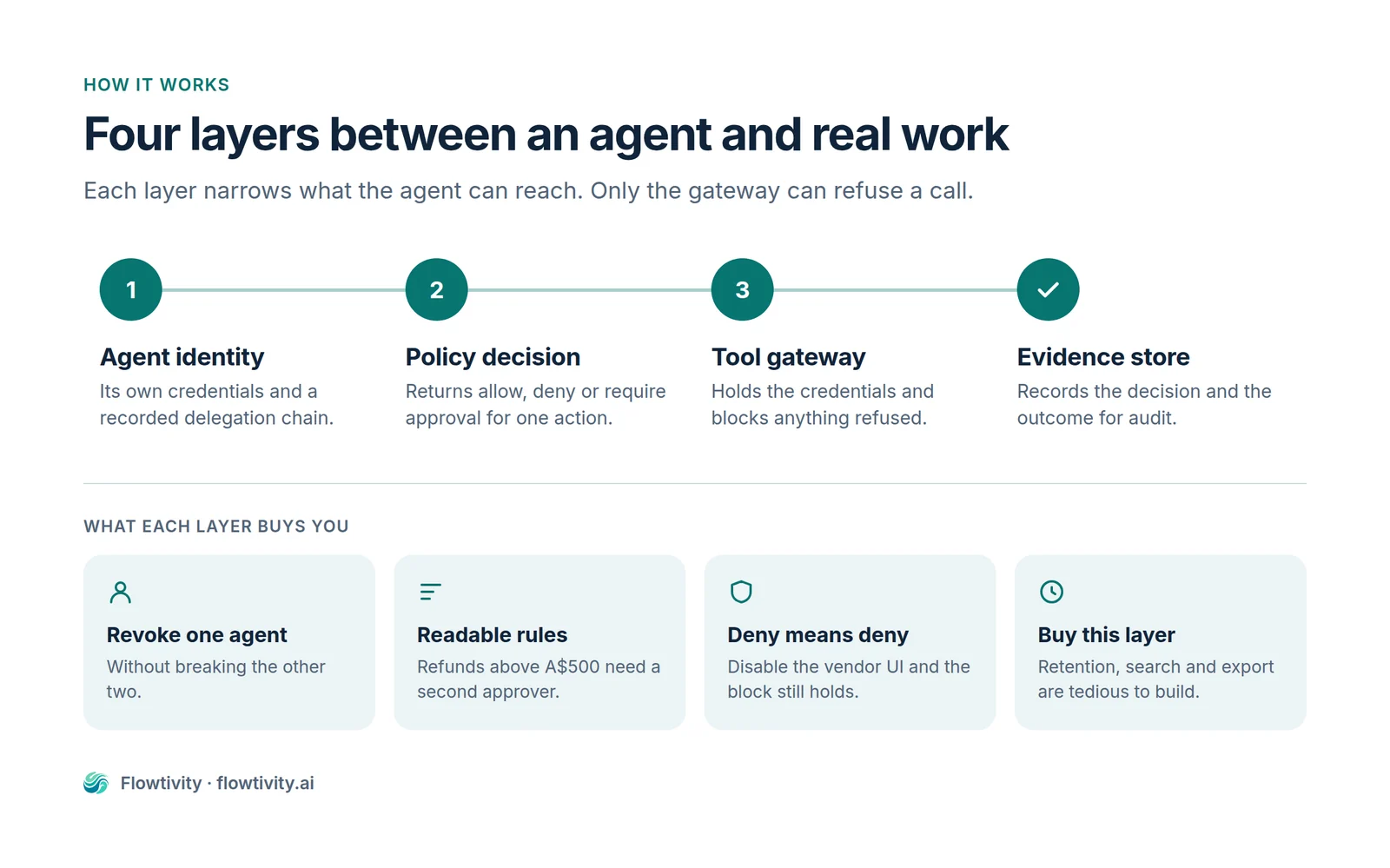
Layer one is the one most businesses skip and the cheapest to fix. If three agents share a service account, you cannot revoke one without breaking the others, and you cannot attribute an action in an audit. Per-agent identity with short-lived credentials is solved in every cloud platform. Layer two is where the design work happens, because policy must be expressible by a business person. Rules like "refunds above A$500 need a second approver" should be readable in a pull request.
Layer three costs money and buys safety. A gateway is unglamorous: a proxy with authentication, rate limits, schema validation and an audit log. It is also the only place where a deny actually denies. Layer four is where most vendor value sits and the layer I would happily buy, because retention, search, tamper evidence and export formats are tedious to build and easy to get wrong. Our post on open source observability covers how far free tooling gets you before you pay.
Buy versus build: where the money actually goes
Building the core costs about A$45,000 across 45 person-days at a loaded day rate of A$1,000, using our arithmetic, and running it costs about A$49,000 a year at a quarter of a full-time engineer. Buying and integrating an enterprise platform costs about A$15,000 across 15 person-days, plus a licence fee that Appian, Zenity and Cogent all quote privately. Build is roughly three times the initial effort and gives you the decision point. Buy is faster and gives you a mature evidence layer.
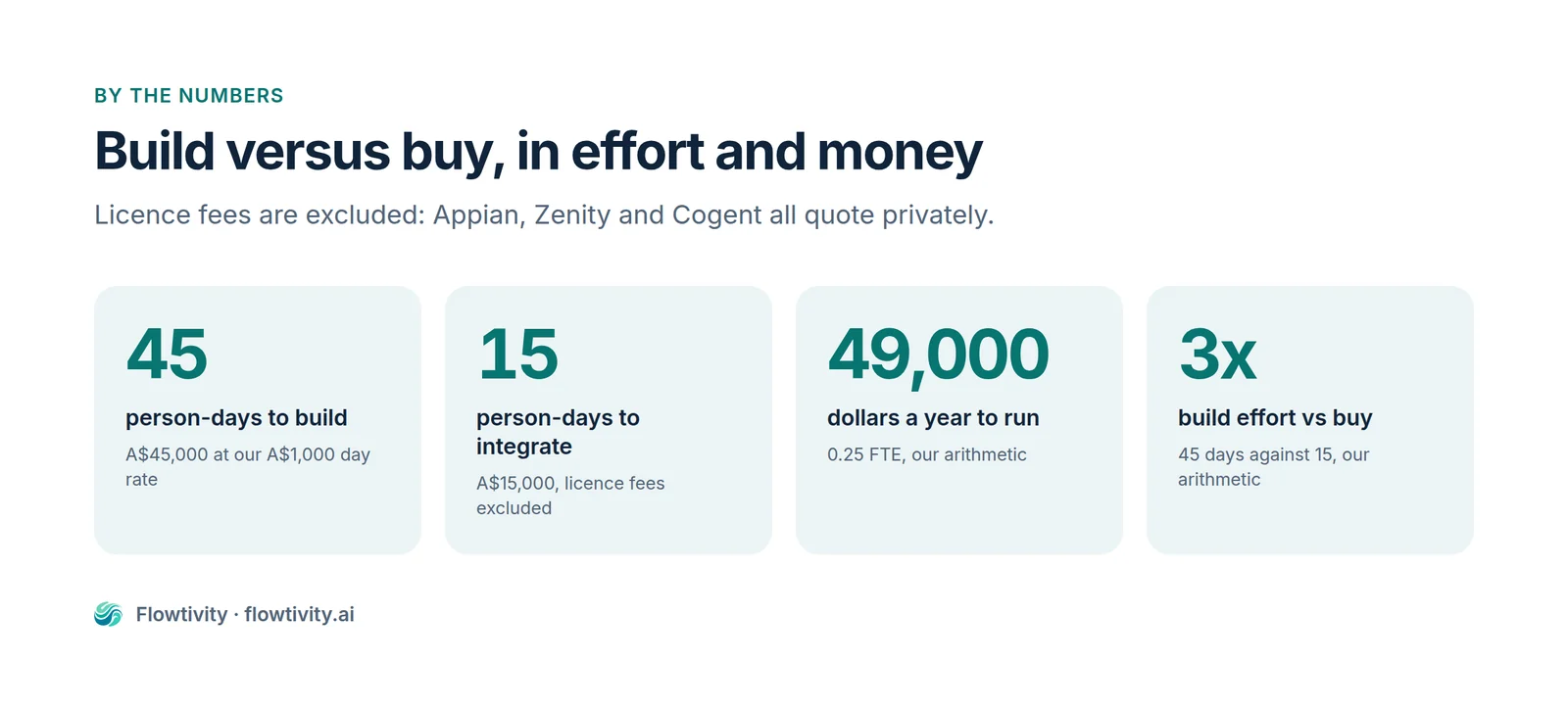
The day rate is derived, not published. SalaryExpert puts the average AI engineer gross salary in Australia at A$149,490 as of 17 November 2026, or A$75.65 an hour. Adding a 30% loading for superannuation, leave, tools and overhead gives A$194,337, which over 195 working days is A$996.60, rounded to A$1,000. That is our arithmetic and an assumption, not a contractor market rate. If your team is on payroll, the marginal cash cost is near zero and the real cost is 45 days of engineering attention.
Vendor pricing deserves a blunt warning. None of the three vendors publishes list pricing for agent governance. Appian sells enterprise agreements, Zenity a platform subscription, Cogent a security product. Any per-agent or per-seat number in a comparison article is unverified. Ask for a written quote with agent count, retention period and SIEM integration spelled out, because those variables move the number more than the headline tier. Treat vendor efficiency claims the same way: Appian's customer Raiffeisen Bank International reported an 80% cut in token consumption and processing time in testing, a vendor-reported result from one bank, not a benchmark.
The lock-in question nobody asks in the demo
Ask who owns the decision point after the contract ends. If policy lives in the vendor's product and the gateway is theirs, leaving means rebuilding every rule, approval path and integration. Our arithmetic puts that exit at about 30 person-days, or A$30,000, more than the original integration. The mitigation is architectural: keep policy as code in your own repository, express it in a portable format such as Open Policy Agent's Rego, and have the vendor consume it rather than own it. Then swapping vendors is a project, not a rebuild.
What to do in the first 30 days
Week one: inventory every agent that can touch a consequential system and record its credential. Week two: put a gateway in front of the three highest-risk tools, even if it is a thin proxy with a hardcoded allowlist. Week three: write five policies as code and wire them to the gateway, starting with amount thresholds, data residency and after-hours restrictions. Week four: instrument decisions into one evidence store and run a tabletop exercise where an agent tries something it should not. Thirty days gets you a real enforcement point, not a proof of concept.
Sequencing matters more than tooling. Teams that start with dashboards spend months producing beautiful reports about actions they cannot stop. Teams that start with a gateway get a deny on day fourteen, and that deny is the moment the control plane becomes real. If you already have an observability stack, keep it and put the gateway in front. If not, structured logs in an immutable bucket with a retention policy answer an auditor's first three questions.
The Flowtivity play: four ways we can help
We run this architecture on our own hardware, with two DGX Sparks serving DeepSeek V4 Flash locally, so the decision point and evidence store never depend on a third-party API being available. For a mid-market Australian business we offer four engagements. The first is a two-day control plane readiness assessment that inventories every agent, maps its credentials and risk-ranks what needs a gateway first. The second is a gateway build: we deploy a tool gateway in front of your highest-risk systems with per-agent identity and policy as code, typically inside three weeks.
The third is a buy-side evaluation. If you are weighing Appian, Zenity, Cogent or a Microsoft-native path, we run the demo you should have run yourself: disable the vendor UI, attempt a tool call, and see whether enforcement holds. We score each option on where the decision point lives, what the export format looks like and what leaving would cost. The fourth is a managed evidence service, where we run telemetry and retention on local infrastructure so your agent audit trail stays in Australia and stays yours. Every engagement produces an artefact you own, not a dependency on us.
All four are fixed-scope and quoted after the assessment, because governance cost depends on how many tools you have exposed and how long you must keep evidence. What we will not do is sell you a dashboard and call it a control plane. If the enforcement point is missing, the dashboard is an expensive way to learn what went wrong. For the economics of local inference see local inference economics, and for the deployment pattern see self-hosted agents on premises.
Frequently asked questions
These are the questions Australian buyers actually ask when they start pricing agent governance. The short version is that a control plane is an architecture, not a product, and the buy versus build decision turns on who owns the policy decision point rather than on which vendor has the prettiest console. If you take one thing from this section, take the gateway test: if disabling the vendor interface does not stop the agent, you have bought a reporting tool.
Do I need a control plane if I only run two or three agents?
Yes, if any of those agents can move money, change a customer record or send external email. Agent count is the wrong measure. What matters is the blast radius of one wrong action. Two agents with production credentials and no gateway is a bigger exposure than twenty read-only agents behind one.
What is the difference between a control plane and an observability platform?
An observability platform records what happened. A control plane decides what is allowed and enforces it before the action occurs. You can run excellent observability with no control plane, and that is exactly the configuration that produces detailed post-mortems for incidents that should never have happened.
Can I build one with open source components?
Yes. Open Policy Agent for the decision point, a reverse proxy or MCP gateway for enforcement, workload identity for agent credentials, and immutable object storage for evidence cover most mid-market needs. The gap is retention management, search and auditor-friendly export, which is where buying becomes rational.
How much does an enterprise agent control plane cost?
Appian, Zenity and Cogent do not publish list pricing, so any figure you see is unverified. Expect quote-only agreements priced by agent count, retention period and SIEM integration. Budget about A$15,000 in integration effort at 15 person-days using our arithmetic, and get the licence quote in writing before committing to a pilot.
Will a control plane slow my agents down?
A well-built gateway adds single-digit milliseconds per tool call, because policy evaluation is a local function call and the proxy hop is short. The real latency risk is approval workflows, where a human decision adds minutes. Set thresholds so low-value actions pass automatically and only consequential ones wait.
Takeaways
Four things to hold onto. The control plane is four layers, and only the tool gateway can actually stop an action. The land grab of 17 November 2026 made governance a priced tier, so the buy decision is now a real budget line. Building the core costs about A$45,000 and 45 person-days on our arithmetic, while integrating a bought platform costs about A$15,000 plus an unpublished licence fee. And the lock-in risk sits entirely in who owns the policy decision point, which is why policy belongs in your repository as code.
- Enforcement beats reporting. A dashboard that cannot deny a tool call is not a control plane, and the gateway test proves which one you have.
- Build the decision point, buy the evidence layer. Policy as code in your own repository keeps the exit cheap and the authority yours.
- The market moved on 17 November 2026. Microsoft, Appian, Zenity and Cogent all shipped governance capability in one week, so compare on architecture, not feature lists.
- Start with a gateway, not a dashboard. Thirty days of sequencing gets you a real deny, worth more than six months of beautiful traces.
What's actually useful in AI, every Friday
We follow everything happening in AI and send what's worth your time: new models, AI agents, and how to put them to work. One email a week, unsubscribe anytime.