
On this page
- What the 35% actually measures
- Why the same automation disappoints in an office
- The three shapes that pay
- The shapes that do not
- The arithmetic, done honestly
- What to measure, before and after
- Frequently asked questions
- What did Rockwell Automation actually achieve with AI?
- Why do most AI automation projects fail to deliver ROI?
- Which workflows should a small business automate first?
- How long should an automation payback take?
- Do I need to redesign the process before automating it?
- About the author
Last Updated: 14 November 2026
Key takeaways
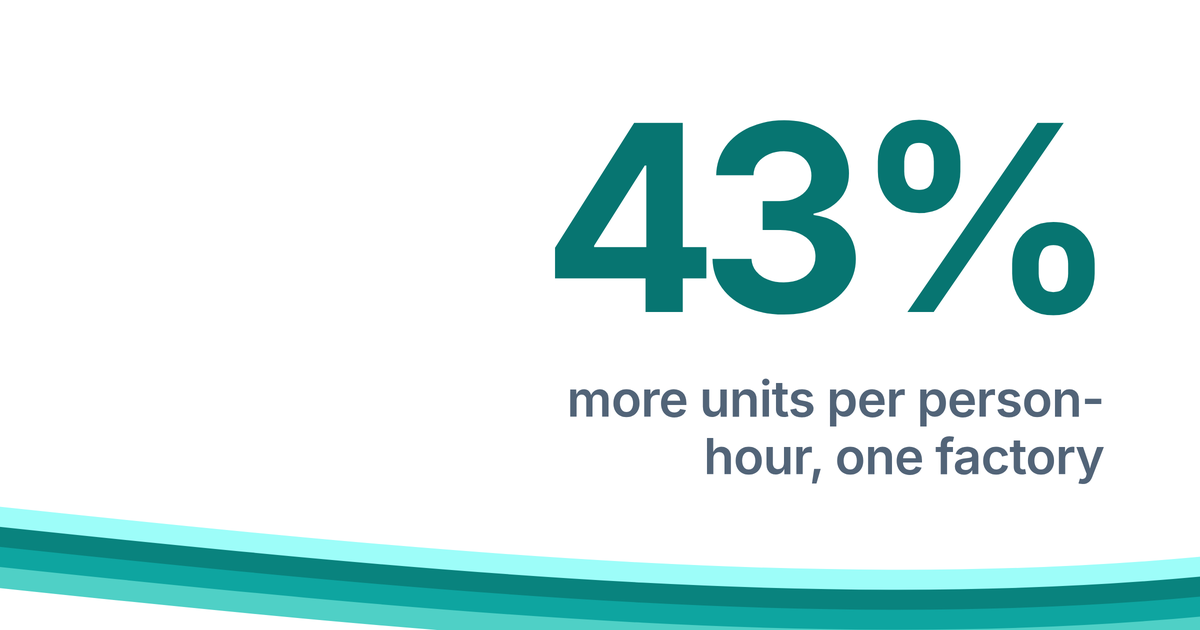
- ▪ Rockwell Automation's Singapore factory, cited by the World Economic Forum as a lighthouse site, reports 43% more units per person-hour, 35% fewer defects and 67% faster time-to-competency. Those numbers came from redesigning the site, not from bolting a model onto it.
- ▪ Citigroup is reworking roughly 100 manual processes end to end in 2026. Research from American Banker found most other banks are still adding AI to existing workflows or making partial changes, which is why their returns are smaller.
- ▪ Automation pays where the task is rule-bound, high volume, low exception rate and measured on a number you already track: defect rate, cycle time, cost per transaction or rework.
- ▪ It loses money on low-volume judgement work, on workflows where more than about a fifth of cases are exceptions, and anywhere the process was never defined well enough to automate.
- ▪ The MIT NANDA study found 95% of organisations reporting zero return from GenAI pilots, and Gartner expects more than 40% of agentic projects to be cancelled by the end of 2027. The gap is process design, not model quality.
- ▪ A worked break-even on a 2,000-document-a-month workflow pays back a $40,000 build in about two months, once supervision is counted honestly.
What the 35% actually measures
Rockwell Automation's Singapore factory is a model manufacturing site for its global operations and its clients, and the World Economic Forum cited it as a lighthouse site with three measured outcomes: 43% more units per person-hour, 35% fewer defects and 67% faster time-to-competency. Microsoft's write-up of the same program describes the mechanism behind those numbers: pairing AI with decades of shop-floor know-how so that workers diagnose glitches faster instead of waiting for an expert.
Read the three numbers together and they describe a site that changed how work flows. Units per person-hour is throughput. Defects is quality. Time-to-competency is how fast a new operator becomes useful. None of those are model benchmarks. They are operational metrics that existed before the AI program and were measured the same way after it, which is exactly what makes them credible.
That is the first lesson for any business owner reading a vendor case study. The number to look for is not the percentage. It is whether the percentage is measured on a metric the business already tracked, over a period long enough to exclude a good quarter, with the process change described. If a case study quotes a percentage but cannot tell you what the denominator was, treat it as marketing.
Why the same automation disappoints in an office
The manufacturing version works because a factory line is already a defined sequence of steps with a measurable output. Most office workflows are not. They are a set of habits that live in someone's head, documented only when someone new joins, and full of exceptions that nobody has counted.
Citigroup is the useful counter-example because it went the other way. The bank has begun a firmwide overhaul of roughly 100 manual processes using AI and automation in 2026, and management is treating the program as an integrated redesign rather than a layer of tools on top of existing procedures. American Banker's research on the same theme found that most other banks report adding AI to existing workflows or making only partial changes. That is the difference between a step change and a rounding error.
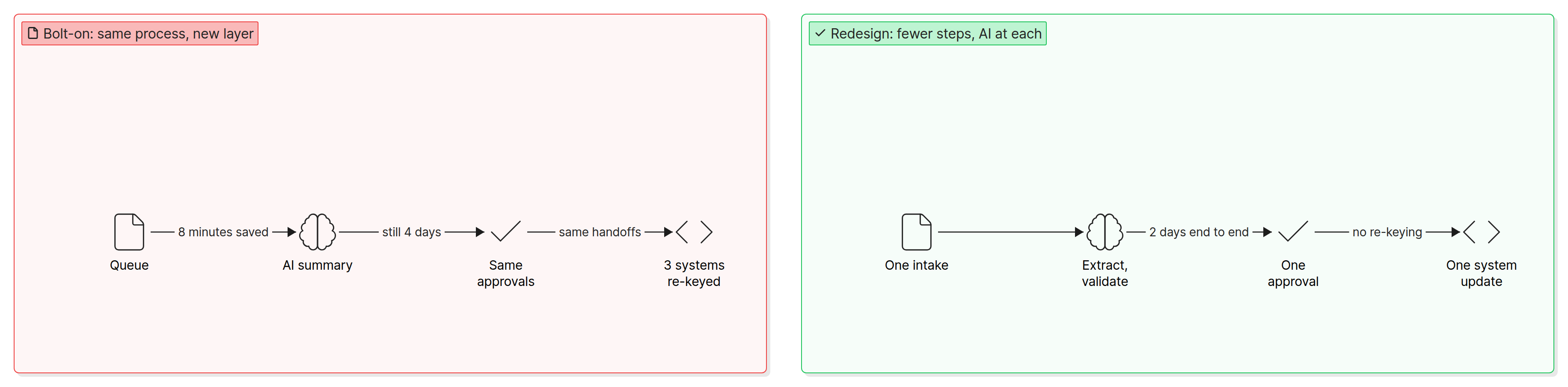
Here is what that looks like in practice. A bolt-on project puts a summariser in front of a queue that still needs a human to triage, route, approve and re-key the outcome into three systems. The model saves eight minutes of reading and the workflow still takes four days. A redesign asks why the queue exists, which approvals are genuinely required, and which systems could be updated once instead of three times. The model then sits at the two or three steps that survive, and the cycle time falls by an order of magnitude because the handoffs are gone.
Bolt-on projects are cheap to start and hard to justify at the end. Redesign projects are expensive to start and produce the numbers that get quoted in press releases. The mistake most small and mid-size businesses make is buying the first kind while expecting the second kind of result.
The three shapes that pay
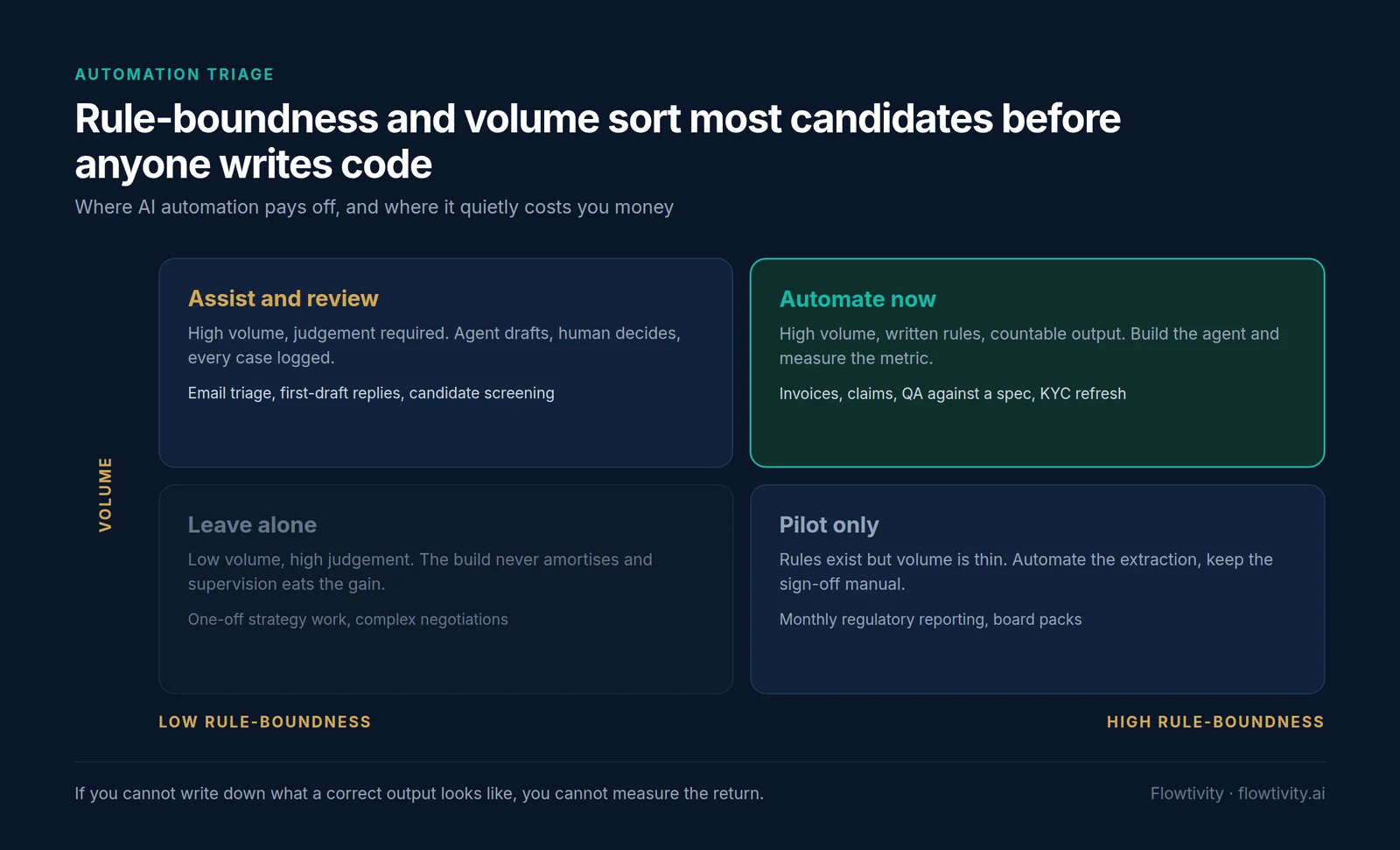
Across manufacturing, banking and back-office work, the workflows that produce measurable return share a shape. They are rule-bound enough that a competent new starter could be trained on them in a week, they run at volume, and their exceptions are rare enough to handle by hand.
| Workflow shape | Why it pays | Metric to watch |
|---|---|---|
| Quality inspection and verification against a spec | Defects are countable, the spec is written down, and the cost of a miss is visible. Rockwell's 35% defect reduction sits here. | Defect rate and escape rate |
| Document-heavy back office: invoices, claims, onboarding packs | High volume, repeated field extraction, and a clear pass or fail test per document. | Cost per document and rework rate |
| Repetitive review with written rules: compliance checks, KYC refresh, contract clause review | The rule set exists because a regulator or a lawyer wrote it, so correctness is testable. | Cycle time and exception rate |
The common thread is testability. If you can write down what a correct output looks like, you can measure the agent against it, and you can prove the return. If you cannot write that down, you are buying a demo.
The shapes that do not
The inverse list is just as useful. Automation loses money on low-volume judgement work, where a specialist handles twenty cases a month and the build cost never amortises. It loses money where the exception rate is high, because the human still has to touch most cases and now has an extra system in the way. And it loses money where the process was never defined, because the agent will faithfully automate the confusion.

There is a specific trap worth naming: the workflow that looks automatable because it is repetitive, but whose repetition is actually a symptom of upstream quality problems. Automating the rework step makes the rework cheaper and therefore more likely to continue. Fix the upstream cause first, then automate what remains. This is unglamorous and it is where most of the return hides.
The arithmetic, done honestly
Take a back-office workflow that processes 2,000 documents a month at 12 minutes each. That is 400 hours a month, or roughly $26,000 at a loaded rate of $65 an hour. A build costs $40,000 once. Running the agent costs about $900 a month in model and infrastructure. Supervision costs 8 hours a month at $65, or $520.
After redesign, assume the agent handles 70% of documents end to end at one minute of machine time and a spot check, and 30% still need a human at six minutes because they are exceptions. That is 70% of 2,000 at one minute, about 23 hours, plus 30% at six minutes, about 60 hours, so 83 hours of human and machine time against 400 hours before. Cost falls to about $5,400 of labour plus $900 of run cost plus $520 of supervision, roughly $6,800 a month.
That is a saving of about $19,200 a month against a $40,000 build, which pays back in just over two months. Those are our numbers with stated assumptions, not a vendor claim, and the point of showing them is that the result is sensitive to two inputs: the exception rate and the supervision hours. Move the exception rate from 30% to 50% and the payback doubles. Remove supervision entirely and you have built something nobody trusts.
This is why the discovery phase matters more than the build. Two days of counting exceptions and measuring cycle time will tell you whether the payback is two months or never, and it costs a fraction of the build.
What to measure, before and after
Pick the metric before the build, measure it for a month, and do not change the definition afterwards. For quality work, defect rate and escape rate. For back office, cost per document and rework rate. For review workflows, cycle time and exception rate. For all of them, add two operational numbers: the share of cases the agent handled without human intervention, and the share that needed escalation because the agent was wrong rather than because the case was unusual.
That last distinction is the one most teams miss. An agent that escalates 30% of cases because they are genuinely hard is working. An agent that escalates 30% because it is wrong 30% of the time is a cost centre with a dashboard. You cannot tell the two apart without reading a sample of the escalations, which is a human hour a week and the cheapest insurance you can buy.
Frequently asked questions
What did Rockwell Automation actually achieve with AI?
Its Singapore factory, cited by the World Economic Forum as a lighthouse site, reports 43% more units per person-hour, 35% fewer defects and 67% faster time-to-competency. The gains came from a site-wide program that paired AI with shop-floor expertise, not from a single model deployment.
Why do most AI automation projects fail to deliver ROI?
Because most projects bolt AI onto an unchanged process. The MIT NANDA study found 95% of organisations reporting zero return from GenAI pilots, and the common pattern is a model inserted at one step while the handoffs, approvals and rework stay the same. Redesigning the process, as Citigroup is doing across roughly 100 processes, is what produces the measurable gains.
Which workflows should a small business automate first?
Start with a workflow that is rule-bound, runs at volume, has a low exception rate and is already measured on a number you track. Document-heavy back office, quality verification against a written spec and repetitive compliance review are the usual first candidates.
How long should an automation payback take?
On a 2,000-document-a-month workflow with a 30% exception rate, a $40,000 build pays back in about two months once run costs and supervision are counted. If the exception rate is above half, the payback stretches past a year and the workflow is not ready.
Do I need to redesign the process before automating it?
Yes, if you want the numbers that get quoted in case studies. A bolt-on project saves minutes on one step and leaves the cycle time intact. A redesign removes handoffs, which is where most of the elapsed time and most of the error live.
About the author
AJ Awan is the founder of Flowtivity, an AI consultancy based on the Gold Coast. He is a former EY management consultant and a TOGAF certified enterprise architect, and he builds agent systems for Australian businesses that need them to run in production rather than in a demo.
What's actually useful in AI, every Friday
We follow everything happening in AI and send what's worth your time: new models, AI agents, and how to put them to work. One email a week, unsubscribe anytime.


