On this page
- Key takeaways
- Why are 80% planning AI agents but stuck at basic fluency?
- What does AI fluency actually mean?
- Why does planning outrun capability?
- What does a five-step AI readiness program look like?
- What should you automate first?
- Where do local models fit in building fluency?
- What is the Flowtivity play?
- Frequently asked questions
- What does basic AI fluency mean?
- How many businesses are actually using AI agents?
- Why is AI not making my team more efficient?
- How long does it take to build AI fluency in a team?
- Do we need local models to build AI fluency?
- Takeaways
Last Updated: 10 November 2026
Key takeaways
- ▪ Nearly 80% of businesses are planning AI agents, assistants or automations while still at basic AI fluency, according to research reported in November 2026.
- ▪ The gap is capability, not tooling. A 1,224-person study found 58% of employees can use AI tools generally but cannot apply them to their own role.
- ▪ Deloitte found 43% of organisations expanding agent deployments and only 15% at scaled, orchestrated multi-agent use. Our arithmetic puts that at roughly one in three.
- ▪ Fluency has four levels: prompting, tool use, workflow design and supervising agents. Most teams are stuck at level one.
- ▪ Local models on hardware you own make experimentation cheap and keep client data onshore, which is how a small team builds fluency without a per token bill.
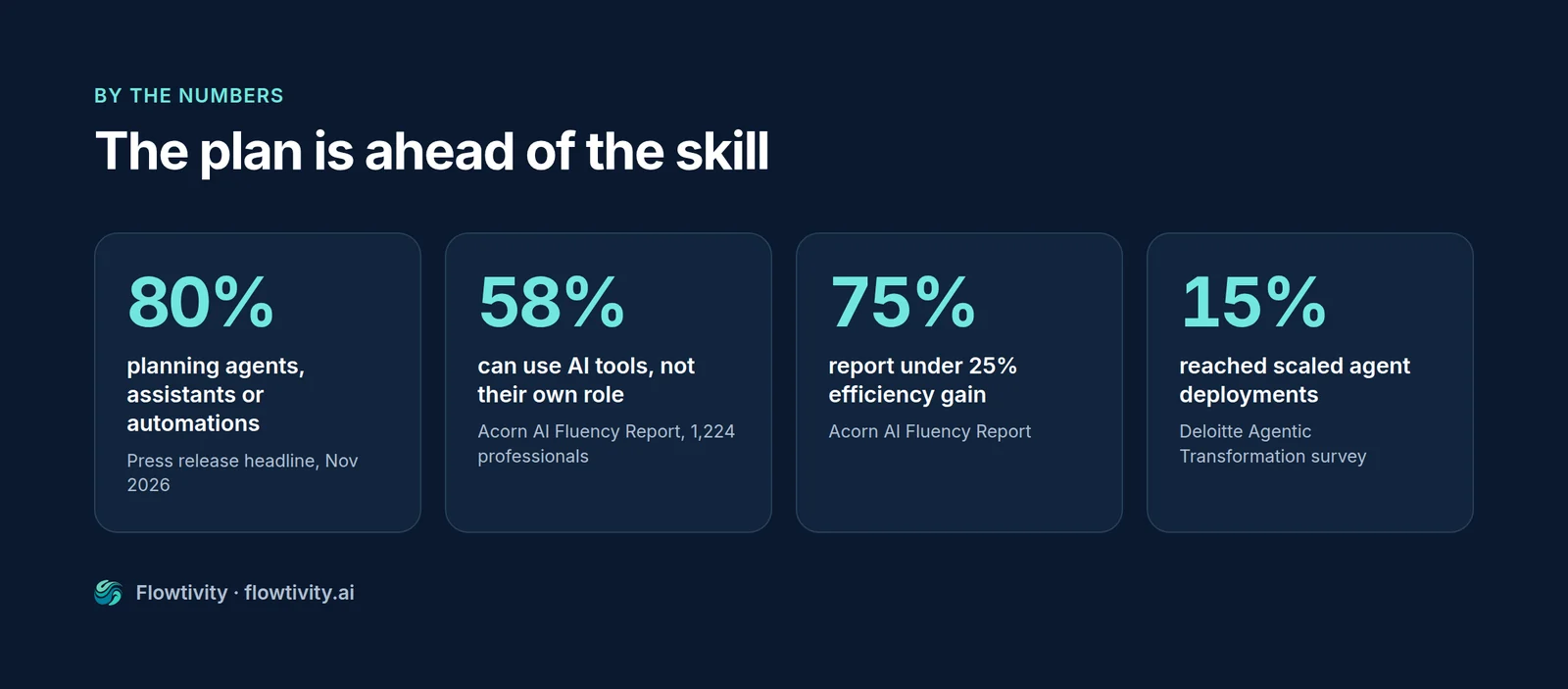
The short answer is that planning an agent is easy and becoming fluent enough to run one is hard, so businesses buy the plan before they build the skill. Research reported in November 2026 found nearly 80% of businesses planning AI agents, assistants or automations while still at basic AI fluency. That headline is the symptom, not the cause. A survey of 1,224 professionals found 58% of employees can use AI tools in general but cannot apply them to their own role, and 75% say AI has made them less than 25% more efficient. The cost of that gap is not the software licence. It is the twelve months a team spends waiting for a tool to fix a capability problem.
Why are 80% planning AI agents but stuck at basic fluency?
Businesses plan agents faster than they build the skill to run them because buying is a decision and fluency is a habit. A plan can be approved in a meeting. Fluency is built by people doing real work with a model, noticing where it fails and changing the workflow around it. The two move at different speeds, and the gap between them is where most agent programs stall.
The numbers line up across independent surveys. Deloitte's Agentic Transformation survey, reported by ZDNET, found 43% of organisations expanding AI agent deployments across functions, but only 15% have reached scaled, orchestrated multi-agent deployments. Our arithmetic puts that at roughly one in three of the organisations that are expanding at all. Acorn's 2026 State of Learning for AI Fluency Report, which surveyed 1,224 professionals from the C-suite to individual contributors across the US, Canada and Australia in April 2026, found that 58% report employees who are proficient with AI tools generally but struggle to apply AI meaningfully to role-specific requirements.
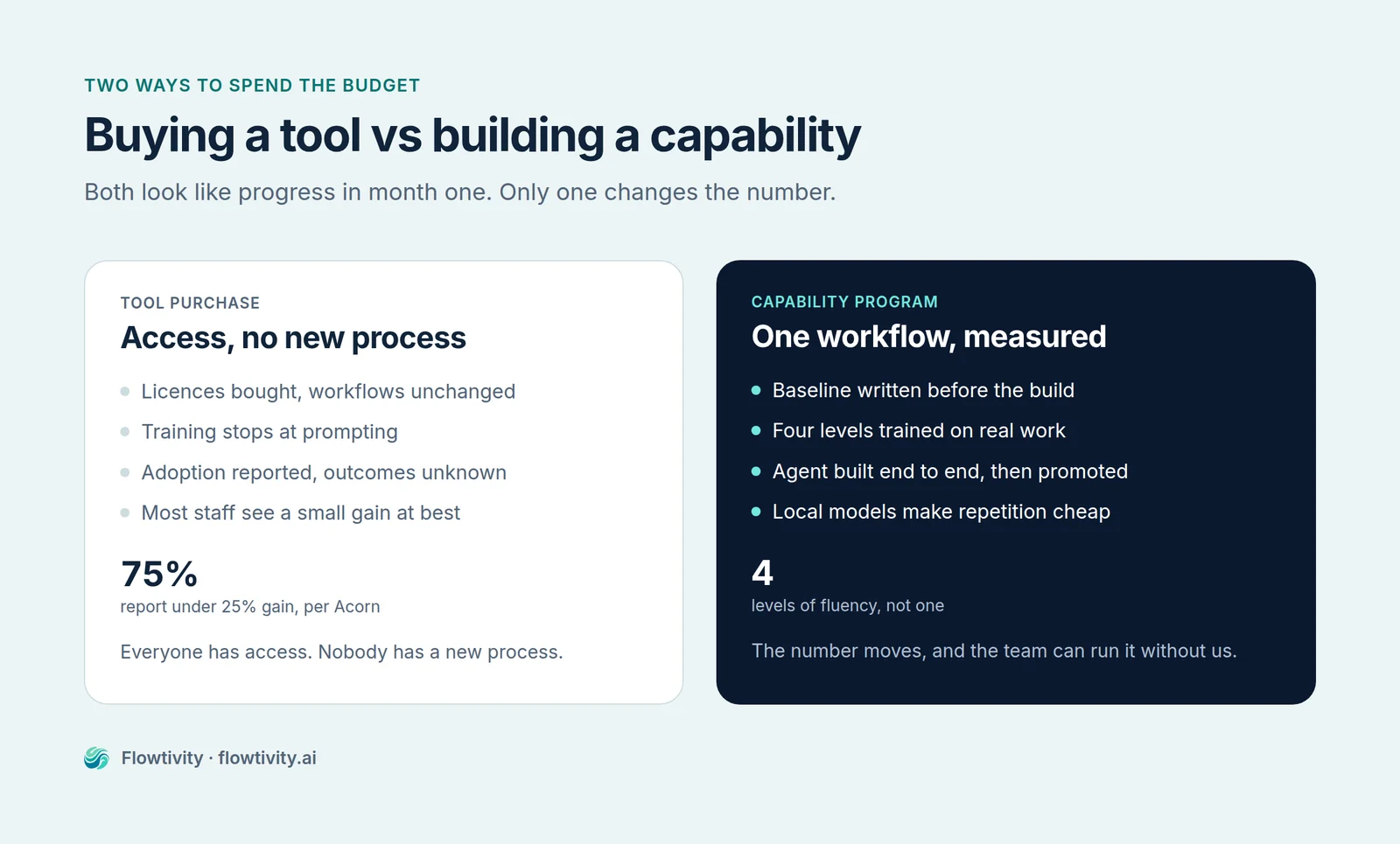
The same report found 75% of employees say AI has made them less than 25% more efficient. That is the sentence worth sitting with. Three in four people are using AI and reporting almost no measurable gain, which is what a tooling-first rollout looks like from the inside. Section's AI Proficiency Report adds the intent: 69% of workers say their organisation has done something with agents, whether access, encouragement, deployment or training, and only 22% say their organisation has done nothing at all. Everyone is doing something. Few are doing it well enough to change a number.
What does AI fluency actually mean?
AI fluency means a person can get a reliable business outcome from a model without someone else designing every step. It is not the same as knowing which tool to open. Fluency has four levels, and each one is a different skill: prompting, tool use, workflow design and supervising agents. A team that can prompt well but cannot design a workflow will produce good paragraphs and no process change.
Level one is prompting: asking for something clearly enough that the model returns usable material. Level two is tool use: knowing when to reach for retrieval, a calculator, a code interpreter or a document store instead of asking the model to remember. Level three is workflow design: breaking a job into steps, deciding which steps a model should do, which a person should do and where the handoff sits. Level four is supervising an agent: setting permissions, reading its trace, catching drift and knowing when to stop it. Levels three and four are where the business value lives, and they are the levels almost nobody trains for.
This is why the 58% figure is not a criticism of employees. Most AI training stops at level one because prompting is easy to teach in an afternoon. Workflow design requires knowing the actual job, which means the person who understands the process has to be in the room. That is a management problem dressed as a training problem, and it is the reason a generic course rarely moves the efficiency number.
Why does planning outrun capability?
Planning outruns capability because the incentives favour announcements. A roadmap is visible to a board, a vendor demo is convincing, and an agent pilot can be launched in a week. Building fluency takes months of unglamorous work with no launch event. McKinsey's State of AI 2026 describes organisations scaling AI across the enterprise, deploying in more business functions and using agentic systems, which is true of the leaders and misleading as a benchmark for everyone else.
There is also a measurement trap. Teams report adoption, not outcomes, because adoption is easy to count. Seats licensed, prompts sent, agents deployed. None of those numbers tell you whether the workflow got cheaper, faster or more accurate. The Acorn finding that 75% of employees see less than a 25% efficiency gain is what you get when nobody agreed on a baseline before the tool arrived.
What does a five-step AI readiness program look like?
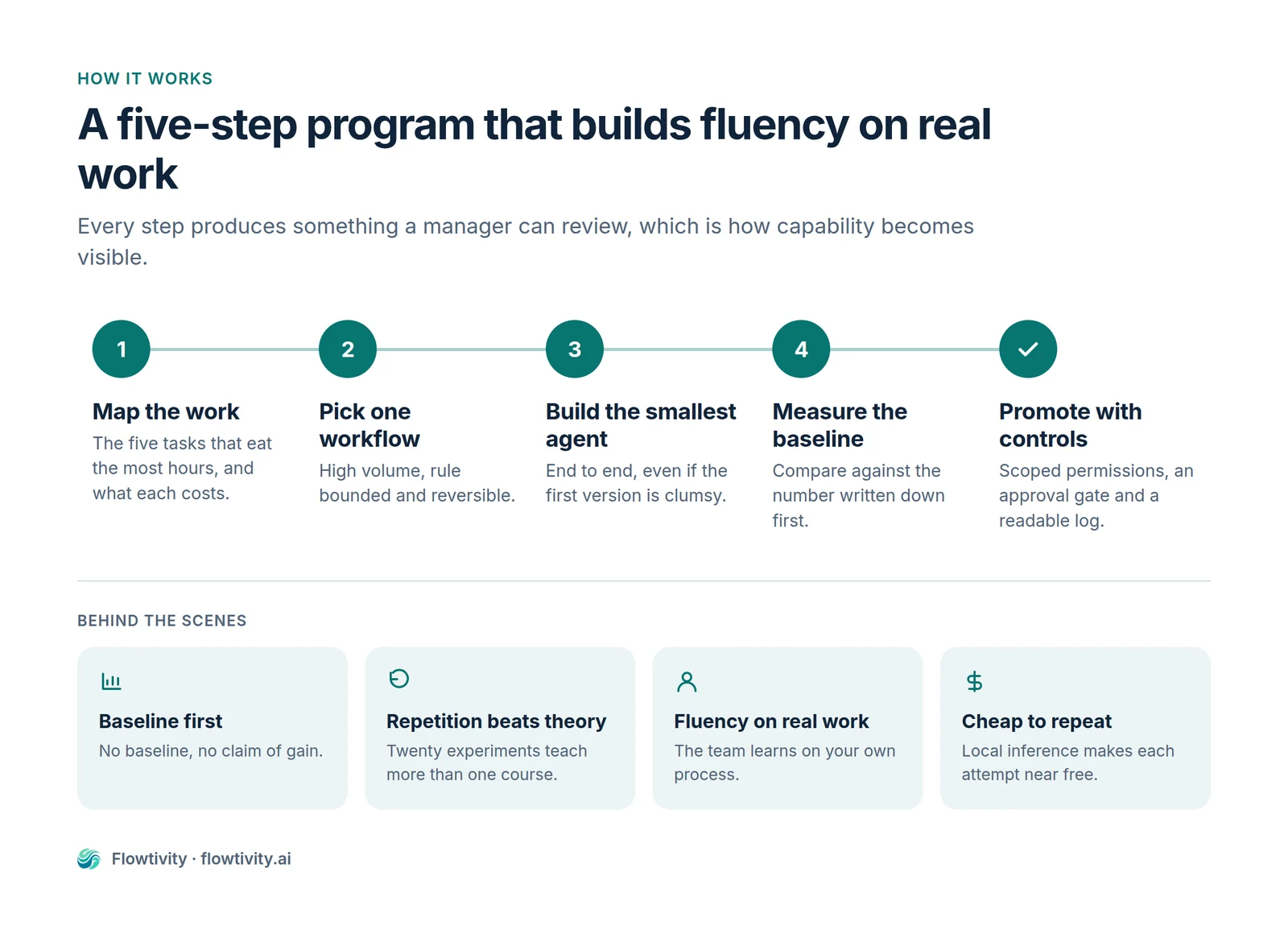
A five-step readiness program works because it forces the team to pick one workflow, measure it and build the skill on real work rather than in a classroom. The steps are: map the work, choose one measurable workflow, build the smallest agent that does it, measure against a baseline and promote it with controls. Each step produces an artifact a manager can review, which is how fluency becomes visible.
Map the work first. Write down the five tasks that consume the most hours per week and what each costs in dollars or days. Choose one workflow that is high volume, rule bounded and reversible, because that is where an agent can show a result without risking the business. Build the smallest version that completes the workflow end to end, even if it is clumsy, because a working loop teaches more than a perfect plan. Measure against the baseline you wrote down in step one, and be willing to find no gain. Then promote it with the controls that make it safe: scoped permissions, an approval gate and a log you can read. Skipping that last step is how a promising pilot becomes an incident.
What should you automate first?
Automate first the work that is high volume, rule bounded, reversible and low consequence when it fails. Quoting, invoice coding, inbox triage, status reporting and document drafting all fit. The test is simple: if the agent gets it wrong, can a person catch it before it reaches a customer, a regulator or a payment? If yes, it is a good first candidate. If no, it belongs in a later phase with tighter controls.
The temptation is to start with the most painful problem, which is usually also the most tangled and the least reversible. Starting there produces a dramatic demo and a stalled program. Starting with a boring workflow produces a number you can defend and a team that has learned to read an agent's output critically, which is the actual asset you are building.
Where do local models fit in building fluency?
Local models fit because fluency requires repetition, and repetition is expensive on a per token bill. When inference runs on hardware you own, the marginal cost of another experiment is close to zero, so a team can try twenty workflows instead of three. That changes behaviour. People experiment more when the meter is not running.
Flowtivity runs dual DGX Spark machines with DeepSeek V4 Flash locally, which gives a small team a fixed monthly cost instead of a variable one and keeps client data onshore while they learn. The trade-off is honest: you take on model updates, hardware lifecycle and the discipline of running a small inference stack, which is why the cost model deserves its own analysis before you commit. But for an Australian business handling client documents, the combination of cheap repetition and data that never leaves the building is hard to beat as a training ground. The same stack then becomes the production home for the agents the team learns to run.
What is the Flowtivity play?
The Flowtivity play is to build the capability and the workflow at the same time, so the team owns the agent rather than renting one. We start with the work, not the tool, because the gap in the research is a capability gap and capability only grows on real tasks.
Four offers cover the work. First, an AI readiness assessment: we map your highest cost workflows, score them for agent suitability and produce a shortlist with a baseline for each. Second, team fluency training built around your own processes, covering prompting, tool use, workflow design and supervising an agent, so people leave able to run what we build. Third, a workflow pilot: one agent built end to end on a workflow from the shortlist, measured against its baseline and promoted with controls. Fourth, a local AI stack: dual DGX Spark hardware with DeepSeek V4 Flash, configured for your data and sized to your volume, so experimentation stays cheap and client data stays onshore.
We do this on the Gold Coast for Australian businesses that want the agent to survive contact with a real client. If your team has AI tools and no measurable gain, the readiness assessment is the place to start.
Frequently asked questions
What does basic AI fluency mean?
Basic AI fluency means someone can use a chat tool to produce usable output for simple tasks, usually at the prompting level. It does not mean they can design a workflow, choose the right tool for a step, or supervise an agent once it runs. The research finding that nearly 80% of businesses remain at basic fluency describes teams that can prompt but cannot yet run an agent reliably.
How many businesses are actually using AI agents?
More are planning than running. Deloitte found 43% of organisations expanding agent deployments, with only 15% at scaled, orchestrated multi-agent use. Section's AI Proficiency Report found 69% of workers say their organisation has done something with agents and 22% say it has done nothing at all. Planning is common. Scaled, supervised operation is rare.
Why is AI not making my team more efficient?
Usually because the tool arrived without a workflow change or a baseline. Acorn's 1,224-person study found 75% of employees say AI has made them less than 25% more efficient, and 58% can use tools generally but not for their own role. Efficiency comes from redesigning a specific workflow around the model and measuring it, not from giving everyone a licence.
How long does it take to build AI fluency in a team?
Longer than a training day and shorter than a transformation program. A team that picks one real workflow and iterates on it weekly typically reaches useful workflow design in a quarter, because the skill grows through repetition on familiar work. Teams that train in the abstract stay at prompting level regardless of how many courses they attend.
Do we need local models to build AI fluency?
No, but they help. Local inference on hardware you own makes each additional experiment cheap, which encourages the repetition fluency requires, and keeps client data onshore. A hosted model with tight data controls can work for teams handling low sensitivity data. Flowtivity runs dual DGX Spark machines with DeepSeek V4 Flash for clients who want both properties.
Takeaways
- Nearly 80% are planning agents while still at basic fluency, and 58% of employees cannot apply AI to their own role.
- Fluency has four levels: prompting, tool use, workflow design and supervising agents. Value sits in the top two.
- Automate a high volume, rule bounded, reversible workflow first, and write the baseline before you start.
- Cheap repetition builds skill. Local models on hardware you own make twenty experiments affordable and keep data onshore.
What's actually useful in AI, every Friday
We follow everything happening in AI and send what's worth your time: new models, AI agents, and how to put them to work. One email a week, unsubscribe anytime.