On this page
- Key takeaways
- What is skill-distill, in plain terms?
- Why are local models suddenly the destination for frontier work?
- How does the teacher-student loop actually work?
- What does "as good as the reference" mean when you measure it?
- Where does the loop break?
- What does a distillation run actually cost?
- When should you distill, fine-tune, or just prompt?
- What does the Flowtivity play look like?
- Sources
Last Updated: 25 November 2026
On 24 November, a developer called 0xSero posted a claim that reads like wishful thinking: Opus can audit its own session traces, write an instruction manual for a local model, and test that manual until the local model reproduces the work. That is how, he says, half of his AI usage runs locally.
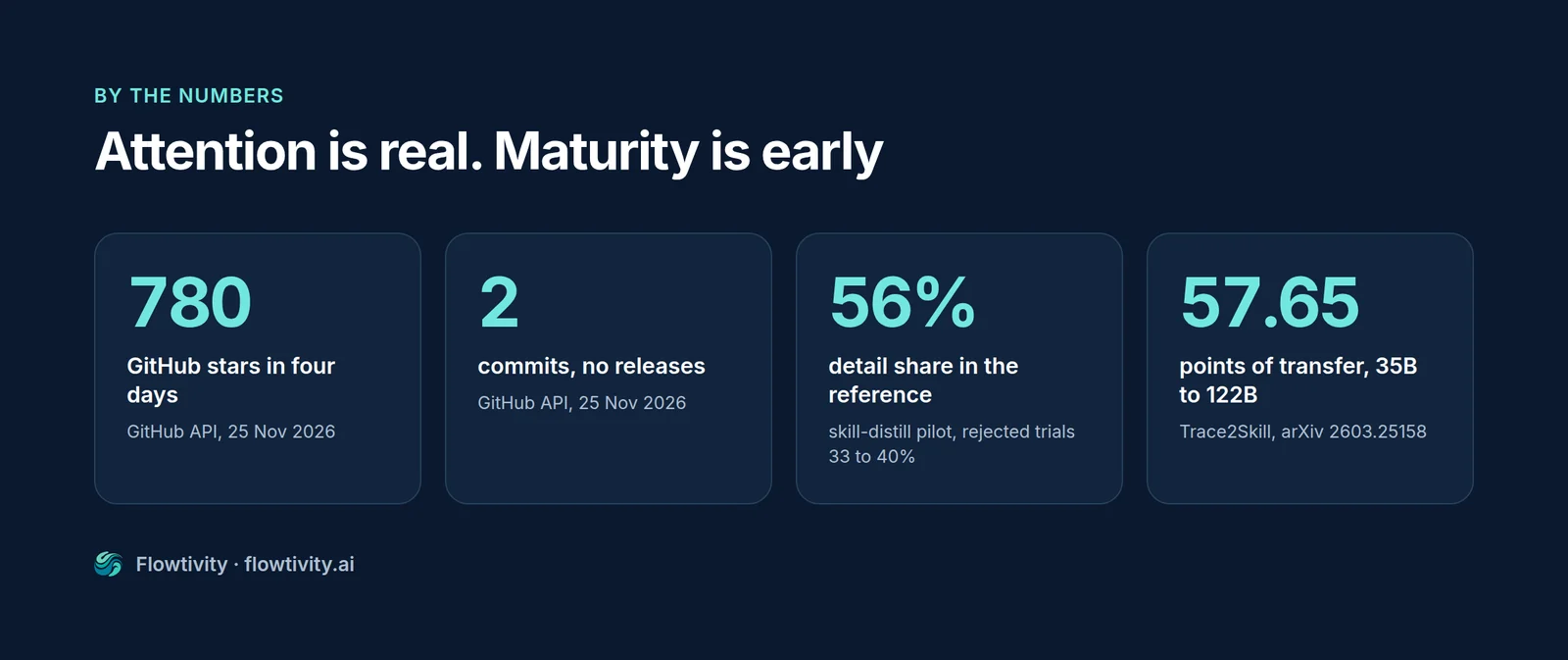
The repository behind the claim is real, small and unusually honest about its own failures. skill-distill is an MIT-licensed skill for Claude Code or Codex, 14 files and 780 stars four days after it was created. It does not fine-tune anything and it does not ship a model. It ships a loop: the frontier model becomes a teacher, a local model becomes a student, and the test is whether the student's output survives a side by side comparison with the reference.
The reusable artefact is a text file you can read, diff and audit, not a set of weights you cannot explain. The interesting part is not that a local model can do the task. It is how much work the teacher has to do before anyone is allowed to say it did.
Key takeaways
- Skill distillation turns one good session into a tested instruction manual for a smaller model. The test is three trials against a reference, not a vibe check.
- Feature parity is not quality. In the repo's own pilot, all three student trials matched at thumbnail size and scored 8.5 to 9 out of 10. The user rejected them as "not even close in quality".
- The cost sits with the teacher, not the student. Every trial is one trace read plus one verdict, and the loop allows up to eight iterations of three trials before it stops.
- Treat "50 percent of my AI usage is local" as an anecdote. The transfer effect behind it is documented: skills built from a 35B model's trajectories lifted a 122B model by up to 57.65 points on one benchmark.
- The repo is four days old with two commits, no releases, one untested adapter and a README that promises an examples folder it does not have. Use the method, check the maturity.
What is skill-distill, in plain terms?
You install it as a skill, finish a session that went well, and say something like "distill this session into a skill for omp with deepseek-v4.1-flash on my local server". The session you just finished is the reference. The harness plus model you name is the student.
From there the teacher follows a fixed loop: read the session and write a skill for the student, start the student in tmux on a fresh copy of the starting state with the original prompt, compare what it produced with what the reference produced, find the first place it went wrong and fix the skill there, then run again with three trials per version until the user accepts the result.
The output is two things: the operator skill itself, reusable for any task, and a produced skill for one task, one model and one harness. A 373-line Python script handles the mechanical half, including runs, trials, evidence, verdicts, the ledger and the report. The teacher only does the parts that need judgement: what the skill says, and whether a trial matches.
Why are local models suddenly the destination for frontier work?
Because the economics moved on both ends at once. Frontier models got good enough to supervise, and open-weight models got good enough to execute narrow tasks. The scarce resource stopped being model capability and became the instructions that let a cheaper model hold a quality line.
There is research behind that, and it predates this repository. Trace2Skill, an arXiv paper from March 2026, consolidates execution trajectories into a unified skill directory. Its authors report that skills evolved from Qwen3.5-35B trajectories improved a Qwen3.5-122B agent by up to 57.65 percentage points on WikiTableQuestions, that the skills transferred across model scales and families, and that they work without any parameter updates.
That is the strongest version of the argument, and it runs in both directions. Skills move upward as well as downward, they are portable, and they compress recurring failures into standard operating procedure. The category is filling up with tools that lint existing skills or record a session and generalise it. What separates this repository is the verification loop: it runs the student, reads the trace, judges the result against named acceptance criteria and records the verdict.
How does the teacher-student loop actually work?
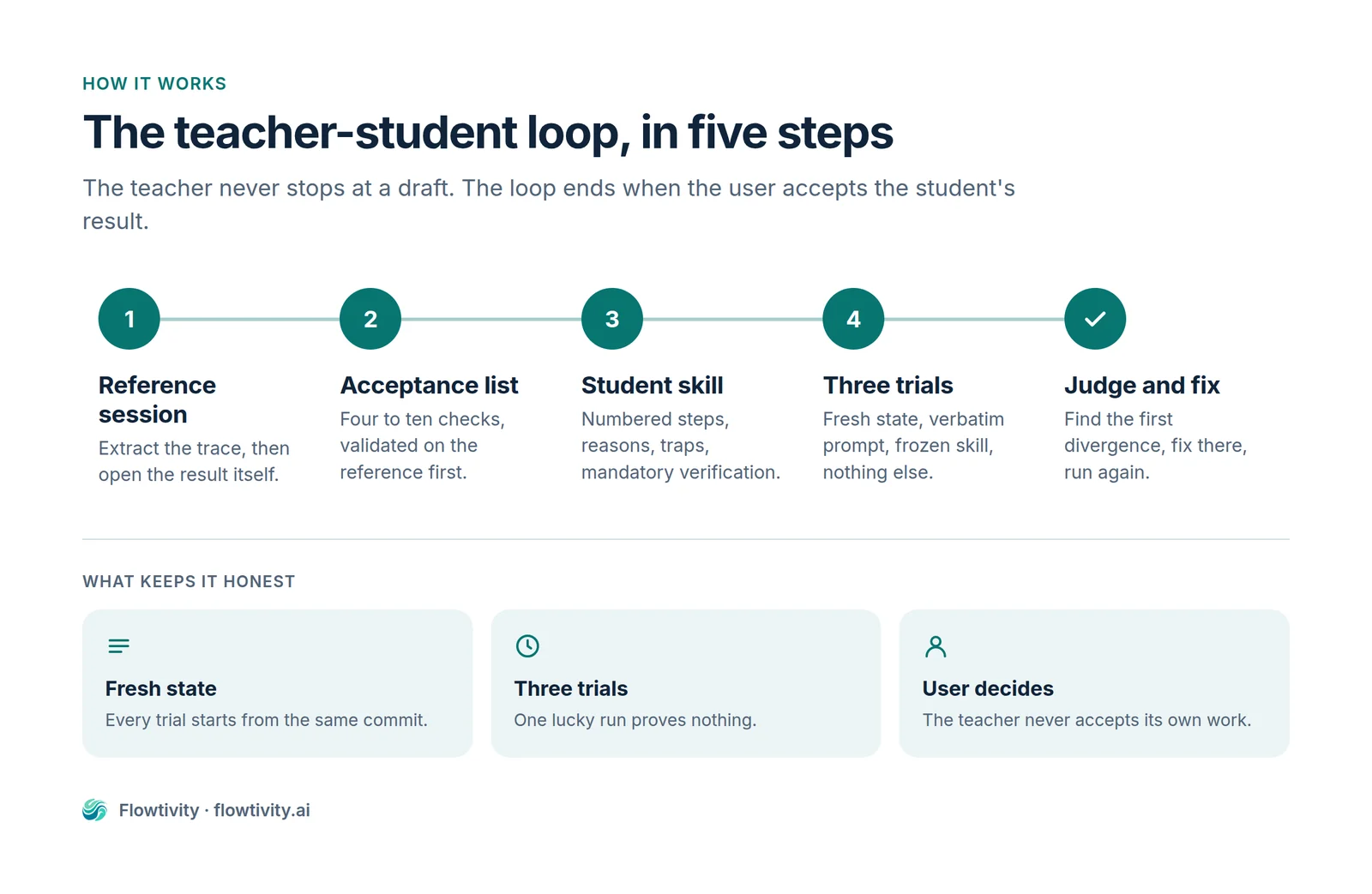
Step one is the reference. The teacher extracts the session log into a readable summary, dropping system prompts and the harness's own context files, then opens the reference result itself. The skill is explicit that the summary is a map, not the result.
Step two is the definition of done. Before any student runs, the teacher writes four to ten observable things that made the reference good, each checkable in a trial, such as "the game starts with no console errors" or "throughput at concurrency one is within five percent of the reference". Then it writes a shell script that checks what a script can, and runs that script on the reference first. If the checks fail on the reference, the checks are wrong.
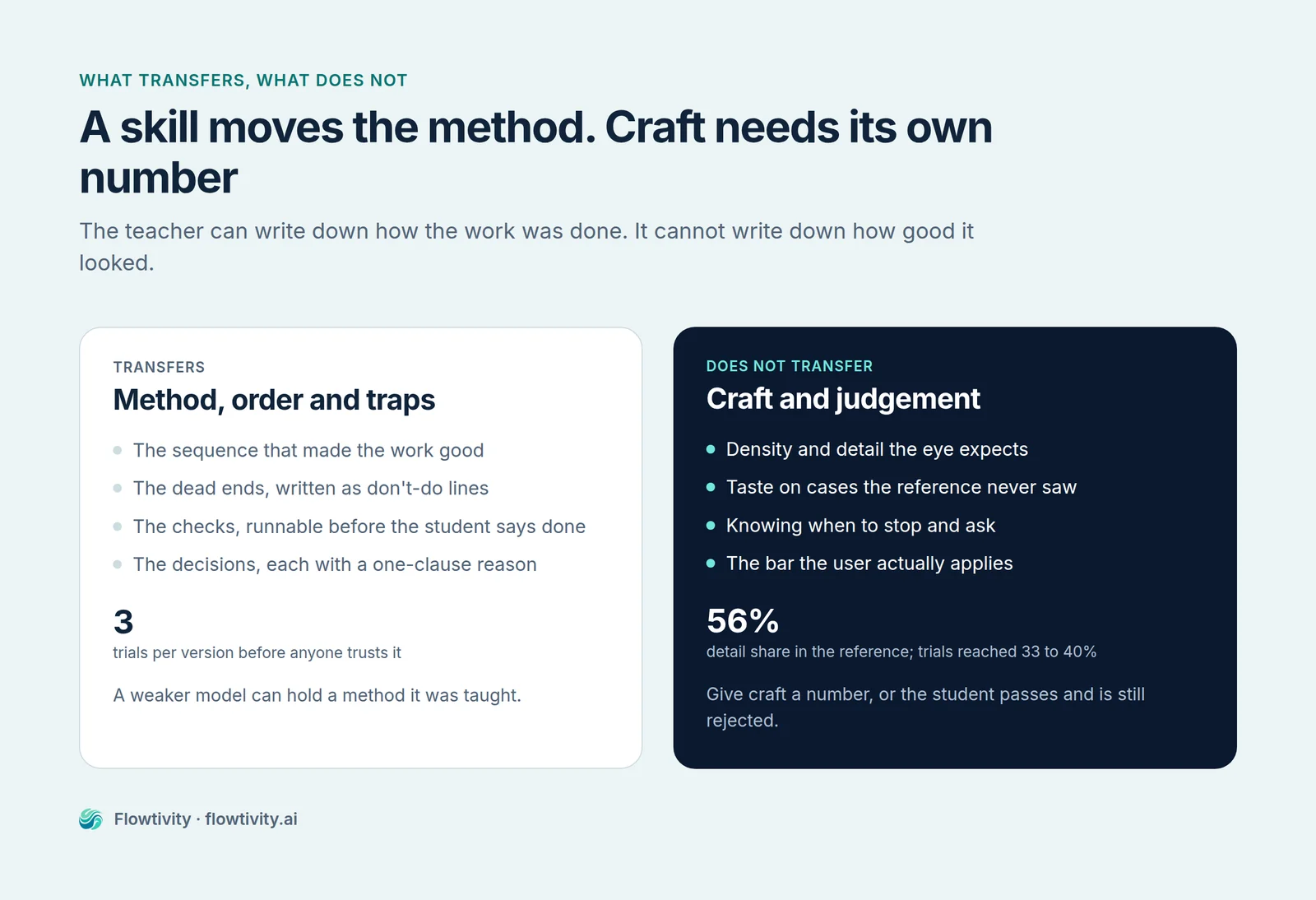
Step three is the first version of the student skill, written for a weaker reader with a shorter usable context. The steps are numbered in the order the reference did the work that mattered, with the dead ends removed. Decisions carry a one-clause reason so the student can adapt. Traps become "don't do X, because Y" lines, and verification is mandatory at the end, because open models often stop early or claim success without checking.
Step four is the trial run. Each trial gets a fresh copy of the starting state, a frozen copy of the skill, the original prompt verbatim and one line pointing at the skill. Nothing else. The student harness's global context files and skills are switched off where it supports that, so the only instructions in play are the prompt and the skill under test. Three trials run in parallel, because open models are noisy.
Step five is the judgement. The teacher reads the trace, the check log and the screenshots, compares them with the acceptance list, and finds the first divergence: the earliest point where the student's path went wrong in a way that explains the gap. It records a verdict of match, close, miss or broken with a score out of ten, then changes the skill in one edit and runs the next iteration.
The stop conditions are explicit. Three matching trials ends the loop, and so do eight iterations or three consecutive iterations without improvement. The user then sees the reference and the trials side by side and makes the pass or fail call. A fail becomes new acceptance criteria, and the loop continues.
What does "as good as the reference" mean when you measure it?
This is where the repository earns its credibility, because the pilot is documented rather than polished.
All three student trials had every feature and matched the reference at thumbnail size. The teacher scored them 8.5 to 9 out of 10. The user rejected them immediately: "not even close in quality". Up close, the student's work was sparse and plain. Feature parity had hidden a craft gap that a score out of ten had smoothed over.
The fix was to stop trusting the eye and give the student a number it could check. The teacher defined "share of screen cells with visible detail", measured the reference at 56 percent and the rejected trials at 33 to 40 percent, and gave the student skill a script that prints the number plus a map of the empty regions. That is the pattern worth stealing even if you never install the tool: if you care about a visual property, give the agent a measurable target, not an adjective.
Three more rules from the skill are worth repeating to anyone running agent evaluations.
- The student's final message is not evidence. Students routinely say "verified, all tests pass". Run the result yourself, then drive it by hand the way a user would.
- When a check fails, suspect the check first. In the pilot, three of four "failures" were probe bugs: a guessed storage key, Escape opening a pause menu, and a dismiss click that missed.
- Probe state at three points, start, middle and end, and inject saved state before the page's scripts run. Setting state and reloading fails because many pages save over it on unload.
Where does the loop break?
Five limits are visible from the repository itself, and none of them appear in the tweet.
The repository is young. Four days old, two commits, no releases, one author. The README's file table lists an examples folder with finished runs, including the prompt, the produced skill, the ledger and screenshots. The repository does not contain that folder. The pilot evidence exists as prose inside the skill, which is honest, but it is not a reproducible example you can inspect.
Two of the five adapters are unfinished. omp is tested, Codex CLI is tested as a teacher and needs a provider configured to act as a student, and Claude Code is written but needs an Anthropic-compatible endpoint for open models. pi is written and untested. opencode is written and untested, and its JSON log has no parser in the extraction script, so it can run a trial but cannot produce the trace the teacher needs to judge it. The only open issue, filed on 25 November, patches the pi adapter.
The skill is only as good as the teacher's judgement. The pilot shows a teacher that scored 8.5 to 9 on work the user rejected outright. The rubric is prose, the verdict is a judgement call, and nothing stops a generous teacher from accepting work that would fail in front of a customer. If you run this, the acceptance list is the control, not the score.
The anti-leak rule is a rule, not a guarantee. The skill may not contain the reference's finished output or a script that writes it, and snippets are capped at about 40 lines. That stops the obvious cheat of shipping an installer, but a skill that encodes the reference's decisions and traps is still a strong hint sheet. The line between teaching a method and handing over the answer is drawn by the teacher, not enforced by code.
Three trials is a small sample. The tool says one lucky run proves nothing, and three is better than one. It is still three. For a high-variance task, three passes can happen without the skill being reliable, so the acceptance list has to test the core loop at three points in time rather than a single screen.
What does a distillation run actually cost?
Start with the arithmetic the tool implies rather than the arithmetic the tweet implies. Three trials per iteration, up to eight iterations, so up to 24 student runs. Each trial costs the teacher one trace read and one verdict. Each iteration costs one skill rewrite and one judgement pass over three sets of evidence. The student's compute is yours, but the teacher's tokens are bought.
That changes the shape of the bill. A distillation run is not cheap because the student is local. It is cheap relative to a fine-tuning pipeline because the artefact is text, the run is measured in hours rather than weeks, and nothing needs a GPU cluster to train. The expensive part is the frontier model reading long traces and making judgements, which is the part you cannot automate away.
The student side is a scheduling question. Three parallel trials mean three concurrent sessions, each holding a long context while it works. On our dual DGX Spark rig running DeepSeek-V4.1-Flash, we measure 35 tokens per second on a single stream and 62 tokens per second across four concurrent streams. That is enough for a three-trial iteration to run in parallel without serialising, which is what makes the loop practical on hardware you own.
Before quoting a client a per-skill price, run one distillation and count the tokens. The repository publishes no cost ledger, so the only honest number is the one from your own run. Our rule: budget the teacher's input tokens as the price of the skill, and treat the student's time as a fixed cost you have already paid for.
When should you distill, fine-tune, or just prompt?
The three options solve different problems, and choosing the wrong one is expensive.
- Distill when the task repeats, a local model is already close, and the gap is method: the order of steps, the checks, the traps, the decisions that shaped a good result. The output is a document you can read, diff, version and audit.
- Fine-tune when the gap is style or format across thousands of examples, when the behaviour has to sit in the weights rather than the context, and when you can maintain a training and evaluation pipeline afterwards. The output is a model you cannot explain line by line.
- Prompt when the task happens once, or when you have not yet run it well enough to have a reference worth teaching from. A bad reference produces a confident bad skill.
For most Australian mid-market businesses, the order is prompt, then distill, then fine-tune, and most stop at distill. The repeatable share of the work moves to local inference, the frontier model stays for judgement calls and exception handling, and the audit trail is a text file a risk committee can read.
What does the Flowtivity play look like?
We run this shape internally, and the discipline is the same one we use on client workflows.
Keep the frontier model for the twenty percent of work that is judgement: the ambiguous request, the exception, the decision that carries liability. Distill the repeatable eighty percent into a skill a local model can follow, and test it against a reference with acceptance criteria written before the student runs. Keep traces and the ledger on your own infrastructure, because they contain paths, customer context and the reasoning behind decisions. Measure acceptance with the same checks every time, and treat a rejected trial as evidence about the skill rather than about the model.
Then charge for the workflow, not the seat. The value is a tested instruction manual that makes a cheaper model hold a quality line, and that asset survives a model upgrade, a provider change or a price rise. That is the part of the tweet worth believing, and it does not depend on anyone's fifty percent.
Sources
- 0xSero, X post on Skill Distill, 24 November 2026, https://x.com/0xSero/status/2125172748347392009 (38,502 views, 755 likes as of 25 November 2026).
- sybil-solutions/skill-distill, GitHub repository, created 21 November 2026, MIT licence, 780 stars and 64 forks as of 25 November 2026.
- skill-distill SKILL.md, teacher loop, judging rules and pilot evidence, repository commit 4c3b3070, 21 November 2026.
- skill-distill README, adapter status table and repository rules, 21 November 2026.
- GitHub issue 1, "feat(pi): support --current pi, context isolation in pi.sh, and --sync trials", 25 November 2026.
- Ni, Liu, Liu, Sun, Zhou, Cheng, Wang, Zhao, Jiang and Jiang, "Trace2Skill: Distill Trajectory-Local Lessons into Transferable Agent Skills", arXiv:2603.25158, 26 March 2026.
- Flowtivity benchmark on dual NVIDIA DGX Spark systems running DeepSeek-V4.1-Flash, 35 tokens per second single stream and 62 tokens per second across four concurrent streams, November 2026.
What's actually useful in AI, every Friday
We follow everything happening in AI and send what's worth your time: new models, AI agents, and how to put them to work. One email a week, unsubscribe anytime.