On this page
Last Updated: August 28, 2026
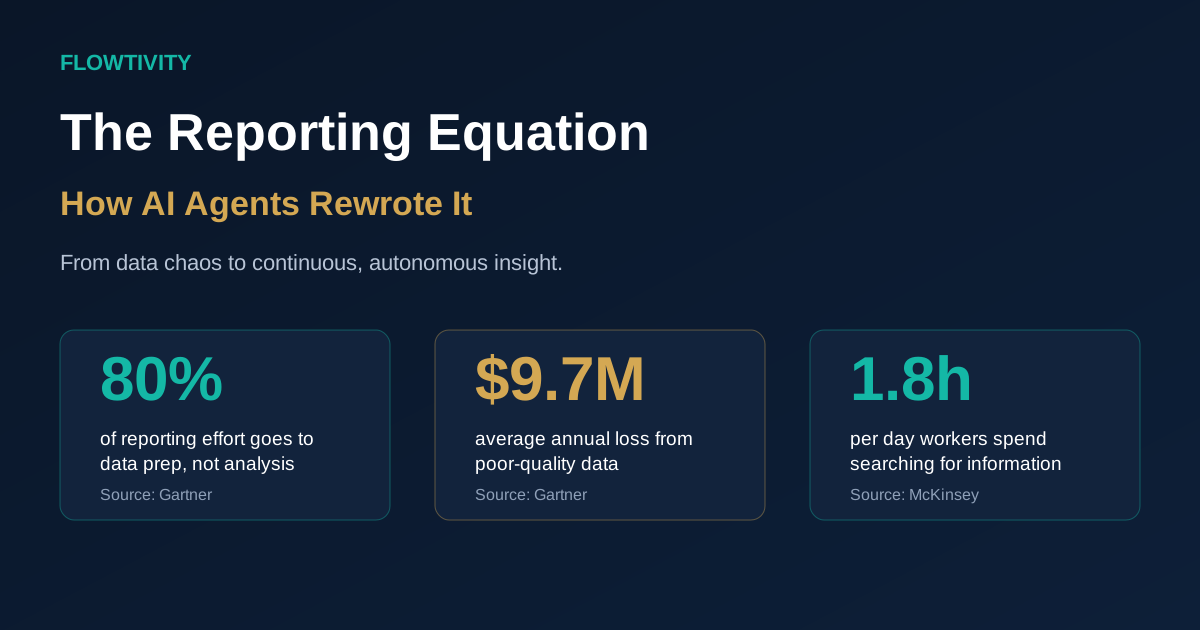
The reporting equation is the quiet arithmetic of modern business: how much data you can convert into decisions, divided by the cost of doing so. For most organisations the equation is badly out of balance. According to Gartner, as much as 80% of reporting and analytics effort is spent preparing and reconciling data rather than analysing or acting on it. That means the average team is not paying for insight. It is paying for the privilege of moving numbers from one spreadsheet to another. AI agents are the first technology to actually rewrite the equation rather than patch one of its variables.
The insight a business can act on has always been a function of data, multiplied by analysis, divided by the friction of preparation and the latency of decision-making. When the denominator grows faster than the numerator, the business drowns in reports while starving for judgement. AI agents collapse the denominator. They perceive, reason, and act in a continuous loop that mirrors a skilled analyst, and in doing so they turn a reporting function into a decision function. This is not dashboard automation. It is the end of reporting as a chore.
Why the reporting equation is broken
Every business faces the same structural imbalance. Data is cheap and abundant while the time and expertise required to turn it into action are expensive and scarce. The result is that most organisations spend the overwhelming majority of their reporting effort on everything except the part that creates value.
According to Gartner, 80% of reporting and analytics effort is spent preparing and reconciling data rather than analysing it. The Pragmatic Institute puts it even more starkly: analysts spend 80% of their time finding, cleaning, and organizing data, leaving only 20% for actual analysis. When the equation is this distorted, the most expensive asset in the modern company, human analytical attention, is squandered on the lowest-value work.
The cost of broken data flows compounds the problem. ClearPoint Strategy reports that Gartner research shows businesses incur average annual losses of approximately $9.7 million due to poor-quality data. And even when the data is sound, the human overhead of simply finding information is enormous. According to a McKinsey report, employees spend 1.8 hours every day, roughly 9.3 hours per week, searching and gathering information. That is the fifth employee out of every five being paid to locate the answer instead of being the answer.
What traditional reporting actually delivers
Traditional reporting hands leaders a rear-view mirror. It tells you revenue was X, expenses were Y, and net income was Z. It tells you where the business has been, in a format that took days or weeks to assemble and that is already stale by the time it is opened.
According to Business.com, what separates AI agents from traditional reporting tools is the layer of analysis they add. Traditional reports give you numbers: revenue was X, expenses were Y, net income was Z. An AI agent adds context. It identifies trends across reporting periods, flags anomalies such as a 40% increase in a spending category, and provides narrative explanations of what changed and why. The difference between a number and an explanation is the difference between data and insight.
This is why dashboards fail to close the loop. The reporting hub Thereportinghub observes that dashboards, no matter how beautifully designed, still require users to navigate filters, interpret visuals, and understand underlying data structures. The paradigm is shifting toward AI agents as the first stop for insights. A dashboard is a tool you must interrogate. An agent is an answer that arrives before you ask.
How AI agents solve the reporting equation
AI agents solve the reporting equation by attacking both sides of the fraction at once. They cut the denominator, the friction of preparation and analysis, close to zero, while expanding the numerator, the depth and speed of insight. The result is that more data becomes actionable in less time than a human team could ever manage alone.
According to SculptSoft, an agentic AI system perceives by continuously monitoring data streams and detecting anomalies, patterns, or opportunities, reasons by analyzing complex datasets across multiple dimensions, and then acts on the findings. Domo describes this as a continuous four-step cycle that mirrors how a skilled analyst approaches problems. Where a human analyst works in serial, one report at a time, an agent works in parallel and on request, and it never sleeps.
Consider the practical mechanics. According to MindStudio, an agent can take a natural language question, generate the SQL, execute it, and return results while understanding business terminology. Activepieces notes that agents can break down a request like "help me improve Q4 profitability" into steps, run the queries, and return an automated report with summaries in natural language. The reporting bottleneck of writing queries, waiting on a data team, and reconciling output disappears because the agent does all of it in seconds.
The multi-agent layer that makes reporting continuous
Singular agents fix single reports. Multi-agent systems fix the entire reporting function. When agents are allowed to specialise and hand work to one another, reporting stops being a periodic event and becomes a continuous property of the business.
According to Activepieces, tools like Kaiya operate within multi-agent systems. They break a high-level request into steps, run queries, and return automated reports with summaries. One agent monitors, another reconciles, a third narrates, and a fourth escalates. The work that once consumed an entire finance or analytics team happens across a supervised network of specialist agents, each contributing a narrow competency. This is the difference between automating a report and automating the reporting function itself.
The shift is real enough that established analytics vendors are describing it in decisively human terms. "AI agents operate through a continuous four-step cycle that mirrors how a skilled analyst approaches problems," says Domo's business intelligence team in its guide to AI agents in BI. That single framing captures why this feels different from every analytics tool that came before it: the agent behaves like a colleague with a method, not a frozen dashboard with a filter.
In our own work on Flowtivity clients, and in the local model deployments we run on dual DGX Spark hardware, we have seen the same pattern repeat. When you remove the manual scramble between source system, spreadsheet, and slide deck, the bottleneck shifts from getting the numbers to choosing what to do with them. The equation does not just balance. It inverts, and leadership attention becomes the scarcest, most valuable input again. That is the sign the reporting equation has been genuinely solved rather than merely deferred.
What the future of reporting looks like
When agents absorb the reporting burden, the future of reporting is not fewer reports. It is better decisions, made faster, by people who have their attention restored to the work that matters. The report stops being the deliverable and becomes the byproduct.
According to Svitla Systems, a biopharma company employed AI agents to generate leads, cutting cycle time by 25% and boosting time efficiency for drafting clinical study reports by 35%. These are not abstract efficiencies. They are hours returned to humans and decision cycles shortened by an order of magnitude. The agents did not replace the analysts. They removed the work that analysts never wanted to do in the first place, so the analysts could do the work that actually requires judgement.
The organisations that win the next decade will not be the ones with the most sophisticated dashboards. They will be the ones whose reporting equation is balanced enough that insight flows to decision-makers continuously rather than in monthly installments. AI agents are the mechanism that makes that possible, and the businesses that adopt them first are already pulling away.
Frequently asked questions
What is the reporting equation in business? The reporting equation describes the relationship between the data a business can convert into decisions and the cost of doing so. It is the constant pressure every organisation feels to turn raw data into insight and action, and it breaks down when preparation and manual analysis consume nearly all the available effort.
How do AI agents improve business reporting? AI agents improve reporting by automating the perceive, reason, and act loop. They monitor data, generate queries, analyze results across multiple dimensions, flag anomalies, and produce narrative explanations in plain language, returning the same insight a human analyst would provide in a fraction of the time.
What is the difference between AI agents and traditional reporting tools? Traditional tools present numbers and require humans to interpret them. AI agents add an analysis layer: they contextualize trends, flag anomalies, and explain what changed and why. A dashboard is a tool you interrogate, while an agent is an answer that arrives on its own.
Do AI agents replace human analysts? No. AI agents remove the manual work of data preparation, cleaning, and structuring that occupies up to 80% of analysts' time. This frees human analysts to focus on the judgement-heavy work of deciding what the insight means and what to do about it.
What's actually useful in AI, every Friday
We follow everything happening in AI and send what's worth your time: new models, AI agents, and how to put them to work. One email a week, unsubscribe anytime.