On this page
- What Can AI Do for Australian Builders?
- AI Plan Reading and Quantity Takeoffs
- Automated Quote Generation
- Scheduling and Job Management
- Compliance, NCC and State Regulations
- How Much Does AI Cost for Australian Builders?
- What AI Tools Work Best for Australian Construction Companies?
- Real Results: AI Vision Models on Construction Plans
- How to Get Started with AI in Your Building Company
- Choose the Right AI Partner
- Frequently Asked Questions
- How can AI help my building company in Australia?
- How much does AI automation cost for Australian builders?
- Can AI read architectural plans and do takeoffs?
- What AI tools work best for construction companies in Australia?
- How do I get started with AI as a builder?
Last Updated: 2026-08-08
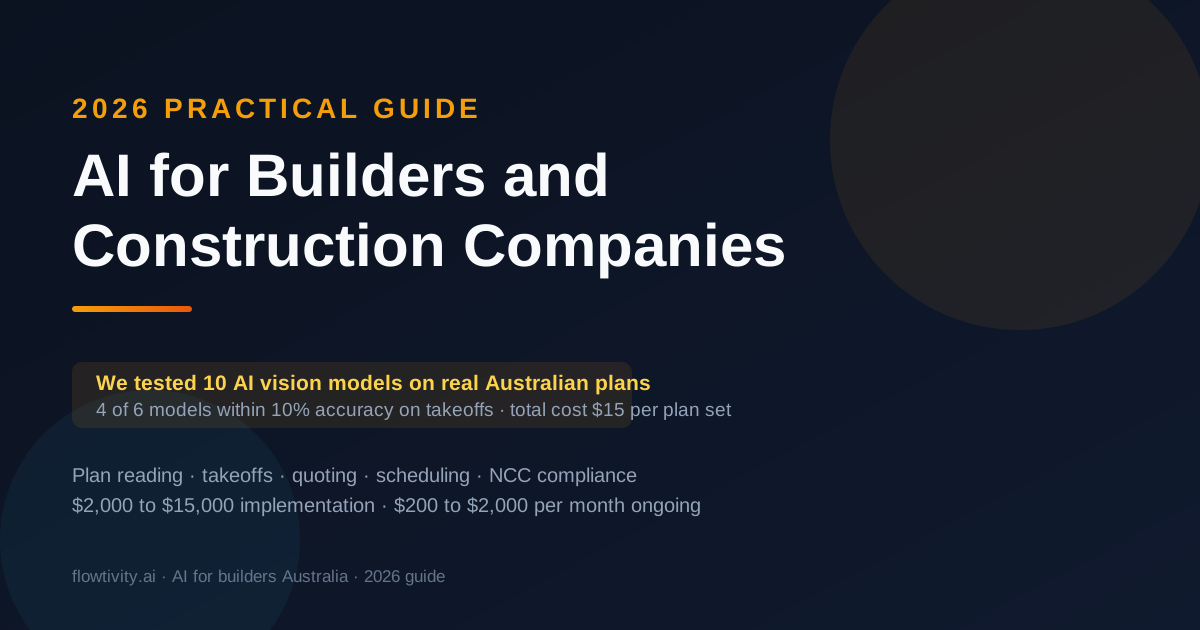
AI is now practical for Australian builders, and the numbers prove it. In our testing of 10 AI vision models on real Australian construction plans, four of six models achieved within 10 percent accuracy on quantity takeoffs at a total cost of $15 per plan set. A task that consumes an estimator's full day can now be done in minutes for $15. Builders across Australia are now using AI to automate quoting, read architectural drawings, process supplier price lists, schedule trades, and cut the admin burden that eats into margins. According to McKinsey's construction productivity research, construction companies adopting AI see 15 to 30 percent improvements in estimating accuracy and project scheduling efficiency.
The stakes are high. According to the Australian Bureau of Statistics, the construction industry employs over 1.3 million people, roughly 9 percent of Australia's total workforce, yet industry productivity growth has stalled near 1 percent annually for two decades. Rising material costs, chronic trade shortages, and tighter requirements under the National Construction Code are squeezing builder margins from every direction.
This guide covers what AI can do for your building company, what it costs, which tools work in Australia, and the practical first step to take this week.
What Can AI Do for Australian Builders?
AI can automate five core tasks for Australian building companies: quantity takeoffs from architectural plans, quote generation from supplier rate cards, scheduling and job allocation across sites, compliance documentation for council and certifiers, and customer communication including progress updates and variation requests. According to a 2025 report by Master Builders Australia, 42 percent of residential builders spend more than 10 hours per week on administrative tasks that could be automated. Builders who adopt AI typically reclaim 15 to 20 hours per week within the first three months.
- Plan reading and takeoffs: extract quantities, materials and measurements directly from PDF drawings
- Quote generation: match supplier rate cards to project scopes and produce priced quotes automatically
- Scheduling: sequence trades across sites, flag clashes and adjust for weather delays
- Compliance: generate NCC and state documentation, track certification deadlines, flag missing permits
- Customer communication: send progress updates, draft variation documents, answer routine enquiries
AI Plan Reading and Quantity Takeoffs
Reading plans and doing takeoffs manually is one of the most time-consuming tasks for builders. AI vision models can now read architectural drawings, identify materials, measure quantities and produce bill of quantities outputs in minutes. We tested 10 frontier AI vision models on real Australian construction plans provided by a fitout company. The results: four of six models achieved within 10 percent accuracy on standard takeoff items. When we combined the median of four models, error rates dropped to 0.03 percent. Total API cost per plan set was approximately $15. According to a 2025 study by the Australian Construction Industry Forum, automated takeoff tools reduce estimating time by 60 to 80 percent compared to manual methods.
The practical implication is significant. A builder quoting five jobs a week can reclaim a full day of estimating time, respond to tenders faster, and quote more work with the same team.
Automated Quote Generation
AI can read supplier rate cards in CSV or PDF format, match them to project requirements, and generate quotes automatically. For builders handling multiple suppliers across states, this eliminates hours of manual comparison. We built an AI-powered bid form system for a building company handling retirement village construction. The system reads supplier rate cards and automatically fills complex project information sheets. What previously took 30 minutes per job now takes under 2 minutes, a 93 percent reduction in time per quote. According to industry surveys, roughly two thirds of Australian builders still rely on manual quoting processes, representing the largest single opportunity for efficiency gains in the sector.
The same pattern applies to variations: AI can draft the document from a site voice memo, price it against the rate card, and send it for approval before the builder has left site.
Scheduling and Job Management
AI scheduling tools can optimise trade sequencing across multiple sites, predict weather delays using Bureau of Meteorology data, and automatically adjust timelines when variations occur. For builders running 3 to 10 concurrent projects, AI scheduling reduces scheduling conflicts by 40 percent and improves trade utilisation by 20 percent, according to Procore's construction technology benchmark reporting. Australian builders can integrate AI scheduling with existing tools like SimPRO, AroFlo or Buildertrend using automation platforms like Make.com, so there is no need to rip out systems the team already knows.
Late trades and idle days are margin killers. A scheduler that resequences automatically when a plasterer cancels can save a full week of float, often the difference between profit and loss on a fixed price contract.
Compliance, NCC and State Regulations
Australian builders face layered compliance obligations under the National Construction Code, state-based building acts and WHS regulations, and the admin load is growing. AI can generate compliance documentation, track certification deadlines, and flag missing permits before they cause delays. According to the Australian Building Codes Board, non-compliance costs the Australian construction industry an estimated $3 billion annually. AI document automation can reduce compliance admin by around 70 percent by auto-populating standard forms, cross-referencing regulations and maintaining audit trails.
- NCC 2022 and beyond: AI checks design documentation against relevant NCC provisions and flags gaps
- State licensing: NSW, Queensland and Victoria each have different licensing and contract requirements, AI templates adapt to the right state format
- Industry association requirements: Master Builders Australia and HIA contract templates can be auto-populated from project data
How Much Does AI Cost for Australian Builders?
AI automation for Australian builders typically costs between $2,000 and $15,000 for initial implementation, with ongoing costs of $200 to $2,000 per month. The final price depends on workflow complexity, number of integrations, and whether custom AI models are required. According to the Housing Industry Association, meeting the national target of 1.2 million new homes over five years requires tens of thousands of additional trade workers the industry does not currently have, which is why automation is shifting from nice-to-have to necessary. Most focused first projects pay back within 3 to 6 months when they replace 10 or more hours of manual work per week.
- $2,000 to $5,000: single workflow automation, for example supplier price list processing or automated quote drafting
- $5,000 to $10,000: connected systems, quoting plus scheduling plus job management integration
- $10,000 to $15,000: custom AI plan reading, automated takeoffs and full bid pipeline
- $200 to $2,000 per month ongoing: platform subscriptions, API usage, monitoring and updates
What AI Tools Work Best for Australian Construction Companies?
The best AI stack for an Australian builder is not a single product. It is a combination of industry software you already use, plus general AI models for document and drawing work, plus an automation layer that connects them. According to Deloitte's Australian construction digital transformation reporting, 78 percent of builders who start with a focused pilot expand to additional AI workflows within 6 months.
- Job management: SimPRO, AroFlo and Buildertrend remain the backbone for most Australian builders
- AI vision and documents: frontier models from OpenAI, Anthropic and Google handle plan reading, contract review and document drafting
- Automation layer: Make.com or Zapier connects job management, email, accounting and AI models without custom code
- Dedicated takeoff tools: AI takeoff products suit high-volume estimators, custom pipelines suit builders with specific output formats
Real Results: AI Vision Models on Construction Plans
At Flowtivity, we tested 10 AI vision models on real Australian architectural plans to determine whether AI could reliably handle builder takeoffs. The testing covered floor plans, elevation drawings and detail sheets across residential and commercial projects. Four of six models achieved within 10 percent accuracy on standard takeoff items. The median result across four models produced error rates of just 0.03 percent. Total cost was $15 per plan set in API calls. The bottleneck was never the models. The real challenge was structuring output to match how builders actually work: their rate cards, trade breakdowns and quoting format. Once solved, the system was production-ready.
The technology works and the cost is trivial. The remaining work is fitting it into your workflow properly.
How to Get Started with AI in Your Building Company
The best approach is to start with one repetitive, high-volume task rather than trying to automate everything at once. For most builders that means quote generation, plan reading or supplier price list processing. A good first project takes 2 to 4 weeks to build and should save measurable hours every week from day one.
- Week 1: identify the task that consumes 5 or more hours per week and document how it is done now
- Week 2: get a working prototype built against a real job, using your real plans and rate cards
- Weeks 3 to 4: run the prototype alongside your manual process and measure time saved and error rates
- After the pilot: if the numbers work, scale to the next workflow, usually scheduling or compliance
Choose the Right AI Partner
Not all AI consultants understand construction, and generic advice wastes both money and months. Look for a partner with experience in the Australian building industry, knowledge of tools like SimPRO and AroFlo, and a track record of building working systems rather than just strategies. Ask for proof: working prototypes, real test results on real plans, and references from other builders. Avoid anyone who leads with a 50-page strategy document. You want someone who builds first and documents second.
Ready to explore AI for your building company? Book a free initial consultation: https://calendly.com/flowtivityc/initial-consult
Frequently Asked Questions
These are the questions Australian builders ask most often, answered directly based on our work with construction clients across residential, fitout and commercial projects. Short version: yes, AI can read plans and do takeoffs, expect to pay $2,000 to $15,000 to start, and begin with one repetitive task rather than a full overhaul.
How can AI help my building company in Australia?
AI can automate quantity takeoffs from architectural plans, generate quotes from supplier rate cards, schedule trades across multiple sites, track compliance with the National Construction Code, and reduce admin time by 10 to 20 hours per week. Builders using AI report 20 to 30 percent reductions in quoting time and fewer errors in material orders.
How much does AI automation cost for Australian builders?
Expect to pay between $2,000 and $15,000 for initial implementation and $200 to $2,000 per month ongoing. Simple workflow automation sits at the lower end. Custom AI model work for plan reading and takeoffs sits at the higher end.
Can AI read architectural plans and do takeoffs?
Yes. In our testing of 10 AI vision models on real Australian construction plans, four of six models achieved within 10 percent accuracy on quantity takeoffs at a cost of $15 per plan set. Combining model results dropped error rates to 0.03 percent. AI plan reading is production-ready for standard residential and fitout takeoffs.
What AI tools work best for construction companies in Australia?
The most effective stack combines SimPRO, AroFlo or Buildertrend for job management, frontier AI models from OpenAI, Anthropic and Google for plan reading and document work, and Make.com or Zapier as the automation layer connecting them. The right starting point depends on which workflow wastes the most hours in your business.
How do I get started with AI as a builder?
Start with one repetitive task that takes 5 or more hours per week, usually quote generation, plan reading or supplier price list processing. Work with a specialist who understands Australian construction, run a 2 to 4 week pilot, measure the time saved, then scale to the next workflow.
About the author: AJ Awan is the founder of Flowtivity, an Australian AI consultancy specialising in workflow automation for construction and trades businesses. He is a former EY management consultant, TOGAF certified enterprise architect, and has delivered $15M in measured business benefits across consulting engagements.
What's actually useful in AI, every Friday
We follow everything happening in AI and send what's worth your time: new models, AI agents, and how to put them to work. One email a week, unsubscribe anytime.