On this page
- What is AtlasKV?
- How does KG2KV turn a triple into something a model can attend to?
- How does AtlasKV fit 1 billion triples into 20GB of VRAM?
- Where does the knowledge actually live?
- How accurate is AtlasKV, and at what scale was it actually tested?
- Does this mean RAG is dead?
- What would we test on local hardware before trusting it?
- What should you do next?
- Frequently asked questions
- What is AtlasKV?
- Does AtlasKV replace RAG?
- How much VRAM does AtlasKV need for 1 billion triples?
- Can I use AtlasKV with my own documents?
- Is AtlasKV available to run today?
- What is the difference between AtlasKV and KBLaM?
Last Updated: 2026-11-20
Key takeaways
- ▪ AtlasKV is an ICLR 2026 paper from HKUST and Huawei's Theory Lab that writes knowledge graph triples into a LLaMA 3.1 8B model's attention layers instead of retrieving them into a prompt.
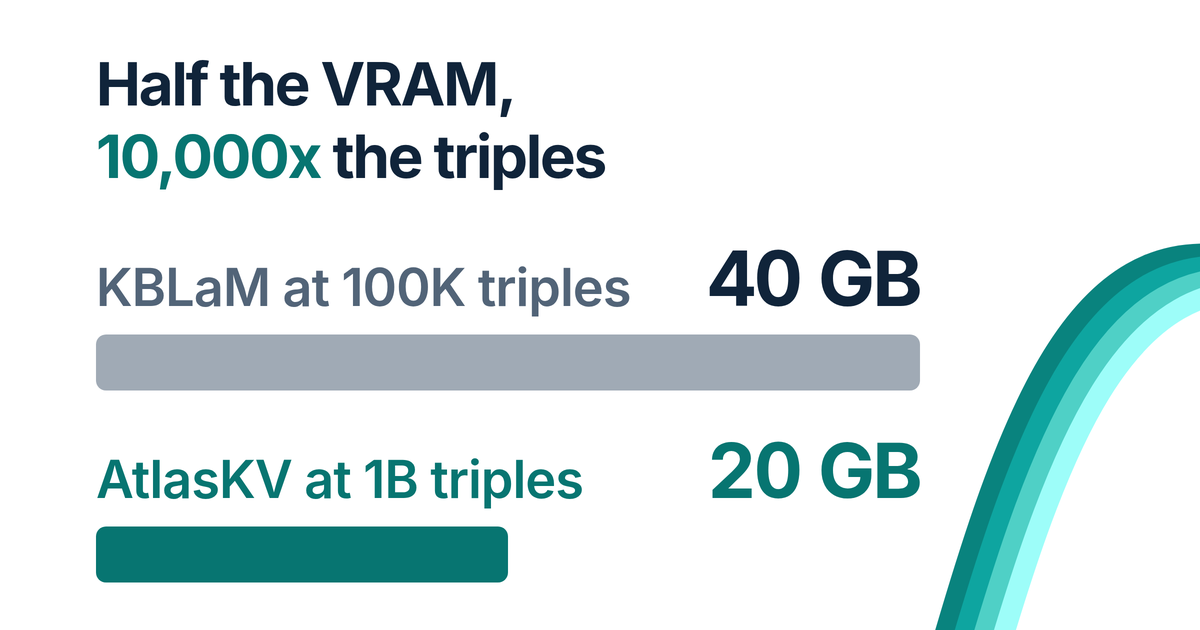
- ▪ The headline result is memory, not speed: under 20GB of VRAM for 1 billion triples, where KBLaM needs over 40GB for 100,000 triples. That is roughly 10,000 times the knowledge at half the memory.
- ▪ The scaling trick is HiKVP, a three-level pruning scheme that keeps 128 root keys, 64 inter-layer keys and 16 leaf keys per query, which turns linear attention cost into sub-linear cost.
- ▪ Accuracy is measured at 1,000 and 10,000 triples, not at 1 billion. At 10,000 triples on the hardest test set, Top-1 grounding rose from 3.6% for KBLaM to 40.0% for AtlasKV, a large relative gain that is still far from dependable.
- ▪ The paper's own limits matter more than the launch thread: the VRAM number excludes offline embedding cost, HiKVP adds CPU to GPU transfer latency, and KG2KV flattens the graph, which the authors say can hinder multi-hop reasoning.
- ▪ This is a structured-knowledge result. It does not replace retrieval over PDFs, email, tickets or transcripts, and it assumes you already own a clean knowledge graph.
No, AtlasKV does not kill RAG. It replaces one narrow slice of the retrieval stack: answering questions against a structured knowledge graph, where every fact is already a subject, a relation and an object. According to the paper by Huang, Tsang, Bai, Peng, Zhang and Song at HKUST and Huawei's Theory Lab, AtlasKV loads 1 billion of those triples into a LLaMA 3.1 8B model using under 20GB of GPU memory, with no external retriever and no long context window. That is a genuine result and it is worth understanding. What it does not prove is that document retrieval is obsolete, that accuracy holds at a billion triples, or that the economics work once you count the cost of building the graph. The X thread that called RAG "officially cooked" skipped all three questions. Here is what the paper actually claims, where each number comes from, and what we would test before putting it near a client's data.
What is AtlasKV?
AtlasKV is a parametric knowledge augmentation method. It converts knowledge graph triples into key and value vectors, injects them into the self-attention layers of a frozen language model, and trains a small set of attention heads to retrieve the right fact for a query. It sits in the same family as KBLaM, the 2024 Microsoft Research method that first showed knowledge could be attended to rather than pasted into a prompt, and it adds two pieces: a better way to build training data, and a way to stop the attention cost growing with the size of the graph. It was submitted to ICLR 2026, the code is MIT licensed on GitHub under HKUST-KnowComp, and it is a research release, not a product.
How does KG2KV turn a triple into something a model can attend to?
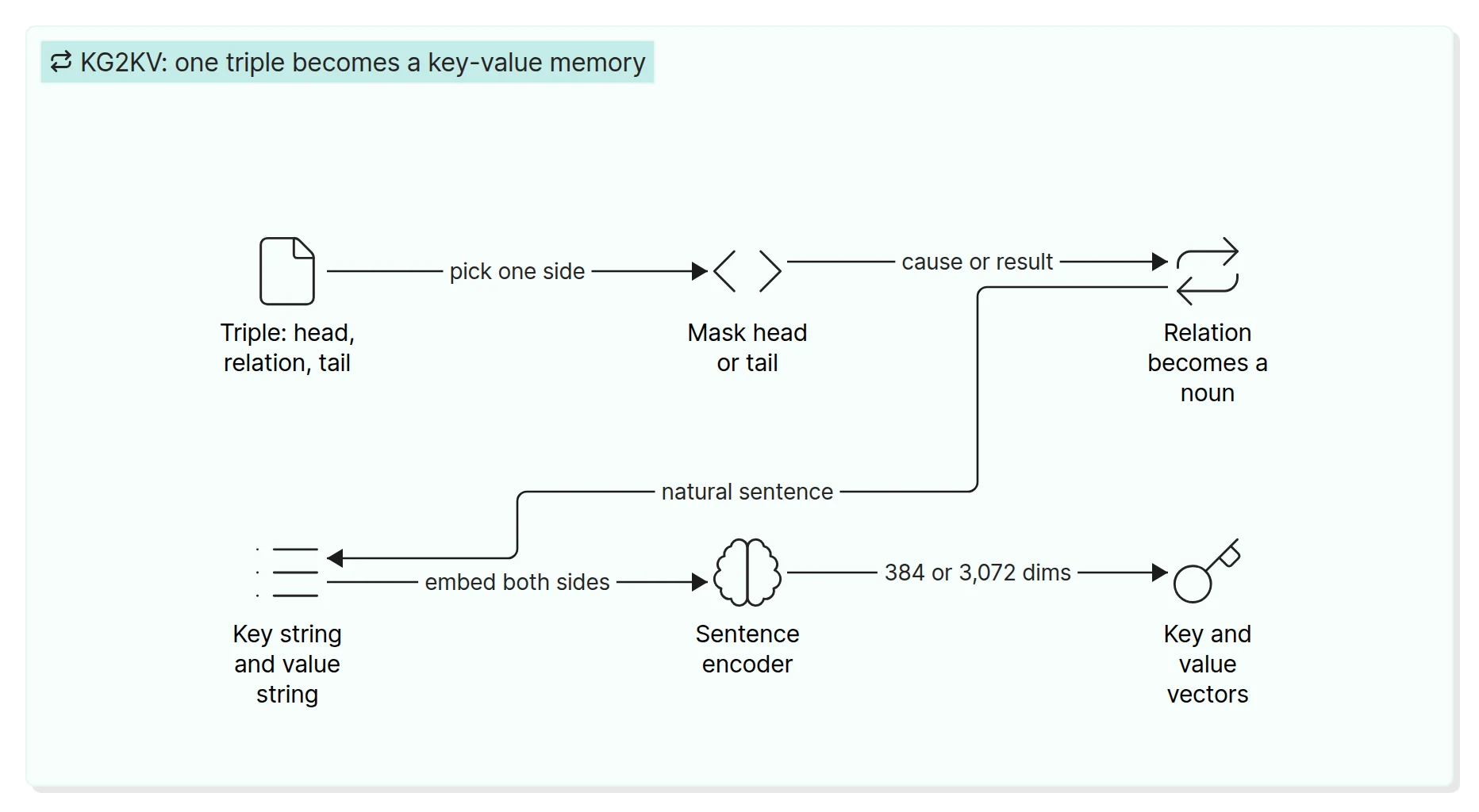
KG2KV is the data pipeline, and it is the part that explains why AtlasKV generalises better than its predecessor. Take a triple such as "John founded StockLemon.com". The pipeline masks either the head or the tail, rewrites the relation as a noun, and produces two strings. The key string holds the surviving entity plus the relation noun, so it reads like a question. The value string holds the masked entity as a sentence. A sentence encoder then embeds both sides, and those embeddings become the key and value vectors injected into attention. Because the relations come from a real graph rather than a hand-written schema, the training data covers far more question shapes. The paper measures this as a diversity ratio of 7.864% for KG2KV against 0.003% for the synthetic approach KBLaM used, at an average token cost of 165.7 versus 349.9. That diversity is the reason AtlasKV still grounds answers on test sets whose question types it never saw in training.
How does AtlasKV fit 1 billion triples into 20GB of VRAM?
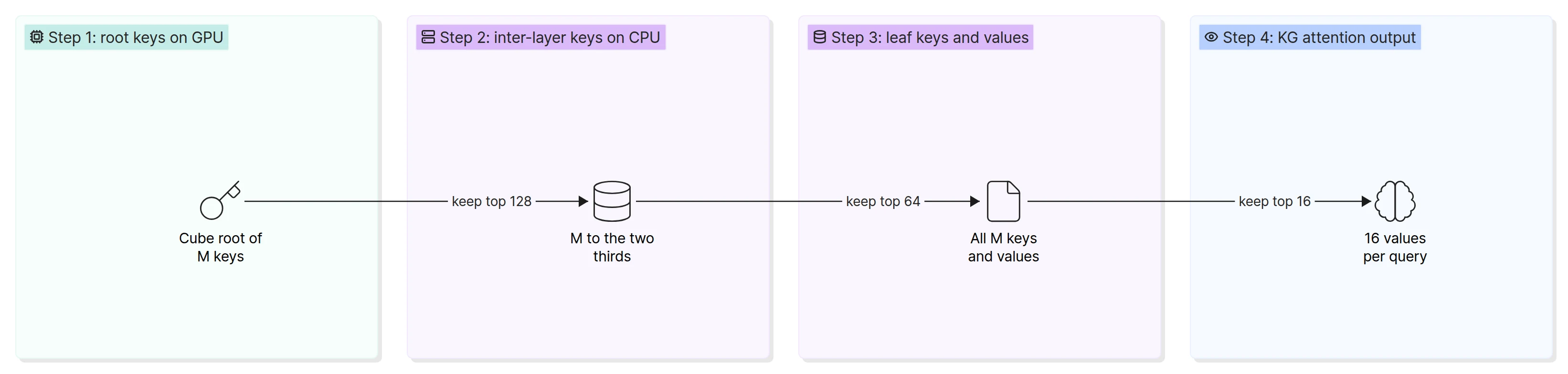
It does not keep all 1 billion key and value vectors on the GPU. HiKVP, hierarchical key-value pruning, arranges keys into a three-level tree using UMAP for dimension reduction and Gaussian mixture models for clustering, then narrows the candidate set in stages at query time. Only the root keys live on the GPU. A query scores the root keys first and keeps the top 128, follows their mappings down to inter-layer keys and keeps the top 64, then scores the surviving leaf keys and keeps 16, whose values feed the attention output. Everything below the root layer is staged from CPU memory as needed. That is what changes the complexity from linear in graph size to sub-linear, and it is why the memory curve in the paper stays close to a zero-shot model while KBLaM and in-context learning climb steeply.
Where does the knowledge actually live?
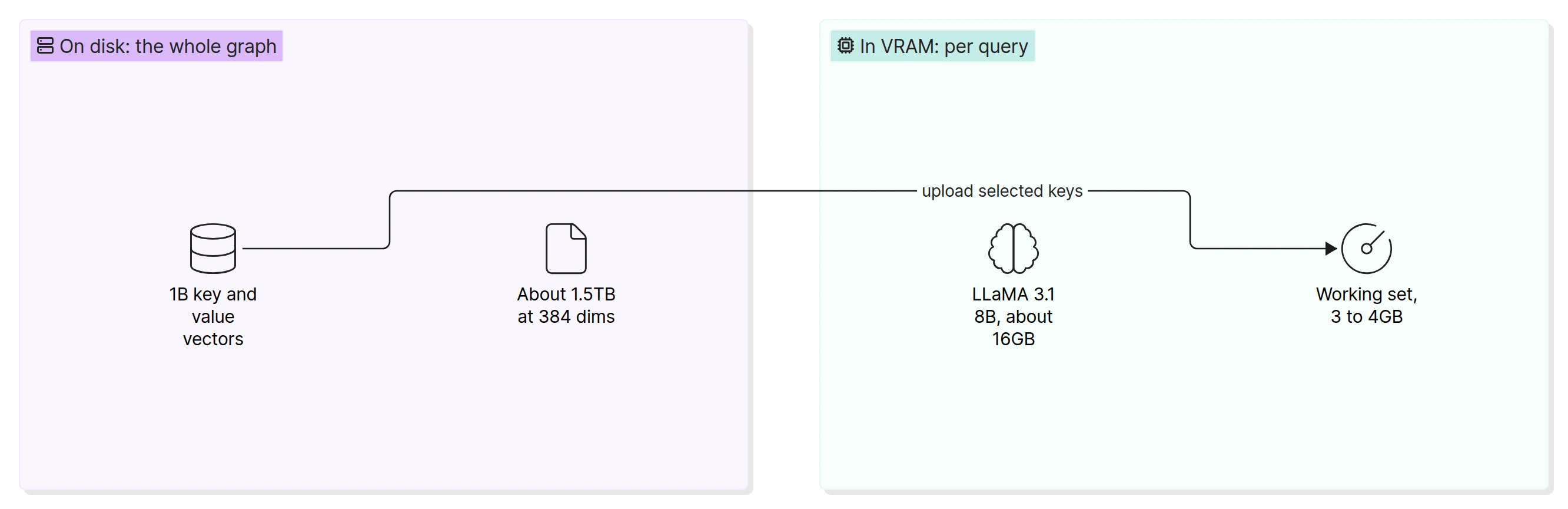
The whole graph still has to live somewhere, and that somewhere is disk plus CPU memory, not a vector database doing approximate nearest-neighbour search at query time. With 1 billion triples, two vectors per triple and 384 dimensions per vector from the all-MiniLM-L6-v2 encoder the paper uses, the key and value store is about 1.5TB at 16-bit precision. So the "no vector DB, no Pinecone bill" framing is half true. You do avoid a managed vector service and the chunking pipeline that feeds it. You do not avoid storing a very large embedding store, and you do not avoid the offline job that embeds every triple, which the project README explicitly excludes from the VRAM figure. Against that 1.5TB store, the model weights are modest: LLaMA 3.1 8B in bf16 is roughly 16GB, and the paper's working set during inference is only a few gigabytes on top.
How accurate is AtlasKV, and at what scale was it actually tested?
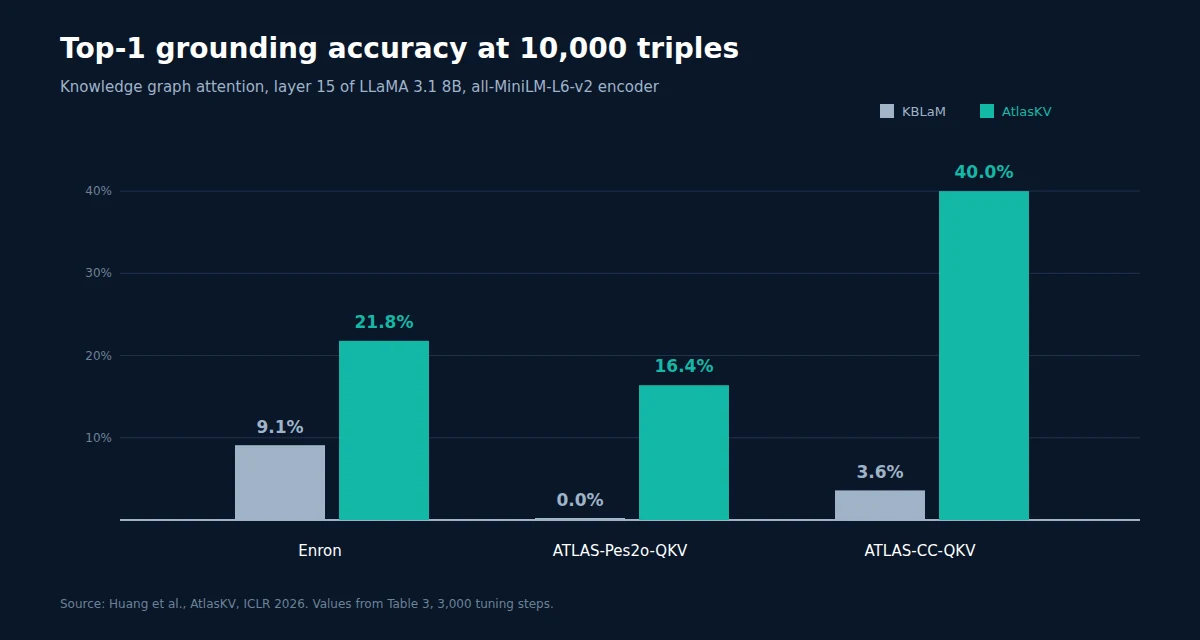
Accuracy was measured by knowledge grounding, not by answer quality. The authors read the attention scores over the knowledge part at layer 15 of LLaMA 3.1 8B and checked whether the correct triple ranked first or in the top five, across three out-of-distribution datasets and graph sizes from 10 to 10,000 triples. AtlasKV beats KBLaM at every size on the two hard datasets, and the margin is large. On ATLAS-CC-QKV at 10,000 triples, Top-1 grounding is 40.0% for AtlasKV against 3.6% for KBLaM. On ATLAS-Pes2o-QKV at 1,000 triples, it is 52.7% against 5.5%. Enron, the easiest set, is where the picture is more mixed: at 1,000 triples AtlasKV improves Top-1 from 29.1% to 41.8% but its Top-5 actually slips from 56.4% to 50.9%. Pruning has a cost, and the paper says so: removing HiKVP lifts ATLAS-Pes2o-QKV at 1,000 triples from 52.7% to 72.7%.
| Test set | Triples | KBLaM Top-1 | AtlasKV Top-1 | KBLaM Top-5 | AtlasKV Top-5 |
|---|---|---|---|---|---|
| Enron | 1,000 | 29.1% | 41.8% | 56.4% | 50.9% |
| Enron | 10,000 | 9.1% | 21.8% | 20.0% | 32.7% |
| ATLAS-Pes2o-QKV | 1,000 | 5.5% | 52.7% | 14.5% | 70.9% |
| ATLAS-Pes2o-QKV | 10,000 | 0.0% | 16.4% | 3.6% | 49.0% |
| ATLAS-CC-QKV | 1,000 | 12.7% | 61.8% | 23.6% | 74.5% |
| ATLAS-CC-QKV | 10,000 | 3.6% | 40.0% | 10.9% | 54.5% |
Does this mean RAG is dead?
No, and the paper is more careful than the thread that promoted it. Four things separate this result from "retrieval is over". First, the input is a knowledge graph, not a corpus. Triples are already atomic facts with a schema. A folder of contracts, a shared inbox or a call transcript archive is none of those things, and turning them into triples is a separate, expensive project that AtlasKV does not solve, though the authors point to AutoSchemaKG as a companion for graph construction. Second, the accuracy numbers stop at 10,000 triples. The billion-triple claim is about memory and complexity, measured by peak VRAM, not about grounding accuracy at that scale. Third, the VRAM figure excludes the offline embedding job, and HiKVP adds latency from CPU to GPU transfers. The paper's latency table compares AtlasKV with AtlasKV without pruning, not with RAG, so it makes no claim about being faster than retrieval. Fourth, KG2KV treats each triple as an independent fact, which flattens the graph, and the authors say this can hinder multi-hop reasoning. What was demonstrated is question answering and grounding, not reasoning across paths.
What would we test on local hardware before trusting it?
In our dual DGX Spark setup, 128GB of unified memory across two GB10 machines, we can hold the whole 1.5TB store problem in a much smaller form: a client graph of 200,000 triples is about 300MB of embeddings, which fits comfortably next to an 8B model. The test we would run is narrow and boring. Build a graph from one client's CRM accounts, tickets and product catalogue, tune the AtlasKV heads for 3,000 steps on 20,000 samples the way the paper does, then measure Top-1 grounding and end-to-end answer latency at 1,000, 10,000 and 100,000 triples against a hybrid retrieval baseline on the same questions. Our own serving numbers give a reference point for what latency feels like: DeepSeek V4.1 Flash runs at about 35 tokens per second on a single stream and 62 at four concurrent streams on this hardware. If AtlasKV's CPU to GPU staging adds more than that per query, the memory saving is not worth the wait. The paper does not answer that question, and any honest deployment has to.
What should you do next?
Treat AtlasKV as a signal about where knowledge augmentation is heading, not as a drop-in replacement for your retrieval stack. If you already maintain a knowledge graph, or your data is naturally relational, this is the most interesting result of the year and worth a two-week spike. If your knowledge lives in documents, the practical move is still hybrid retrieval over chunks, with a graph layer added only where the questions are genuinely relational. And if you are sizing hardware, note that the interesting number in this paper is not 20GB. It is 1.5TB on disk plus a 3,000-step tuning run, and neither of those appears in the headline.
Frequently asked questions
What is AtlasKV?
AtlasKV is a research method that injects knowledge graph triples directly into a language model's attention layers as key and value vectors, so the model can answer questions from the graph without an external retriever or a long prompt. It was submitted to ICLR 2026 by researchers at HKUST and Huawei's Theory Lab and builds on KBLaM.
Does AtlasKV replace RAG?
No. AtlasKV replaces retrieval over structured knowledge graphs only. Document retrieval, chunking and reranking remain necessary for PDFs, email, transcripts and other unstructured sources, and AtlasKV assumes a clean graph already exists.
How much VRAM does AtlasKV need for 1 billion triples?
Under 20GB of GPU memory during inference, according to the paper, compared with over 40GB for KBLaM at just 100,000 triples. That figure excludes the offline job that embeds every triple, and the full key and value store still occupies roughly 1.5TB on disk.
Can I use AtlasKV with my own documents?
Not directly. AtlasKV needs triples, so you would first have to extract a knowledge graph from your documents, which is a separate project. The authors point to AutoSchemaKG, from the same lab, as a way to build graphs automatically, and that step is where most of the real cost sits.
Is AtlasKV available to run today?
The code and data links are published in an MIT licensed repository at github.com/HKUST-KnowComp/AtlasKV, which had around 74 stars at the time of writing. It is a research release: expect to tune heads, manage your own embedding store and build your own evaluation before it does anything useful.
What is the difference between AtlasKV and KBLaM?
KBLaM introduced the idea of attending to knowledge as key and value vectors, but its cost grows linearly with the knowledge base and its training data had limited question variety. AtlasKV adds KG2KV for more diverse training data and HiKVP for sub-linear cost, which is how it reaches 1 billion triples where KBLaM struggles past 100,000.
About the author. AJ Awan is the founder of Flowtivity, an AI consultancy on the Gold Coast. He is a former EY management consultant and a TOGAF certified enterprise architect, and he builds local and private AI systems for Australian mid-market firms.
What's actually useful in AI, every Friday
We follow everything happening in AI and send what's worth your time: new models, AI agents, and how to put them to work. One email a week, unsubscribe anytime.