On this page
- What is the difference between automation and an AI agent?
- When is automation a bad investment? The $70,000 lesson
- What is the Destination Test?
- Why trained agents break the payback formula
- What does phase 2 of AI mean for your business?
- Automation vs AI agents: the comparison table
- How do you measure the ROI of an AI agent?
- Frequently asked questions
- About the author
Last Updated: 1 September 2026
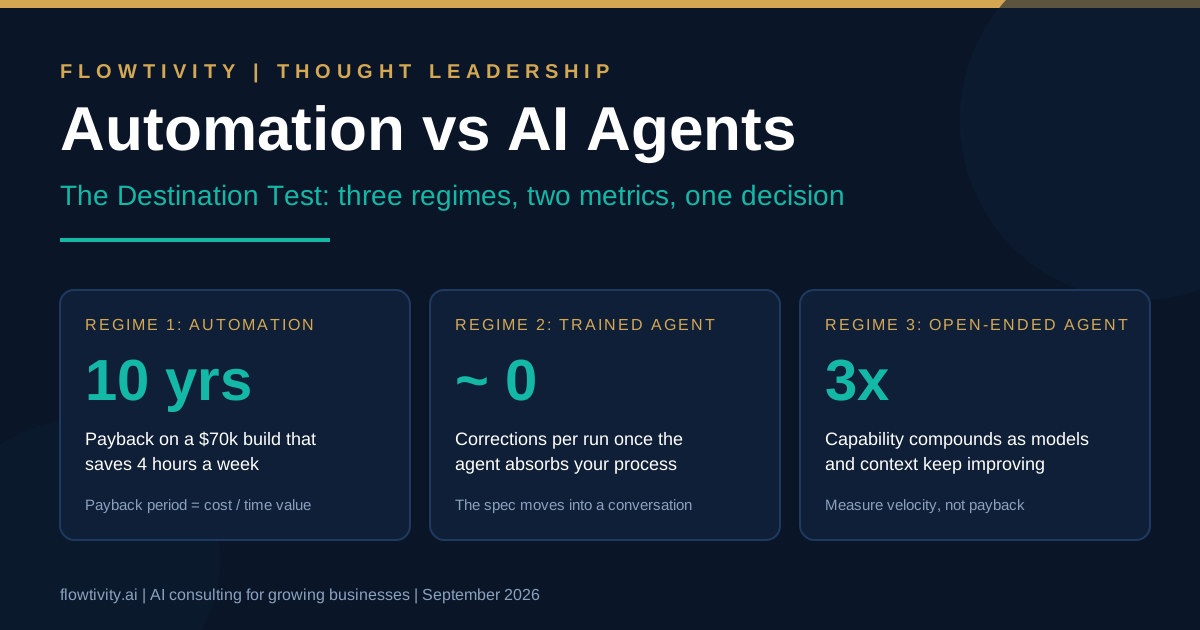
Automation and AI agents are different asset classes, and the difference comes down to one question: do you know the destination? Automation executes a documented process with a fixed outcome, so its value is bounded and calculable. Alex Hormozi, founder of Acquisition.com, recently described his accounting team proposing a $70,000 custom build to save 4 hours a week, roughly $7,000 a year of salary value: a 10-year payback before maintenance costs. That is automation math working exactly as it should. Agents are different. A trained agent completes work that was never fully documented, improves every time you correct it in plain English, and compounds as models and context get better. Measure that with payback math and you will kill your highest-leverage investment: according to MIT Media Lab's 2025 State of AI in Business report, 95 percent of enterprise generative AI pilots already show no measurable P&L return, usually because businesses buy the wrong asset for the wrong regime.
This article gives you a three-regime framework, the Destination Test, and the two metrics that replace hours saved: corrections per run and capability velocity.
What is the difference between automation and an AI agent?
Automation is software that executes a fully documented, fixed process with a known outcome. Its value equals the time it saves, full stop. An AI agent is a system with skills, tools and access to your business systems that completes a process end to end, learns from plain-English feedback, and improves output quality over time. The commercial difference matters more than the technical one: automation is a static asset you can price with a formula, while an agent is an appreciating asset whose value depends on how fast it improves.
Most confusion comes from vendors selling "AI automation" as a single category. It is not. According to Gartner, 33 percent of enterprise software applications will include agentic AI by 2028, up from less than 1 percent in 2024, which means the distinction between static automation and improving agents is about to become a purchasing decision every business makes. Treating them as one category is how companies end up either overpaying for automation they did not need or killing agent pilots that paybacks were never designed to evaluate.
When is automation a bad investment? The $70,000 lesson
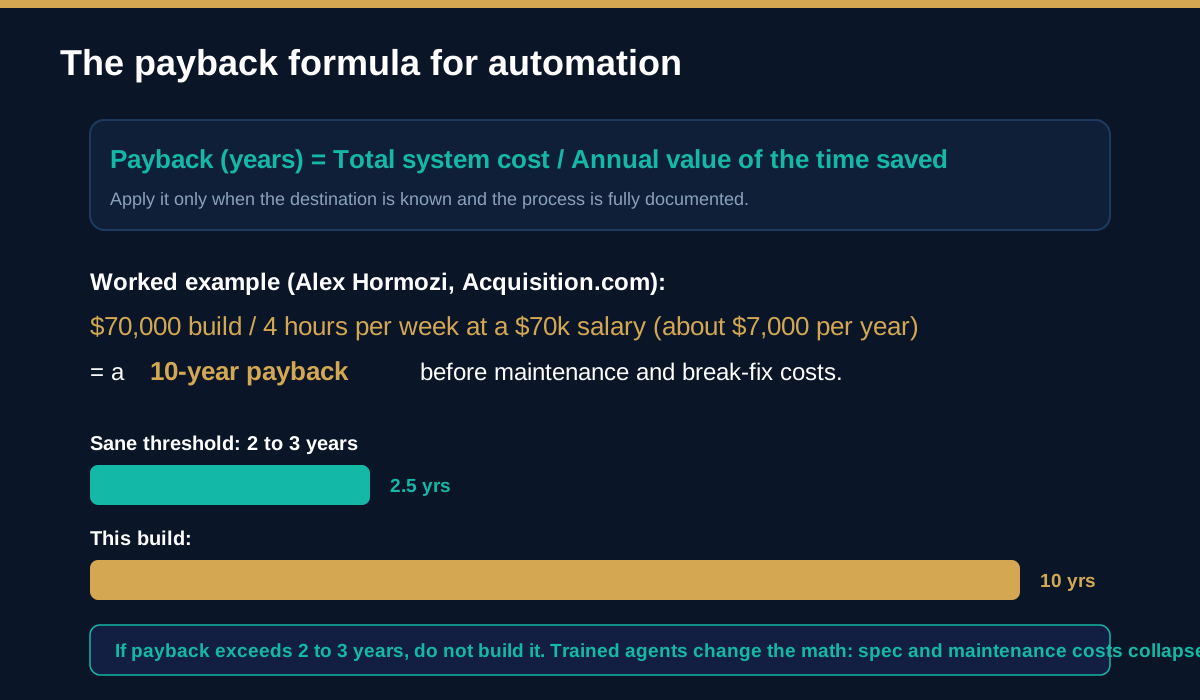
Automation is a bad investment when the payback period exceeds 2 to 3 years or when the process will change before the investment pays back. The formula is simple: payback in years equals total system cost divided by the annual value of the time saved. Run the math before anyone writes code.
Hormozi's example is the cleanest teaching case available. His accounting team wanted $70,000 of custom software to eliminate a task that took 4 hours a week. Four hours a week is 10 percent of a full-time workload, so at a $70,000 salary the manual work costs about $7,000 a year. Divide $70,000 by $7,000 and you get a 10-year payback, before counting the break-fix and change costs every time the business evolves. His verdict: not everything worth doing is worth systemizing, and systems are tools, not trophies.
The hidden cost is rarely the build itself. The expensive part of classic automation is extracting and documenting every edge case that lives in someone's head, then paying a developer again every time the process changes. That is where budgets blow out, and it is exactly the cost line that trained agents collapse.
What is the Destination Test?
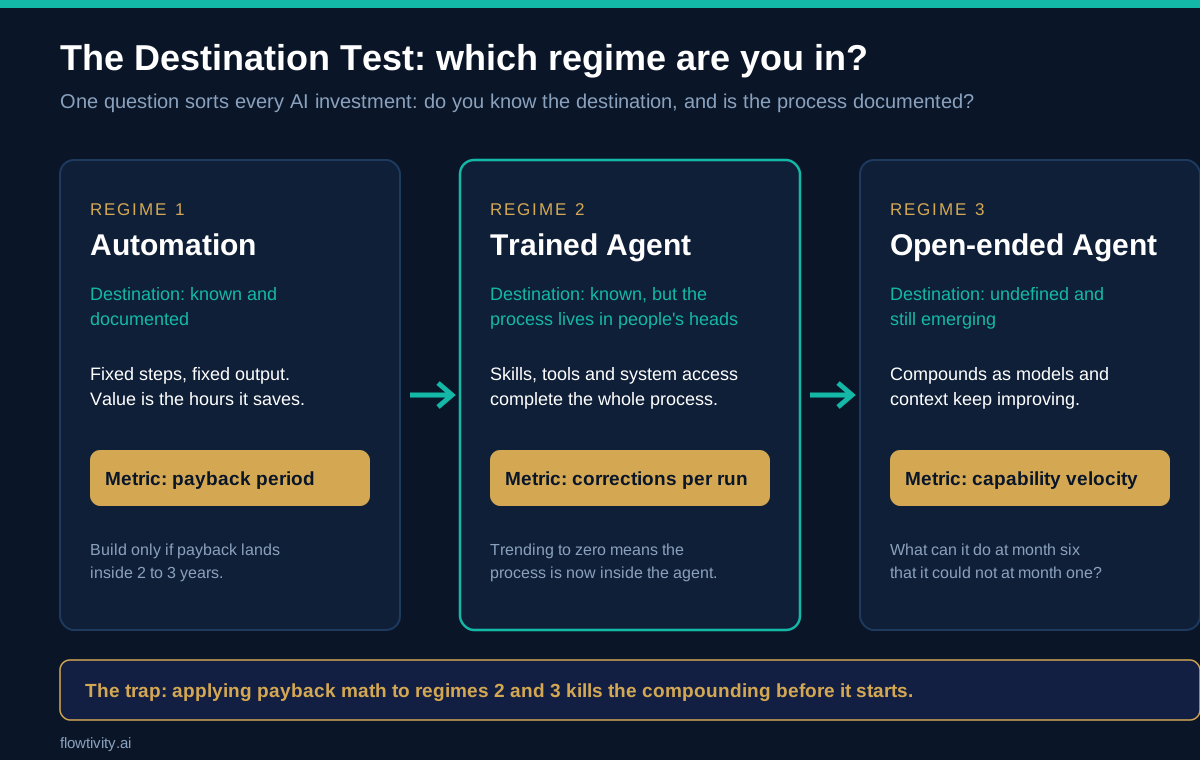
The Destination Test sorts every AI investment into one of three regimes using two questions: do you know the destination, and is the process documented? Known destination plus full documentation means automate and apply payback math. Known destination with undocumented tribal knowledge means deploy a trained agent and track corrections per run. Undefined destination means pilot a compounding agent and measure capability velocity.
Here are the four steps:
- Write down the destination. Describe the exact end-state. If you cannot, you are in agent territory already.
- Check the documentation. If every step and edge case exists on paper, automation can quote accurately. If the process lives in people's heads, automation will charge you to extract all of it first.
- Run payback math when it is documented. Total cost divided by annual value of time saved. Beyond 2 to 3 years, do not build.
- Pick the agent metric when it is not. Corrections per run for trained agents. Capability velocity for open-ended agents.
"The most expensive part of automation was never the build. It was writing down what only your team knows. Agents move that spec from a document into a conversation," says AJ Awan, founder of Flowtivity and former EY management consultant.
Why trained agents break the payback formula
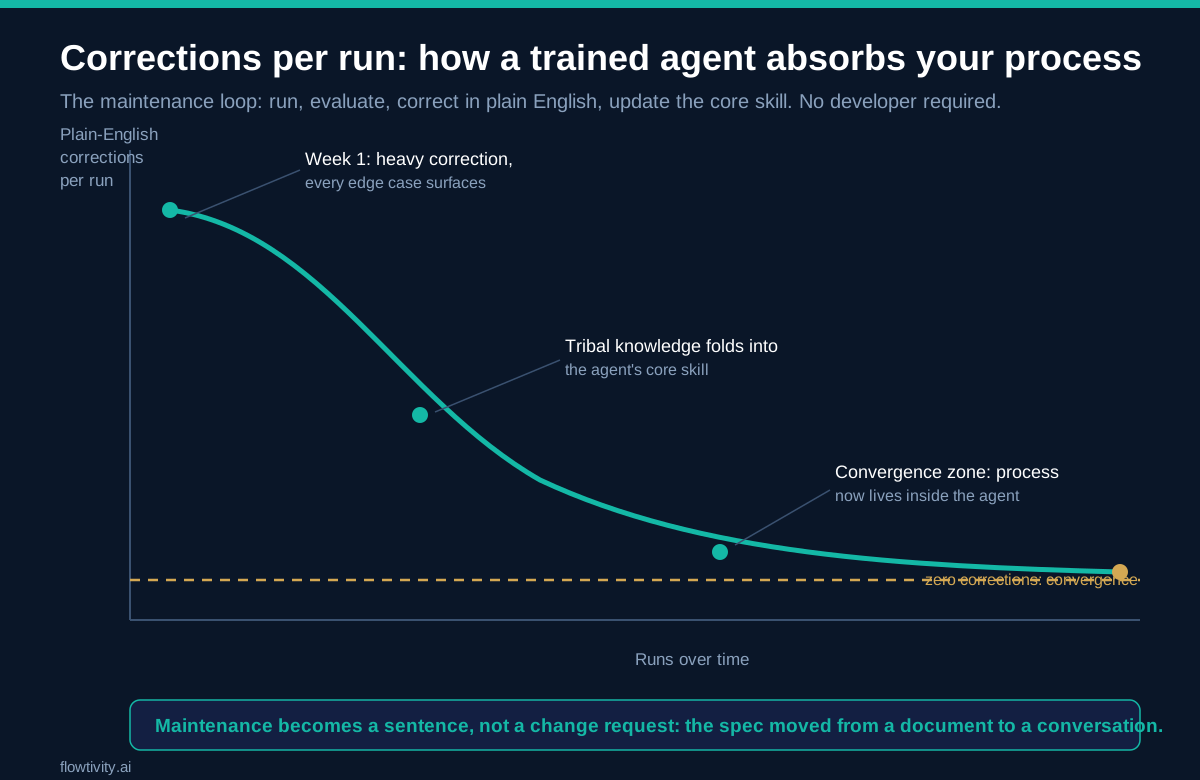
A trained agent is an AI system that completes a known process end to end, even though nobody ever wrote the process down, and it improves every time you correct it in plain English. The metric that tells you it is working is corrections per run: the number of plain-English fixes you give it each time it runs. That number trends toward zero as the agent absorbs your tribal knowledge, and when it flattens, your process is finally documented, living inside the agent instead of in someone's head.
This is the regime where classic automation projects died. The $70,000 quote in the Hormozi example was not really for the workflow. It was for extracting, specifying and encoding every undocumented edge case, plus re-engaging a developer every time the process changed. A trained agent inverts those economics in three ways:
- The spec moves into a conversation. You describe the outcome, give the agent skills, tools and access to your systems, and correct it in plain English after each run. No requirements document, no change request, no developer.
- Every run is an evaluation. You see exactly where output quality breaks, fix that specific behaviour in a sentence, and the core skill updates immediately.
- Maintenance collapses. When the process changes, you tell the agent. The break-fix cost line that ruined the 10-year payback math largely disappears.
In Flowtivity's own deployments this pattern has held consistently: early runs need frequent plain-English corrections, and the correction curve bends toward zero within weeks as feedback is folded into each agent's core skill. The practical effect is that processes which could never justify a $70,000 build, because the requirements were never documented, become viable as trained agents because the documentation happens through use.
What does phase 2 of AI mean for your business?
Phase 2 of AI maturity is the shift from demos and point efficiency on existing workflows to agents embedded in operations that take on a growing share of real work. In phase 1, businesses asked AI to speed up today's tasks. In phase 2, businesses let agents own processes and measure what new capacity appears. 'We are getting to the end of the second phase of AI,' All-In Podcast co-host Chamath Palihapitiya said in a widely shared clip, describing the shift from the demo era into agents that do production work.
Palihapitiya is acting on the thesis directly. He is CEO of 8090, a company that builds specialized AI agents, and discussed the state of agent deployment on CNBC in August 2026. On a recent All-In episode, the hosts covered his "tokenmaxxing" update, and clips from the segment reported his companies' AI token consumption doubling roughly every 45 days as agents take on steadily more work. That is the signature of phase 2: agent usage grows because the work grows, not because someone approved a bigger budget.
The trap for most businesses is evaluating phase 2 assets with phase 1 math. Applying payback calculations priced against today's toil list systematically kills the compounding before it starts. According to MIT Media Lab's 2025 State of AI in Business report, 95 percent of generative AI pilots deliver no measurable P&L return, and the root cause is usually regime mismatch: buying an automation when the process was undocumented, or judging an agent on hours saved in month one instead of capacity created by month six.
Automation vs AI agents: the comparison table
The table below is the one-glance version of the Destination Test: three asset classes, three value models, three metrics, three failure modes. Copy it into your next leadership discussion before anyone approves an AI budget.
| Dimension | Automation | Trained Agent | Open-ended Agent |
|---|---|---|---|
| Destination | Known and documented | Known, process undocumented | Undefined, still emerging |
| Value model | Static: hours saved | Converging: process absorbed | Compounding: capacity created |
| Right metric | Payback period (2-3 yr limit) | Corrections per run trending to 0 | Capability velocity at month 6 |
| Build cost driver | Specifying every edge case | Skills, tools and system access | Pilot scope and guardrails |
| Maintenance | Developer per change | A sentence per change | Supervision and review |
| Failure mode | 10-year payback nobody calculated | Never correcting it, so it never converges | Judging it on month-1 hours saved |
| Best first project | High-frequency documented task | High-frequency tribal-knowledge process | A bounded pilot with review gates |
How do you measure the ROI of an AI agent?
Measure the regime you are actually in: payback period for documented processes, corrections per run for trained agents, and capability velocity for open-ended agents. One formula per regime, applied consistently, replaces the hours-saved spreadsheet that misprices every agent investment.
Operationally: payback period is total system cost divided by annual value of time saved, with a 2 to 3 year ceiling. Corrections per run is the count of plain-English fixes per execution, tracked weekly; a falling curve means the agent is absorbing the process, and a flat non-zero curve tells you the requirements themselves are still moving. Capability velocity is a monthly inventory of what the agent can now do that it could not do the month before, plus the dollar value of any task it took over that was never in the original scope.
That third metric is the one most businesses skip, and it is where the multiplier hides. An agent that takes over quoting follow-ups in month one, draft proposals in month three and parts of job scheduling by month six has created capacity nobody planned for. That is the entire promise of the agent asset class: the ROI is not defined at purchase, it is discovered through use.
Frequently asked questions
When should you not automate a task?
When payback exceeds 2 to 3 years, when the process will change before the investment pays back, or when the process is undocumented tribal knowledge. In the undocumented case, use a trained agent instead and track corrections per run.
What is corrections per run?
The number of plain-English corrections you give a trained agent each time it executes a process. It falls toward zero as the agent absorbs your tribal knowledge, which is the signal that the process has been captured.
Are AI agents worth it for small and growing businesses?
Trained agents are often the highest-ROI entry point, because small businesses rarely have documented processes yet run plenty of high-frequency tribal-knowledge workflows: quoting, follow-ups, job paperwork, invoice matching. The payback math that killed classic automation projects rarely applies, because the spec cost has collapsed.
About the author
AJ Awan is the founder of Flowtivity, an AI consultancy that builds automation and trained agents for growing businesses. He is a former EY management consultant with 9+ years of consulting experience, a TOGAF 9 certified enterprise architect, and he has delivered an average of $15M in business benefits across engagements while shipping 200+ product features. Flowtivity runs the Destination Test as a triage step with every client: payback discipline where the destination is known, agent pilots where the value compounds.
One email a month, no noise
Practical AI notes for Australian businesses. Unsubscribe anytime.