
On this page
Last Updated: September 16, 2026
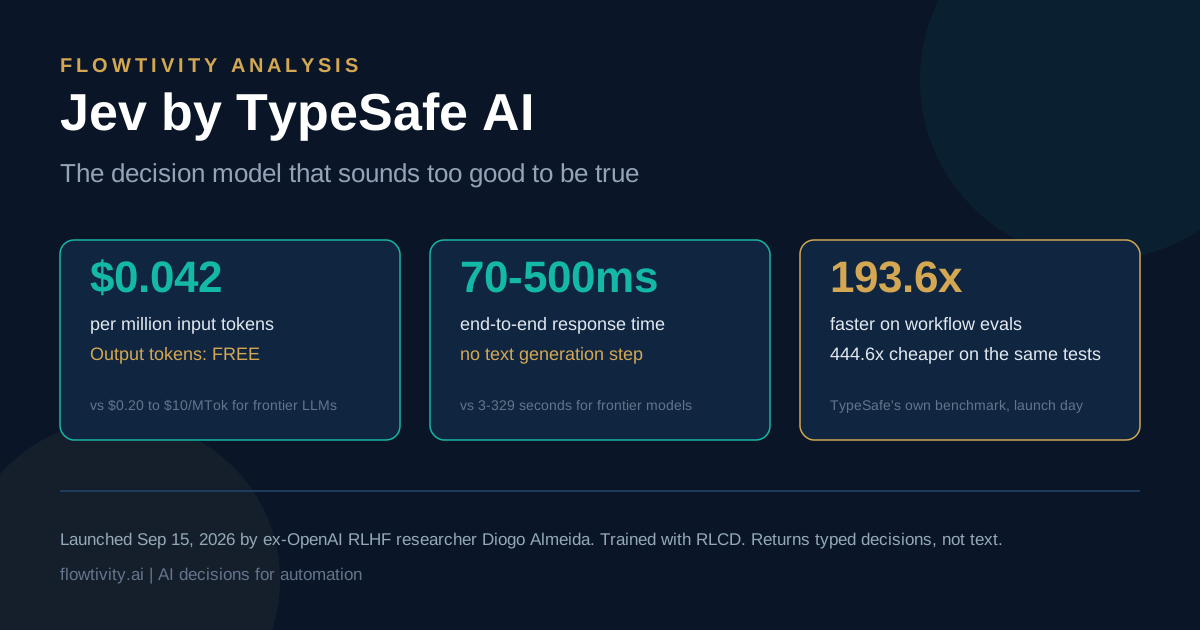
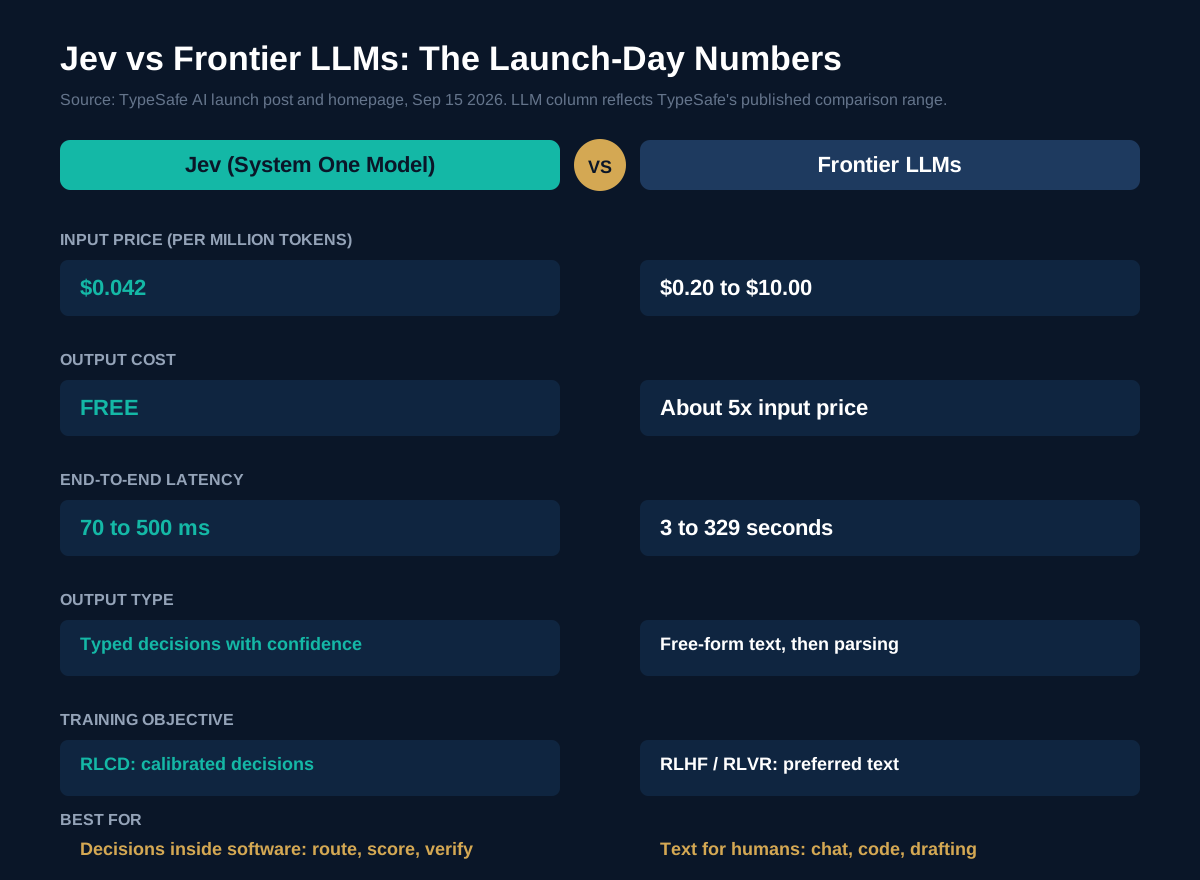
Jev is a new kind of AI model that makes typed decisions instead of generating text. Its maker, TypeSafe AI, launched it on September 15, 2026 after two years in stealth, and the pitch is aggressive: 20-200x faster and 40-400x cheaper than frontier LLMs on decision-shaped work, input tokens at $0.042 per million, output tokens free, and 70-500ms end-to-end latency versus 3 to 329 seconds for frontier models. The founder is Diogo Almeida, the ex-OpenAI researcher whose team page credits him with co-inventing RLHF and InstructGPT, the methods behind ChatGPT. Our audit verdict: the speed and price are real as published, the intelligence comparison is vendor-graded homework, and the trade-off is bigger than the marketing admits. Jev cannot write a single word, and that is the whole point.
The launch pulled more than 1,500 points and 426 comments on Hacker News within a day, which is the closest thing the AI industry has to a peer review speed run. Here is what held up.
What is Jev, the model that refuses to write?
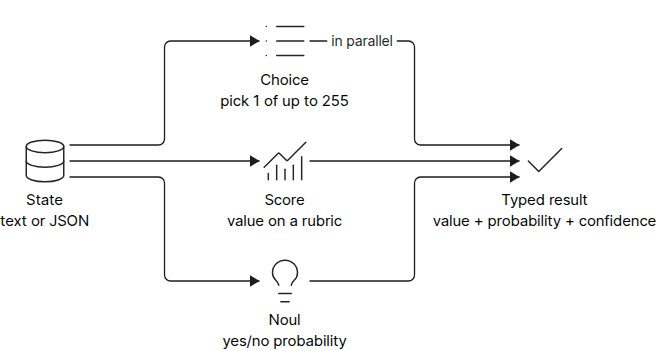
Jev is the first commercial System One Model, a class TypeSafe named after Daniel Kahneman's fast, intuitive thinking in Thinking, Fast and Slow. A chat LLM is optimized to produce strings a human enjoys reading. Jev is optimized to produce decisions a program can branch on. According to TypeSafe's documentation, every Jev call takes a state (text or JSON) plus typed questions, and returns one of three primitives, each carrying a calibrated probability and confidence score. There is no chat interface, no code generation, and no parsing step, because the model is mathematically incapable of returning a value outside the schema you defined. The model itself is named after William Stanley Jevons, the economist behind the Jevons paradox: when a resource gets radically cheaper, consumption explodes. That name is a strategy statement.
How can output tokens be free?
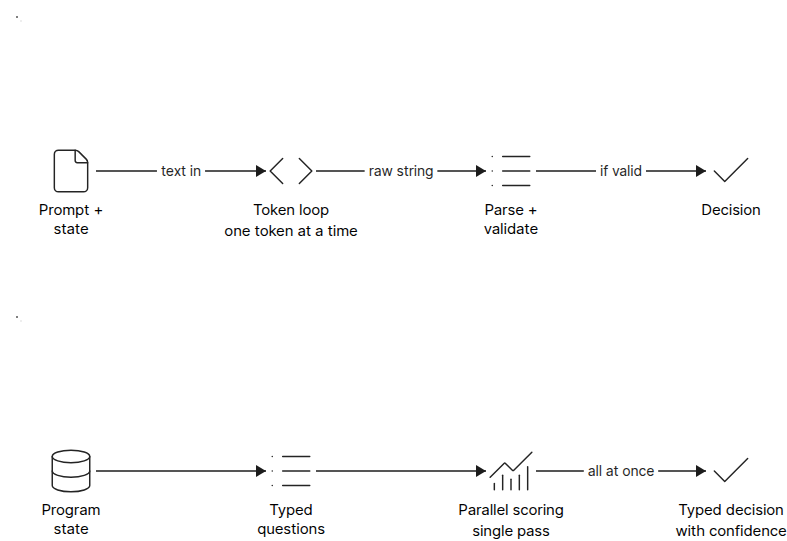
Because Jev never decodes tokens in sequence. A standard LLM generates answers one token at a time, each conditioned on the last, then you parse the string back into structured data. Jev scores every possible answer in the schema in a single parallel forward pass. The generation loop that dominates LLM latency and output pricing simply does not exist, which is how TypeSafe can call outputs "too cheap to meter." According to TypeSafe's launch post, this is also the source of the speed claim: 40x to 200x faster than frontier models on System One-shaped queries, with the homepage's workflow evals topping out at 193.6x faster and 444.6x cheaper ($0.000081 versus $0.013880 per workflow, and 0.114 seconds versus 8.566 seconds).
What does $0.042 per million tokens save in practice?
We modeled it on a workflow we actually build for clients: intake and routing for a service business doing about 40,000 classification decisions a month on roughly 800-token states. That is 32 million input tokens. Priced at TypeSafe's published rates, the Jev bill is about $1.34 a month, with zero output cost. The same decision volume on a frontier model at $10 per million input tokens, plus a few hundred generated output tokens per call at roughly 5x input pricing, lands near $900 a month. Even on a $1 per million token model it is still around $90. To be clear, this is a cost model from published prices, not a live benchmark. Jev is waitlist-only and we have not run it yet. But when the decision layer of a workflow costs less than a coffee, you stop consolidating calls and start sprinkling them everywhere, which is precisely the Jevons dynamic the name winks at.
The pricing is transparent but young. TypeSafe itself writes: "We can't prove it isn't subsidized; we'll need the long-term to prove the sustainability of our pricing (which we expect to go down, not up)," says the company's launch post. That honesty is rare and worth rewarding with attention, not yet with your production stack.
Is Jev too good to be true? Auditing the claims
Partly. The extraordinary claims come with unusual receipts: TypeSafe publishes its eval methodology, its prompt harness on GitHub, and a page of "nuance" footnotes admitting its workflow evals were built by its own team and that reference answers come from averaging GPT-6 Astra and Fable 5.1, which biases toward OpenAI and Anthropic models. Independent verification does not exist yet: no architecture paper, no public leaderboard scores, no OpenRouter listing. Here is the claim-by-claim audit.
| Claim | Source | Audit status |
|---|---|---|
| $0.042/MTok input, outputs free | TypeSafe pricing page | Published and live. Sustainability unproven; TypeSafe admits it cannot rule out subsidy. |
| 20-200x faster, up to 193.6x on evals | TypeSafe workflow evals | Vendor benchmark, run from West Coast laptops per their own footnote, against LLMs wrapped in TypeSafe's adapter. |
| 40-400x cheaper, up to 444.6x | TypeSafe workflow evals | Real math on their harness. No third-party replication yet. |
| 70-500ms latency | TypeSafe | Consistent with parallel sampling design. Measured from their own region. |
| Zero hallucinations | TypeSafe homepage | True only for schema validity. It can still be confidently wrong; the CEO agreed on Hacker News. |
| "Frontier intelligence" on decisions | TypeSafe | Disputed framing. No public benchmark scores; HN critics called it credibility borrowing. |
| Availability | TypeSafe | Early access waitlist only. 32K context, text and JSON only, no images yet. |
The sharpest pushback was not that the tech is fake. "This sounds good but so far all claims just sound like marketing terms," wrote one Hacker News commenter, ramon156, flagging that 70ms versus 329 seconds is not apples-to-apples if the LLM baseline is doing full chain-of-thought generation. The most-upvoted critique targeted framing: "frontier model" for something that cannot hold a conversation borrows credibility it has not independently earned. And the "can't hallucinate" chart drew the best exchange of the thread. "'It's also possible to be confidently wrong (and all future models will be smarter still and still have that possibility),'" says Diogo Almeida, founder and CEO of TypeSafe, conceding the point directly in the launch thread. A guaranteed-valid answer can still be a wrong one, the same way a classifier can be certain and incorrect. Meanwhile, defenders with production experience were already sold on the category: "I'm guessing it might be able to replace maybe 40-70% of LLM calls for a given pipeline depending on the business task, cutting the API costs on those calls by an order of magnitude," says jrickert, a commenter who signed up for the beta on the spot.
"Extraordinary claims require extraordinary evidence so see below for the receipts," says Almeida in the launch post. The receipts are better than average for a stealth launch. They are not yet extraordinary.
Where would you actually use Jev?
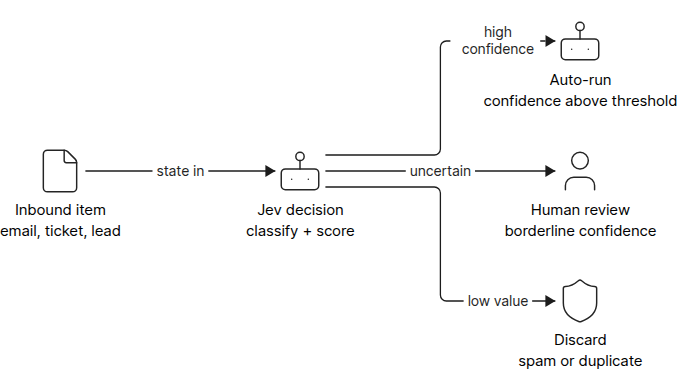
The launch post calls it a smart if-statement: classify, route, score, extract, or branch wherever hand-written rules are too brittle and a full LLM call is too slow or expensive. The two launch demos make the point viscerally. Jev plays Doom at roughly 10 queries per second, about $7 an hour at published prices, using a text description of game state rather than pixels. And it plays Wikiracing, picking the next Wikipedia link toward a target page from hundreds of candidates, where not hallucinating link names is the whole game. The production pattern is threshold-based autonomy: Jev acts when confidence is high and escalates to a human when it is not, which is exactly how we build guardrails for client automations today, except today the gatekeeper is an overqualified LLM doing an impression of a checkbox.
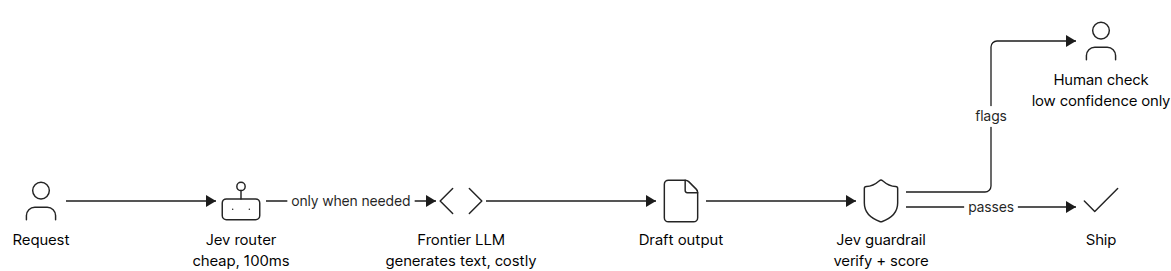
The stack that actually makes sense: Jev decides, the LLM writes
Jev does not replace GPT or Claude any more than a router replaces a web server. The sensible architecture layers them: cheap, fast, calibrated decisions from Jev at every branch point, and expensive generation from an LLM only when something genuinely needs writing. One Jev call decides whether an LLM call is needed at all. Another scores the draft afterward as a guardrail. In our client work, the decision-to-generation call ratio in a healthy automation is easily 10 to 1, and that ratio is where all the cost lives. That is the wedge TypeSafe is attacking, and why an LLM vendor should be worried about the margin, not the model.
The verdict
Too good to be true is the wrong test. Jev is more like too early to fully trust and too cheap to ignore. The pricing is published, the mechanism is coherent, the founder pedigree is real, and the company's own nuance page is more honest than most launch blogs. But the benchmarks are self-graded, the architecture is unpublished, early access is waitlist-only, and a 32K text-only context window rules out plenty of real workloads today. If you build automations, the correct move in September 2026 costs nothing: join the waitlist, port one routing workflow, and measure it against your current LLM calls. The category is arriving either way. Every order of magnitude drop in the cost of decisions unlocks orders of magnitude more automation, and the company named after that exact paradox knows it.
Disclosure: Flowtivity has no relationship with TypeSafe AI. All figures above come from TypeSafe's published launch materials and public community discussion, cited inline. Our cost model uses published prices and our own client workflow volumes, not a live benchmark.
What's actually useful in AI, every Friday
We follow everything happening in AI and send what's worth your time: new models, AI agents, and how to put them to work. One email a week, unsubscribe anytime.