
On this page
Last Updated: 27 September 2026
Last week we benchmarked Laya against Jev honestly. This week a different question, because benchmarks do not sign invoices: which one should your business actually run? The short answer: run Laya if you have a spare server, a predictable workload and a preference for keeping data and costs in-house. Run Jev if you need peak capability and are happy to pay per token for it. If neither describes you, the honest answer is a third option, and we will get to it.
The 30-second decision table
| Your situation | Run | Why |
|---|---|---|
| You have a spare 4-vCPU server and want zero per-token cost | Laya | Our CPU-only test box ran it comfortably on the 808 MB English checkpoint |
| You need top capability and many languages at the edge | Jev | Managed routing, 236 to 276 ms latency, $0.042 per million input tokens |
| You just want automation that works, without hosting anything | Neither | A managed automation platform on a mainstream model is the better purchase |
When Laya wins
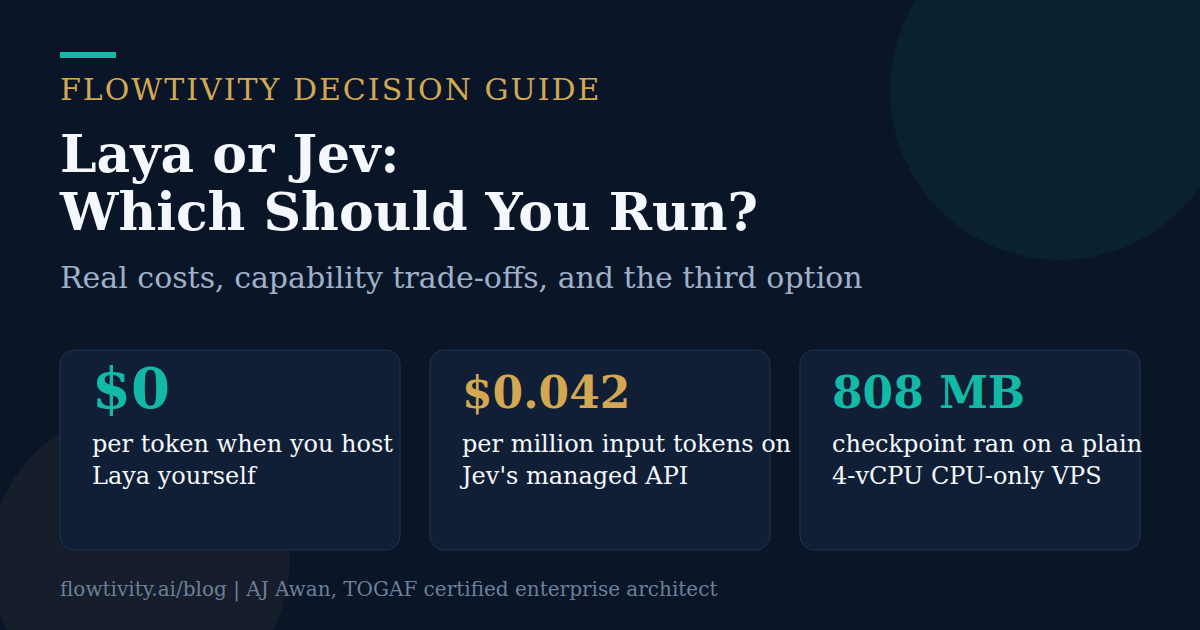
Laya's case is economic and control-based. It charges nothing per token because you host it yourself, and its checkpoint runs on hardware you already have: our test was a plain 4 vCPU, 7 GB RAM VPS with no GPU. For predictable internal workloads, document classification, summarisation, routine QA over your own text, that economy compounds monthly. The control story matters just as much in Australia: the model, the data and the logs never leave infrastructure you own, which simplifies privacy conversations before they start.
When Jev wins
Jev's case is capability and convenience. It gives you one price per million input tokens ($0.042 in our benchmark), sub-300-millisecond latency across a broad language set, and none of the operational weight of hosting. Where Laya's ceiling is what its open community has shipped, Jev's ceiling is the frontier. If your workloads are spiky, unpredictable, or demand the strongest possible outputs, paying for managed capability is the rational choice.
What running Laya actually costs
The download is free and the checkpoint is roughly 808 MB, so the money hides in three places: the server you host it on (about 15 to 25 Australian dollars a month for our test class), the engineering time to install, fine-tune and monitor it, and the discipline of maintaining your own deployment over time. Run the numbers at even modest volume and Laya wins the monthly bill. Add realistic staff hours and the decision is closer than most launch posts admit, which is exactly why a decision guide is more useful than a benchmark.
The first 90 minutes with Laya
For the technically curious, this is the whole path we walked: install Laya 0.3.4 from PyPI on your server, download the standard English checkpoint, run the evaluation loop against a sample of your own text, then wire the output into whatever workflow you intend to improve. Ninety minutes is generous. Nothing about the install is exotic, which is precisely its promise: open-source AI small enough to live on ordinary infrastructure.
The third option
Most growing businesses do not have a spare engineer to babysit a model, and most do not need frontier capability every day. For them the right answer is neither Laya nor Jev as a hobby, but a managed automation platform where those models sit invisibly inside business workflows. That is what we build at Flowtivity: the models are the engine, but the value is in what the car does. If you want this decision made once, correctly, and never thought about again, that is the work we do.
One email a month, no noise
Practical AI notes for Australian businesses. Unsubscribe anytime.


