On this page
Last Updated: September 30, 2026
- OpenAI DevDay 2026 shipped a Decisions API: real-time classify and route with fixed answer sets. That is the decision-only category Jev created and Laya open-sourced.
- Three layers are forming: OpenAI owns the default layer, Jev the optimized cost layer, Laya the sovereign self-hosted layer.
- Jev's moat is calibration with an evidence trail: 99 percent of GPT-6 cascade quality at 57 percent of the cost, per CMU.
- Laya wins on price ($0), latency (~33ms), 100+ languages and license, but its accuracy figures are still self-reported.
- The winning production pattern is model-agnostic: cheap confident first pass, escalate the uncertain tail to a reasoning model.

At OpenAI DevDay 2026, between the Dots agents and the Codex cloud launches, one line item read: Decisions API, real-time classify and route with fixed answer sets, limited preview. If you have followed this space since mid-September, that sentence should sound extremely familiar. It is, almost word for word, the pitch TypeSafe has made with Jev, and the pitch Laya made as its open-source alternative.
Three players now occupy the same category with three different business models. This post maps what changed, who is exposed, and how to choose. It is the fifth piece in our decision-model series, after the Jev launch audit, the Jev use cases field guide, the Laya benchmark test, and the CMU cascade study.
What is OpenAI's Decisions API?
Per OpenAI's DevDay 2026 recap, the Decisions API handles real-time classification and routing with fixed answer sets. You define the answer space, the service picks. That is the decision-only model architecture we have covered three times this month: no text generation, no output tokens to parse, schema-valid answers by construction. OpenAI has not published architecture, pricing or latency numbers while it is in limited preview, so this analysis pins down what is known and flags what is not.
Why it matters: when a category exists only as a startup product, enterprise buyers file it under interesting but exotic. When OpenAI productizes it inside the platform those buyers already pay for, it graduates to default infrastructure. Nobody has to take a meeting about decision models now; they just have to scroll their OpenAI dashboard.
The three bets in one line each
- OpenAI Decisions API: decisions should be a primitive inside the ecosystem you already pay for.
- Jev: decisions should be a specialized, calibrated, optimized service.
- Laya: decisions should be infrastructure nobody can charge you rent for.
Same words, three radically different business models, and the choice between them is about more than benchmarks.
Decision-only models, the 60 second refresher
A frontier LLM generates text token by token, then your code parses the string and hopes it validates. A decision-only model scores typed answer options in parallel and returns the winner with a probability distribution. No prose, no parsing, no off-schema answers. That architectural inversion is what makes these models cheap and fast at precisely the jobs enterprise back offices run at volume: classify, score, route, gate, rank.
| Dimension | Frontier LLM (GPT-6 class) | Jev (TypeSafe) | Laya (open source) | OpenAI Decisions API |
|---|---|---|---|---|
| Architecture | Autoregressive text generation | Parallel scoring of typed answers | Non-autoregressive parallel scoring | Not disclosed; fixed answer sets |
| Latency | 0.5 to 2+ seconds | ~0.15s median (CMU) | ~33ms (self-reported) | Unknown (preview) |
| Marginal cost | $12.18 per 1k judgments (CMU) | $0.044 per 1k judgments (CMU) | $0 (self-hosted) | Unpublished |
| Calibrated confidence | Informal | Yes, cascade-proven | Contact-info style label | Unknown |
| Deployment | API | API, gateway-routed | Self-hosted, Apache 2.0 | OpenAI API (preview) |
| Independent evidence | Extensive | CMU study (arXiv 2609.26550) | None yet | None yet |
Figures from the CMU JEV-as-a-Judge study and Laya's release benchmarks. OpenAI has not published Decisions API figures.
What OpenAI is actually doing at DevDay
The feature is not the news; the distribution is. DevDay also shipped Sign in with ChatGPT, an OpenAI Marketplace spanning Figma, HubSpot and Salesforce, agents in Slack and Teams without per-seat licenses, and Bedrock Managed Agents. Decisions slots into that gravity well. A routing call inside your ChatGPT plugin does not need a second vendor. That is not a benchmark advantage, it is a switching-cost advantage, and it is how OpenAI has won every market it has entered late.
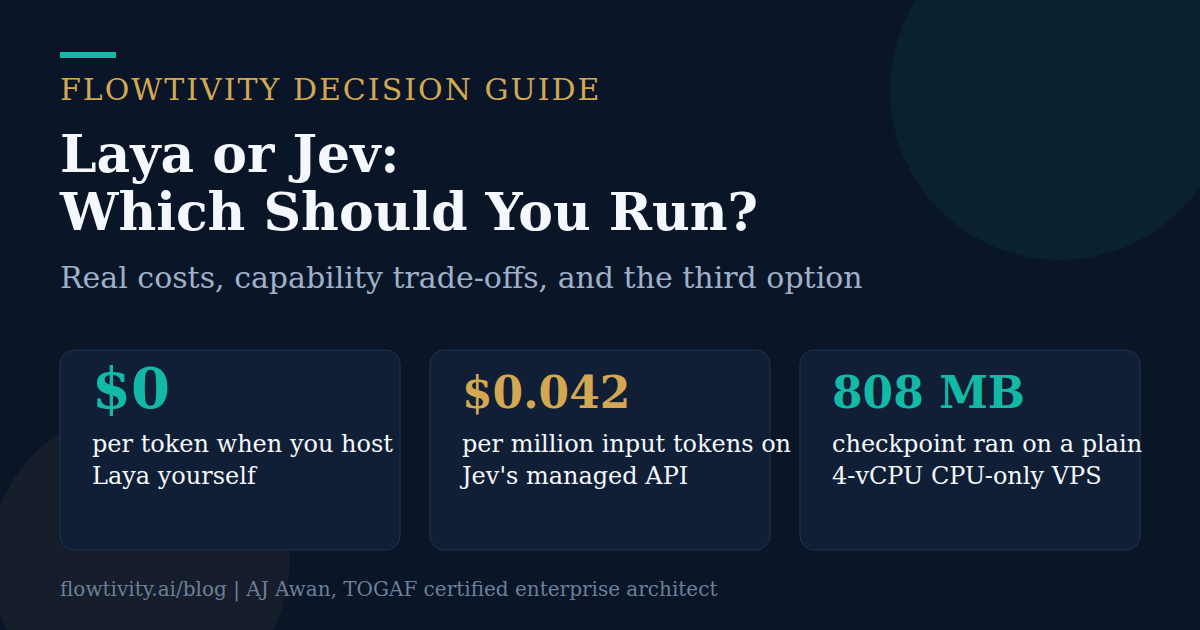
One more consequence: pricing normalization. OpenAI will almost certainly price the Decisions API like a GPT-family offering, cheap versus a frontier model, expensive versus a specialist. That is good for Jev and Laya. A visible price anchor on the same invoice makes $0.042 per million tokens and free self-hosting look better, not worse.
What Jev still owns
OpenAI is borrowing Jev's category, not Jev's homework. The moat is calibration, and it now has an independent evidence trail. CMU's JEV-as-a-Judge study (arXiv 2609.26550) found Jev's confidence score is a real routing signal: at a 0.9 threshold, Jev-accepted answers run within a point of GPT-6 accuracy, and a cascade escalating the uncertain tail kept 91.3 percent pooled quality versus 91.7 percent for GPT-6 alone at 47 percent of the fee. Per-task on RewardBench, the cascade actually beat GPT-6 outright at 22 percent of the cost.
Where Jev is exposed: reasoning-heavy judgment (78.6 versus 93.1 percent on JudgeBench against GPT-6) and adversarially styled inputs, where accuracy dropped nine points when the wrong answer was dressed up more elaborately. If OpenAI's preview ships calibration scoring with fewer failure modes, Jev's narrow technical lead narrows fast. What is unlikely to narrow is price: TypeSafe charges $0.042 per million input tokens with free output, a line OpenAI's margin structure has never matched.
What Laya owns
Laya is the wrench in the works: Apache 2.0 licensed, 421M parameters, self-hostable, with a sub-millisecond router across three checkpoints (English, 100+ languages, specialist). Self-reported benchmarks put it around 33ms per decision at zero marginal cost, versus Jev's 236 to 276ms published range. OpenAI's Decisions API, whatever its pricing lands at, will never be free, and it will never run inside your own perimeter.
Which is why OpenAI entering helps Laya more than it hurts. The maturing-category split is predictable:
- Default layer: OpenAI, for the majority who want it to just work inside what they already buy.
- Optimized layer: Jev, for buyers who watch per-decision cost and want cascade-grade calibration.
- Sovereign layer: Laya, for buyers whose data cannot leave their infrastructure: healthcare, finance, government, and anyone whose compliance team says no.
The honest caveat from our CPU-benchmarked review stands: Laya's headline 0.766 versus Jev's 0.727 accuracy is self-reported, checkpoint-selection flavored, and not independently verified. On verified accuracy alone, Jev's CMU-validated record is stronger.
How to choose: the five question test
We run client decisions through five questions in order:
- Is the data sensitive or regulated? Laya or a self-host equivalent on day one. Cloud options wait until compliance signs off.
- Are decisions high volume with a fixed answer set? Decision-only wins on both cost and latency, whichever vendor.
- Does the workflow need ChatGPT-native pieces? OpenAI's Decisions API earns its convenience premium inside plugins, Spaces and agent estates.
- Is there a long tail of hard cases? Use the cascade: cheap decision model first pass, escalate low-confidence calls to a reasoning model. That is 99 percent of the quality at half the cost.
- Are the decisions genuinely novel or context-heavy? Then you do not want decision-only at all, you want a reasoning model, and no category convergence changes that.
The meta lesson from DevDay
OpenAI entering your category is the moment it becomes real, and the moment being early stops being an edge. Whatever the Decisions API charges, being 10 to 40 times cheaper or self-hostable remains a durable advantage. The claim "we are the only API that does this" was a perishable advantage, and DevDay expired it. Three layers will survive the convergence: default, optimized, sovereign. The winners in each layer are respectively OpenAI at scale unless they fumble price, Jev while its calibration lead holds, and Laya wherever data gravity bites hardest.
We build these cascade patterns for growing businesses at Flowtivity: support triage, lead routing, document scoring, all running on decision-only economics with reasoning-model escalation on the hard tail. The math on whether your workflow fits takes about an hour, and it is usually the cheapest hour of AI consulting you will buy this year.
Disclosure: Flowtivity has no relationship with OpenAI, TypeSafe AI or Convai Innovations. Figures come from OpenAI's DevDay 2026 recap, TypeSafe's published pricing, the CMU JEV-as-a-Judge study (arXiv 2609.26550), and our own published benchmarks of Laya. OpenAI Decisions API details are limited-preview and unpublished; verify current pricing at openai.com before making build decisions.
One email a month, no noise
Practical AI notes for Australian businesses. Unsubscribe anytime.