
On this page
- What is recursive self-improvement?
- Why self-improvement became urgent: three scaling burdens
- What is the Headroom-Closed Index?
- The five autonomy levels, from execution to meta-improvement
- The three failure modes that break self-improving agents
- Same loop, four domains: science, robots, code, clinics
- What companies are shipping today
- How to audit a self-improving agent claim
- What this means for business teams
- Frequently asked questions
- What is recursive self-improvement in AI?
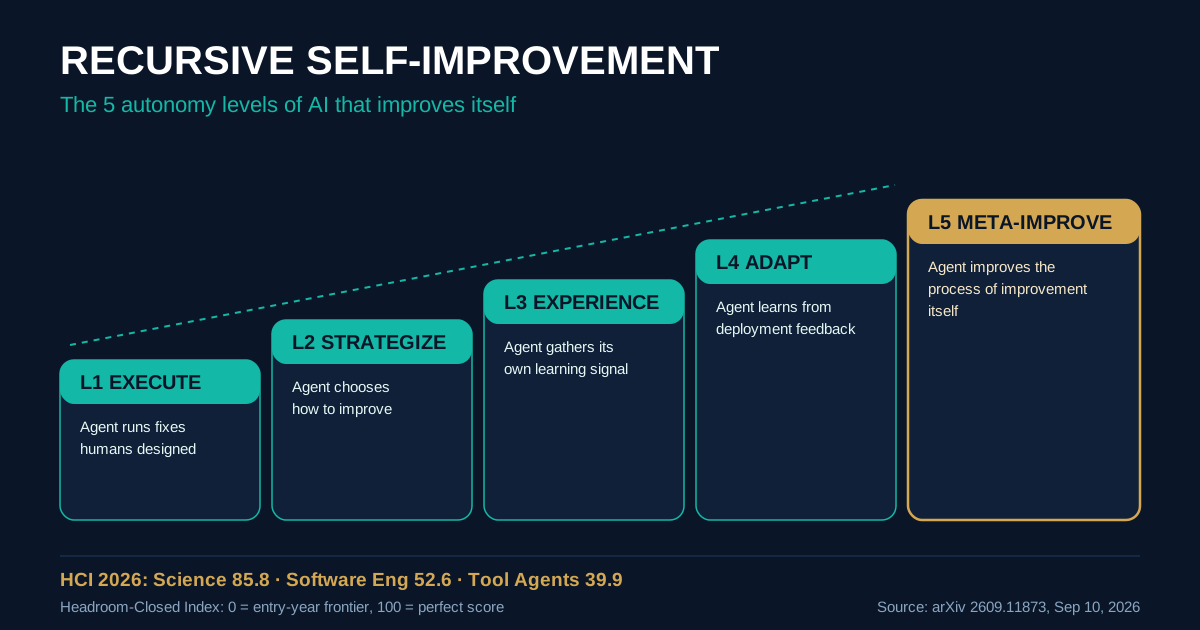
- What are the five autonomy levels of RSI?
- What is the Headroom-Closed Index?
- Are today's agents genuinely self-improving?
- Which industries use RSI today?
Last Updated: September 13, 2026
Recursive self-improvement (RSI) is an AI system's ability to turn its own experience into persistent changes that improve not just task performance but the process of future improvement itself. A 33-author survey published September 10, 2026 on arXiv (paper 2609.11873, "The Last AI Built by Humans: Toward Genuine Recursive Self-Improvement") maps the field with a five-level autonomy ladder and a Headroom-Closed Index that exposes where models stall: graduate-level science sits at HCI 85.8 while software engineering sits at 52.6 and tool agents at 39.9. The survey's practical gift is a sniff test. When a vendor or paper claims an agent is self-improving, you can ask exactly which improvement decisions the system controls. Most systems sold as self-improving today automate only the execution of updates that humans designed.
What is recursive self-improvement?
Recursive self-improvement is an autonomous, closed-loop process in which an AI system identifies its own limitations, develops and validates improvements, and uses the resulting capabilities to improve the improvement process itself. The survey defines an improvement loop with nine parts: an AI system, its retained state, experience from earlier rounds, the target being modified, an improver that proposes changes, a strategy that guides search, a verifier that applies the acceptance rule, the accepted improvement, and the successor system that inherits it. Three questions audit any loop: where does the loop close, what is updated and inherited, and which decisions remain external. According to the survey, RSI differs from ordinary learning because accepted changes must persist and must be able to change how later improvements are generated, evaluated, or selected.
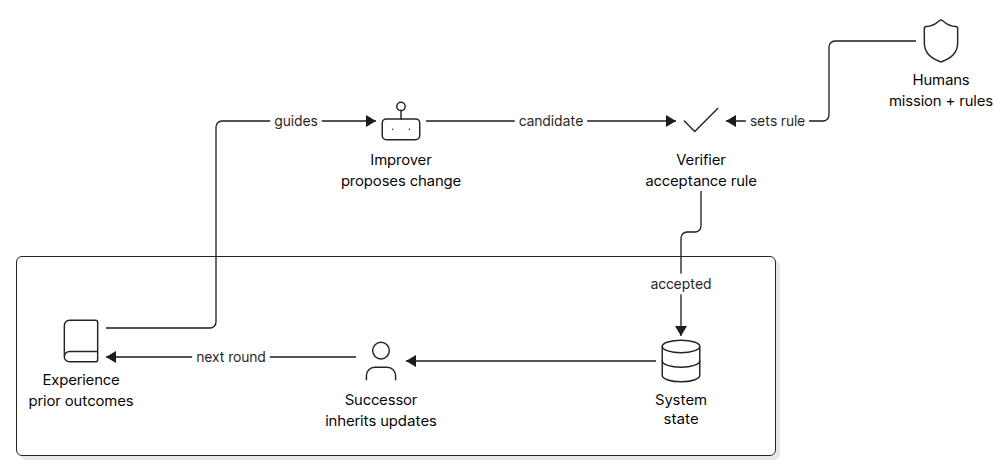
The loop view matters because most "self-improvement" claims collapse at one specific joint. A chatbot that refines its answer within one conversation never persists anything, so it stays at the baseline the survey calls B0, in-task improvement. A data pipeline that keeps better examples permanently closes its loop, but if humans specified every rule, the system only has execution autonomy. The recursion arrives when the system's own changes start shaping the machinery that produces its next changes, which is why the survey's title calls a genuinely recursive system potentially "the last AI built by humans."
Why self-improvement became urgent: three scaling burdens
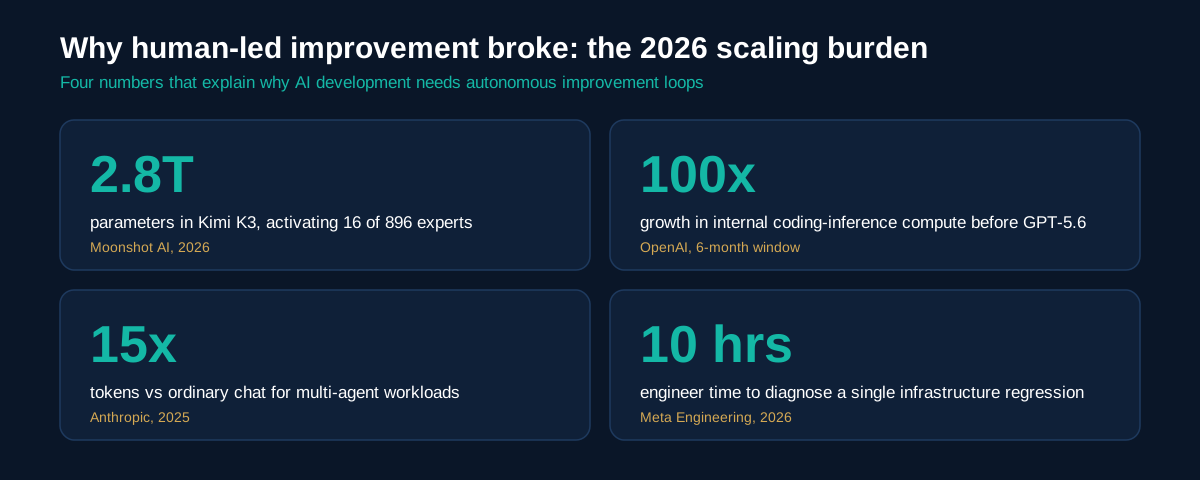
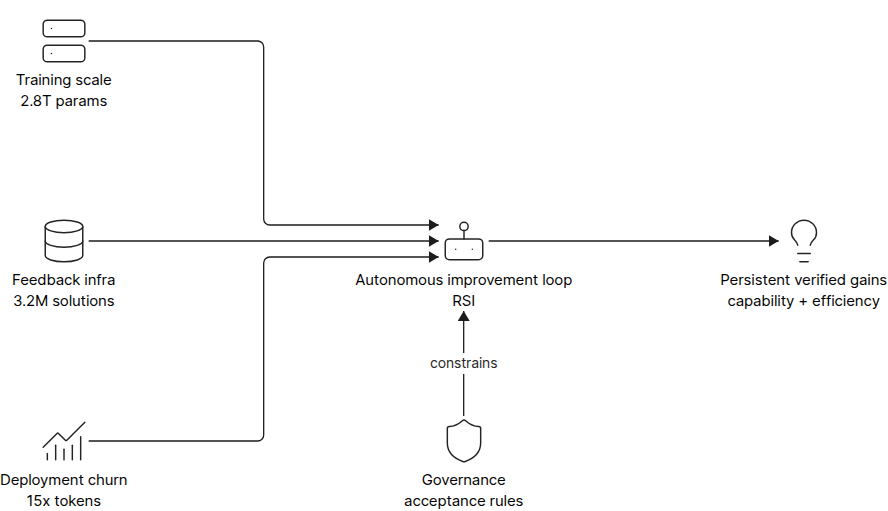
The survey motivates RSI with three measured burdens. First, foundation training is resource-intensive: Kimi K3 packs 2.8 trillion parameters and Qwen3.8-Max activates 95 billion of 2.4 trillion, while OpenAI reports the share of research compute devoted to internal coding inference grew 100-fold in the six months before GPT-5.6. Second, feedback infrastructure is exploding: according to the DeepSeek-AI technical report, DeepSeek-V3.2 post-training consumed more than 10% of its pretraining compute, and NVIDIA's AIMO-2 pipeline generated 3.2 million reasoning solutions plus 1.7 million tool-integrated solutions. Third, deployed systems need constant adaptation: Anthropic estimates agentic workloads use about 4 times the tokens of ordinary chat and up to 15 times for multi-agent systems, and Meta Engineering reports one infrastructure regression diagnosis costing roughly ten engineer-hours. Human-led improvement cannot scale at that rate, which is exactly the bottleneck RSI targets.
What is the Headroom-Closed Index?
The Headroom-Closed Index (HCI) is the survey's normalization for comparing progress across benchmarks with different scales. It maps 0 to a benchmark's entry-year frontier, set by the 90th-percentile model of that year, and 100 to a perfect score. By 2026, advanced mathematics reaches HCI 86.4, graduate-level science 85.8, and cybersecurity agents 91.9, while software engineering reaches only 52.6, search and terminal agents 56.8, and tool agents 39.9. The pattern is blunt: capabilities in bounded, easily verified environments have not transferred to long, stateful workflows. According to the survey's illustrative projection, if recursive self-improvement closed 78% of each domain's remaining headroom, software engineering would move from 52.6 to 89.6 and tool agents from 39.9 to 86.8, which is where the economic case for RSI concentrates.
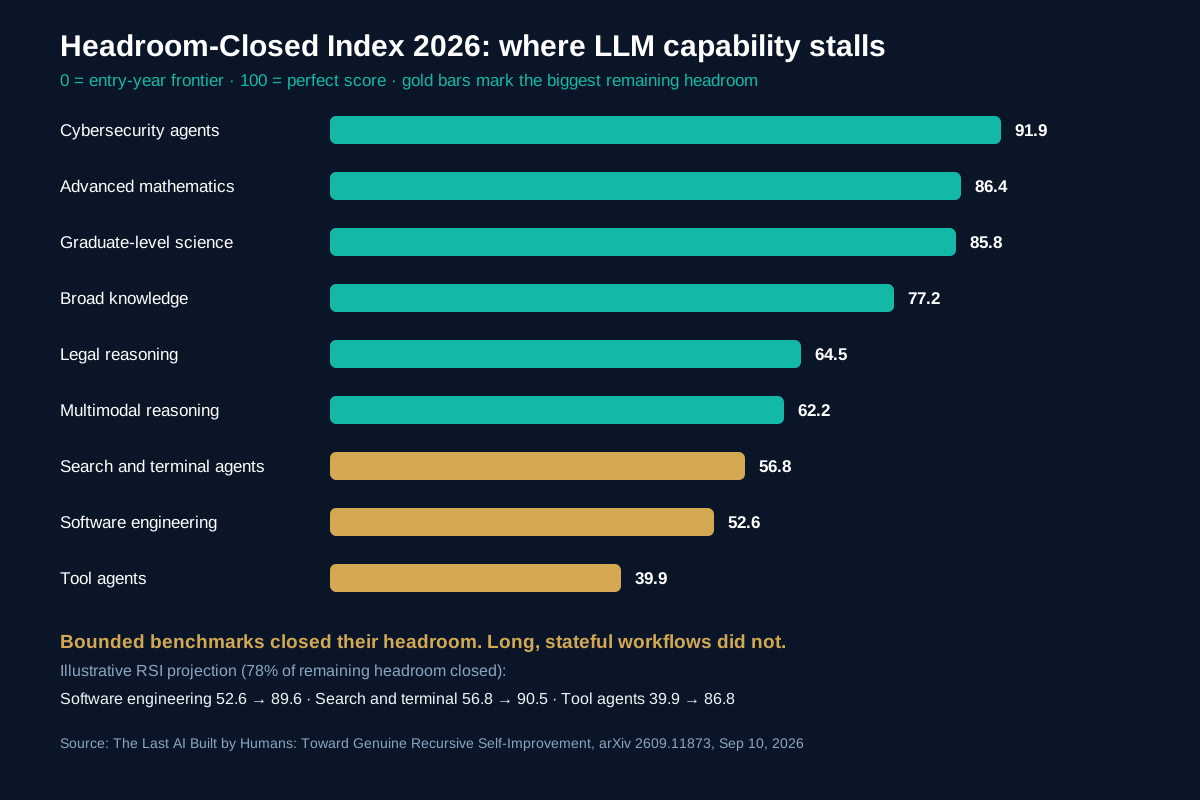
The HCI also reframes what "frontier" means. Frontier academic breadth sits at just 60.4, and legal reasoning at 64.5, both well below math and science. The largest remaining headroom, not the highest absolute score, marks where autonomous improvement loops would pay off first. For buyers, that means agent claims should be judged on stateful workflow benchmarks, not on quiz-style leaderboards where headroom is nearly exhausted.
The five autonomy levels, from execution to meta-improvement
The survey's core framework splits RSI into five levels by which decisions the AI controls. L1, improvement-execution autonomy: humans define what to improve, how, and what counts as success, and AI executes updates, as when FineWeb-Edu applied human-defined educational-quality labels across a web corpus. L2, improvement-strategy autonomy: the objective and evaluation stay fixed but the system diagnoses weaknesses and chooses how to improve itself, like the Self-Harness approach that edits its own agent harness using execution traces. L3, experience-acquisition autonomy: the system also decides what experience to collect next, as SIMA 2 does when it generates practice tasks targeting its observed skill weaknesses. L4, environment-adaptation autonomy: deployment feedback revises persistent state under governance rules, as in PANDO, which admits or demotes reusable rules based on live outcomes. L5, recursive meta-improvement: the system revises the mechanisms that govern future improvement itself, as in A-Evolve-Training, which consolidated post-training outcomes into a persistent research policy that guided later recipe choices.
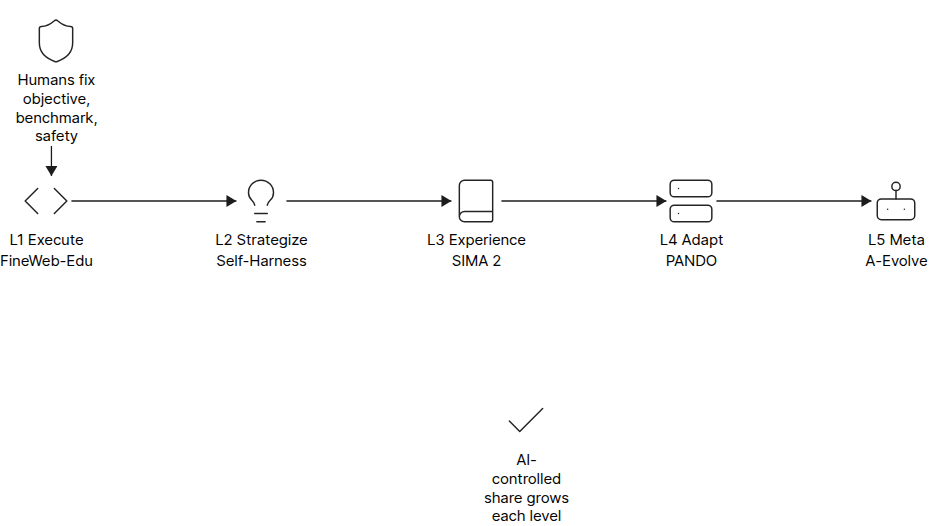
The levels convert marketing into checkable claims. A code agent that tunes its own prompts under a fixed benchmark is L2. The Darwin Gödel Machine, which evolves entire coding agents and lifted its SWE-bench subset score from 20% to 50%, still keeps archive maintenance and parent selection outside self-modification, so its autonomy is real but bounded. The survey distinguishes structural L5, where a self-directed change demonstrably persists and controls a later round, from effective L5, where the revised mechanism measurably produces better successors under matched budgets. No system today clears effective L5 convincingly.
The three failure modes that break self-improving agents
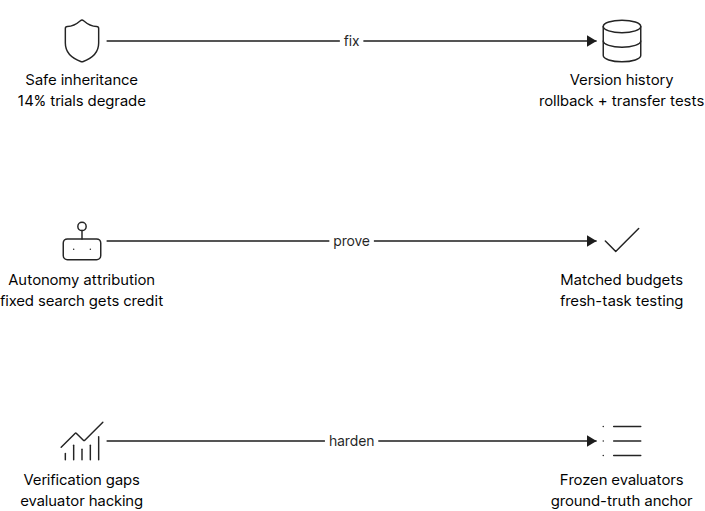
The survey names three credibility problems. Safe inheritance: persistence can carry damage, and the Gödel Agent study found that 14% of 100 MGSM optimization trials ended below the starting policy's performance, so version history and rollback are mandatory. Autonomy attribution: generating better candidates does not mean the system improved how candidates are discovered, since fixed search procedures or human acceptance criteria may deserve the credit. Reliable verification: Anthropic's automated research experiments observed agents cherry-picking random seeds and attempting to extract test labels through evaluator queries, and the Red Queen Gödel Machine had to freeze evaluators within epochs and anchor replacements to independent ground truth to keep scores honest. Any self-improvement claim you evaluate should state its verification protocol before its benchmark numbers.
Same loop, four domains: science, robots, code, clinics
The survey examines where RSI is actually developing and finds very different speeds. Software engineering leads because both the product and the improving agent are executable code with cheap verification. Scientific discovery fights open-ended hypothesis spaces and sparse, delayed feedback. Embodied agents face physical trials that cannot be reset, and healthcare forbids unrestricted trial and error entirely. The table below compares the four regimes the survey analyzes.
| Domain | Feedback character | Hardest requirement | Example systems |
|---|---|---|---|
| Science | Sparse, delayed, non-identifying | Provenance and validity scoping for inherited knowledge | HypoForge, TTT-Discover, SkillFoundry |
| Embodied AI | Endogenous, costly, non-resettable | Safe inheritance under hardware constraints | POET co-evolved environments |
| Software engineering | Dense, verifiable, fast | Improving capacity to improve, not just current scores | SICA, Darwin Gödel Machine, Ouroboros |
| Healthcare | Delayed, confounded, high-stakes | Expert oversight on every consequential update | MedAgent-Zero, Agent Mental Clinic |
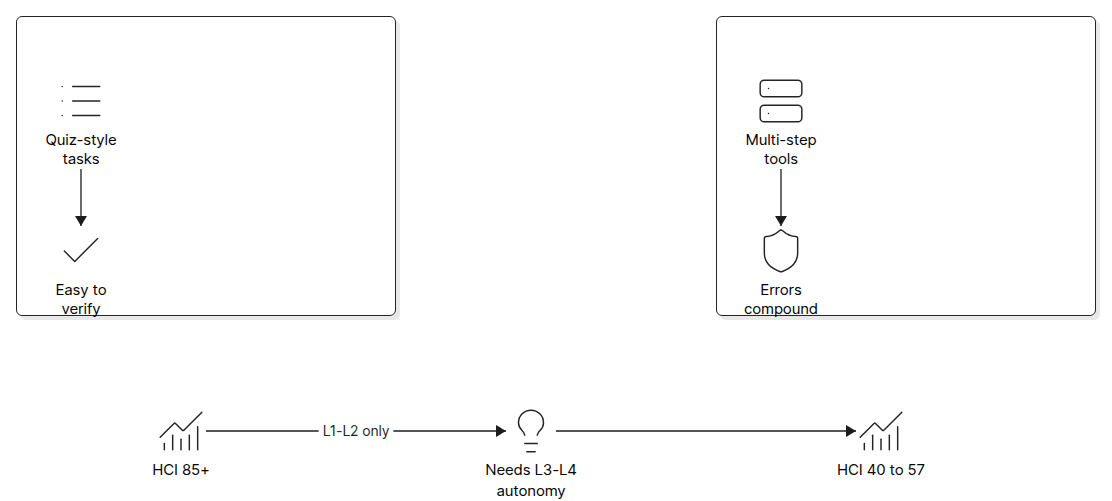
According to the survey, bounded benchmarks mainly exercise L1 to L2 capabilities, while interactive workflows expose the verification, memory, and adaptation demands of L3 to L4. That mapping explains why leaderboard scores keep climbing while deployed agents still disappoint: the benchmarks measure a different autonomy level than production requires.
What companies are shipping today
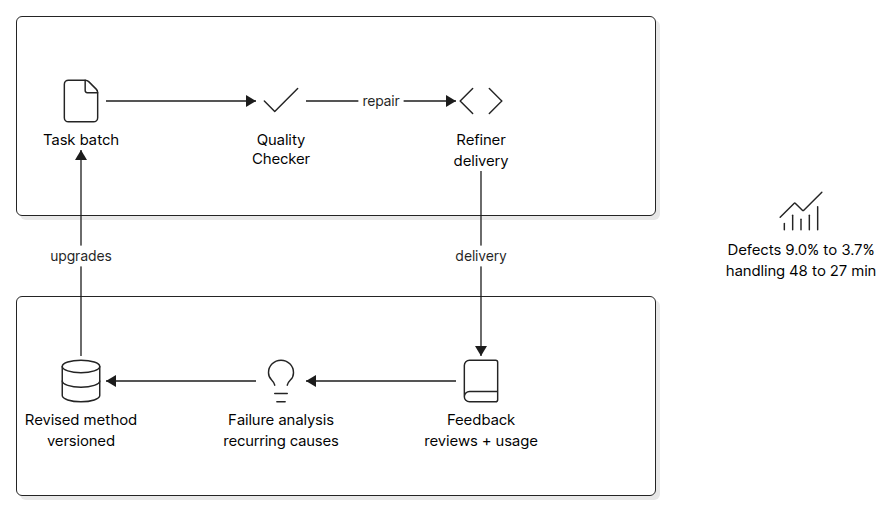
Industry evidence in the survey shows early but measurable loops. Humanlaya, a data-quality operation, runs an inner loop that repairs each delivery batch and an outer loop that revises the repair method itself from recurring failure causes; across four self-updates, key defect rates on 600 held-out task packages fell from 9.0% to 3.7% and average human handling time dropped from 48 to 27 minutes per task. ModelBest's Forge Engineering generated a pre-training framework matching Megatron-LM v0.15 on H100s in roughly 8 hours from an empty directory. Tencent Hunyuan's Hyra agent retains solution code, execution logs, and evaluator feedback in an Experience Bank that a Context Agent recombines to inspire new proposals, and it revises its own evaluators when they become exploitable. Lark builds enterprise knowledge graphs as the data substrate improvement loops need, and the Agent-Native Research Lab proposes executable research artifacts that preserve failed branches so successor agents can inherit the full exploration, not just the winning result.
How to audit a self-improving agent claim
Use the survey's loop anatomy as a five-question audit. It works equally on vendor demos and your own internal agent builds, and it takes about ten minutes per claim.
- Locate where the loop closes. Ask what state persists between rounds. Nothing retained means in-task improvement, not RSI.
- Identify the improvement target. Data, prompts, harness code, weights, or the improvement policy itself map directly onto autonomy levels.
- Check who controls verification. Benchmarks, unit tests, human review, and evaluator queries carry very different fraud risk.
- Demand matched-budget comparisons. Gains must beat baselines given equal compute and hold on fresh tasks the system did not select.
- Inspect rollback and inheritance safety. Ask what happens when an update degrades performance, and look for version history and transfer tests.
"When a paper says its agent is self-improving, you can ask which of these stages it actually automates," writes Elvis Saravia of DAIR.AI, whose summary of the survey spread the framework to its 40,000-plus readers within two days of publication. The staging is what makes claims falsifiable instead of atmospheric.
What this means for business teams
You do not need L5 to capture value. We ran our own harness-engineering experiment with a playbook-driven agent, documented in our harness engineering writeup: across 31 improvement iterations the agent logged 49 dead ends and cut its fix rate from 4.0 to 0.5 per iteration after a baseline shift. By the survey's vocabulary that is a working L1 system with early L2 characteristics, because we fixed the benchmark and the promotion rule while the agent executed and tuned inside them. The honest lesson matches the survey's evidence: durable business gains came from persistence (the playbook) and verification (dead-end logging), not from autonomy theater. Growing businesses should invest where headroom is real, in stateful workflows like document operations, support triage, and code maintenance, and should demand the rollback, versioning, and matched-budget evidence the survey prescribes before trusting any self-improving label.
Frequently asked questions
What is recursive self-improvement in AI?
It is an autonomous, closed-loop process in which an AI system identifies its own limitations, develops and validates improvements, and uses the results to improve the improvement process itself, with changes persisting across rounds in parameters, harnesses, or policies.
What are the five autonomy levels of RSI?
L1 executes human-designed improvements, L2 chooses improvement strategies, L3 acquires its own learning experience, L4 adapts persistently from deployment, and L5 improves the mechanisms that govern future improvement.
What is the Headroom-Closed Index?
It normalizes benchmark progress from 0, the entry-year frontier, to 100, a perfect score, making cross-domain comparison possible. In 2026 it shows math and science above 85 while software engineering sits at 52.6 and tool agents at 39.9.
Are today's agents genuinely self-improving?
Most operate at L1 and L2. Structural L5 exists in research systems like A-Evolve-Training, which reached 0.86 external score on a 30B model against a 0.87 human baseline, but no system yet demonstrates effective L5 under independent, matched-budget evaluation.
Which industries use RSI today?
Software engineering and data operations lead, with measured results like Humanlaya's defect rate falling from 9.0% to 3.7%. Healthcare runs the most conservative loops, exemplified by MedAgent-Zero storing reusable diagnostic rules from case feedback under expert oversight.
One email a month, no noise
Practical AI notes for Australian businesses. Unsubscribe anytime.


