
On this page
Last Updated: 22 September 2026
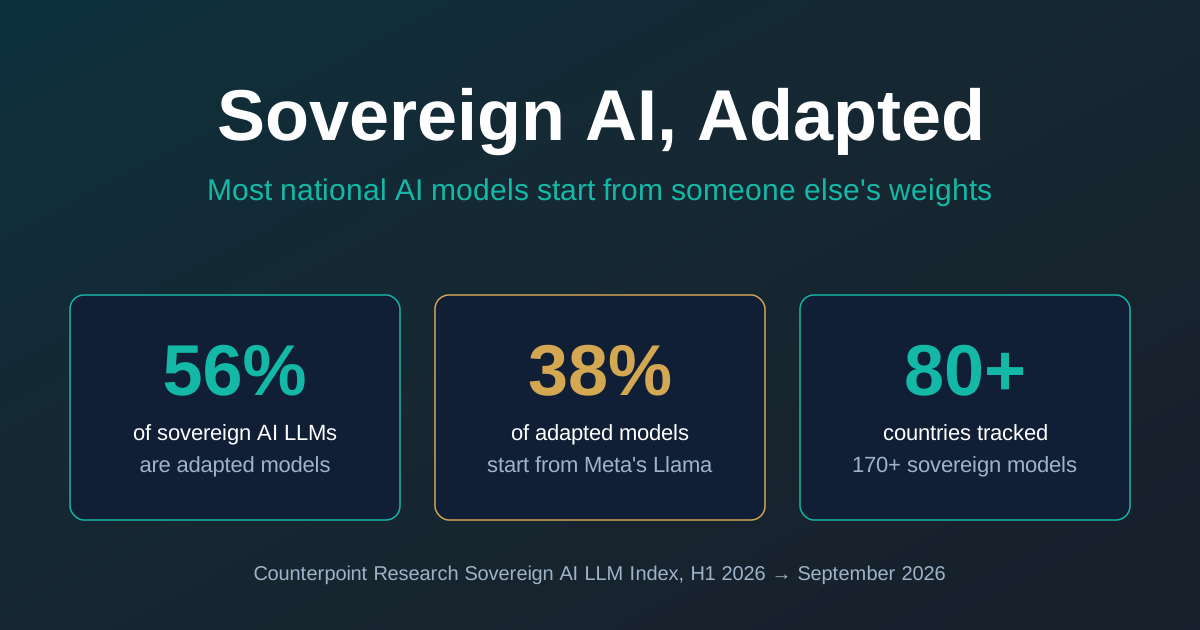
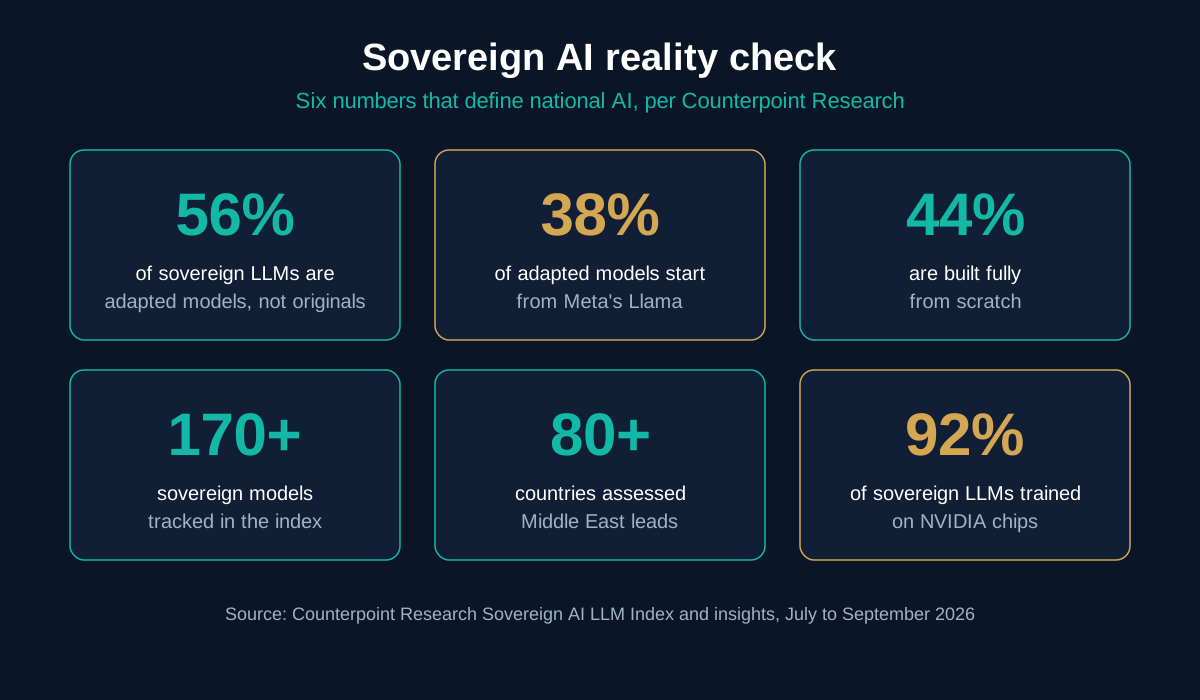
Sovereign AI is mostly an adaptation project, not a moonshot. According to Counterpoint Research's September 2026 insight, 56 percent of the sovereign large language models it tracks are adapted models, meaning fine-tuned versions of existing open-source models, and Meta's Llama is the base for 38 percent of them, followed by Alibaba's Qwen and France's Mistral. The reason is economics: adapting a proven open model to your language, law and data takes months and local hardware, while training from scratch takes years and hundreds of millions of dollars. For Australian businesses the practical takeaway is bigger than geopolitics. You do not need a national supercomputer project to run onshore AI, an NVIDIA DGX Spark with an adapted open model is a mini sovereign stack, and that is a decision you can make this quarter.
What Is Sovereign AI?
Sovereign AI is the practice of building and running language models inside a country or organisation so that data, model and compute stay onshore. It is measured by Counterpoint Research's Sovereign AI LLM Index, which assesses more than 80 countries and 170 active models, and it ranges from national model programs down to one company hosting its own inference server. The common thread is control over weights, data and hardware.
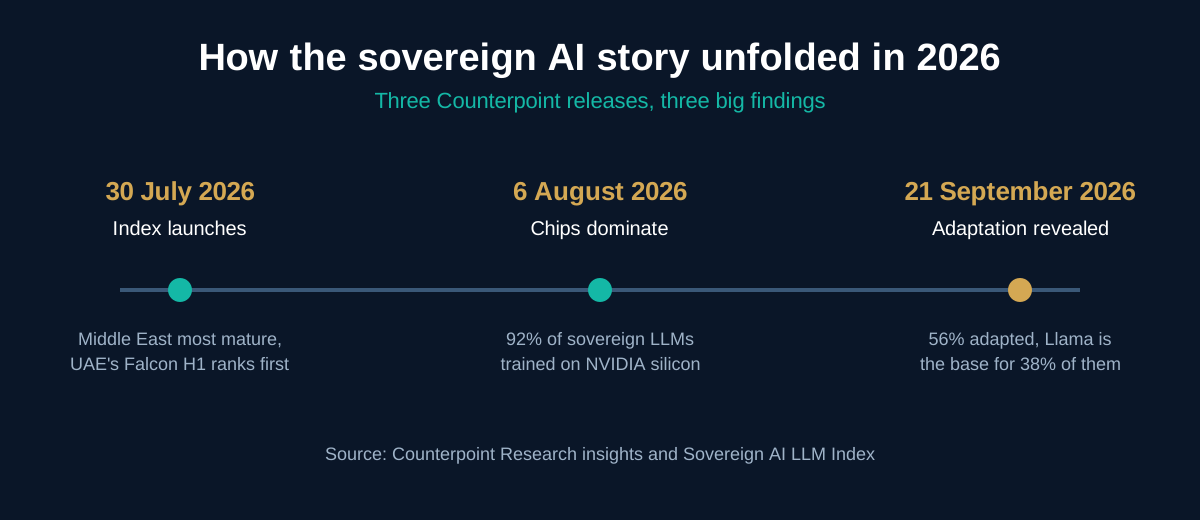
The term covers everything from national model programs to a single company hosting its own inference server. The common thread is control: the model weights, the training data, the serving hardware and the governance all sit where the organisation wants them. According to the index coverage, the Middle East was the most mature sovereign AI region in H1 2026, led by the UAE's Falcon H1 from the Technology Innovation Institute in Abu Dhabi, with Saudi Arabia's ALLaM, Jais 2 and K2 Think V2 also at the leading edge of the sovereignty spectrum.
What counts as sovereign is a spectrum, not a flag. A model adapted from open weights and served on local hardware is more sovereign than a model called through a foreign API, and less "pure" than one trained from scratch. For most businesses, that middle ground is exactly the right spot.
What Did Counterpoint Find?
Counterpoint Research's Sovereign AI LLM Index insight, published 21 September 2026 by author Marc Einstein, found that 56 percent of sovereign LLMs are adapted models, Llama is the dominant foreign base at 38 percent of adapted models, with Alibaba's Qwen second and France's Mistral third. The finding reframes the race: most national AI capability is built on someone else's open weights, and that is a strategy, not a shortcut.
The insight is blunt about the implication: "Llama is the dominant foreign base model family, accounting for 38% of adapted sovereign LLMs," according to the Counterpoint Research insight. In other words, the fastest national AI programs in the world are standing on open weights from a US company, then adapting them. Adaptation is the standard route, and it is a deliberate strategy, not a compromise.
Two earlier findings frame it. According to Counterpoint's July 2026 index launch, the UAE's Falcon H1 ranked first among more than 170 active models across 80-plus countries. Then, according to Counterpoint's August 2026 insight, 92 percent of sovereign AI LLMs were trained on NVIDIA chips. Sovereignty is real, but the supply chain underneath it is concentrated, and that concentration is exactly why adaptation is winning.
Why Do Countries Adapt Instead of Build From Scratch?
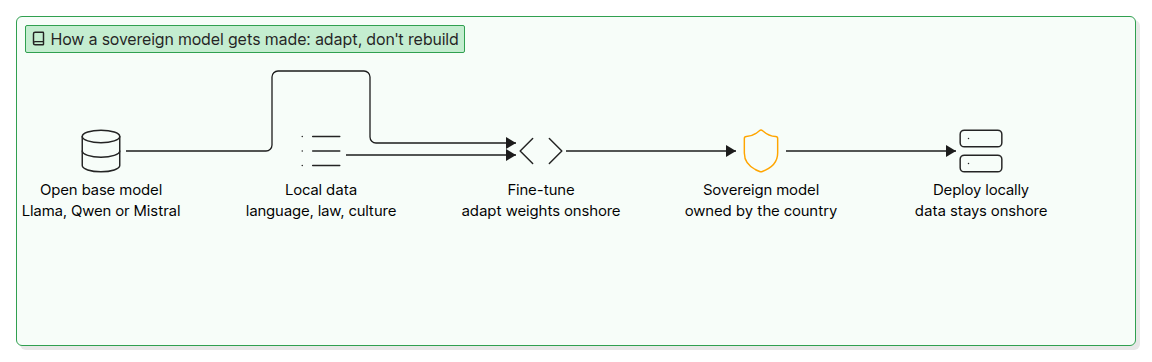
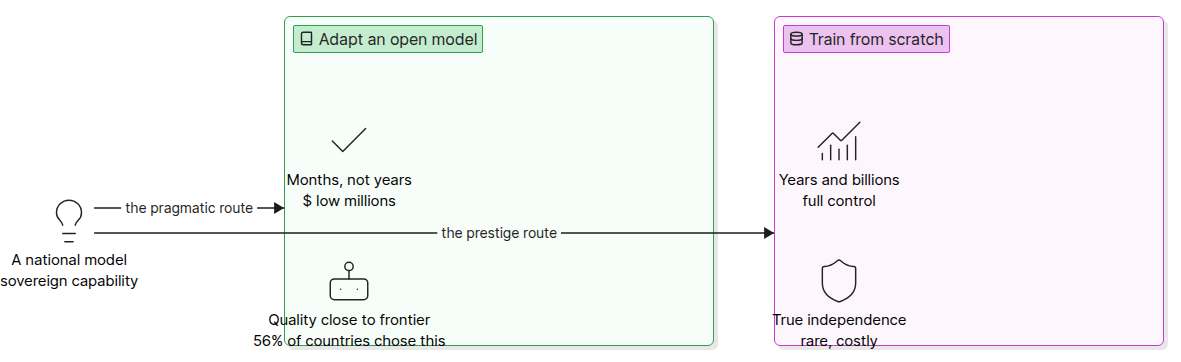
Because adapting is dramatically faster and cheaper. Adaptation means taking an open base model, fine-tuning it on local language, law and culture, and controlling the result. Building from scratch means training a foundation model, which requires years, elite teams and capital in the hundreds of millions. With quality close to frontier and a fraction of the cost, the pragmatic route wins for almost everyone.
The quality gap is the deciding factor. According to Counterpoint's finding, 56 percent of sovereign models are adapted, meaning the majority of national programs judged that a strong open base plus domain fine-tuning was good enough, and the remaining 44 percent judged that full independence was worth the cost. The adapted route is also resilient: when a better base model ships, you re-run the adaptation in weeks, whereas a from-scratch program has to keep pace with frontier labs that spend vastly more.
The trade-off is control. Adapted models inherit some dependencies, including licence terms and upstream behaviour, and the 92 percent NVIDIA share adds a hardware dependency on top. For most countries and companies, accepting those dependencies is rational because the alternative cost is prohibitive.
| Attribute | Adapt an open model | Train from scratch |
|---|---|---|
| Time to a working model | Months | Years |
| Cost | Low millions, mostly GPUs | Hundreds of millions |
| Quality vs frontier labs | Close, improves with each base release | Must be re-run every cycle |
| Dependencies | Base model licence and upstream | Compute, data and talent |
| Who chooses it | 56 percent of sovereign programs | 44 percent, mostly well funded states |
What Does Sovereign AI Mean for Australian Businesses?
It means onshore AI is now a build decision, not a government decision. You can adapt a strong open model and host it in Australia on affordable hardware, keeping client data onshore and passing privacy and residency checks without joining a national research program. The useful question is no longer whether Australia will have sovereign AI, it is whether your business will.
Australian firms face a familiar squeeze: cloud AI APIs send data offshore, and sectors like financial services, health and government have strict rules about that. According to our own client work in automation, the blocker is rarely model quality, it is who holds the data and who controls the keys. A sovereign stack answers both. You pick an open model, adapt it to your domain on your hardware, and the model never leaves the building.
The Australian advantage is scale. Enterprise-grade GPU boxes in the DGX Spark class are affordable, and top open models now run on them comfortably. For many workloads, that delivers 80 to 90 percent of frontier capability without sending a single token offshore, which turns a compliance problem into a cost advantage.
How to Build a Mini Sovereign Stack
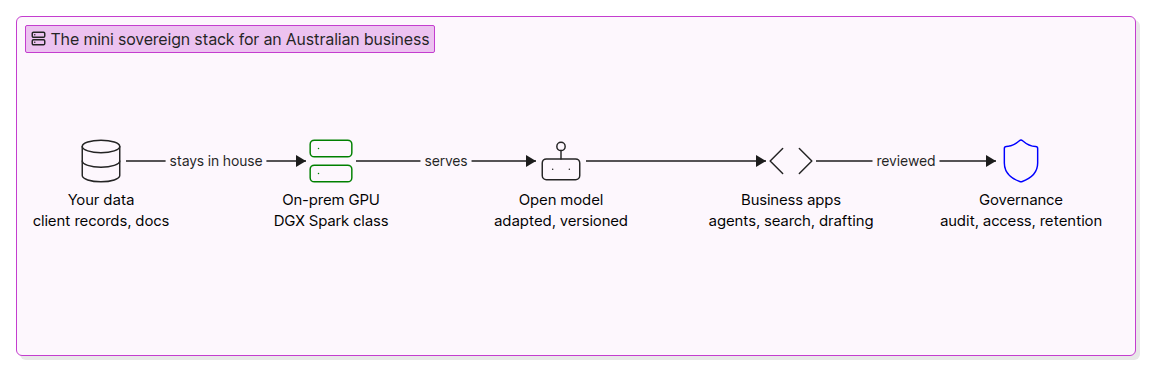
Six steps stand up a working onshore AI capability in about two weeks of effort and modest hardware spend, starting with model choice and ending with governance. The stack is small: one GPU box, one adapted open model, one API surface, and a ruler of policy around it. It is a project any business can run.
- Pick a base model: choose an open-weight model that fits your language and domain, such as Qwen, Mistral or Llama, and check the licence before commercial use.
- Collect your domain data: gather the records, transcripts and documents that teach the model your business.
- Fine-tune on your hardware: adapt the base with parameter-efficient fine-tuning on a local GPU.
- Serve it locally: expose it through an OpenAI-compatible API so existing apps and agents can call it.
- Add governance: document access, retention and review so the stack passes an audit.
- Keep it current: re-run adaptation as new open base models ship, which happens every few months.
The HowTo is deliberately light on budget. At Flowtivity, our own dual DGX Spark stack serving DeepSeek V4 Flash at roughly 60 tokens per second is an adapted-model sovereign stack in miniature: open weights, local hardware, full control of the data path. If a two-person consultancy runs one, any business can.
Should Your Business Go Sovereign?
Go sovereign when data residency, cost predictability or vendor dependence matters more than maximum benchmark scores. Start narrow, pick one workflow that cannot go offshore, and prove the stack there before expanding. Most businesses do not need sovereignty everywhere, they need it where the data is sensitive or the spend is material.
Three signals mean it is time. First, your data is regulated or contractually restricted to Australia. Second, your agent usage is growing fast enough that per-token cloud APIs are a recurring cost you cannot forecast. Third, you want continuity that does not depend on one provider's pricing and policy. If two of three are true, an adapted open model on local hardware is worth a pilot.
What you should not do is chase frontier benchmarks. The 56 percent figure is the market telling you that strong-enough wins. Adapt, host, govern, iterate, and your sovereign stack becomes a business asset rather than a research project.
Frequently Asked Questions About Sovereign AI
Sovereign AI is mostly adaptation, 56 percent of models adapt open weights, Llama leads at 38 percent, Australia can build a mini sovereign stack on local hardware, and no, you do not need to train from scratch to get onshore AI. The short answers are below, followed by the nuance each one deserves.
One email a month, no noise
Practical AI notes for Australian businesses. Unsubscribe anytime.


