On this page
- Which model is best for a 256GB dual DGX Spark cluster?
- Does DeepSeek V4.1 Flash fit on two DGX Sparks?
- Why the 2-box interconnect decides the winner
- How fast is GLM 5.3 Flash on a dual DGX Spark?
- The production serving recipe for two Sparks
- Is DeepSeek V4.1 Flash the smarter model?
- What would flip the verdict?
- Honest caveats about this comparison
- Frequently asked questions
- Which model is best for a 256GB dual DGX Spark cluster?
- Does DeepSeek V4.1 Flash fit on two DGX Sparks?
- How fast is GLM 5.3 Flash on a dual DGX Spark?
- Can you run DeepSeek V4.1 Flash on four DGX Sparks?
- What quant and stack for GLM 5.3 Flash on DGX Spark?
Last Updated: September 13, 2026
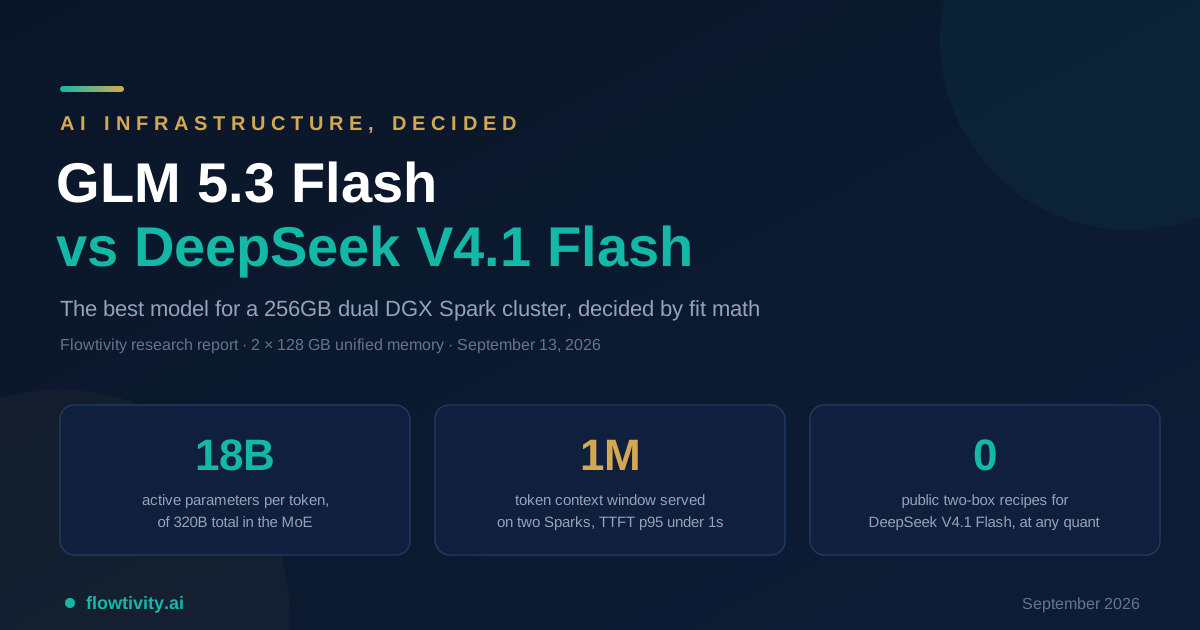
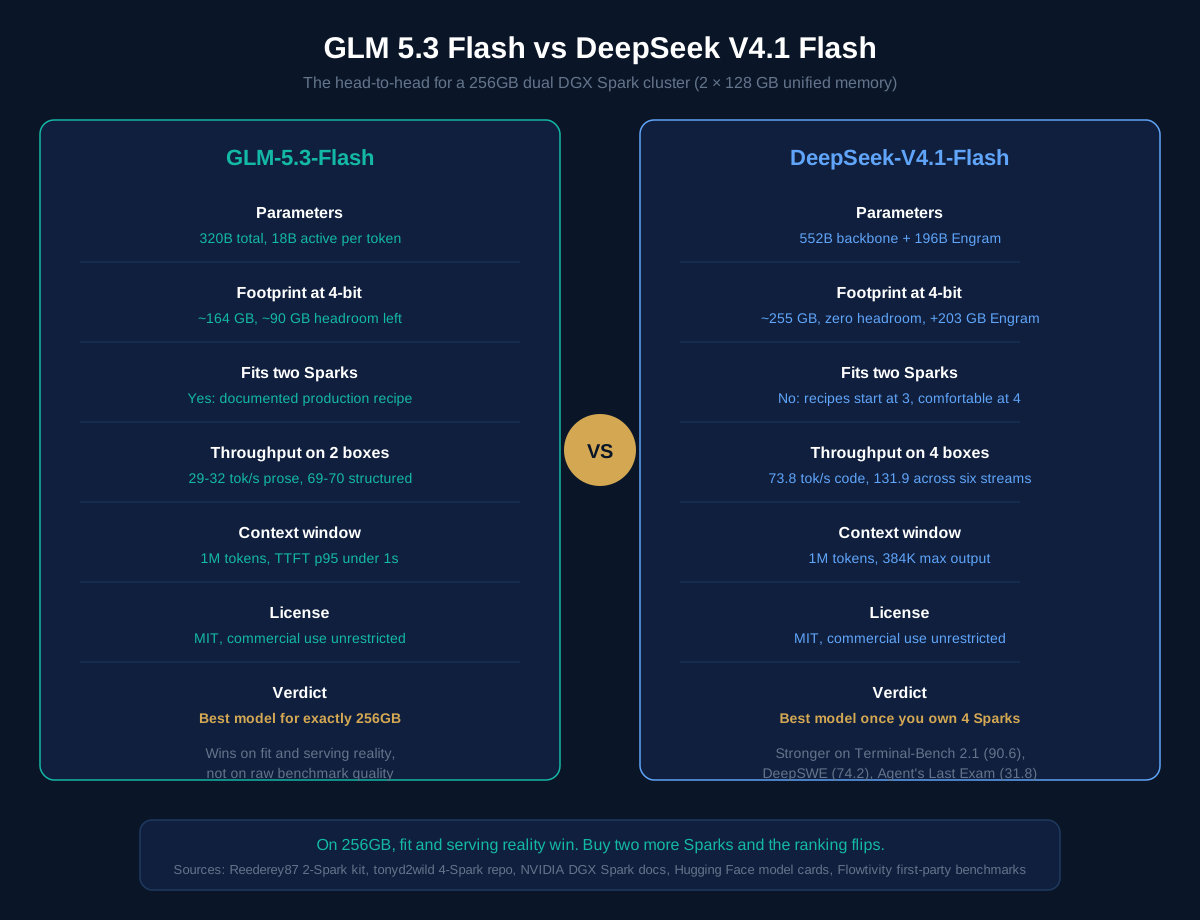
GLM-5.3-Flash is the best AI model for a dual DGX Spark cluster with 256GB of unified memory, and it wins on fit and serving reality, not raw model quality. According to the Reederey87 two-Spark production kit, GLM-5.3-Flash decodes at 29-32 tok/s on prose and 69-70 tok/s on structured output with speculative decoding, holds a 1M-token context, and keeps time-to-first-token p95 under one second. DeepSeek-V4.1-Flash is objectively stronger on public agentic benchmarks: according to DeepSeek's published table, it scores 90.6 on Terminal-Bench 2.1 and 74.2 on DeepSWE, versus 88.2 and 66.9 for the larger GLM-5.3. But its 510GB of FP8 weights plus a 203GB Engram memory mean every documented working recipe starts at three Sparks and is comfortable at four. No public two-box recipe exists at any quantization.
We tested the same hypothesis on our own hardware and published the harness numbers. In our dual DGX Spark agent harness in August 2026, GLM-5.3-Flash sustained 41-66 tok/s at 1M context while DeepSeek V4-Flash managed 10-15 tok/s at 24K context, and our owner baseline puts DeepSeek V4-Flash near 60 tok/s in agent workloads. This week's full research comparison confirms the hypothesis with one precision: for exactly 2x128GB, GLM-5.3-Flash is the pick. Buy two more Sparks and the ranking flips.
Which model is best for a 256GB dual DGX Spark cluster?
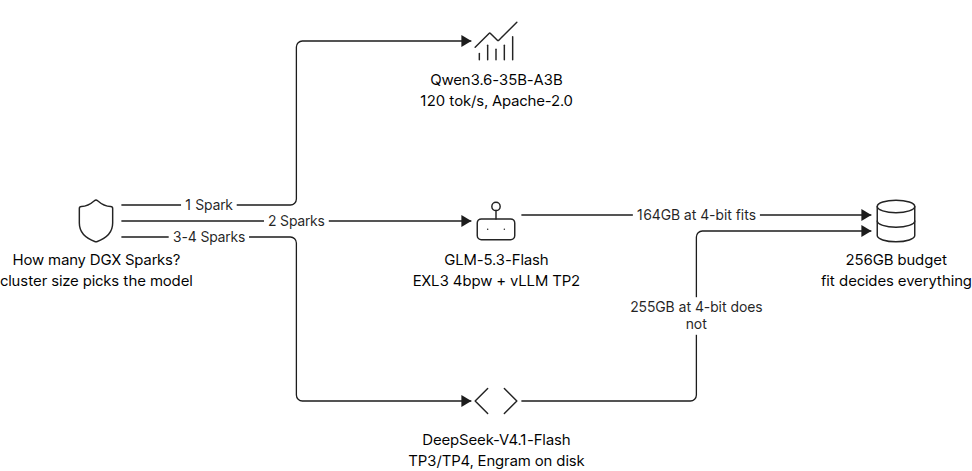
GLM-5.3-Flash at roughly 4 bits is the only frontier-class model with a documented, reproducible two-Spark production recipe: 29-32 tok/s prose, 69-70 tok/s structured with speculative decoding, TTFT p95 under one second, a 1M-token context, and an MIT license. DeepSeek-V4.1-Flash needs at least three Sparks via a custom TP3 path and is comfortable on four with TP4. Qwen3.6-35B-A3B is the single-box speed pick at 120 tok/s under Apache-2.0.
The comparison comes down to three numbers. According to NVIDIA's DGX Spark documentation, each unit carries 128GB of LPDDR5x unified memory behind the GB10 Grace Blackwell Superchip, rated for models up to 200B parameters per unit and 405B in a dual configuration. GLM-5.3-Flash's 320B total fits that dual envelope at 4-bit with about 90GB to spare for KV cache and runtime. DeepSeek-V4.1-Flash's 552B backbone plus 196B Engram conditional memory does not. According to the Hugging Face model cards for both models, each ships under an MIT license, so licensing does not break the tie. Memory does.
| Model | Total params | Active params | 4-bit footprint | Fits 2 Sparks? | Expected tok/s | License |
|---|---|---|---|---|---|---|
| GLM-5.3-Flash | 320B | 18B/token | ~164 GB | Yes, ~90 GB headroom | 29-32 prose / 69-70 structured / 41-66 in our agent harness | MIT |
| DeepSeek-V4.1-Flash | 552B + 196B Engram | 16B decode | ~255 GB | No, ~0 headroom | No 2-box recipe; 4 boxes: 73.8 code / 24.4 prose | MIT |
| Qwen3.6-35B-A3B | 35B | 3B/token | ~19 GB | Yes, one box is enough | 120 (single box) | Apache-2.0 |
Does DeepSeek V4.1 Flash fit on two DGX Sparks?
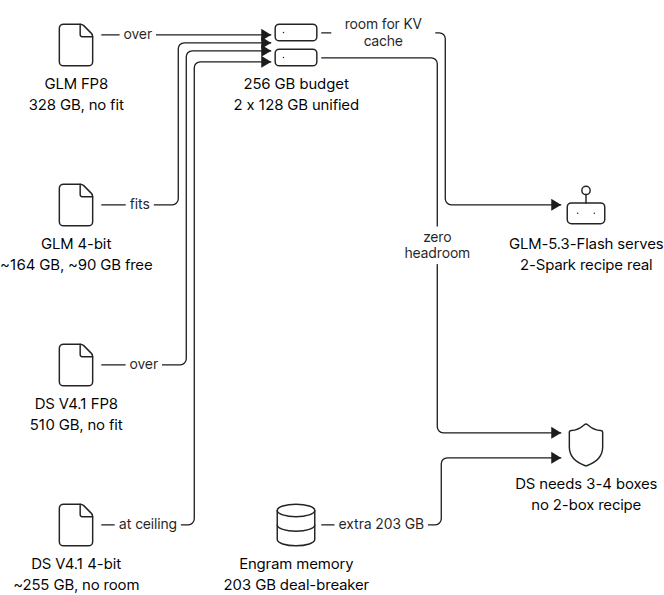
On paper, barely; in practice, no. At 4-bit, DeepSeek-V4.1-Flash weighs about 255GB against a 256GB budget, leaving roughly zero headroom for KV cache and runtime, and its 203GB Engram n-gram memory loads into host memory by default, which on Spark is the same unified GPU memory. Every documented working recipe starts at three Sparks using a custom TP3 path and is comfortable at four with TP4. A two-box build would need 2.0-2.9bpw quants whose quality is unquantified.
The footprints tell the story. FP8 weights are 510GB (no fit), 4-bit is about 255GB (the ceiling), and 3-bit-class runs 190-200GB with about 55GB of headroom, per the DeepSeek-V4.1-Flash model card and our fit math. GLM-5.3-Flash at FP8 is 328GB (no fit) but at 4-bit is about 164GB, leaving roughly 90GB for KV cache and runtime. According to the tonyd2wild DeepSeek-V4.1-Flash repository, even the 3-box TP3 path needed hand-built engineering: virtual attention heads expanded from 64 to 72, a vocab split, and Engram rows spread across 3 ranks. On four boxes, TP4 measured 73.8 tok/s on code, 24.4 tok/s on prose, and 131.9 tok/s aggregate across six streams.
Why the 2-box interconnect decides the winner
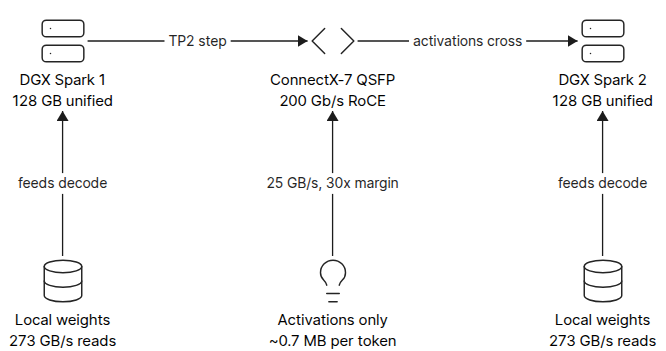
Each DGX Spark reads its local LPDDR5x at 273 GB/s, but box to box the fastest path is a ConnectX-7 QSFP port at 200 Gb/s, about 25 GB/s, roughly one eleventh of local memory bandwidth. NVLink-C2C exists only inside the GB10 package. That asymmetry makes MoE models whose experts stay local, with only activations crossing the wire, the viable class on two Sparks. Dense tensor parallelism that streams weights across boxes would collapse to wire speed.
According to NVIDIA's DGX Spark clustering documentation, each Spark has two QSFP ports wired to a ConnectX-7 SmartNIC in Ethernet mode, with a RoCE device per interface, and the NIC connects to the GB10 over PCIe Gen5 x4 links. Our wire check: TP2 activations per token come to roughly 45 layers times 2 transfers times 8KB (hidden size 4096 at bf16), about 0.7MB per token, which the 25 GB/s link carries with about 30x margin. Decode survives two-box tensor parallelism because only activations cross the wire and weights stay local.
How fast is GLM 5.3 Flash on a dual DGX Spark?
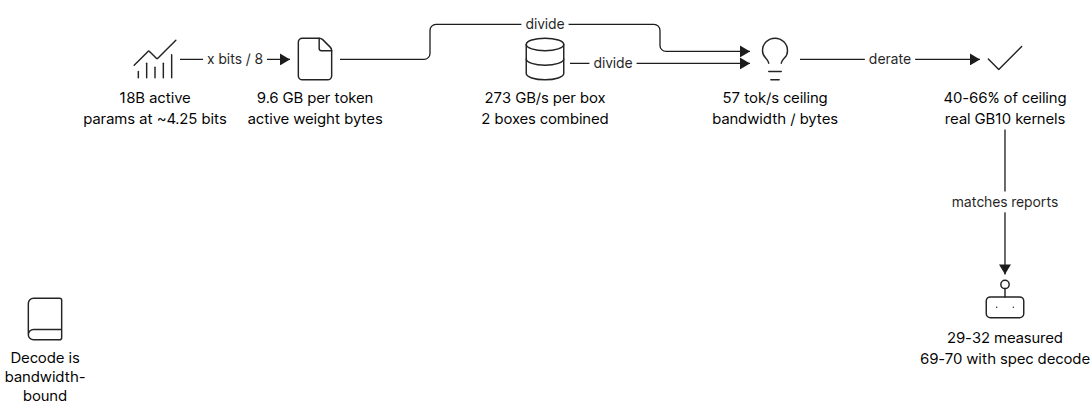
Decode is memory-bandwidth-bound, so the ceiling equals box bandwidth divided by active bytes per token, split across boxes. For GLM-5.3-Flash at ~4.25 bits: 18B active parameters times 4.25 bits divided by 8 is about 9.6GB of active weights per token, against 273 GB/s per box over two boxes, giving a ceiling near 57 tok/s. Real GB10 MoE kernels land at 40-66% of ceiling, and speculative decoding multiplies effective throughput on structured traffic. That is exactly the 29-32 prose and 69-70 structured spread the production kits report.
The measured record backs the math. According to the Reederey87 production kit, four concurrent agents aggregate 63.4-66.3 tok/s, the model holds 31.3 tok/s at roughly 519K context, prefill runs at 1,408 tok/s at 240K tokens, and TTFT p95 sits at 0.92-0.96 seconds. In our own dual DGX Spark agent harness we measured 41-66 tok/s at 1M context with 348,979 KV tokens in flight and 14.2x concurrency headroom, against DeepSeek V4-Flash at 10-15 tok/s at 24K context. On a single Spark, Classmethod's first-touch test ran 2-bit GGUF at 17.7 tok/s and showed reasoning_effort low finishing a 10-task batch in 98 seconds versus 29 minutes at max.
The production serving recipe for two Sparks
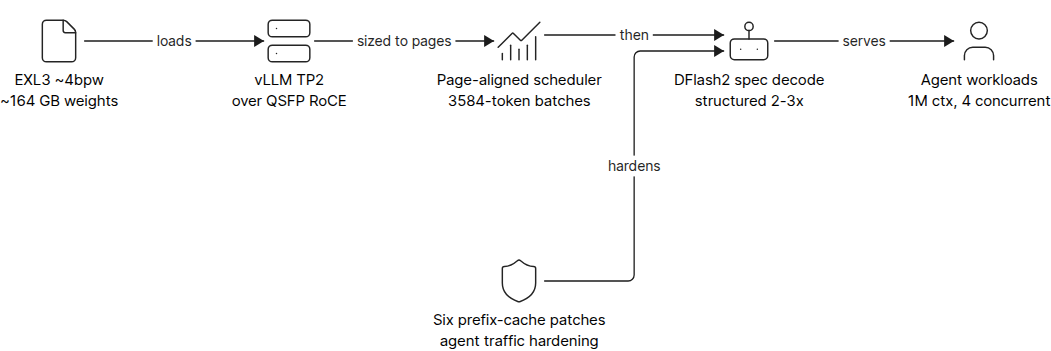
The documented recipe is GLM-5.3-Flash in EXL3 at roughly 4bpw (about 164GB), vLLM TP2 over the direct 200 Gb/s QSFP link with RoCE, MAX_NUM_BATCHED_TOKENS=3584 to match the model's 3,584-token attention pages, DFlash2 speculative decoding, and six prefix-cache and fairness patches. The patches matter because the hybrid linear and sparse attention caches in pages, and naive scheduler settings silently zero out prefix-cache hits under agent traffic.
- Quantize to EXL3 ~4bpw: about 164GB of weights, roughly 90GB of headroom left
- Serve with vLLM TP2 across the QSFP link (RoCE), not stock single-node settings
- Set MAX_NUM_BATCHED_TOKENS=3584, page-aligned to the attention cache
- Enable DFlash2 speculative decoding for structured and code traffic
- Apply the six prefix-cache and fairness patches from the Reederey87 kit
- Use reasoning_effort low for chat-speed turns: 98 seconds versus 29 minutes on a 10-task batch
Is DeepSeek V4.1 Flash the smarter model?
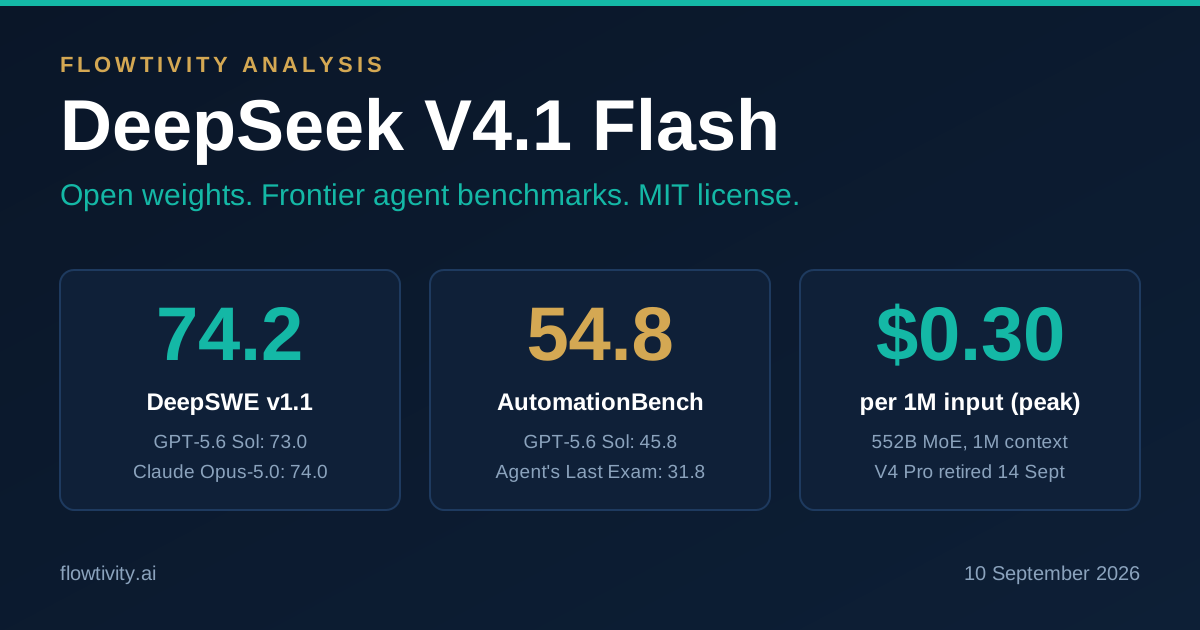
Yes, on public numbers. According to DeepSeek's vendor-published table, V4.1-Flash scores 90.6 on Terminal-Bench 2.1, 74.2 on DeepSWE, 31.8 on Agent's Last Exam, 88.1 on CyberGym, and 54.8 on AutomationBench, beating GLM-5.3 (full) at 88.2, 66.9, and 28.5 on the shared rows, and beating Opus-5.0 on several agentic benchmarks at just 8B prefill and 16B decode active parameters. Its weak spots are Terminal-Bench 3.0 and 4.0 (30.0 and 31.2 versus Opus-5.0's 43.3 and 51.8), ProgramBench, and ExploitGym.
Two honesty notes. GLM-5.3-Flash's exact public scores are published only as a chart image, so the GLM column here is the full 755B model, an upper bound. And Flash's edge is efficiency, not peak intelligence: about 3.01x less attention compute and a 4.44x smaller KV cache than GLM-5.3 full, native vision in the loop, and a two-week head start of ecosystem hardening. In our first-party task eval, GLM-5.3-Flash passed 2 of 5 agent-harness tasks where DeepSeek V4-Flash passed 0 of 5.
"On a 256GB dual DGX Spark, GLM-5.3-Flash beats DeepSeek-V4.1-Flash, not because it's the smarter model, but because it's the one that actually fits and serves at production quality on two boxes. Buy two more Sparks and the ranking flips,"
rules the Flowtivity research report Best Local AI Model for a Dual DGX Spark Cluster (2x128GB), September 13, 2026. That is the whole article in two sentences.
What would flip the verdict?
Hardware. With four Sparks, DeepSeek-V4.1-Flash TP4 measured 73.8 tok/s on code, 55.4 on tables, 52.1 on JSON, and 131.9 tok/s aggregate across six streams, with TTFT of 0.3-0.5 seconds: above anything GLM-5.3-Flash posts on equivalent traffic. NVFP4 on GB10 is target-gated rather than silicon-absent, so an NVIDIA stack update could also shift the quant math for both models. Until either happens, cluster size picks your model.
One Spark: Qwen3.6-35B-A3B at 120 tok/s with 1M context under Apache-2.0, freeing the budget entirely (MiniMax M2.7 ran 26.4 tok/s single-box in our May 2026 tests). Two Sparks: GLM-5.3-Flash, the subject of this comparison. Three to four Sparks: DeepSeek-V4.1-Flash, where its benchmark lead finally has room to serve. We cover the release numbers in our DeepSeek-V4.1-Flash launch coverage.
Honest caveats about this comparison
Five things could move this verdict, and you should know all of them before buying hardware. DeepSeek's benchmark table is vendor-published and not independently cross-checked here. GLM-5.3-Flash's exact scores are chart-image-only and unverified in text. DeepSeek-V4.1-Flash quality at the 2.0-2.9bpw quants a two-box build would require is unquantified. NVFP4 remains target-gated on GB10. And our own DeepSeek baselines span configurations, from 10-15 tok/s at 24K context in the August harness to roughly 60 tok/s in September agent workloads.
- DeepSeek's benchmark table is vendor-published; cross-checks were not extractable this session
- GLM-5.3-Flash's exact public scores are chart-image-only (UNVERIFIED); the GLM column used is the full model
- V4.1-Flash quality at 2.0-2.9bpw (the only theoretical 2-box fit) is unquantified
- NVFP4 on GB10 is target-gated; an NVIDIA update claimed up to 2x inference speedups and could shift the math
- "No public 2-box recipe" is a negative claim verified as of September 13, 2026 against the main repos and forum threads
Frequently asked questions
Which model is best for a 256GB dual DGX Spark cluster?
GLM-5.3-Flash: 320B total, 18B active, MIT, 1M context, and the only documented two-Spark production recipe, at 29-32 tok/s prose and 69-70 tok/s structured with speculative decoding.
Does DeepSeek V4.1 Flash fit on two DGX Sparks?
Not productively. Its 4-bit footprint of about 255GB leaves zero headroom on 256GB, and its 203GB Engram memory must be patched to disk. Documented recipes start at three Sparks.
How fast is GLM 5.3 Flash on a dual DGX Spark?
29-32 tok/s prose, 69-70 tok/s structured with DFlash2 speculative decoding, 63.4-66.3 tok/s aggregate across four agents, TTFT p95 under one second, and 41-66 tok/s at 1M context in our own harness.
Can you run DeepSeek V4.1 Flash on four DGX Sparks?
Yes. TP4 with Engram-on-disk measures 73.8 tok/s code, 24.4 tok/s prose, and 131.9 tok/s across six streams, with 1M context proven.
What quant and stack for GLM 5.3 Flash on DGX Spark?
EXL3 ~4bpw, vLLM TP2 over QSFP RoCE, MAX_NUM_BATCHED_TOKENS=3584, DFlash2 speculative decoding, and the six prefix-cache patches from the Reederey87 kit.
One email a week, no noise
A Friday digest of the week's analysis, guides and comparisons. Unsubscribe anytime.