On this page
- The numbers first
- Why it feels like the OpenClaw moment again
- Five reasons dsh is the meta
- 1. Composability is backed by a proven kernel, not a whitepaper
- 2. Model-agnostic economics
- 3. Ecosystem ignition in week one
- 4. Ship velocity with receipts
- 5. The timing matches the market shift
- The honest caveats
- What we are doing about it
- Frequently asked questions
Last Updated: August 22, 2026
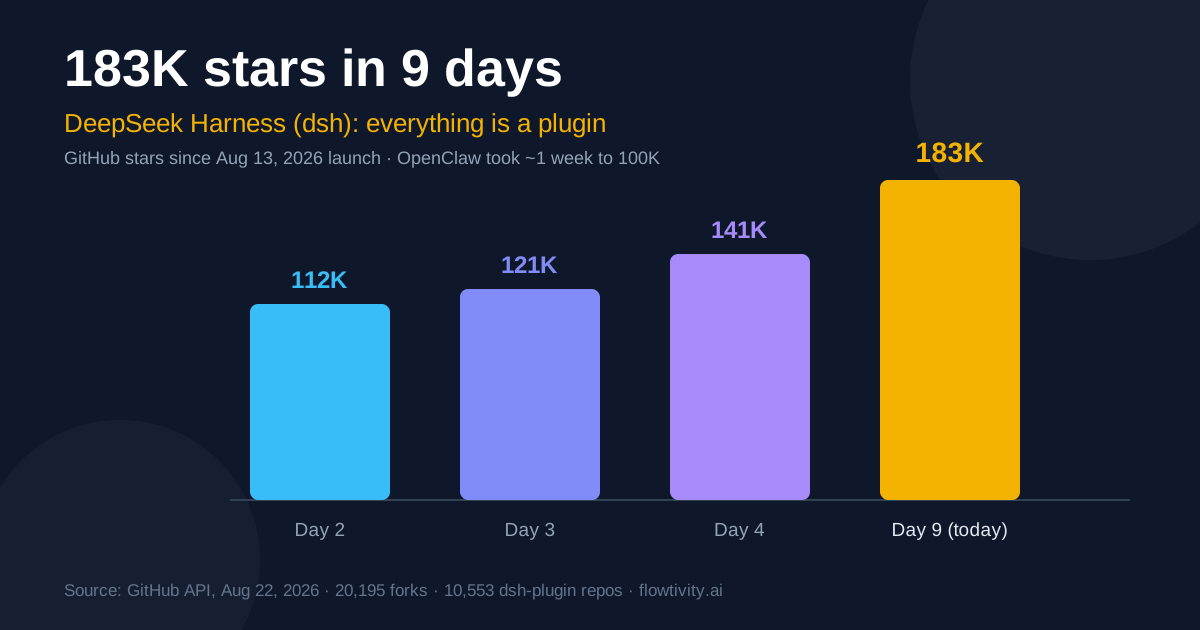
Nine days ago a TypeScript repo appeared on GitHub with a plain README and a big claim: everything is a plugin. As of today that repo has 183,581 stars and 20,195 forks. It crossed 100K stars in about two days, peaking near 2,100 stars per hour. For reference, OpenClaw, the runaway agent story of early 2026, took roughly a week to hit the same milestone.
DeepSeek Harness, or dsh, is the new meta for AI agents. Not because of hype, but because it changes what the base layer of an agent stack looks like. We covered what dsh is in our original explainer and how it stacks up against TrueForge and Claude Managed Agents. This post is about the why: why the community flipped so fast, and why this feels like the OpenClaw moment happening all over again, one level deeper.
The numbers first
Adoption velocity is the loudest signal here, and it is not subtle:
- 183,581 stars in 9 days since the repo went public on August 13, 2026 (GitHub API, August 22)
- 100K stars in roughly 2 days, versus about a week for OpenClaw, which now sits near 386K
- 745 points and 310 comments on the launch Hacker News thread
- 10,553 repositories tagged
dsh-pluginon GitHub, up from a few hundred during launch week - Release candidates shipping almost daily: v0.1.0-rc.7 on Aug 17, rc.8 on Aug 19, then v0.1.1-rc.1 and rc.2 both on Aug 21
Independent plugin directories like CordisPlugin and the DeepSeek Plugin Registry self-organized within the first week because the official discovery layer, a GitHub topic, could not keep up. When the community builds registries for you before you build one yourself, that is ecosystem pull, not push.
Why it feels like the OpenClaw moment again
Early 2026 was OpenClaw season. A self-hosted agent runtime hit 100K stars in a week, and suddenly every technical founder had a always-on agent connected to Telegram, email and a workspace. The insight behind OpenClaw was that the agent, not the model, is the product. Wiring, memory, channels and tools mattered more than which frontier model you plugged in.
dsh takes that same insight one abstraction level down. The bet now is that the harness, not any specific agent, is the product. And the evidence is in the architecture:
- Every capability is a plugin: model adapters, tool registries, session logs, the agent loop itself, filesystem access, subprocess execution, sandboxing, approvals, telemetry, even the UI
- Replace anything without forking: you do not patch dsh, you mount a different plugin
- Full execution traces: every instruction, tool call and intermediate result is recorded, which makes replays, error isolation and benchmarking first-class features
OpenClaw shipped an opinionated, deployable agent. dsh ships the machinery for building opinionated agents. That is why the comparison keeps coming up, and why dsh adoption compressed the OpenClaw curve: it appeals to the same audience, but it hands them the keys to the substrate.
Five reasons dsh is the meta
1. Composability is backed by a proven kernel, not a whitepaper
dsh runs on Cordis, whose design is described in the paper A Programming Paradigm for Spatiotemporal Composability. This is not a new experiment: the Koishi chatbot framework has run Cordis in production for four years and accumulated over 4,000 community plugins, with dynamic load and unload of components and automatic cleanup of side effects. The "everything is a plugin" claim has already survived contact with reality at ecosystem scale. dsh inherits that plumbing and points it at agents.
2. Model-agnostic economics
If the harness is the differentiator, models become swappable commodities. Model adapters are plugins, so teams run dsh against OpenAI-compatible endpoints, OpenRouter, or cheap open-weight models. We practise this ourselves: Flowtivity's own stack runs GLM-5.3 on OpenClaw, which is exactly the cost pattern dsh generalizes. When the same agent loop can run a frontier model for hard days and a budget model for routine work, the cost per agent run stops being fixed by your vendor and starts being a dial you control.
3. Ecosystem ignition in week one
10,553 dsh-plugin repositories nine days in. A TUI plugin for terminal-first users, a Hacker News feed plugin, an awesome list with 813 stars, curated registries, sandbox and skill plugins across tools, models and sessions. In consulting terms: the platform crossed the network-effect threshold where the community builds more value than the core team can. That rarely happens to frameworks this early.
4. Ship velocity with receipts
Two release candidates on August 21 alone. A public BENCHMARK.md with reproducible instructions rather than marketing charts. An explicit README warning that breaking changes are coming, which is refreshingly honest for a 183K-star project. The repo itself is a clean pnpm monorepo with native and Python SDK directories, MIT licensed, with documentation that treats developers like adults.
5. The timing matches the market shift
Frontier models are converging. GLM, DeepSeek, Qwen and Claude-class models all complete most agent tasks competently when the scaffolding is right. When capability equalizes at the model layer, competition moves up the stack to context selection, tool exposure, state persistence, failure recovery, permission enforcement and action verification. That is precisely the list dsh productized as plugins. The project is a clean expression of where the industry already was heading.
The honest caveats
This is a developer preview, and the team says so in capitals. Expect breaking changes between release candidates. The default experience is a Web UI on localhost with a CLI and Python SDK, which means it is developer-centric: if your team cannot read TypeScript, OpenClaw remains the faster path to a working personal agent. Community plugin registries also mean community plugin quality, so vet what you mount. We would not put dsh in production today. We would absolutely put a contained pilot on it this quarter, which is the same posture we recommended for TrueForge.
What we are doing about it
We run an OpenClaw-based stack daily and it earns its keep, so this is not a migration pitch. It is a portfolio decision. The pattern to adopt from dsh is architectural: keep your agent's model, tools, memory and policies as swappable layers, because the model market will keep repricing underneath you. That is why we already run a GLM-5.3 core with fallbacks, and why we are watching dsh release candidates for the moment a stable v0.2 makes a production pilot defensible.
If you are an established business experimenting with agents, the play is simple: do not marry a harness yet, but do standardize on harness thinking. Model, tools, memory, policy: four layers, each replaceable. That is the meta dsh just made mainstream, and it is the same design we build client automations on.
Frequently asked questions
Is DeepSeek Harness replacing OpenClaw?
No. OpenClaw is a deployable personal agent runtime with channels, skills and heartbeat automation built in. dsh is a composable substrate where every part of the agent, including the loop itself, is a swappable plugin. Different jobs, shared audience.
How fast is it growing?
100K GitHub stars in roughly two days at a peak of 2,100 stars per hour, and over 183K stars with 10,000+ plugin repos nine days after launch.
Is it production ready?
Not yet. It is a developer preview with explicit breaking-change warnings. Run pilots, not payroll, on it.
Does it only work with DeepSeek models?
No. Model adapters are plugins, so it works with OpenAI-compatible endpoints, OpenRouter and open-weight models, which is central to its cost story.
One email a month, no noise
Practical AI notes for Australian businesses. Unsubscribe anytime.