On this page
- Key takeaways
- What does it mean to govern what an AI agent knows?
- Why is knowledge governance the gap buyers are finding now?
- What breaks when customer knowledge is fragmented?
- How is this different from runtime agent governance?
- What does a knowledge governance model look like?
- How do you audit the answers a customer actually gets?
- How does local inference help with customer data?
- What should you measure beyond automation savings?
- What does the Flowtivity play look like?
- Run the 60-minute knowledge audit
- Frequently asked questions
- Do we need a new platform for knowledge governance?
- Can we just use a bigger model to fix bad answers?
- What about customer data in prompts and logs?
- How often should sources be reviewed?
- Does this slow the agent down?
- How does this relate to the Privacy Act?
- Takeaways
Last Updated: 25 November 2026
Key takeaways
- ▪ Governing what an agent knows is a data architecture problem: source inventory, ownership, freshness, retrieval scope and an evidence log.
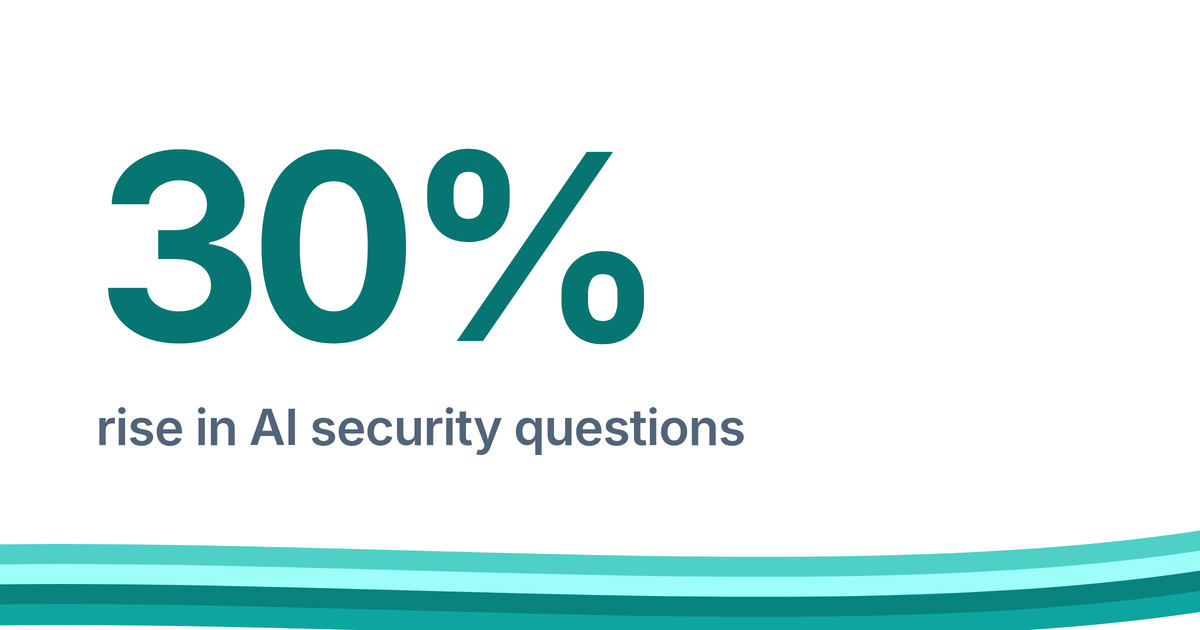
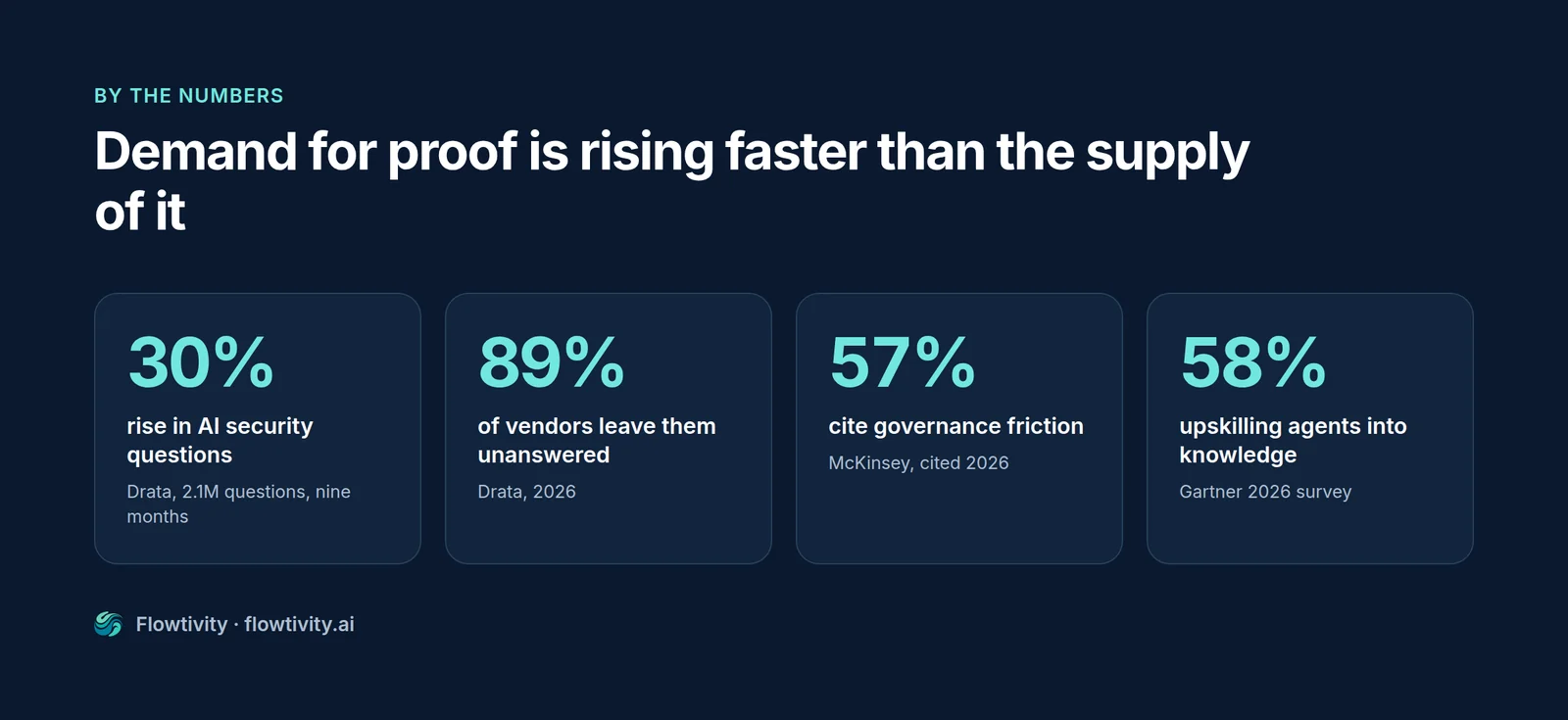
- ▪ AI-specific security questions in procurement rose more than 30 percent in nine months across 2.1 million questions on Drata's platform (IT Brief UK, November 2026).
- ▪ Buyers ask which agents run, what they can do, who they run as, whether they behave and whether you can prove it. Drata says 89 percent of vendors leave those questions unanswered.
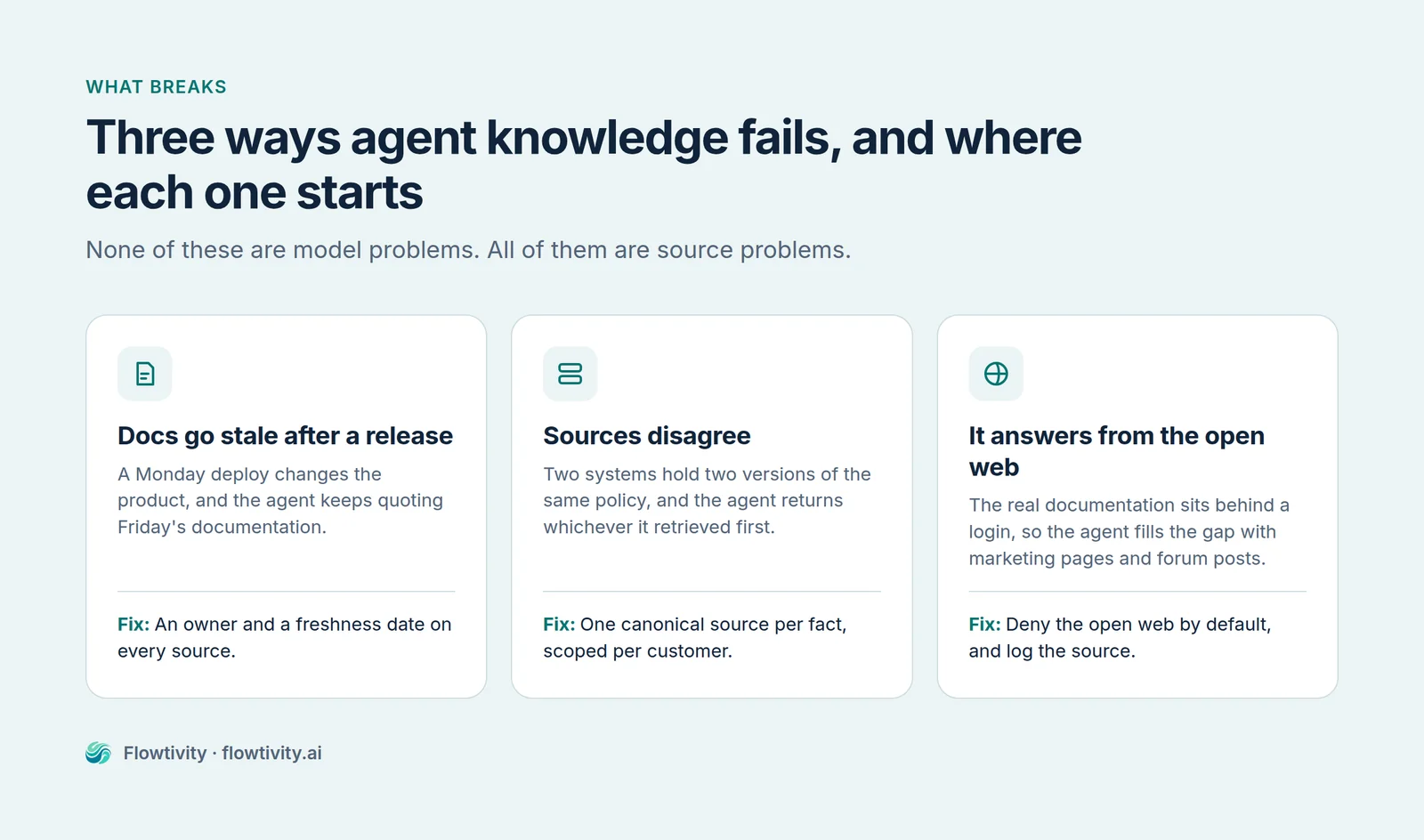
- ▪ Fragmented knowledge produces conflicting answers. A feature shipped on Monday with documentation updated on Friday means Tuesday's answer is already wrong (Digital Journal, 24 November 2026).
- ▪ 57 percent of business leaders say governance friction is the main obstacle to wider AI deployment (McKinsey, cited by Drata), and 58 percent of service leaders plan to upskill agents into knowledge management roles (Gartner, 2026).
- ▪ Knowledge governance and runtime governance are different layers. A control plane can block a refund. It cannot stop a stale help centre page from producing a wrong refund policy.
What does it mean to govern what an AI agent knows?
Governing what an agent knows means controlling the sources it can retrieve from, proving those sources are current and authoritative, and scoping access by customer and by record. It is a data architecture problem, not a policy document. The practical work is an inventory of every source the agent can reach, an owner and a freshness date for each one, retrieval permissions that match the customer in front of it, and a log that records which sources produced which answer. Without those four things, the agent is answering from whatever it happened to find, and you cannot prove what it knew when it spoke. That is the gap most businesses discover only after a customer quotes the wrong policy back at them.
Why is knowledge governance the gap buyers are finding now?
Because agents have moved from answering questions to acting on them, and procurement teams have noticed. AI-specific security questions rose by more than 30 percent over nine months across 2.1 million security questions processed on Drata's platform, making them the fastest-growing category in enterprise procurement, according to IT Brief UK's coverage of Drata's agent governance launch in November 2026. Buyers now ask five things: which AI agents are running, what they are allowed to do, who they run as, whether they are behaving as expected, and whether the company can prove those controls. Drata says 89 percent of vendors leave that category of queries unanswered. McKinsey research cited in the same piece found 57 percent of business leaders see governance friction as the main obstacle to wider AI deployment. The message is not subtle. Adoption is outrunning oversight, and the buyers are checking.
What breaks when customer knowledge is fragmented?
The agent gives conflicting answers to the same question. Irana Wasti, chief executive of Thought Industries, described the pattern to Digital Journal on 24 November 2026. Customer knowledge sits across product documentation, educational resources, FAQs and support materials. When an agent draws from disconnected sources, it has no way to know which one is authoritative, so two customers asking the same thing can receive different answers. Her example is the one every product team recognises: a feature is released on Monday, documentation is updated on Friday, and a customer asking on Tuesday receives outdated instructions even though the product has already changed. When real documentation sits behind a login, assistants may fall back to marketing materials or third-party platforms such as Reddit, which turns an old discussion into the company's answer. Adding an agent to that mess does not fix it. It spreads the conflict faster.
How is this different from runtime agent governance?
Runtime governance controls what an agent may do. It covers agent identity, scoped credentials, which tools the agent can call, which actions need a human approval and what evidence is kept. We wrote about that layer in our guide to keeping agents under control after the pilot phase, and about the architecture in our breakdown of agent control planes. Knowledge governance controls what an agent may know and say. It covers which sources the agent retrieves from, whether those sources are current, which customer records it can see and how the answer is evidenced. You need both, and they fail in different ways. A control plane can stop an agent from issuing a refund. It cannot stop the same agent from telling a customer the wrong refund policy because the help centre page was last edited in March. That is why buyers now ask what the agent knows as well as what it can do.
What does a knowledge governance model look like?
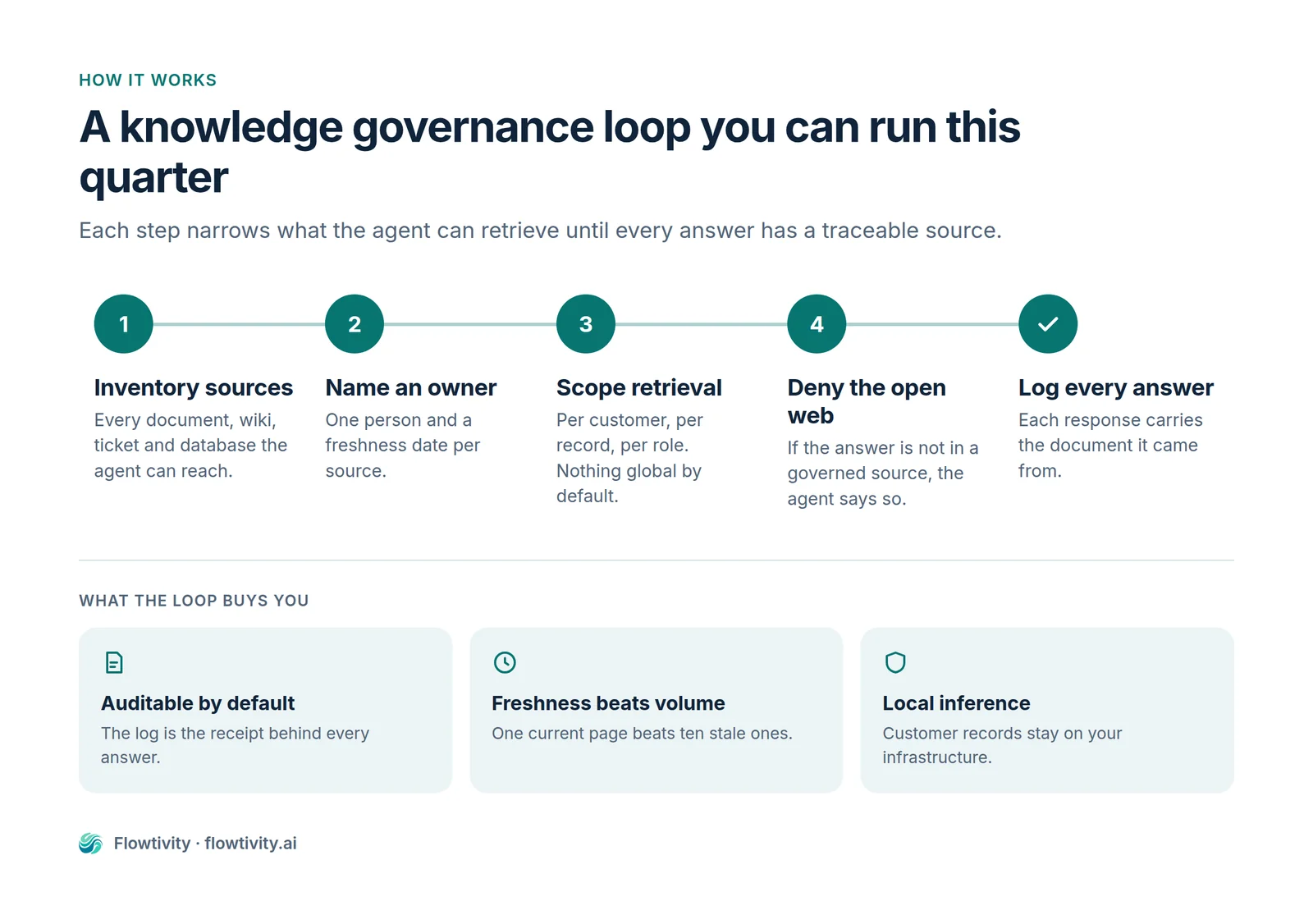
It looks like five controls, applied in order. First, inventory every source the agent can reach, including the shared drive nobody has audited since 2023. Second, assign each source an owner and a review date, so freshness is a named responsibility rather than a hope. Third, scope retrieval by customer and by record, so the agent answering a billing question cannot pull from the HR folder. Fourth, deny the open web by default and allowlist the domains the agent may use. Fifth, log the sources behind every answer, with a timestamp, so you can reconstruct what the agent knew at the moment it spoke. None of this requires an enterprise platform. It requires someone to own the source list and the retrieval rules, and a store that can answer the question "where did that answer come from?"
How do you audit the answers a customer actually gets?
Run the top ten questions test. Identify the ten questions customers ask most often, then compare four answers: what the help centre says, what the product documentation says, what the AI assistant says and what the support team says. Anywhere those four disagree is a governance gap, and it is usually cheaper to fix the source than to add another retrieval layer. Wasti recommends exactly this starting point, and she notes that Gartner's 2026 survey found 58 percent of service leaders aim to upskill agents into knowledge management specialists. That number is a signal about where the work is going. The knowledge layer is becoming a service operations job, not a back-end IT job, because the people closest to the customer know where the answers conflict.
How does local inference help with customer data?
It keeps the model calls inside your perimeter, which is the largest data path in most agent deployments. On our dual DGX Spark rig running DeepSeek V4.1 Flash, customer context is processed on hardware we control rather than sent to a third-party API. For Australian businesses, that simplifies obligations under the Privacy Act 1988 and the Australian Privacy Principles, particularly around use and disclosure, and it makes records handling more straightforward because the prompts and answers sit in a store you own. It is not a complete answer on its own. You still need to check the integrations, the retrieval store and the log storage, because a local model reading from a cloud drive has not solved residency. But moving the inference layer onshore removes the biggest and least visible data path first.
What should you measure beyond automation savings?
Most businesses measure the wrong thing. KPMG's 2026 research found organisations are more likely to measure AI impact through productivity (39 percent) or time saved through automation (36 percent) than through customer engagement or retention (26 percent), as reported by ZDNET. Those numbers describe internal relief, not customer outcome. For an agent that touches customers, add answer accuracy, repeat contact rate, escalation rate and time to resolution. Then check whether the answers are consistent across channels. If a customer gets one answer from the assistant, a different one from the help centre and a third from a support agent, the automation has not improved the experience, it has just moved the inconsistency somewhere faster. Deloitte's Agentic Transformation survey adds a warning here: 43 percent of organisations are expanding agent deployments, but only 15 percent have reached scaled, orchestrated multi-agent deployments, and only 16 percent say their processes are prepared. Scale without knowledge control multiplies the same defects.
What does the Flowtivity play look like?
We treat knowledge governance as an architecture engagement with four parts. First, source audit: map every source an agent can reach, with owners, review dates and known conflicts. Second, retrieval design: define what the agent may see for each customer type and record type, and deny the open web by default. Third, evidence layer: log the sources behind every answer so you can prove what the agent knew and when. Fourth, deployment: run inference on-prem across our DGX Sparks, with the retrieval store and logs onshore, and wire the approval gates for anything that changes a record or contacts a customer. The commercial case is straightforward. The same source inventory and evidence layer support every agent you add later, so the marginal cost of the next agent falls while the governance standard stays constant.
Run the 60-minute knowledge audit
Do this before you add another agent to a customer-facing workflow:
- List every source the agent can retrieve from, including shared drives, wikis, PDFs and support tickets.
- Write the owner and the last review date beside each source. Anything older than 90 days gets flagged.
- Ask the top ten customer questions of the assistant, the help centre, the documentation and a support agent. Record where the answers disagree.
- Check whether the agent can see any record it does not need for the question it is answering.
- Pull one answer at random and try to reconstruct which sources produced it. If you cannot, you have no evidence layer.
Frequently asked questions
Do we need a new platform for knowledge governance?
Not necessarily. You need a source inventory, ownership rules, retrieval scoping, an allowlist and an evidence log. Those can be built on top of the retrieval stack you already run. A platform helps at scale, but the first version is usually a spreadsheet, a permissions model and a logging change.
Can we just use a bigger model to fix bad answers?
No. A bigger model will produce a more confident wrong answer from the same stale source. Model quality helps with reasoning and language, not with whether the help centre page is current. Fix the source first, then choose the model that fits the task.
What about customer data in prompts and logs?
Treat prompts and logs as customer records. Scope them by customer, encrypt them at rest, set a retention period and restrict who can read them. If the logs sit offshore, you have reintroduced the residency problem you solved at the inference layer.
How often should sources be reviewed?
Match the review cycle to how often the source changes. Product documentation needs a review tied to each release. Policy pages need a review tied to each policy change. Static legal terms can go a year. The point is that every source has a named owner and a date, so staleness is visible rather than discovered by a customer.
Does this slow the agent down?
Retrieval scoping and allowlists add a small amount of latency per call. In practice the bigger cost is the first build: inventory and ownership take time. Once they exist, scoping is a permission check and logging is a write. The trade is predictable, and it is much cheaper than handling a customer complaint caused by a stale answer.
How does this relate to the Privacy Act?
The Australian Privacy Principles require you to take reasonable steps to protect personal information and to use and disclose it only for the purpose it was collected. An agent retrieving customer records is a use of that information. Scoped retrieval, onshore inference and retention limits are the practical controls that support those obligations.
Takeaways
- Knowledge governance is a data architecture problem: source inventory, ownership, freshness, retrieval scope and evidence.
- Buyers are already asking the five agent governance questions, and 89 percent of vendors cannot answer them (Drata, via IT Brief UK).
- Fragmented sources produce conflicting answers. Fix the source before you add another retrieval layer or a bigger model.
- Runtime controls and knowledge controls are different layers, and a control plane cannot fix a stale policy page.
- Measure answer accuracy, repeat contact rate and resolution time, not just time saved, because customer outcomes are where the trust is won or lost.
Sources: IT Brief UK, Drata expands platform to govern enterprise AI agents, November 2026, citing Drata platform data, McKinsey research and Drata's 8,500 customer base. Digital Journal, Q&A with Irana Wasti, chief executive of Thought Industries, 24 November 2026, citing Gartner 2026 survey data. ZDNET, synthesis of Deloitte, KPMG and Accenture agentic AI surveys, 2026. Privacy Act 1988 (Cth), Australian Privacy Principles. Flowtivity benchmark on dual DGX Sparks running DeepSeek V4.1 Flash, November 2026.
What's actually useful in AI, every Friday
We follow everything happening in AI and send what's worth your time: new models, AI agents, and how to put them to work. One email a week, unsubscribe anytime.