On this page
- Key takeaways
- Why do AI agent pilots stall before production?
- What does the demo room hide?
- Why does governance have to be built alongside the pilot?
- What does automating a workflow instead of redesigning it look like?
- What does an execution pipeline look like in practice?
- Why is Infrastructure as Code a good test case?
- How do you run evals before you run production traffic?
- Why does local inference make pilots repeatable?
- What does the Flowtivity play look like?
- The one-page pre-production gate
- Frequently asked questions
- Is a successful pilot evidence that the agent will work in production?
- How long should advisory mode run?
- Do we need a dedicated agent owner?
- What if the underlying process is genuinely broken?
- Can we start with Infrastructure as Code if we are not a software company?
- How do we keep cost predictable in production?
- Takeaways
Last Updated: 25 November 2026
Key takeaways
- ▪ Pilots stall on execution reliability, not model quality. The demo runs on curated data and a friendly process. Production does not.
- ▪ ToTheNew names three obstacles: legacy integration, governance not built alongside the pilot, and a workflow automated rather than redesigned.
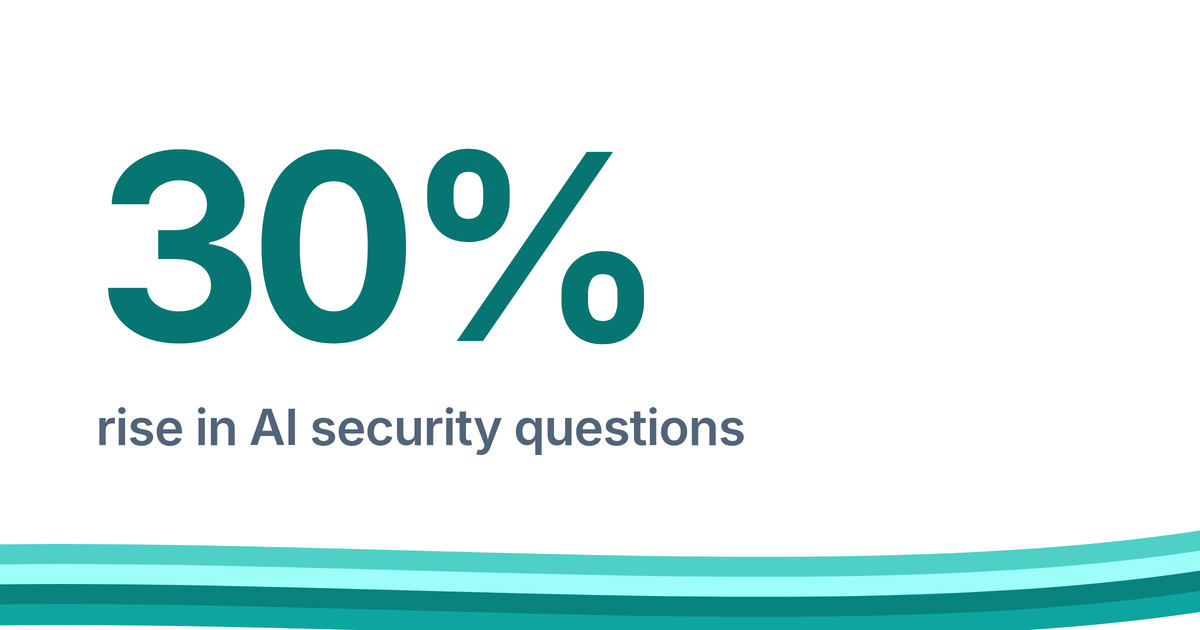
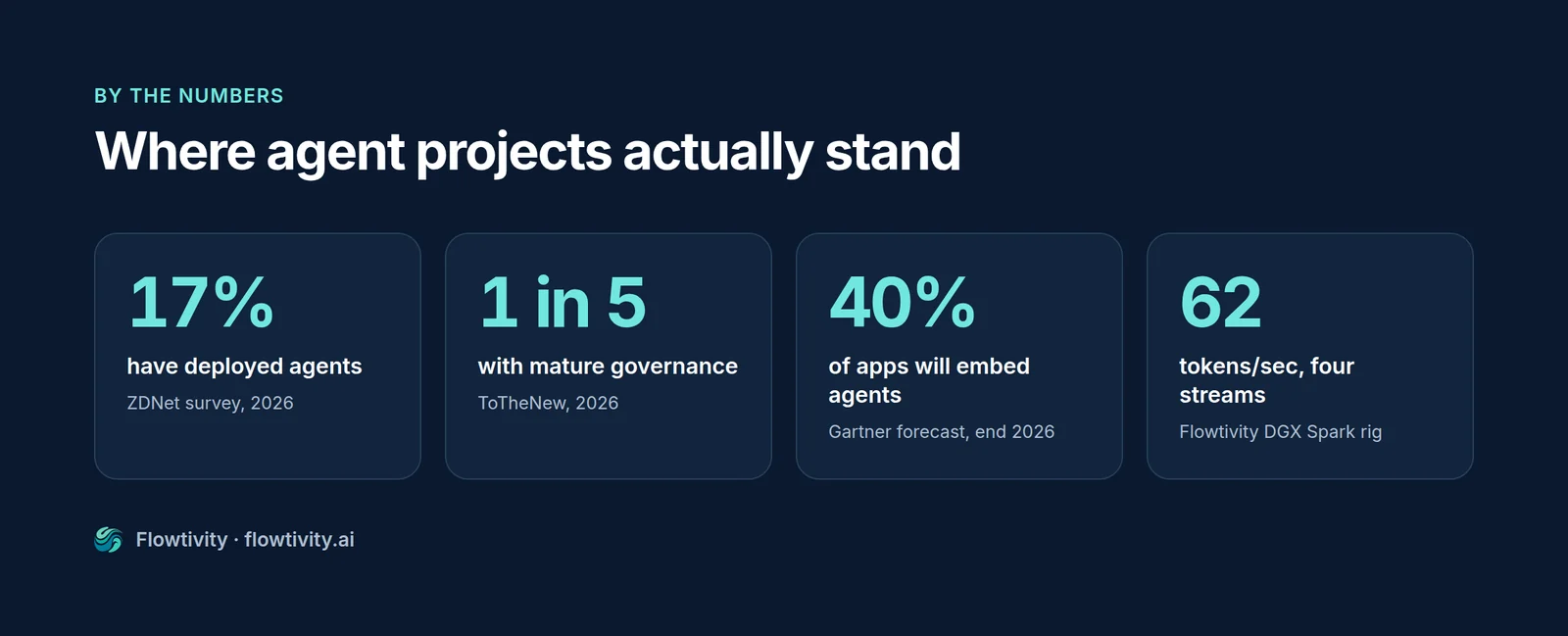
- ▪ Only 17 percent of organisations have deployed AI agents, and only 1 in 5 has a mature governance model for autonomous agents (ToTheNew, 2026).
- ▪ Gartner expects 40 percent of enterprise applications to integrate task-specific AI agents by the end of 2026, up from less than 5 percent in 2025.
- ▪ Evals, advisory mode and a named agent owner are the three cheapest ways to convert a demo into a system that keeps working.
- ▪ Local inference makes cost per run flat and keeps data inside the perimeter, which removes two of the most common reasons pilots freeze.
Why do AI agent pilots stall before production?
Pilots stall on execution reliability, not model quality. The demo runs on clean, curated data and a process that was chosen because it looks good in a room. Production runs on decades of ERP configuration, inconsistent APIs, siloed warehouses and permissions nobody has mapped. ToTheNew's 2026 production playbook names three obstacles: legacy integration is harder than the demo made it look, governance infrastructure was not built alongside the pilot, and the workflow was automated rather than redesigned. The numbers behind those obstacles are stark. Only 17 percent of organisations have deployed AI agents to date, while more than 60 percent expect to within two years. Only 1 in 5 companies has a mature governance model for autonomous agents. That gap between intent and execution is the whole problem.
What does the demo room hide?
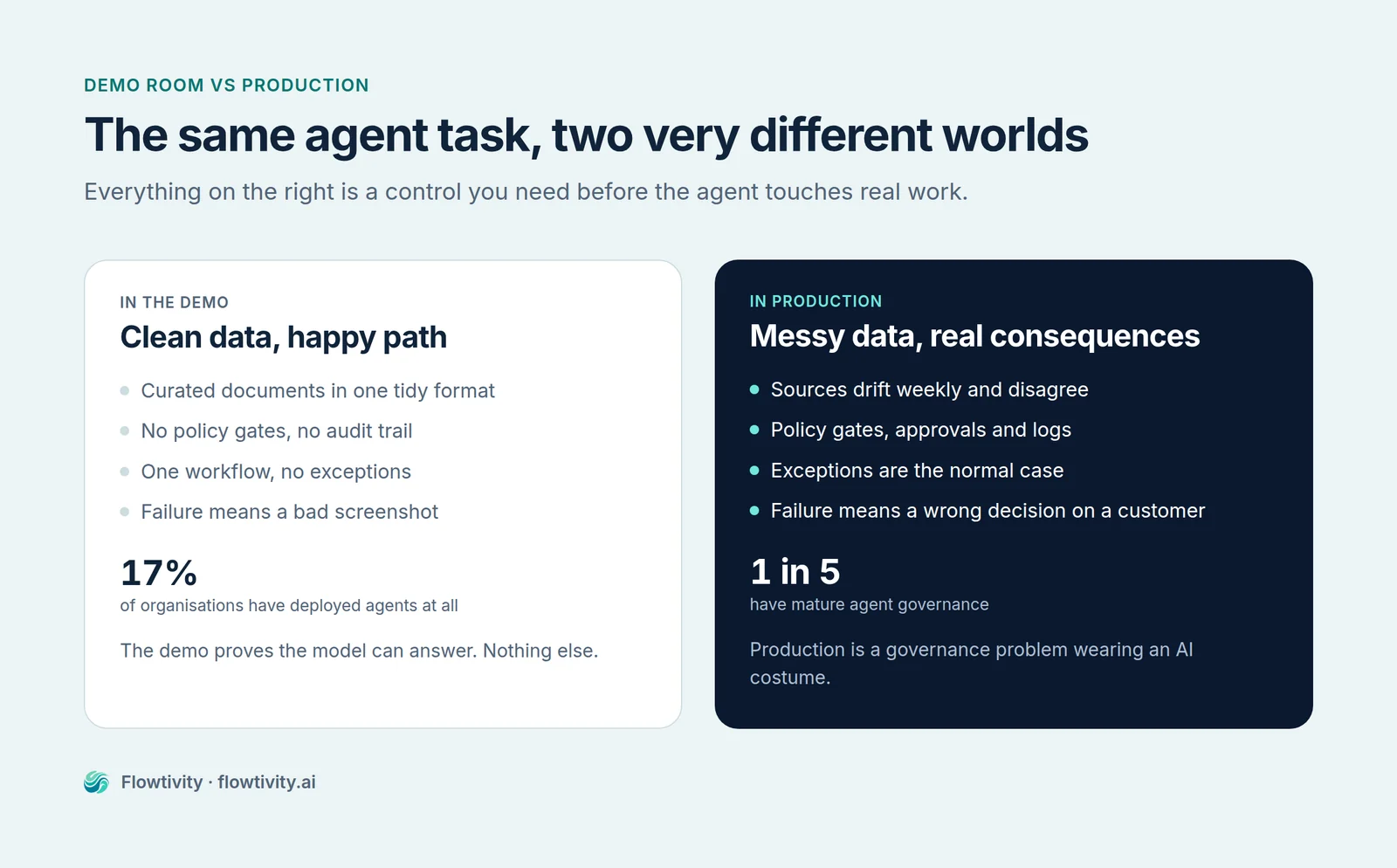
The demo hides the data, the permissions and the failure path. Demo data is curated and small. Production data is messy, duplicated and spread across systems that were never designed for automation. Demo permissions are broad because nobody is watching. Production permissions must be scoped by customer, record and action. The demo has no failure path because nothing fails in front of a buyer. Production needs a review queue, a rollback and an alert before the agent touches a real record. ToTheNew puts the symptom well: an agent that resolved tickets in 30 seconds during the pilot may take 10 minutes in production, or fail, because the real systems behave differently from the demo environment.
Why does governance have to be built alongside the pilot?
Because governance answers questions that cannot wait until after go-live. What can the agent do without approval? Who is liable for a wrong decision? What happens when it fails? Only 1 in 5 companies has a mature governance model for autonomous agents, according to ToTheNew, so most pilots reach production with those questions unanswered. The project then stalls while the answers are negotiated, and the stall is usually blamed on the model. We wrote about this gate in our guide to keeping agents under control after the pilot phase. The practical fix is to treat governance as a build item, not a launch item: define the approval boundary, the escalation path and the audit record while the pilot is still being built, so the production decision is a configuration change rather than a new project.
What does automating a workflow instead of redesigning it look like?
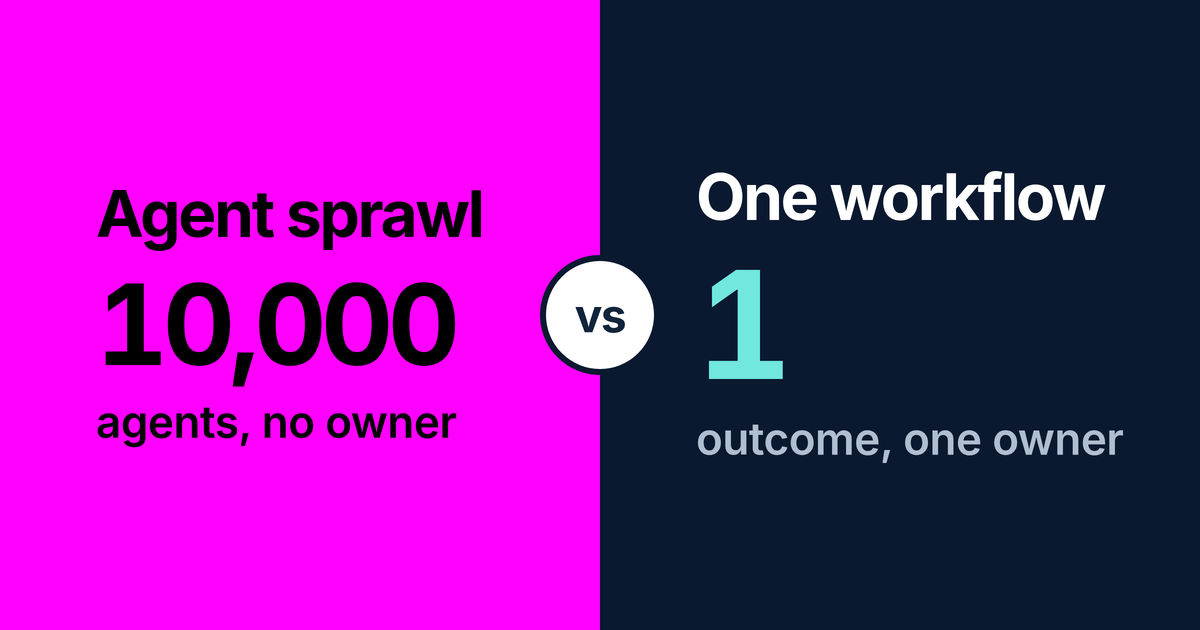
It looks like a faster version of the same broken process. The existing sequence stays, and an agent is dropped into one step. The handoffs, duplicate checks and approval loops are all still there, so the agent inherits every delay and every exception. ToTheNew calls this the deepest and most consequential failure pattern, because layering an agent onto a broken process produces a faster broken process. The test we use is the handoff count, which we set out in our guide to rebuilding workflows around AI agents. Two or fewer handoffs per outcome usually suits a bolt-on agent. Five or more means the workflow itself is the problem. Between three and four, redesign the middle and leave the ends alone.
What does an execution pipeline look like in practice?
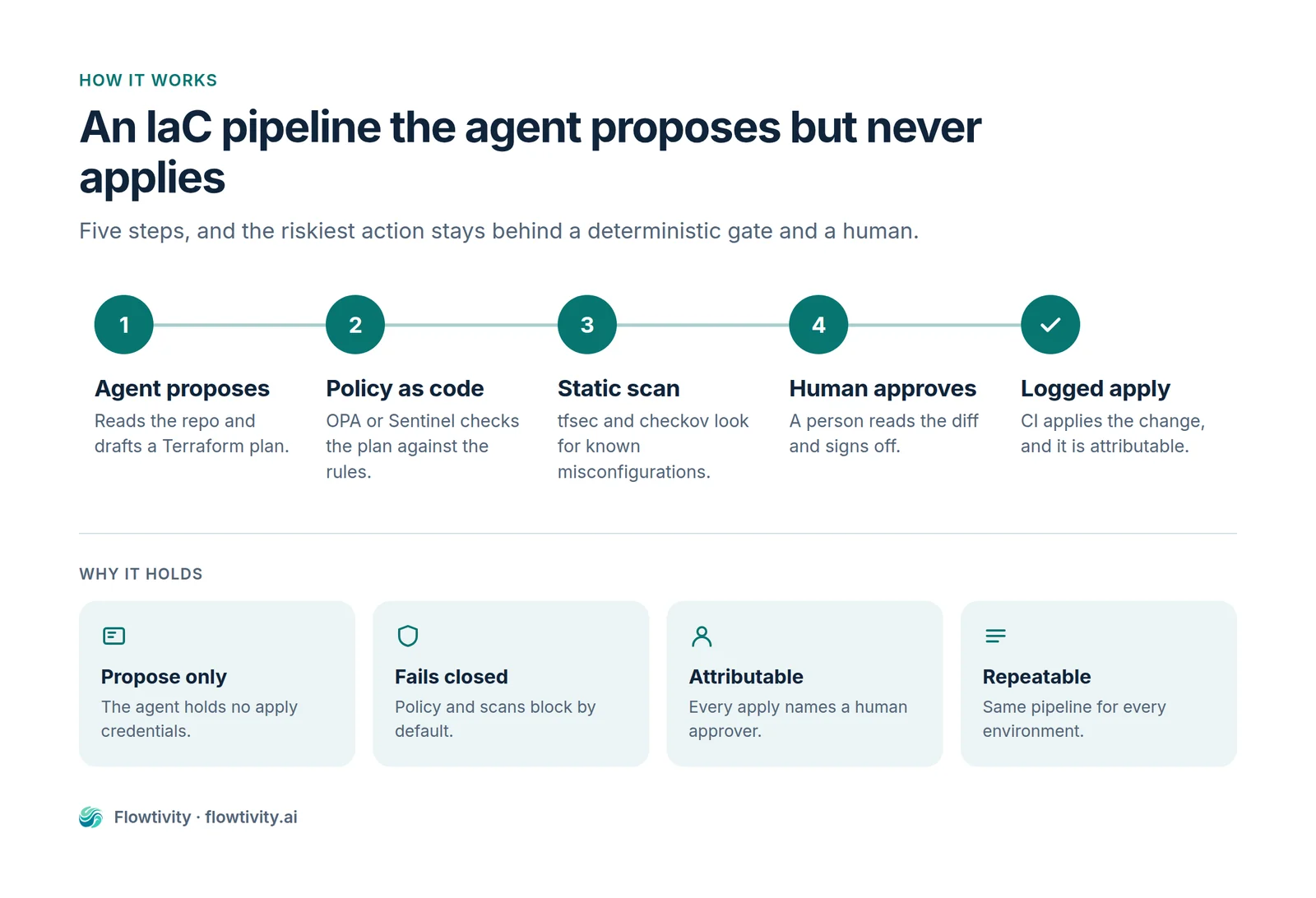
Take Infrastructure as Code as the worked case. An agent reads a change request and proposes a Terraform plan. Policy as code validates the plan against the organisation's rules. A static scan checks the diff for risky resources, open security groups or public buckets. A human reviews the plan and the scan output, then approves the apply. The plan, the approval and the resulting change are logged together. The agent never holds the apply permission. It proposes, and the deterministic layer decides. That structure is what makes the pipeline repeatable: the model handles the ambiguous part, reading intent from a ticket or a chat message, while the controls that matter stay in code and in a person's hands.
Why is Infrastructure as Code a good test case?
Because the artefacts are already structured and the validation gates already exist. Esposito, Robredo, Bakhtin, Taibi and Lenarduzzi published a conceptual framework and roadmap in Automated Software Engineering for integrating generative AI into the DevSecOps lifecycle to automate and continuously refine Infrastructure as Code, reported by Scienmag on 25 November 2026. The framework maps onto the nine DevSecOps stages used by the US Department of Defense and industry baselines, and executes infrastructure through Terraform, Ansible, Puppet and Chef. It uses stage-specific artefacts as inputs: requirements and architecture diagrams in planning, source code and static analysis in development, build scripts, dependency graphs and SBOMs in build, test suites and dynamic scanning reports in testing, deployment manifests and Helm charts in deployment, then monitoring logs and incident reports in operations. The authors identify planning as the least automated stage, which is the right warning. The agent can propose, but the decision to deploy belongs to a person.
How do you run evals before you run production traffic?
Build an eval set from real cases with known correct outcomes. Measure the agent against that set, and record accuracy by case type rather than as one aggregate number, because a 90 percent average can hide a 40 percent failure rate on the cases that matter most. Then deploy in advisory mode, where the agent proposes and a human decides, for a defined period. ToTheNew recommends this sequence for two reasons: it generates the accuracy data needed to justify expanded autonomy, and it builds organisational trust. Teams that watch an agent work correctly for weeks accept broader autonomy. Teams that see a visible failure on day one rarely recover their confidence. Expand scope only where the evidence supports it, and treat every expansion as a new governance surface.
Why does local inference make pilots repeatable?
Because a production workflow runs thousands of times, and variable cost kills pilots. A per-seat API budget is the first thing finance cuts when a project loses its sponsor, and a pilot that depends on it never becomes infrastructure. Local inference on hardware you own turns cost per run into a flat line. On our dual DGX Spark rig running DeepSeek V4.1 Flash, we measure 35 tokens per second on a single stream and 62 tokens per second across four concurrent streams, which is enough for the judgement steps in a production workflow. Data also stays inside the perimeter, which removes the security review that freezes so many pilots. The model is not the bottleneck in most stalled projects. The integration and the governance are.
What does the Flowtivity play look like?
We run production readiness as a four-part engagement. First, readiness audit: map the pilot's data, permissions, integrations and failure path against a production gate. Second, execution design: define the eval set, the advisory mode period, the approval boundary and the named owner. Third, build: deploy the pipeline on local inference across our DGX Sparks, with policy-as-code checks, a static scan and a human approval gate on anything that changes state. Fourth, prove and expand: measure accuracy, cycle time and cost per run, then widen scope only where the evidence supports it. The same pipeline pattern covers Infrastructure as Code, claims triage, invoice matching and support escalation, so the second deployment costs far less than the first while the control standard stays the same.
The one-page pre-production gate
No agent goes live until all seven are answered in writing:
- Which real cases form the eval set, and what accuracy did the agent score by case type?
- How long did advisory mode run, and what did the human override rate look like?
- What can the agent do without approval, and who signed off on that boundary?
- What happens when it fails: review queue, rollback, alert, and who owns the response?
- Which credentials does it hold, and are any broader than the task requires?
- Where do the prompts, actions and outputs go, and how long are they kept?
- Who is the named agent owner, and what is the expansion plan for the next 90 days?
Frequently asked questions
Is a successful pilot evidence that the agent will work in production?
No. A pilot proves the capability on curated data with a friendly process. Production proves the integration, the permissions and the failure path. Treat a pilot as evidence that the idea is worth testing, not evidence that the system is ready.
How long should advisory mode run?
Long enough to cover the case types that matter, not a fixed calendar period. In practice that is usually two to four weeks of real traffic. The exit criterion is accuracy by case type plus an override rate the business accepts, not a date on a project plan.
Do we need a dedicated agent owner?
Yes. ToTheNew found organisations with a named agent owner cross the production threshold at measurably higher rates. The owner is accountable for accuracy, escalation handling and the improvement cycle. It cannot be distributed across a team or delegated to a vendor, because nobody then owns the number.
What if the underlying process is genuinely broken?
Then fix the process first. Automating a broken workflow produces a faster broken workflow, and the agent will be blamed for delays that were always there. Count the handoffs. If there are five or more per outcome, redesign before you automate.
Can we start with Infrastructure as Code if we are not a software company?
Yes, if you run cloud infrastructure. The pipeline pattern, propose, validate, scan, approve, log, transfers to any workflow with structured artefacts and existing validation gates. That includes claims triage, invoice matching and contract review. The point is to pick a process where the controls already exist in code.
How do we keep cost predictable in production?
Run inference on hardware you own, cap the number of model calls per case, and measure tokens per completed case rather than tokens per call. A flat cost per run is what lets a workflow survive a budget review. It also makes the business case easier, because the cost does not move when volume does.
Takeaways
- Pilots stall on execution reliability, not model quality. Integration, governance and workflow design are the three failure points.
- Only 17 percent of organisations have deployed agents and only 1 in 5 has mature governance, so the production gate is where most projects stop.
- Evals, advisory mode and a named owner are the cheapest ways to prove an agent is ready for real work.
- Infrastructure as Code is a good first production case because the validation gates already exist: plan, policy check, static scan, human approval, logged apply.
- Local inference makes cost per run flat and keeps data inside the perimeter, which removes two of the most common reasons pilots freeze.
Sources: ToTheNew, Enterprise AI Agents in Production: Governance, Workflows and Deployment Strategy, 2026, citing 17 percent deployment, 60 percent intent, 1 in 5 mature governance and Gartner's 40 percent enterprise application forecast. Esposito, Robredo, Bakhtin, Taibi and Lenarduzzi, Generative AI as an infrastructure copilot: automating Infrastructure-As-Code across the DevSecOps lifecycle, Automated Software Engineering, DOI 10.1007/s10515-026-00600-5, reported by Scienmag on 25 November 2026. The Next Web, 25 November 2026, on Automation Anywhere and Boost.ai. Gartner prediction on agentic AI project cancellations by the end of 2027. Flowtivity benchmark on dual DGX Sparks running DeepSeek V4.1 Flash, November 2026.
What's actually useful in AI, every Friday
We follow everything happening in AI and send what's worth your time: new models, AI agents, and how to put them to work. One email a week, unsubscribe anytime.