On this page
- What is NVIDIA Auto Ontology?
- How does it build an ontology from database metadata?
- What do the leaderboards actually show?
- Why is 14.1 per cent the number to look at, not the ranking?
- What happens when the agent is about to answer wrong?
- What do the three agent skills change?
- Who does this compete with?
- What does Auto Ontology not do?
- What should an Australian business do with this?
- Frequently asked questions
- What is NVIDIA Auto Ontology?
- Is Auto Ontology really open source?
- How accurate is Auto Ontology on text-to-SQL benchmarks?
- What is the difference between a schema and an ontology?
- Why did NVIDIA disable its own result checks?
- Should an Australian business self-host Auto Ontology?
Last updated: 28 November 2026
Key takeaways
- • NVIDIA's Auto Ontology is an Apache-2.0 framework that builds a semantic graph from enterprise database metadata, so an agent retrieves what a term means before it writes SQL. The repo had 16,986 stars and 237 open issues on 28 November 2026, seven months after it was created.
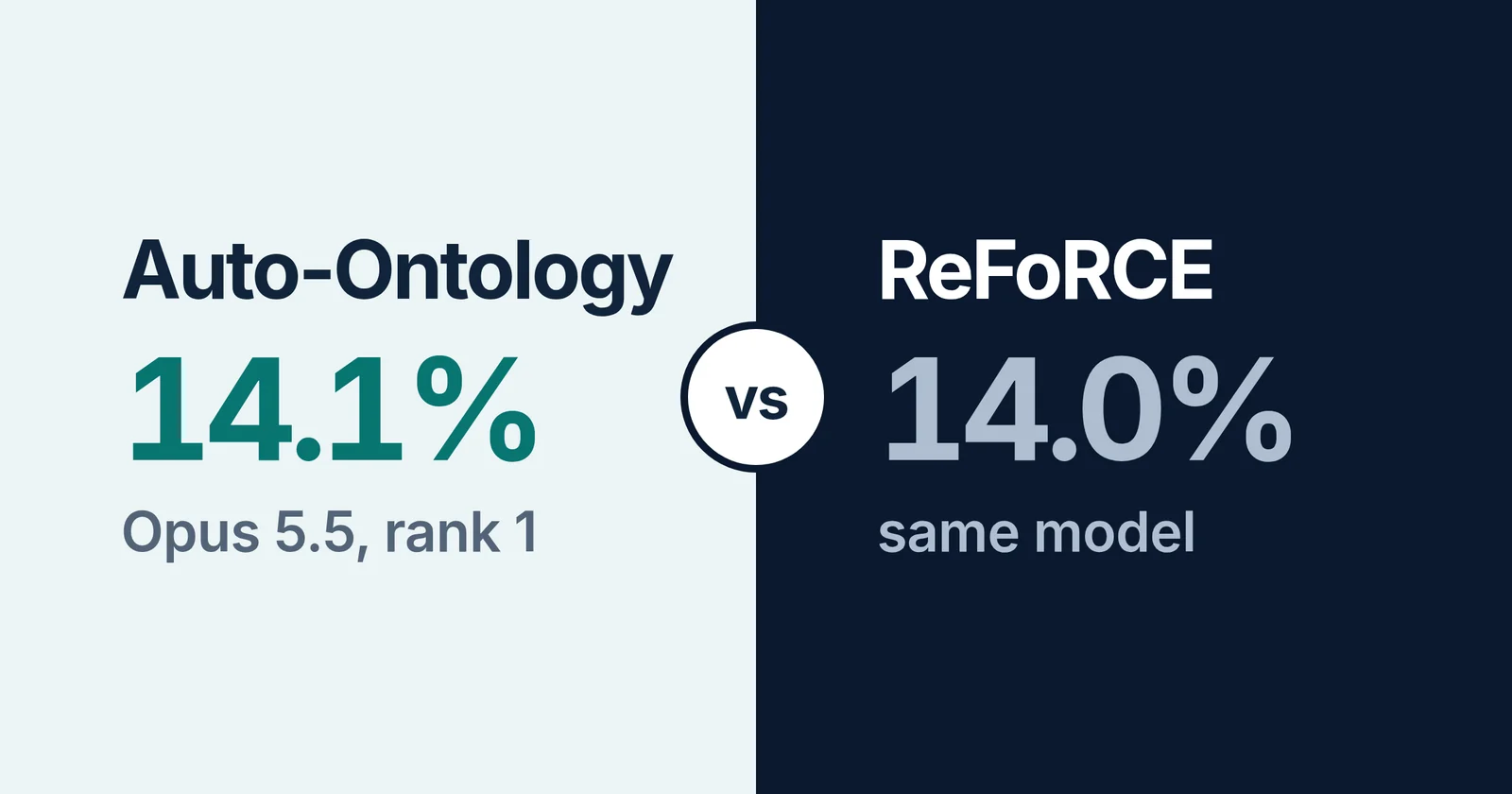
- • It ranks first on BEAVER's Setting 0 leaderboard at 14.1 per cent execution accuracy, against 14.0 for ReFoRCE running the same Claude-Opus-5.5 model. That is a one-tenth-of-a-point lead, and Setting 0 is the variant with no subtask annotations.
- • On BIRD-Interact it tops the query category in the active-interaction mode at 41.95 per cent Phase 1 and 24.88 per cent Phase 2, a 36.83 per cent reward. There is no bare Claude-Opus-5.5 row on that board, so the lift over the same model is not published.
- • The interesting engineering is not the ranking. It is the submit step: NVIDIA added three correctness checks on 24 November, then removed one and disabled the rest by default within 48 hours because they produced false positives.
- • Its own eval harness is the right shape: same model, same questions, schema-only arm versus ontology arm, one deterministic verifier, no LLM judge. The repo publishes no results table, so the controlled number is one you run yourself.
- • The default install runs a 30B Nemotron, not the Opus model that produced the leaderboard entry. Two services have no authentication of their own, and the optional prediction path uploads your tables to a hosted service.
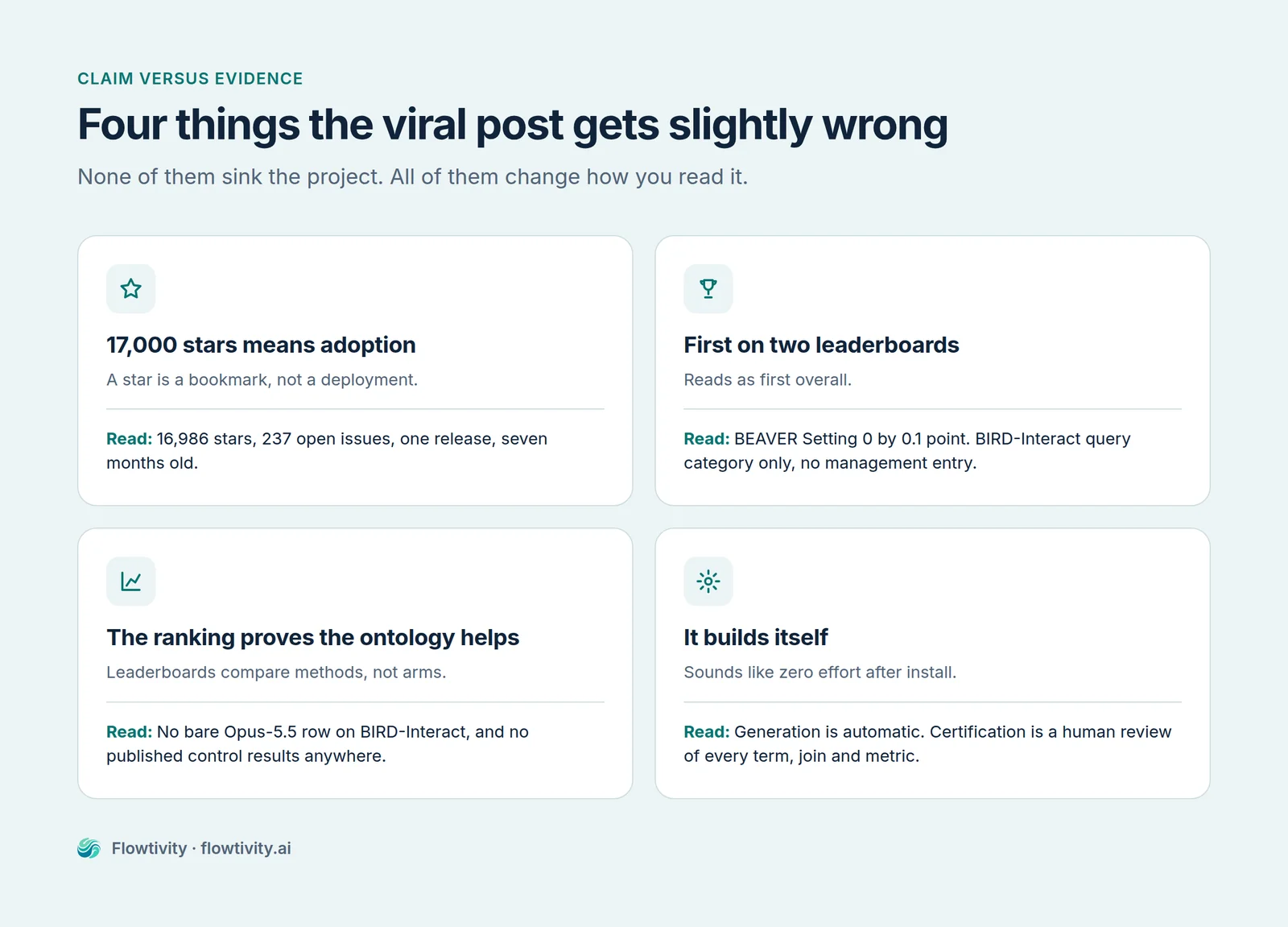
On 27 November 2026, a post from Tech with Mak went past half a million views with a simple pitch: NVIDIA had open-sourced a system that gives AI agents something a database schema cannot, an understanding of what the company's data actually means. The post named it Auto Ontology and put the star count at 15,000.
By the next day the repo showed 16,986 stars, 1,518 forks and 237 open issues, so the tweet undersold its own subject. But the star count is the least interesting number in this story. The useful question is narrower and harder: does a machine-built ontology actually make an agent's answers more correct, and by how much?
NVIDIA has an answer, and it is more honest than most launch material. It ranks first on two public leaderboards. The margins are thin, the settings are specific, and the repo's own commit history shows the team shipping a correctness layer and then switching it off within two days. That sequence tells you more about the state of agentic analytics than any badge does.
What is NVIDIA Auto Ontology?
Auto Ontology is a Python framework that reads an enterprise database's metadata, builds a semantic graph over it, and serves that graph to agents through MCP, a CLI and a REST API. It is licensed Apache-2.0, and it is a full application rather than a library: a Next.js web app, a FastAPI backend, an ingestion service, a Postgres database with pgvector, and an MCP server, all shipped as Docker Compose or a Helm chart.
The problem it targets is specific. An LLM can write perfectly valid SQL and still return the wrong number, because "revenue" may exist in four tables under three definitions, and the column called amt_net tells you nothing about which one it holds. The repo's own framing is blunt about the stakes: a revenue metric answered faster is worth nothing if the number is wrong.
So the ontology is not a knowledge base about the world. It is a governed map from business language to physical columns, and it answers six questions, each with its own element type:
- What does it mean? A concept, meaning a term such as Invoice Line, with a description and synonyms.
- Where is it? A mapping, meaning column attributes that tie each term to tables and columns.
- What is connected? A relationship, meaning joins including bridge tables, declared keys plus inferred links confirmed against the data.
- How do I calculate it? A metric, meaning reviewed SQL stored under a term, so every answer computes margin the same way.
- Where does it come from? Lineage, meaning each term links to its source tables and each answer returns its SQL.
- Should I use it? Certification, meaning an expert has marked the element as reviewed.
That last element is the one that separates this from a schema dump with better prose. The graph is a draft until a person certifies it, and the product is designed around that review loop rather than around the model's confidence.
How does it build an ontology from database metadata?
There are two stages, and only the first one is automatic. The second is a person deciding whether the draft is right.
Generate. The ingestion service reads tables, columns, keys, views and query history from any of eleven connectors: PostgreSQL, MySQL, Databricks, Snowflake, ClickHouse, Trino, BigQuery, Apache Kyuubi, HeavyDB, DuckDB and SQLite. It profiles column values with SQL, embeds tables and columns into pgvector, and optionally tags PII. Per table, a model proposes foreign key candidates and junction tables, writes column descriptions and names the terms. Across tables, it groups copies of a schema into term families, links foreign keys to the terms they reference, and keeps an inferred link only when the data confirms it. It also suggests SQL attributes from query history, which is how a metric like margin gets a reusable definition instead of being rewritten from scratch on every question.
Certify. The output lands in Postgres with embeddings, and can be imported or exported as Ossie YAML. Experts test the draft with real questions, refine descriptions and SQL attributes in the UI or through the API, and certify what is correct. Certified edits are re-embedded immediately and survive the next compilation, with one exception: which semantic foreign key each join uses is re-selected on every compile.
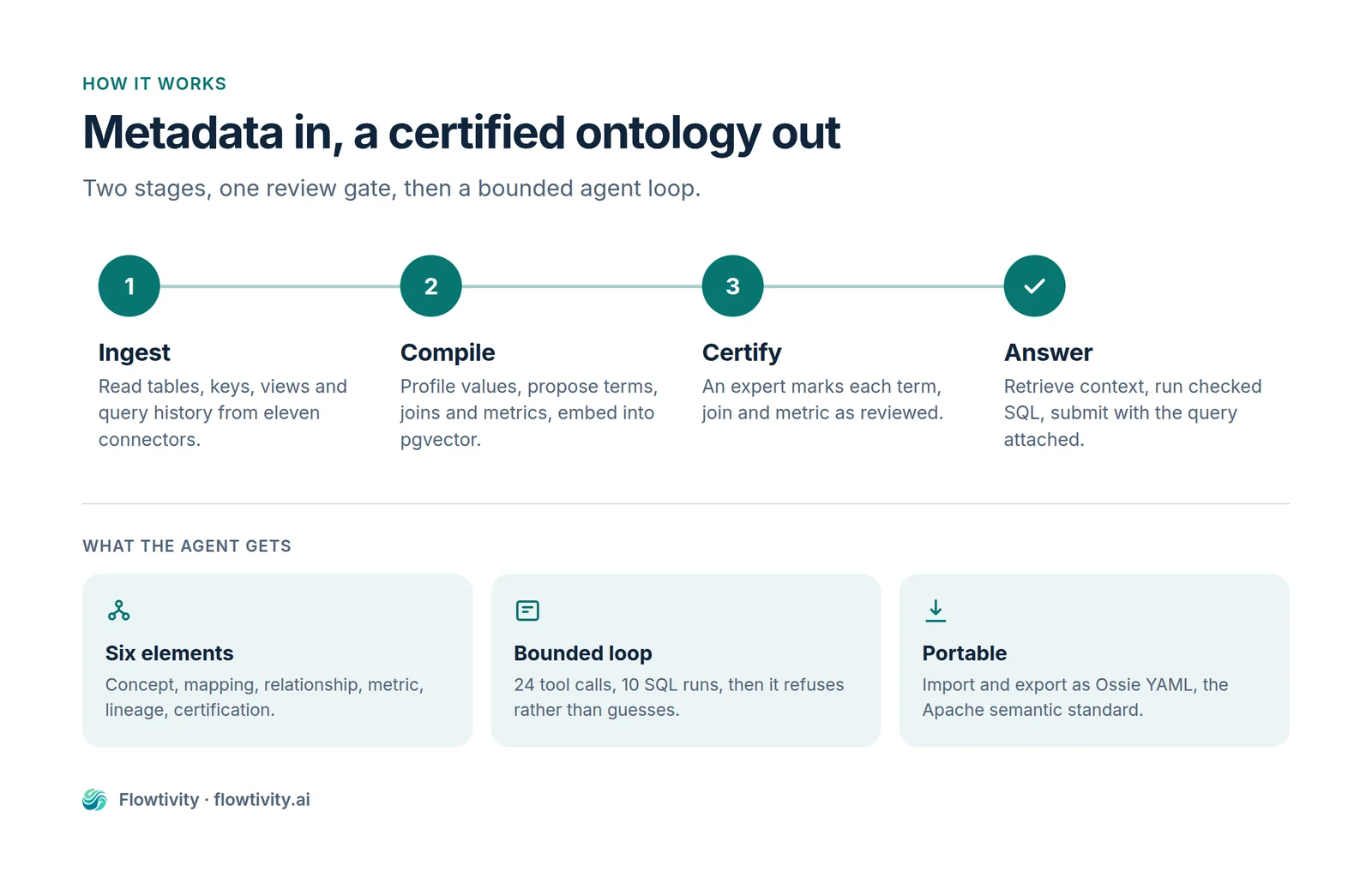
Answer. A ReAct agent runs a loop with three tools. retrieve searches the semantic layer by meaning and by name for concepts, column meanings and named calculations, and returns tables and columns with their descriptions, definitions with their SQL, and join paths. run_sql checks table and column names against the catalog before a query runs. submit takes the final query plus an explanation, runs it, and sends errors back to the model to fix.
The loop is bounded. By default an agent gets 24 tool calls, 10 SQL runs, 2 prediction calls, 100 rows per result and 8,000 characters per tool observation. When the budget runs out, it refuses. That refusal behaviour matters more than it sounds, because the alternative is a plausible answer invented under pressure.
What do the leaderboards actually show?
NVIDIA reports two first places, and both are worth reading closely.
BEAVER. Auto Ontology sits at the top of the Setting 0 leaderboard with 14.1 per cent execution accuracy, submitted on 9 November 2026, running Claude-Opus-5.5. The entry directly below it is ReFoRCE at 14.0, submitted on 16 October with the same model. Then it drops away: ReFoRCE with GPT-5.6-Sol at 11.5, ReFoRCE with Claude-4.5-sonnet at 11.4, the best few-shot prompt at 8.8, DIN-SQL at 6.1, DAIL-SQL at 4.7.
Two things about that board are easy to miss. The first is the margin: one tenth of a point over a method using the identical model. The second is the setting. BEAVER's Setting 0 is the end-to-end variant with no subtask annotations, and no submission on the board reports Settings 1 or 2 at all. Setting 1 hands over schema-linking annotations and Setting 2 adds domain knowledge and query decomposition. So the 14.1 was earned in the hardest configuration, where an ontology has to reconstruct the domain knowledge that Setting 2 would otherwise supply. That is the right test for this tool, and it is also why the absolute number is low.
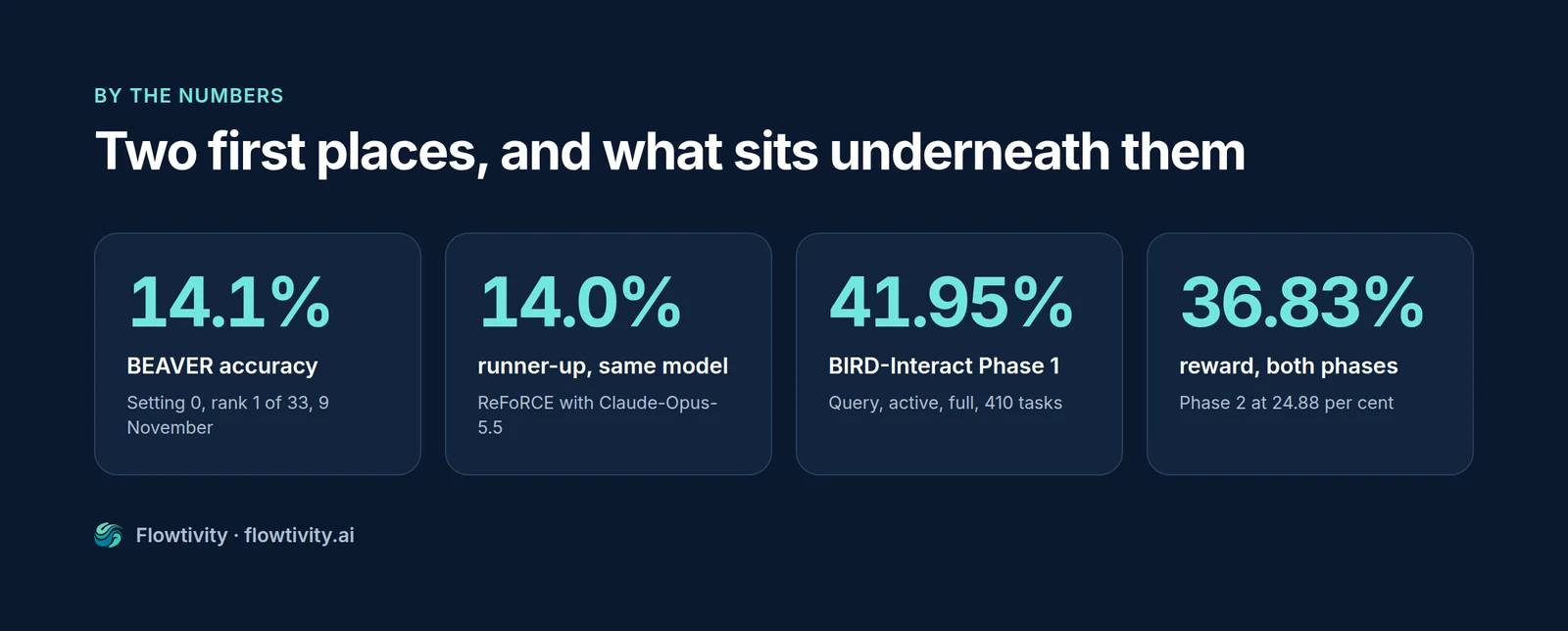
BIRD-Interact. In the query category, full dataset, active-interaction mode, Auto Ontology with Claude-Opus-5.5 records 41.95 per cent on Phase 1, 24.88 per cent on Phase 2, and a 36.83 per cent reward across 410 tasks, dated 11 November and marked verified. The next entry is AIDBS-DataAgent at 32.98, then Quick-BlendedIntelligence at 27.39, MERIT with GPT-5.4 at 23.17, and a bare Claude-Opus-4.6 at 17.32.
The reward figure is a weighted blend of the two phases. A 70 per cent Phase 1, 30 per cent Phase 2 split reproduces the published reward exactly on the rows we checked, which is our arithmetic from the published components rather than a formula NVIDIA states. It does not reproduce the passive-mode row exactly, so treat it as a description, not a definition.
The caveats on this board are real. There is no bare Claude-Opus-5.5 row, so the same-model comparison that BEAVER allows does not exist here: the nearest bare model is Opus-4.6 at 17.32, a different model in a different release cycle. And there is no Auto Ontology entry in the management category at all, where MERIT with GPT-5.4 leads at 55.47. So the claim is accurate only in its narrow form: first in the query category, active interaction, full dataset. It is not first overall, and the board's own text still describes state-of-the-art reasoning models solving roughly 16 per cent of full-version tasks, a figure from the benchmark paper rather than the current table.
Why is 14.1 per cent the number to look at, not the ranking?
Because 14.1 per cent means 86 per cent of questions still get the wrong answer, and because the ranking is a comparison between methods rather than a measurement of what the ontology adds.
The vendor knows the difference. The companion repository, auto-ontology-eval, is built around a controlled design: the same model, the same questions, two arms. The control arm is called schema_only_sql and gets the question plus a schema dump in one prompt with no tools. The treatment arm is auto_ontology_sql and gets the question while the agent retrieves its own context from the ontology. One deterministic verifier executes both arms' SQL and the gold SQL against the same database and compares the results, using BIRD's execution accuracy or BEAVER's ex_acc. There is no LLM judge, and the harness withholds its headline number when more than 5 per cent of questions produced no model output.
That is a better experiment than a leaderboard position. But the repository publishes no results table. You can run it on BIRD's 1,534 dev questions, a 100-question BEAVER sample, FDABench-Lite's 169, the 41-question Wide World Importers sample, or BIRD-Interact's 300 lite and 600 full tasks. Until someone does and publishes the delta, the honest statement is: the tool wins a method comparison by a tenth of a point, and the controlled uplift is unmeasured in public.
There is one more number worth flagging. The leaderboard entry ran on Claude-Opus-5.5. The default installation runs nvidia/nemotron-3.5-lightning-30b-a3b for both the reasoning and non-reasoning roles, with a 1B embedding model and an 8B reranker. A 30B mixture-of-experts model with 3B active parameters is a different proposition from a frontier Claude model, in accuracy and in cost. If you evaluate Auto Ontology with the defaults and compare the result to 14.1 per cent, you are comparing two different systems.
What happens when the agent is about to answer wrong?
This is the part of the repo that a tweet cannot carry, and it is the most useful thing in it.
Until 26 November 2026, the submit step accepted any final query that ran without an error. Running is not the same as being right. A query can join a table that repeats rows, sum a rate once per repeated row, and return a number that is ten times too large with no error at all. Pull request 688, merged on 26 November, added three checks to close that gap:
- Join fanout. If a join repeats the rows an aggregate is adding up, the query is refused once, and the model is told which aggregate and which join column caused it. Resubmitting the same SQL unchanged is accepted, so the check costs one turn rather than blocking the run.
- Empty result. If a filtered query returns zero rows, each literal filter is run alone against its table, and the stored values come back to the model. That is how
site_id = '1'gets caught against an integer column, or'open'against'OPEN'. - Numbers in the answer. If the answer's prose cites none of the numbers its own rows hold, it is sent back once, together with the rows.
The review that tightened the fanout rule is the interesting part. The original version skipped the check whenever any condition mentioned the joined table, so SUM(CASE WHEN a.qty > 0 THEN s.rate END), SUM(s.rate) FILTER (WHERE a.qty > 0) and a plain WHERE a.qty > 0 all returned an inflated 620 instead of 60, with no warning. The merged version only exempts a joined table when a condition proves at most one row per join key, meaning a unique column or every other column of a composite key set to a single value.
Then the team looked at what the stricter rule did to real runs. Three commits landed on main the same morning:
- 09:08 UTC, 26 November: add rollout switches for the result checks.
- 09:35 UTC: remove the answer-number submit check.
- 09:41 UTC: disable the result checks by default.
The pull request's own automated summary states it plainly: these checks are disabled by default and can be enabled through configuration. The PR body had already warned that the stricter fanout rule would produce more refusals than intended, and that each false positive costs the model one turn.
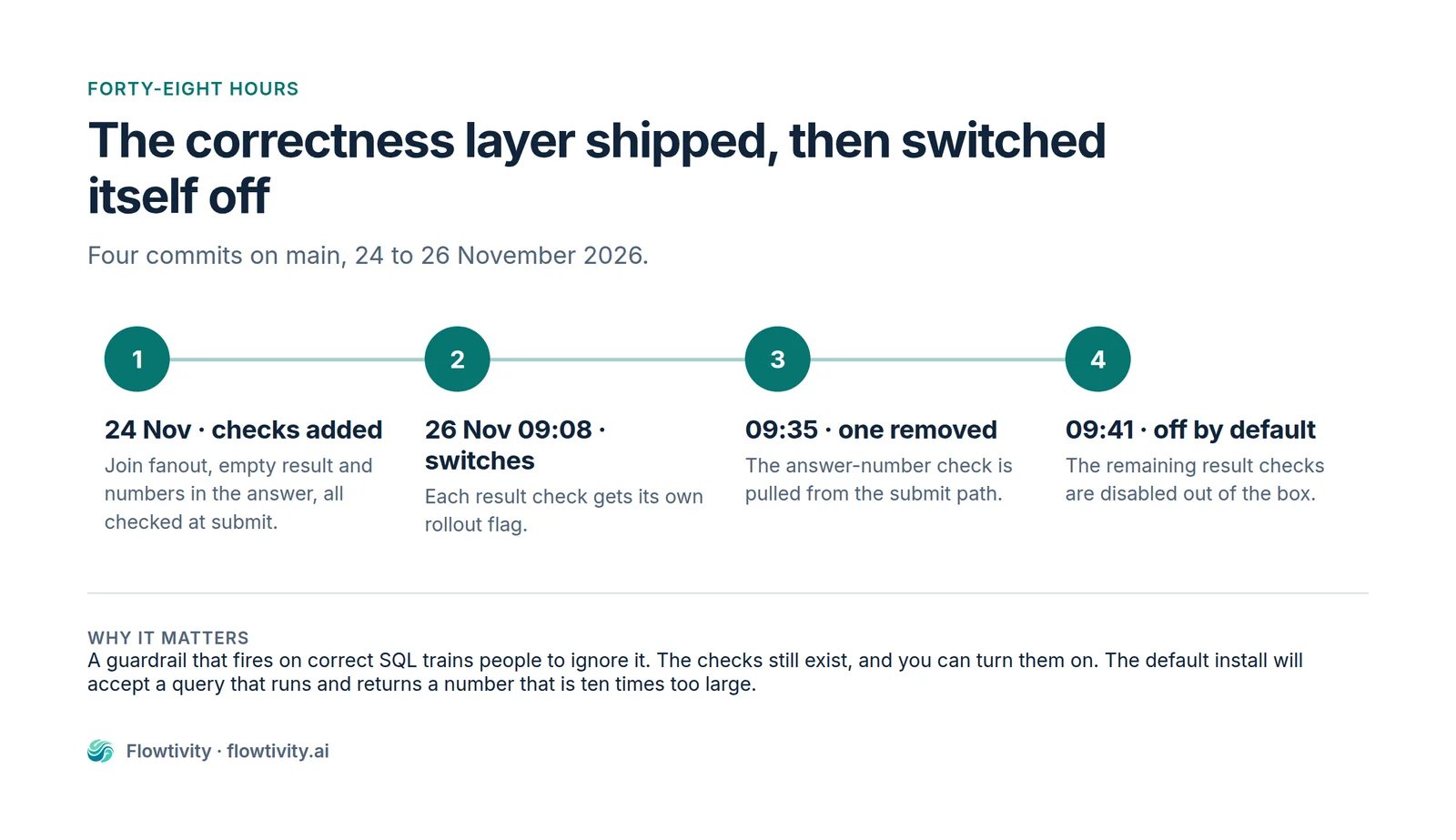
Read that sequence as engineering honesty rather than as a failure. A deterministic guardrail that refuses wrong queries is the right architecture for analytics, and the hard part is calibration: a check that fires on correct SQL trains users to ignore it. Shipping the checks, measuring the false positives and turning them off by default is how that calibration gets done in public. It also tells you the guardrail is not yet load-bearing in the default configuration. If you deploy this, the first thing to decide is whether you turn the result checks on and accept the extra turns.
What do the three agent skills change?
NVIDIA ships three skills that teach a coding agent to install, model and query the system, and each comes with its own benchmark report dated 19 November 2026. The pattern is consistent and the numbers are large.
For nvidia-ontology-query, correctness went from 53.3 per cent without the skill to 98.7 per cent with it for Claude Code, and from 58.7 to 94.7 for Codex. For nvidia-ontology-management, 40.0 to 97.1 and 45.7 to 84.3. For nvidia-ontology-setup, 48.0 to 100.0 and 58.0 to 98.0.
Those lifts are too large to read as a verdict on the product. They measure whether an agent can follow a written procedure for a specific tool, and the sample is 15 tasks with one attempt each in an isolated sandbox. What they do show is that the instruction file carries most of the operational knowledge, which is the same lesson the skill-distillation work has been teaching all year.
The security column is the one to watch, because it does not always move in the same direction. For the query skill, Codex went from 100 to 96.7, a 3.3 point drop. For the management skill, security fell 3.6 points for Claude Code and 7.1 for Codex. For the setup skill, it rose 20 points and 15. A skill that makes an agent more effective at operating a system can also make it more willing to operate the system, which is exactly the trade a security reviewer should be looking at.
Who does this compete with?
The Hacker News thread from 3 November, 292 points and 140 comments, put the competitive question bluntly. One commenter asked what separates this from a memory system plus skills. Another framed it as Jensen Huang's answer to Alex Karp, since building ontologies is Palantir's core business.
The answer that held up in the thread came from a commenter named IanCal: the hard part is not storing facts, it is agreeing on what the data means. Is a customer someone who bought something, or anyone who might? Do two systems use the same definition? An ontology is a machine-readable answer to those questions, and the value is in the reconciliation, not the retrieval.
Against that backdrop, three things about Auto Ontology are genuinely different from the semantic layers already in the market:
- It builds the draft from metadata. dbt and Cube style semantic layers are hand-authored. This one profiles the data, proposes the terms, proposes the joins and proposes the metrics, then asks a human to certify. The labour model is different even if the artefact is similar.
- It is portable. Import and export go through Apache Ossie, the incubating Apache standard formerly known as Open Semantic Interchange, which defines metrics, dimensions and joins in YAML. A converter for Auto Ontology lives in the Apache converters repository. That matters because it means the definitions are not trapped in NVIDIA's database.
- It is exposed to any harness. The MCP server gives read-only tools to Cursor, Claude Desktop or any agent, and the REST API streams answers with their SQL. The ontology is a shared service rather than a feature of one chat window.
The thread also produced the counter-argument worth keeping. A commenter named grey-area summarised it as fixing unreliable agents by adding more unreliable agents, and argued that models cannot reliably separate what they learned about the world from the instructions and data in front of them. Another, sudo-giusppe, made the practical version: the number of symbolic rules needed to handle real data's noise and complexity produces a graph too dense to stay human-maintainable. Auto Ontology's answer to that is the certification step and the bounded tool budget, which is a reasonable answer and not a proof.
What does Auto Ontology not do?
The repo is unusually candid about its edges, and they matter more than the feature list.
- The ReAct agent does not ask clarifying questions. It is documented as a limit, not a roadmap item. Answerability checking lives on the MCP path through
check_answerable, which reports coverage and asks the user to clarify when a term has no mapping. The in-app agent instead resolves, runs and submits, or refuses when the budget runs out. - The trust boundary is the deployment. The backend trusts the
x-auto-ontology-user-idheader that the web app forwards, and the ingestion service's endpoints, which include ingest, delete, reset and compile, have no authentication of their own. Ports 3001 and 3002 must stay on a private network. That is a normal internal-service design and a serious misconfiguration if you expose it. - Predictions leave the building. If you set the KumoRFM endpoint, the agent routes predictive questions to a hosted service and uploads the connected tables to it, capped at 20 tables by default with no row cap unless you set one. The README tells you to review what that sends before enabling it. For an Australian business that is an APP 8 cross-border disclosure question, not a performance setting.
- It is young and busy. One release, v1.3.0 on 24 November 2026. 237 open issues. A commit log that includes fixes for duplicate column values, BigQuery date-sharded tables and CTE scoping in the same week. The eval repository explicitly does not accept external pull requests.
- There is no launch post. NVIDIA's own developer topic page links the repository and describes it in one line, but no engineering blog post announces it. The README is the marketing, which is why the Hacker News thread spent a hundred comments arguing about whether the first sentence was written by a human.
What should an Australian business do with this?
Treat it as a way to make a pilot measurable, not as a way to make an agent trustworthy.
Start with the eval harness, not the UI. The valuable artefact here is the two-arm comparison. Point it at one database, write 50 questions with gold SQL that your analysts agree on, and run the control arm against the treatment arm. If the ontology does not beat the schema dump on your own questions, the leaderboard is irrelevant. That test costs a day and settles the argument.
Budget for the certification loop. The generation is automatic and the certification is not. The realistic effort is a domain expert reviewing terms, descriptions and SQL attributes for the metrics that matter, which is the same effort a semantic layer always required. The difference is that the draft arrives pre-filled, so the review starts from something rather than from a blank page.
Decide the guardrails before the pilot. The result checks are off by default, so a default deployment will accept a query that runs and returns an inflated aggregate. Turning them on costs extra turns and will refuse some correct queries. Pick one setting deliberately and measure the refusal rate on your own question set.
Keep the data inside the perimeter. Self-hosted, the stack needs Postgres with pgvector, four model endpoints and a private network for the two unauthenticated services. If you cannot run a local model that supports structured output, you are sending schema, sample values and question text to a model provider, which is the disclosure you have to document. The Ossie export is the exit plan: it means your definitions survive a change of tool.
Judge it on cost per accepted answer. The ReAct loop spends tokens on retrieval, on SQL runs and on refusals. A 24-tool-call budget with a 30B model is cheap; the same loop on a frontier model is not. The only metric that compares those two configurations fairly is cost per answer a human accepts, which is also the metric that tells you whether the ontology earned its keep.
Frequently asked questions
What is NVIDIA Auto Ontology?
Auto Ontology is an Apache-2.0 Python framework that builds a semantic graph from enterprise database metadata and serves it to AI agents over MCP, a CLI and a REST API. The graph maps business terms to the tables and columns that hold them, records valid join paths, stores reviewed SQL for named metrics, and tracks lineage so every answer returns the query behind it. It ships as a Docker Compose stack or a Helm chart, with a Next.js web app, a FastAPI backend, an ingestion service and Postgres with pgvector.
Is Auto Ontology really open source?
Yes, under Apache-2.0, with one release, v1.3.0 on 24 November 2026. The framework, the MCP server and the evaluation harness are all public. Two practical limits apply: the optional prediction path uploads connected tables to the hosted KumoRFM service, and the evaluation repository does not accept external pull requests. Neither affects the licence, but both affect how independently the claims can be checked.
How accurate is Auto Ontology on text-to-SQL benchmarks?
It ranks first on BEAVER's Setting 0 leaderboard with 14.1 per cent execution accuracy, against 14.0 for ReFoRCE running the same Claude-Opus-5.5 model. On BIRD-Interact's query category in active-interaction mode it records 41.95 per cent Phase 1 and 24.88 per cent Phase 2, a 36.83 per cent reward. Both figures come from the public leaderboards, dated 9 and 11 November 2026. Absolute accuracy remains low: 14.1 per cent on BEAVER means most questions are still answered incorrectly.
What is the difference between a schema and an ontology?
A schema says which tables and columns exist and how they are typed. An ontology says what those tables and columns mean, which business term owns which column, which joins are valid, how a metric is calculated, where it came from and whether an expert has certified it. Agents need the second because valid SQL is not the same as a correct number: a query can join a table that repeats rows and return an aggregate ten times too large without raising an error.
Why did NVIDIA disable its own result checks?
Because the checks produced false positives. Pull request 688, merged on 26 November 2026, added join-fanout, empty-result and answer-number checks to the submit step. The stricter fanout rule refused more queries than intended, so three follow-up commits added rollout switches, removed the answer-number check and disabled the result checks by default. They can be re-enabled through configuration. The sequence is public in the commit log and the pull request description.
Should an Australian business self-host Auto Ontology?
Self-hosting is viable if you can run Postgres with pgvector, four model endpoints and keep the backend and ingestion ports on a private network, because those two services have no authentication of their own. If you cannot run a local model that supports structured output, schema details, sample values and question text will go to an external model provider, which needs to be assessed as an APP 8 cross-border disclosure. Start with the two-arm evaluation on your own questions before committing to a rollout.
Sources
- NVIDIA, "Auto Ontology" repository, github.com/NVIDIA/auto-ontology, created 27 April 2026, README and docs/architecture.md read 28 November 2026.
- NVIDIA, "Auto-Ontology Eval" repository, github.com/NVIDIA/auto-ontology-eval, README read 28 November 2026.
- BEAVER leaderboard, beaverbench.github.io, leaderboard data and settings fetched 28 November 2026; Chen et al., "BEAVER: An Enterprise Benchmark for Text-to-SQL", arXiv:2409.02038.
- BIRD-Interact leaderboard, bird-interact.github.io, task category results fetched 28 November 2026.
- NVIDIA Auto Ontology pull request 688, "Fix/answer-correctness submit checks", merged 26 November 2026, plus the commit log for 24 to 26 November 2026.
- NVIDIA skill benchmark reports for nvidia-ontology-query, nvidia-ontology-management and nvidia-ontology-setup, evaluation date 19 November 2026.
- Hacker News discussion, "Nvidia - open-source auto-ontology", 292 points, 3 November 2026.
- Apache Ossie (incubating), ossie.apache.org, and apache/ossie-converters, read 28 November 2026.
- Tech with Mak (@techNmak), X post, 27 November 2026, 547,156 views and 10,164 bookmarks at capture on 28 November 2026.
What's actually useful in AI, every Friday
We follow everything happening in AI and send what's worth your time: new models, AI agents, and how to put them to work. One email a week, unsubscribe anytime.