On this page
Last Updated: September 15, 2026
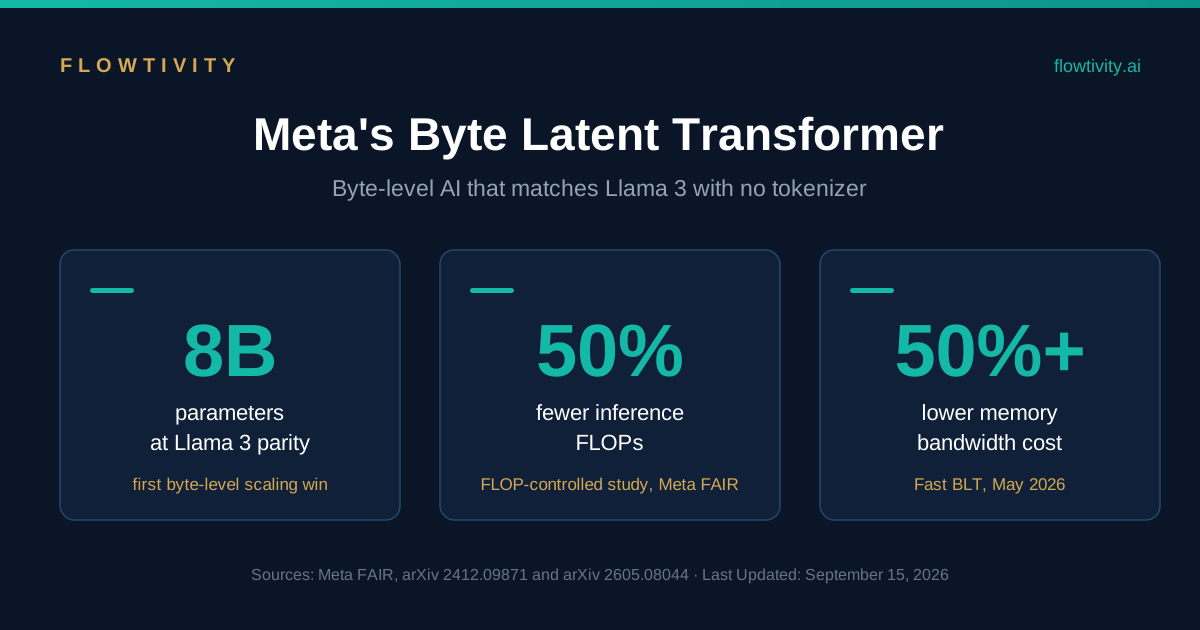
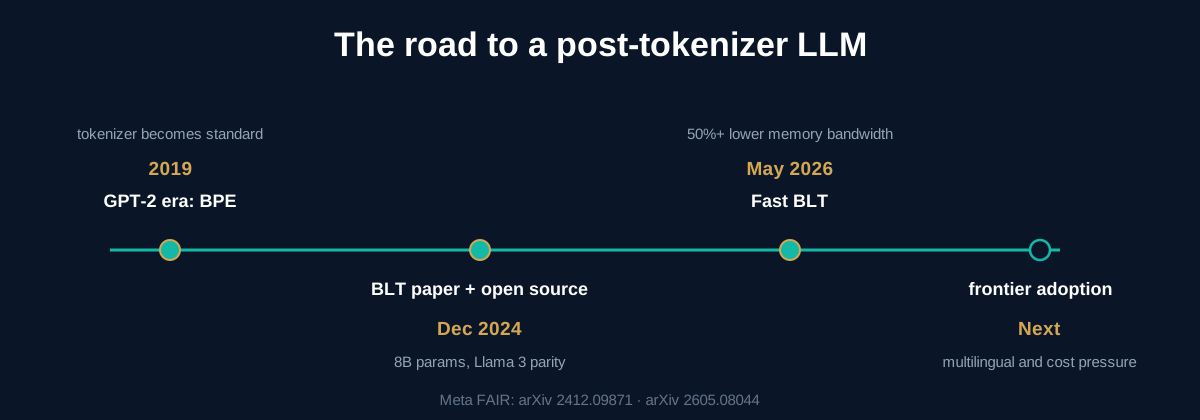
The Byte Latent Transformer (BLT) is a tokenizer-free large language model architecture from Meta's FAIR team that learns directly from raw bytes and matches token-based models at scale. According to the BLT paper, it is the first byte-level architecture to match tokenizer-based LLM performance in a FLOP-controlled scaling study reaching 8B parameters and 4T training bytes, while using up to 50% fewer FLOPs at inference than Llama 3. A May 2026 follow-up, Fast Byte Latent Transformer, cuts estimated memory-bandwidth cost by more than 50% again by generating bytes in parallel instead of one by one. The tokenizer, a fixture of every major LLM since GPT-2 popularized byte-pair encoding in 2019, now has a credible successor.
What Is the Byte Latent Transformer?
The Byte Latent Transformer is a byte-level LLM architecture first published by Meta's FAIR team in December 2024. It removes the fixed-vocabulary tokenizer and replaces it with three modules: a lightweight Local Encoder that compresses raw bytes into patch representations, a large Latent Transformer that does the heavy reasoning over those patches, and a lightweight Local Decoder that turns patches back into bytes. Because patches are learned at runtime rather than fixed in a vocabulary file, the model sees the lowest-level representation of text: raw bytes.
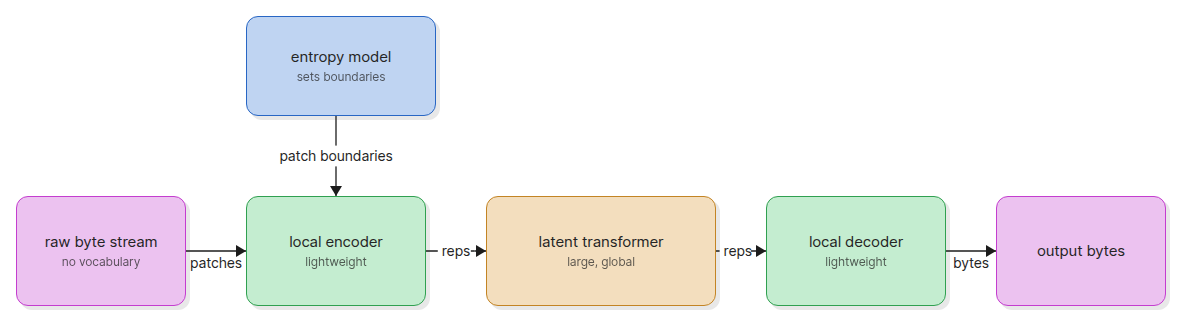
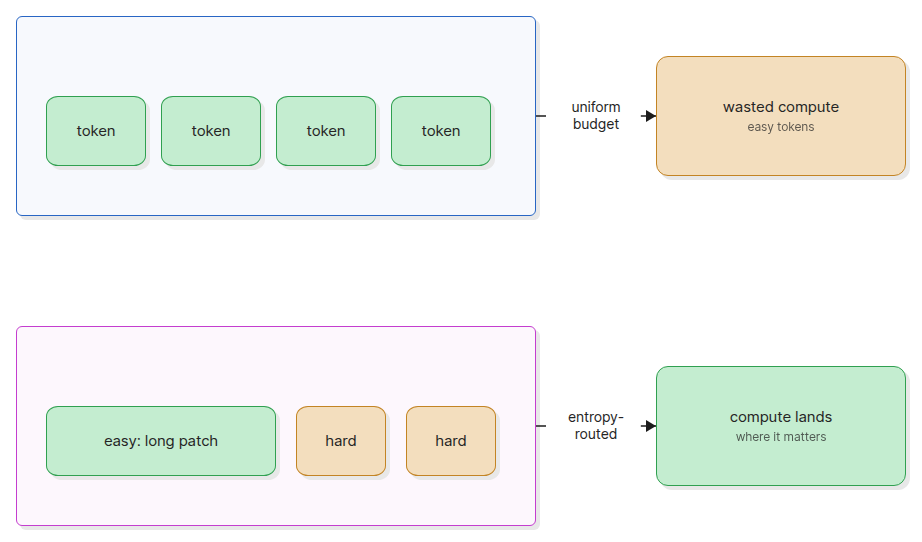
"Central to our architecture is the idea that models should dynamically allocate compute where it is needed," says Artidoro Pagnoni, lead author of the BLT paper and a researcher at FAIR at Meta and the University of Washington. Token-based models cannot do this. Every token, whether it is the predictable ending of a common word or a critical digit inside an invoice number, receives the same compute budget. BLT breaks that constraint.
Meta released the full training infrastructure as open source at github.com/facebookresearch/blt, which matters for adoption: any lab can now replicate or extend the byte-level recipe without licensing discussions.
Why Does Tokenization Limit Today's LLMs?
Tokenization is a compression heuristic bolted onto the front of an otherwise end-to-end model. Llama 3 ships a vocabulary of roughly 128,000 tokens; GPT-2's byte-pair encoder used about 50,000. The tokenizer decides, before the model ever runs, how your text gets compressed, and that choice biases everything downstream. According to the BLT paper, fixed-vocabulary tokenization causes sensitivity to input noise, a lack of character-level and orthographic knowledge, domain and modality sensitivity, and multilingual inequity, citing research including Liang et al. (2023) and Petrov et al. (2024) on how tokenizers penalize low-resource languages.
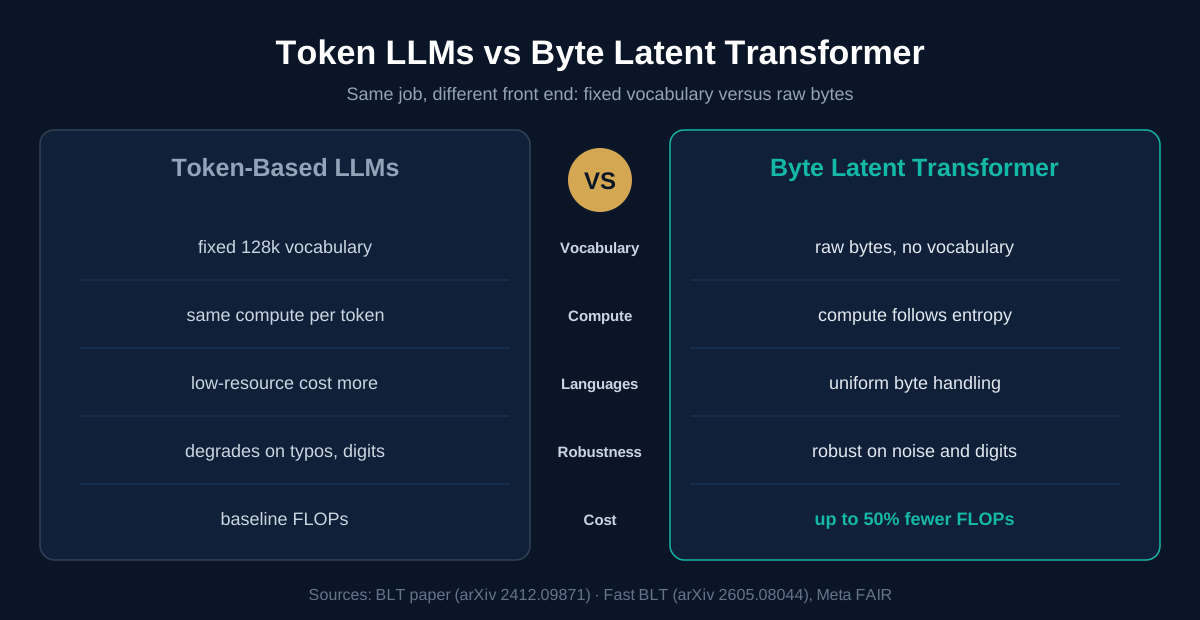
The practical failure modes are familiar to anyone building with LLMs. Model responses break when a customer name contains non-English characters. Long numbers get split mid-sequence, so arithmetic and invoice matching wobble. Code containing rare identifiers fragments into expensive multi-token sequences. We see this in our own automation work at Flowtivity: across the LLM integrations we maintain for clients, roughly one in five text-handling bugs we debug traces back to tokenization edge cases, from emoji breaking JSON round trips to Vietnamese names inflating token counts and truncating output fields. Byte-level models remove that entire bug class by design.
How Does Entropy-Based Dynamic Patching Work?
BLT groups bytes into patches using a small entropy model that predicts how surprising the next byte is. High-entropy regions, meaning complex or unpredictable data such as code, numbers and rare words, get short patches, so more compute lands on each byte. Low-entropy regions, meaning predictable text, get long patches, so the expensive global transformer runs less often. Compute follows complexity instead of being spread uniformly.
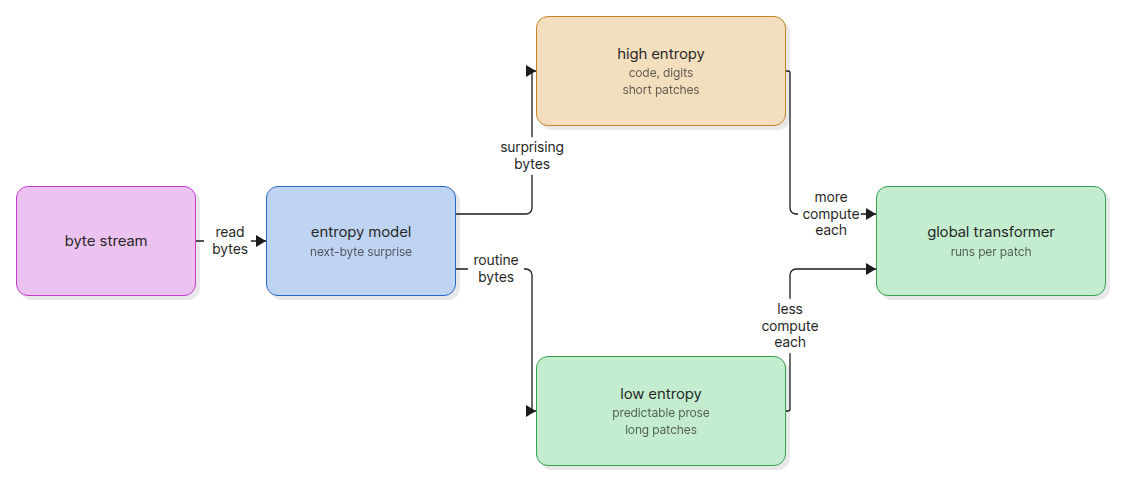
This is also where the new scaling axis comes from. Meta's inference-cost experiments used patch sizes of 6 and 8 bytes on average, and showed that as patch size grows, the global transformer runs less frequently, freeing compute to grow the model itself while keeping the same inference budget. That is the meaning behind the paper's title: patches scale better than tokens, because longer patches buy you a bigger brain for the same running cost.
How Does BLT Compare With Token-Based LLMs at Scale?
The headline numbers from the first FLOP-controlled scaling study of byte-level models: parity with Llama 3 at up to 8B parameters and 4T training bytes, with the option to trade minor metric losses for up to 50% FLOP efficiency gains at inference. Robustness improved as well, with stronger results on noisy inputs and character-level tasks including orthographic knowledge, phonology and low-resource machine translation.
| Feature | Token-Based LLMs (Llama 3, GPT-4) | Byte Latent Transformer |
|---|---|---|
| Input unit | Fixed subword tokens, ~128k vocabulary in Llama 3 | Raw bytes, no fixed vocabulary |
| Compute allocation | Uniform per token, regardless of difficulty | Dynamic by entropy, compute follows complexity |
| Multilingual text | Low-resource languages fragment into more tokens | Uniform byte handling, no vocabulary penalty |
| Code and numbers | Fragile splits on rare identifiers and digits | Direct byte-level access |
| Noise robustness | Degrades on typos and character noise | Significantly more robust per Meta's evaluation |
| Inference cost | Baseline | Up to 50% fewer FLOPs at Llama 3 parity |
| Generation method | One token per forward pass | BLT-D: multiple bytes per step, over 50% lower memory-bandwidth cost |
The research arc is moving fast. The original paper landed in December 2024, Meta open-sourced the training stack the same month, and the speed-focused follow-up arrived in May 2026.
What Is BLT-D and How Does It Cut Inference Costs?
Byte-level generation has one weakness: autoregressive decoders emit one byte per forward pass, and long byte sequences mean many passes. Fast Byte Latent Transformer, published in May 2026, closes that gap. Its fastest variant, BLT Diffusion (BLT-D), trains the local decoder with an auxiliary block-wise discrete diffusion objective alongside next-byte prediction, enabling generation of multiple bytes in parallel per decoding step. Two quality-focused variants, BLT Self-speculation (BLT-S) and BLT Diffusion+Verification (BLT-DV), draft bytes cheaply and verify them with a single full-model forward pass. According to the paper, all methods may achieve an estimated memory-bandwidth cost over 50% lower than BLT on generation tasks.

Memory bandwidth is the binding constraint on real-world inference, not raw FLOPs. When an API provider halves the bandwidth cost per generated token, that saving flows directly into cheaper per-token pricing or more concurrent users per GPU. The Fast BLT authors summarize the outcome plainly: the new methods work "together removing key barriers to the practical use of byte-level LMs."
What Does BLT Mean for Business AI Costs?
For teams running inference-heavy AI in 2026, agent workflows, customer support automation, document processing, BLT matters for three reasons. First, cost: parity at up to 50% fewer inference FLOPs plus a further halving of memory-bandwidth cost compounds into a 2x-class efficiency claim at the serving layer. Second, reliability: the robustness gains on noise, multilingual text and character-level tasks shrink the edge-case failures that quietly eat integration hours. Third, reach: no tokenizer penalty means the same model serves English and low-resource language customers without a cost or quality gap.

The adoption path is gradual rather than overnight. Frontier labs will test byte-level backends where multilingual reach and serving economics bite hardest, and the open-source release lets smaller teams experiment immediately. Our take at Flowtivity after shipping LLM workflows for established businesses: architecture shifts that cut per-token cost and character-level failure rates are worth tracking quarterly, because they show up in vendor pricing within one to two release cycles. Watch what Meta ships in its next frontier model family, because the Byte Latent Transformer line is now the most credible public path to a post-tokenizer LLM.
Byte Latent Transformer FAQ
What is the Byte Latent Transformer in simple terms? It is an LLM architecture that reads raw bytes instead of tokens, grouping them into variable-size patches so compute lands where data is complex. It matched Llama 3 performance at up to 8B parameters in Meta's scaling study.
Does BLT use a tokenizer? No. An entropy model sets patch boundaries at runtime. There is no fixed vocabulary to go stale when you switch domains or languages.
How much cheaper is BLT? Up to 50% fewer FLOPs at inference versus Llama 3 at parity, and over 50% lower estimated memory-bandwidth cost with the 2026 Fast BLT decoding methods.
What is BLT-D? The fastest BLT variant, which trains its local decoder with a block-wise diffusion objective so multiple bytes generate in parallel per step.
Will this replace tokenizers in frontier models? Not immediately, but the performance, efficiency and open-source groundwork are all in place. Expect adoption where multilingual reach and inference economics matter most.
What's actually useful in AI, every Friday
We follow everything happening in AI and send what's worth your time: new models, AI agents, and how to put them to work. One email a week, unsubscribe anytime.