On this page
- What is DeepSeek V4.1 Flash?
- DeepSeek V4.1 Flash Benchmark Results vs Frontier Models
- Why the Agentic Wins Matter: KV Cache Economics
- DeepSeek V4.1 Flash Pricing
- Where DeepSeek V4.1 Flash Still Loses
- What DeepSeek V4.1 Flash Means for Australian Businesses
- V4 Pro Is Retired and V4.1 Pro Is Coming
- Frequently Asked Questions
- Is DeepSeek V4.1 Flash better than GPT-5.6 Sol?
- How much does DeepSeek V4.1 Flash cost?
- Is DeepSeek V4.1 Flash open source?
- What is the context window of DeepSeek V4.1 Flash?
- When was DeepSeek V4.1 Flash released and what happens to V4 Pro?
Last Updated: 10 September 2026
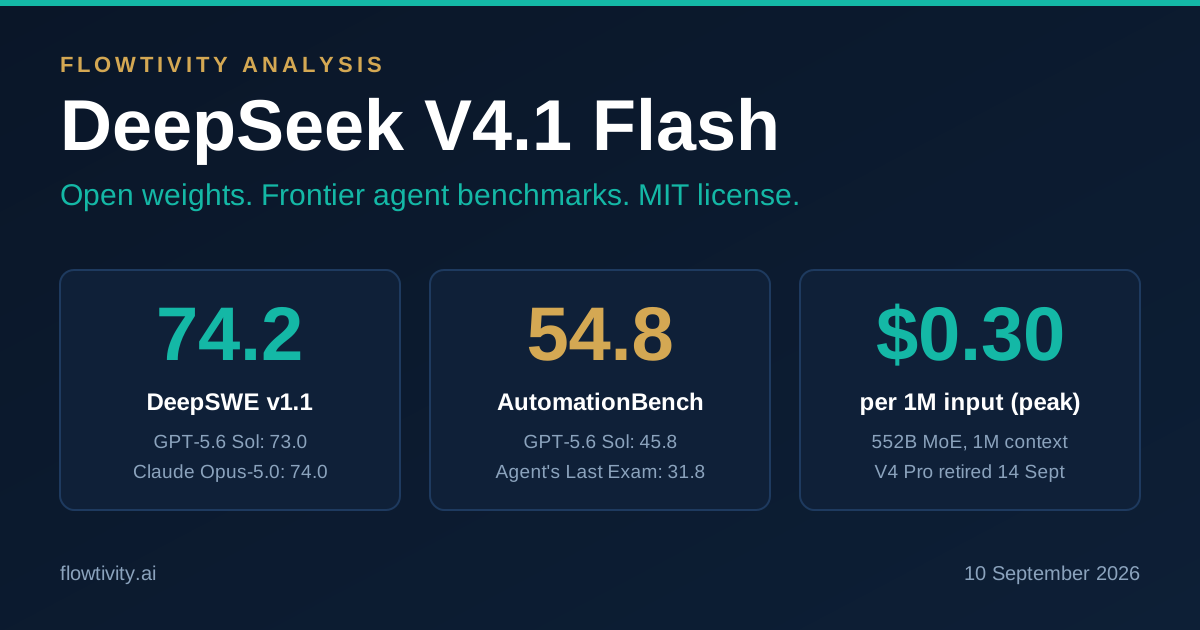
DeepSeek released V4.1 Flash on 10 September 2026, and according to the official model card it beats OpenAI's GPT-5.6 Sol and Anthropic's Claude Opus-5.0 on four of the five hardest agentic benchmarks: DeepSWE v1.1 (74.2 vs Sol's 73.0), AutomationBench (54.8 vs 45.8), Agent's Last Exam (31.8 vs 26.7) and CyberGym (88.1 vs 84.5). The model is a 552B-parameter Mixture-of-Experts that activates only 8B parameters per token during prefill, carries a 1M-token context window, reads images natively, ships under the MIT license, and costs $0.30 per million input tokens at peak. DeepSeek is so confident in it that the company is retiring the roughly four-times-more-expensive V4 Pro on 14 September 2026, telling API users that "V4.1 Flash has comprehensively surpassed V4 Pro across all key metrics, including performance, cost, speed, and task completion time."
What is DeepSeek V4.1 Flash?
DeepSeek V4.1 Flash is a multimodal Mixture-of-Experts model released by Chinese AI lab DeepSeek on 10 September 2026. It has 552B backbone parameters but activates just 8B parameters per token during prefill and 16B during decoding, supports a 1M-token context window with up to 384K output tokens, and processes images and text natively. The weights are downloadable under the MIT license, so any organisation can self-host, fine-tune or serve the model commercially without royalties or usage restrictions.
The architecture is the most interesting part. According to DeepSeek's official model card, V4.1 Flash uses a Causal Encoder-Decoder (CED) design: a 40-layer Transformer split into a 20-layer causal encoder and a 20-layer decoder, with the decoder's global KV cache projected from the encoder's final hidden states instead of rebuilt layer by layer. Combined with Compressed Sparse Attention 2 (CSA2) and FP4 KV caching in E2M1 format, the global KV cache shrinks to 890 bytes per token, roughly one quarter of the previous V4-Flash and one 437th of DeepSeek V1. An SWA Bounded Replay technique cuts the persistent KV cache footprint to about one eighth of V4-Flash, and a 196B-parameter conditional memory module called Engram is accessed sparsely via token-based lookup. Each MoE layer holds 1 shared expert and 384 routed experts, activating 6 routed experts per token. The model was trained from scratch on 45T tokens, with context extended to 1M tokens at the 34T mark.
The post-training recipe is standard SFT, RL and on-policy distillation, but the model card credits the agentic gains to "large-scale automated synthesis of agent tasks and environments with progressive scaling of data, tasks, and rollouts." In practice that means DeepSeek generated enormous volumes of synthetic agent tasks to train on. Reasoning effort is continuously controllable from 1 to 100, letting you trade inference cost against accuracy per request.
DeepSeek V4.1 Flash Benchmark Results vs Frontier Models
According to DeepSeek's official model card at maximum reasoning effort, V4.1 Flash scores 74.2 on DeepSWE v1.1, 90.6 on Terminal-Bench 2.1, 54.8 on AutomationBench, 31.8 on Agent's Last Exam and 88.1 on CyberGym. That beats GPT-5.6 Sol on all five of those benchmarks and beats Claude Opus-5.0 on four of them. V4.1 Flash also posts a 3471 Codeforces rating, up from V4 Pro's 3348, and matches Kimi's K3 at 65.6 on MathArena Apex. Bold marks the leader in each row.
| Benchmark | GPT-5.6 Sol | Claude Opus-5.0 | DeepSeek V4.1 Flash |
|---|---|---|---|
| DeepSWE v1.1 (real GitHub issues) | 73.0 | 74.0 | 74.2 |
| Terminal-Bench 2.1 (terminal tasks) | 88.8 | 89.1 | 90.6 |
| AutomationBench (workflow automation) | 45.8 | 50.3 | 54.8 |
| Agent's Last Exam (agentic reasoning) | 26.7 | 28.6 | 31.8 |
| CyberGym (cybersecurity tasks) | 84.5 | not reported | 88.1 |
| Humanity's Last Exam with tools | not reported | 63.6 | 63.9 |
| Terminal-Bench 4.0 (long horizon) | 39.9 | 51.8 | 31.2 |
| ProgramBench (Almost@1) | 23.0 | 37.0 | 20.3 |
| NL2Repo-Bench (repo-level coding) | 56.8 | 75.3 | 64.0 |
Two caveats keep this honest. First, DeepSeek evaluated its own model, and the comparison table draws on the company's internal harness settings, so treat the exact decimals as vendor-reported. Second, the wins are concentrated in short-horizon, high-volume agent work rather than every category, which the next sections cover in detail.
Why the Agentic Wins Matter: KV Cache Economics
V4.1 Flash's agent scores are really an inference-economics story. Agentic workloads are input-heavy: a coding agent re-reads its context dozens of times per task, so the cost of attention memory dominates the bill. At 890 bytes of KV cache per token, roughly a quarter of the previous Flash generation, plus only 8B parameters active during prefill, V4.1 Flash can re-read very large contexts cheaply. Cache hits cost $0.003 to $0.006 per million tokens, so an agent loop that re-reads a stable 500K-token context pays fractions of a cent per pass.
That is also why DeepSeek felt safe retiring V4 Pro. According to the company's announcement email to API users, "After extensive internal and external testing, V4.1 Flash has comprehensively surpassed V4 Pro across all key metrics, including performance, cost, speed, and task completion time." Community reception was immediate: the Hacker News launch thread collected 409 points and 214 comments within its first day, with the KV cache compression technology drawing most of the discussion.
DeepSeek V4.1 Flash Pricing
According to DeepSeek's API pricing documentation, V4.1 Flash costs $0.30 per million input tokens at peak and $0.15 off-peak for cache misses, $0.006 peak and $0.003 off-peak for cache hits, and $1.20 peak or $0.60 off-peak per million output tokens. That is roughly a quarter of the V4 Pro pricing it replaces ($1.32 peak input, $3.96 peak output), and the concurrency limit rises from 500 to 2,500 parallel requests.
| Cost per 1M tokens (USD) | Peak | Off-peak |
|---|---|---|
| Input tokens, cache miss | $0.30 | $0.15 |
| Input tokens, cache hit | $0.006 | $0.003 |
| Output tokens | $1.20 | $0.60 |
| V4 Pro input (for comparison) | $1.32 | $0.66 |
| V4 Pro output (for comparison) | $3.96 | $1.98 |
The maths for a typical agentic coding session makes the gap concrete. A run that consumes 2M input tokens and 200K output tokens costs $0.42 off-peak on V4.1 Flash versus $1.72 for the same run on V4 Pro off-peak pricing, a 4.1x saving. Peak hours are 01:00-04:00 and 06:00-10:00 UTC on weekdays, which is essentially the Chinese business day. For Australian teams that translates to 11:00-14:00 and 16:00-20:00 AEST on weekdays being peak, so overnight, early morning, weekend and 14:00-16:00 AEST batch runs are always half price.
Where DeepSeek V4.1 Flash Still Loses
V4.1 Flash is not a universal frontier-killer. According to the same official benchmark table, Claude Opus-5.0 leads decisively on long-horizon terminal work: Terminal-Bench 3.0 (43.3 vs 30.0), Terminal-Bench 4.0 (51.8 vs 31.2), ProgramBench (37.0 vs 20.3) and NL2Repo-Bench (75.3 vs 64.0). GPT-5.6 Sol holds the security categories, winning SEC-Bench Pro 74.3 to 62.8 and ExploitGym 33.7 to 15.3. On GPQA Diamond, Sol leads 94.1 to 90.9, and on text-only Humanity's Last Exam, Opus-5.0's 56.3 stands well above V4.1 Flash's 39.1 on the text-only subset.
The pattern is consistent: V4.1 Flash dominates short-horizon, high-volume agent loops where cost per task matters, while Opus-5.0 and Sol keep the crown on marathon autonomous sessions, repo-scale refactors and offensive security. For buyers the practical rule is simple. Route bulk agent traffic to V4.1 Flash and keep a frontier model for the hard 5 percent of tasks. That is also why DeepSeek confirmed a bigger V4.1 Pro is coming, with the company stating Pro tier requests will route to V4.1 Flash only "until V4.1 Pro is released in the future."
What DeepSeek V4.1 Flash Means for Australian Businesses
For Australian teams, V4.1 Flash makes always-on AI agents economically viable at scale. A full 1M-token context read costs $0.15 off-peak, roughly the price of nothing, and an agentic session burning 2M input plus 200K output costs about $0.42. Scheduling batch agents outside 11:00-14:00 and 16:00-20:00 AEST on weekdays halves every bill automatically, no negotiation required.
We test open-weight models locally on our dual NVIDIA DGX Spark rig, where Flash-class DeepSeek models have been our high-volume automation baseline at around 60 tokens per second, and V4.1 Flash changes the calculus on both ends. On the API side, the price-to-capability ratio is now unmatched for agent workloads. On the self-hosted side, the MIT license plus FP4 KV caching means the 552B weights are dramatically cheaper to serve than a dense frontier model, and data-sensitive organisations get a real sovereignty option: download the weights, run them in your own region, keep every token on your own infrastructure.
Adoption is also low-friction. The API is compatible with both OpenAI and Anthropic request formats, so teams running Claude Code, GitHub Copilot or OpenCode switch by changing a base URL and an API key. DeepSeek also shipped DeepSeek Harness, its own agent scaffold, in developer preview on launch day. The continuously adjustable reasoning effort from 1 to 100 is the sleeper feature for operations teams: run cheap low-effort passes for routine classification and dial up to 100 only for the decisions that justify the tokens.
V4 Pro Is Retired and V4.1 Pro Is Coming
DeepSeek retires V4 Pro at 12:00 Beijing time on 14 September 2026. From that moment every deepseek-v4-pro API request routes to V4.1 Flash and is billed at Flash pricing, according to the company's API documentation. DeepSeek has confirmed V4.1 Pro is coming, and the Flash tier's launch positioning, a cheaper model beating its own flagship, signals that the Pro release will target the long-horizon and security categories where Flash still trails. Teams building on DeepSeek today should standardise on the deepseek-flash model name, which already serves V4.1 Flash and will keep receiving point updates.
Frequently Asked Questions
Is DeepSeek V4.1 Flash better than GPT-5.6 Sol?
On agentic benchmarks, yes. According to DeepSeek's official model card, V4.1 Flash beats GPT-5.6 Sol on DeepSWE v1.1 (74.2 vs 73.0), AutomationBench (54.8 vs 45.8), Agent's Last Exam (31.8 vs 26.7), CyberGym (88.1 vs 84.5) and Terminal-Bench 2.1 (90.6 vs 88.8). Sol still leads on GPQA Diamond (94.1 vs 90.9), SEC-Bench Pro and ExploitGym, so security and science-heavy workloads still favour Sol.
How much does DeepSeek V4.1 Flash cost?
According to DeepSeek's pricing page, V4.1 Flash costs $0.30 per million input tokens at peak and $0.15 off-peak, with cache hits at $0.006 and $0.003, and output at $1.20 peak and $0.60 off-peak per million tokens. Peak hours are 01:00-04:00 and 06:00-10:00 UTC on weekdays. V4 Pro pricing was roughly four times higher and retires on 14 September 2026.
Is DeepSeek V4.1 Flash open source?
Yes. The weights are released under the MIT license on Hugging Face, with local inference instructions and a Rust-plus-Python toolkit called deepseek-recipe for prompt encoding. MIT permits commercial use, modification and redistribution without royalties.
What is the context window of DeepSeek V4.1 Flash?
V4.1 Flash accepts up to 1M tokens of input context and can generate up to 384K output tokens in a single request, with native image and text input.
When was DeepSeek V4.1 Flash released and what happens to V4 Pro?
DeepSeek released V4.1 Flash on 10 September 2026 (Beijing time), with pricing effective at 04:00 UTC the same day. V4 Pro service ends at 12:00 Beijing time on 14 September 2026, after which Pro API requests route to V4.1 Flash at Flash pricing until V4.1 Pro launches.
One email a month, no noise
Practical AI notes for Australian businesses. Unsubscribe anytime.