On this page
- HY3 vs The Open Source Field: Is Tencent's 295B Model the Best Value in AI?
- What Is Tencent HY3?
- How Does HY3 Compare on Benchmarks?
- Benchmark Comparison: HY3 vs Top Open Source Models
- How Much Does HY3 Cost vs Competitors?
- API Pricing Comparison (per 1M tokens)
- What About Reliability and Hallucination?
- Hallucination Rate Comparison
- HY3 vs GLM-5.2: Which Should You Choose?
- What This Means for the Open Source AI Landscape
- Frequently Asked Questions
HY3 vs The Open Source Field: Is Tencent's 295B Model the Best Value in AI?
Last Updated: July 9, 2026
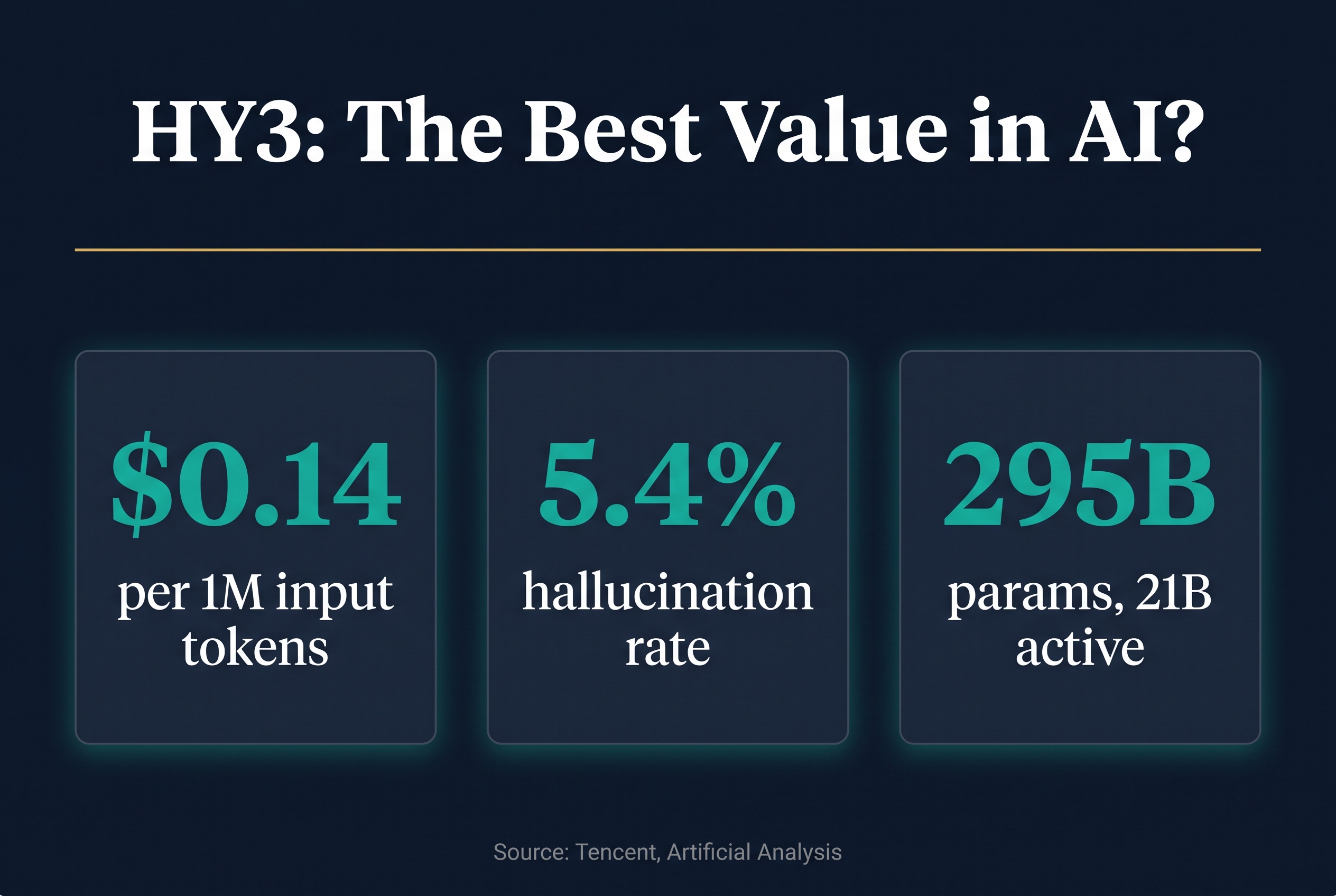
Tencent released HY3 on July 6, 2026, and the open source AI community took notice. A 295-billion-parameter Mixture-of-Experts model with only 21 billion active parameters per token, shipped under Apache 2.0 with no regional restrictions. It is not the biggest open model, it is not the best at coding, but it might be the smartest tradeoff between cost, reliability, and capability available right now.
What Is Tencent HY3?
HY3 is Tencent's flagship open source large language model, built by the Hunyuan team. It uses a Mixture-of-Experts architecture with 295 billion total parameters across 192 experts, but activates only 21 billion per forward pass via top-8 routing. This design means it delivers near-frontier capability while requiring far less compute per request than denser models or larger MoE competitors.
The model supports a 256K token context window and includes a 3.8B-parameter multi-token prediction layer for speculative decoding, pushing throughput to roughly 201 tokens per second. It was released under Apache 2.0, which means no regional exclusions, no field-of-use restrictions, and full commercial use. That license is a bigger deal than it sounds: previous Chinese open models like GLM-5.2 excluded the EU, UK, and South Korea, which killed enterprise deployments before engineering teams even finished their evaluations.
How Does HY3 Compare on Benchmarks?
HY3 ranks competitively across benchmarks but does not dominate any single category. Its strengths are in agentic search, tool orchestration, and reliability, while it trails GLM-5.2 on coding tasks. The Artificial Analysis Intelligence Index scores HY3 at 34, above the average of 25 for comparable models.
On agentic search, HY3 posts 84.2 on BrowseComp and 91.0 on DeepSearchQA, ahead of every open model and competitive with proprietary models like Claude Opus 4.8 and GPT-5.5. It leads the open source field on tool orchestration with 79.1 on the public MCP-Atlas set. On long-context retrieval, it scores 73.4 on AA-LCR.
Where HY3 falls short is coding. GLM-5.2 outperforms it across the entire agentic coding suite: SWE-bench Verified (84.2 vs 78.0), SWE-bench Multilingual (83.0 vs 75.8), Terminal-Bench 2.1 (81 vs 71.7), and DeepSWE (46.2 vs 28.0). This gap makes sense given that GLM-5.2 is a 744B-parameter MoE with roughly 40B active parameters, nearly double HY3's size and compute per token.
Benchmark Comparison: HY3 vs Top Open Source Models
- SWE-bench Verified: HY3 = 78.0%, GLM-5.2 = 84.2%, DeepSeek V4 Pro = 76.0%, Kimi K2.6 = 82.0%
- Terminal Bench 2.1: HY3 = 71.7%, GLM-5.2 = 81.0%, Grok 4.5 = 83.3%
- DeepSWE 1.1: HY3 = 28.0%, GLM-5.2 = 46.2%, GPT-5.5 = 67%, Fable 5 = 70%
- BrowseComp (agentic search): HY3 = 84.2, GLM-5.2 = 78.0, DeepSeek V4 = 76.0
- MCP-Atlas (tool orchestration): HY3 = 79.1, GLM-5.2 = 72.0, Kimi K2.6 = 70.0
- GPQA Diamond (STEM reasoning): HY3 = 90.4%, GLM-5.2 = 88.0%, DeepSeek V4 = 85.0%
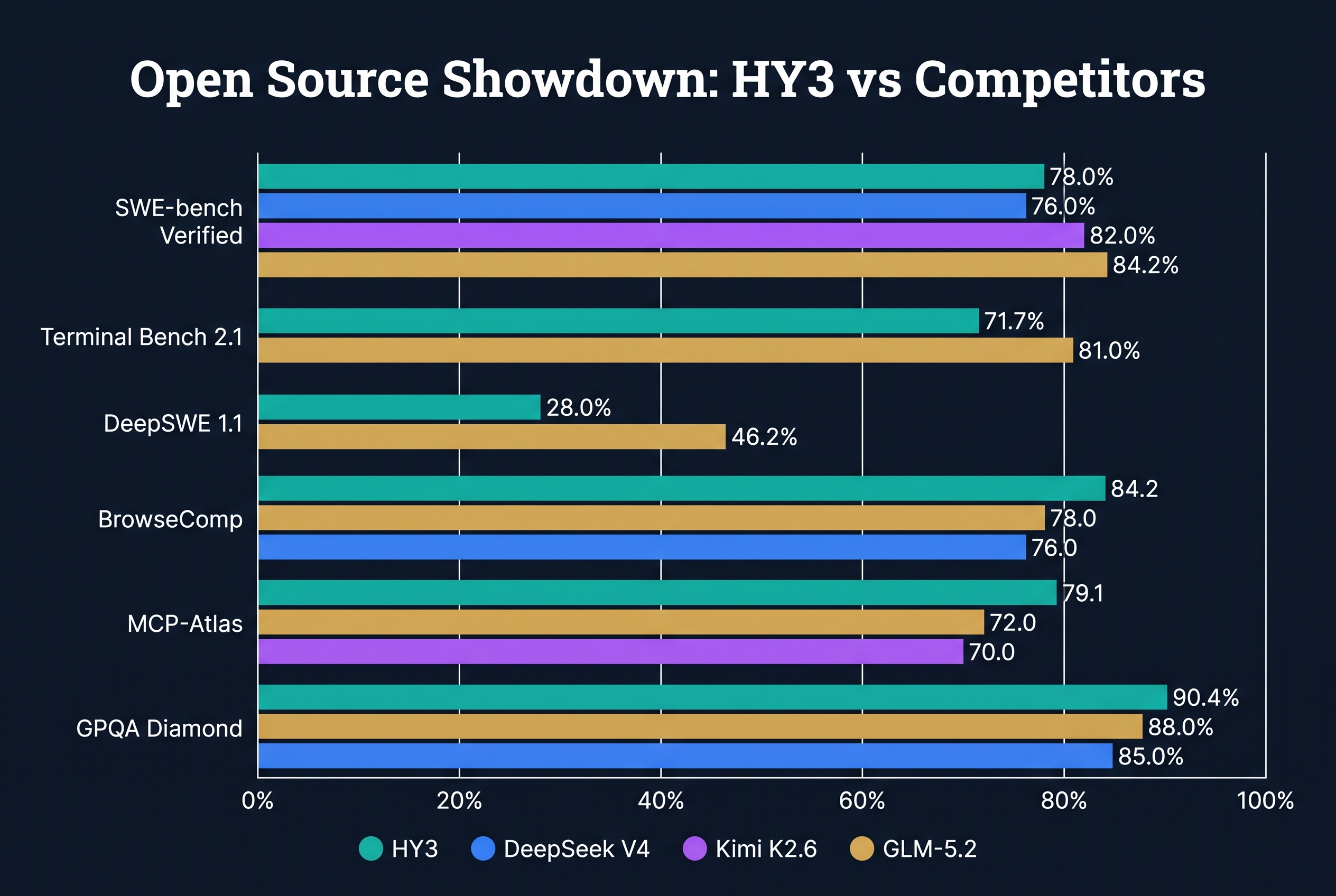
Figure 1: HY3 (teal) vs GLM-5.2 (gold), DeepSeek V4 (blue), and Kimi K2.6 (purple) across six benchmarks. HY3 leads on agentic search and tool orchestration; GLM-5.2 dominates coding. Source: Tencent, Artificial Analysis
Figure 1: HY3 (teal) vs GLM-5.2 (gold), DeepSeek V4 (blue), and Kimi K2.6 (purple) across six benchmarks. HY3 leads on agentic search and tool orchestration; GLM-5.2 dominates coding. Source: Tencent, Artificial Analysis
How Much Does HY3 Cost vs Competitors?
HY3 is one of the cheapest frontier-adjacent models available. Tencent Cloud lists it at approximately 1 yuan per million input tokens and 4 yuan per million output tokens, which translates to roughly $0.14 input and $0.56 output per million tokens. During its launch period, it is available free on OpenRouter and Novita AI through July 21, 2026.
This pricing dramatically undercuts both proprietary and open source competitors. For context, GLM-5.2 charges $1.40 input and $4.40 output per million tokens through Z.ai's official API. Kimi K2.6 costs $0.55 input and $2.65 output. DeepSeek V4 Flash is the closest at $0.14 input and $0.28 output, though it is a smaller model with lower benchmark scores.
API Pricing Comparison (per 1M tokens)
- HY3 (Tencent Cloud): $0.14 input / $0.56 output
- DeepSeek V4 Flash: $0.14 input / $0.28 output
- Kimi K2.6: $0.55 input / $2.65 output
- GLM-5.2 (Z.ai): $1.40 input / $4.40 output
- DeepSeek V4 Pro: $1.74 input / $3.48 output
- Grok 4.5: $2.00 input / $6.00 output
- GPT-5.5: $5.00 input / $30.00 output
- Fable 5: $10.00 input / $50.00 output
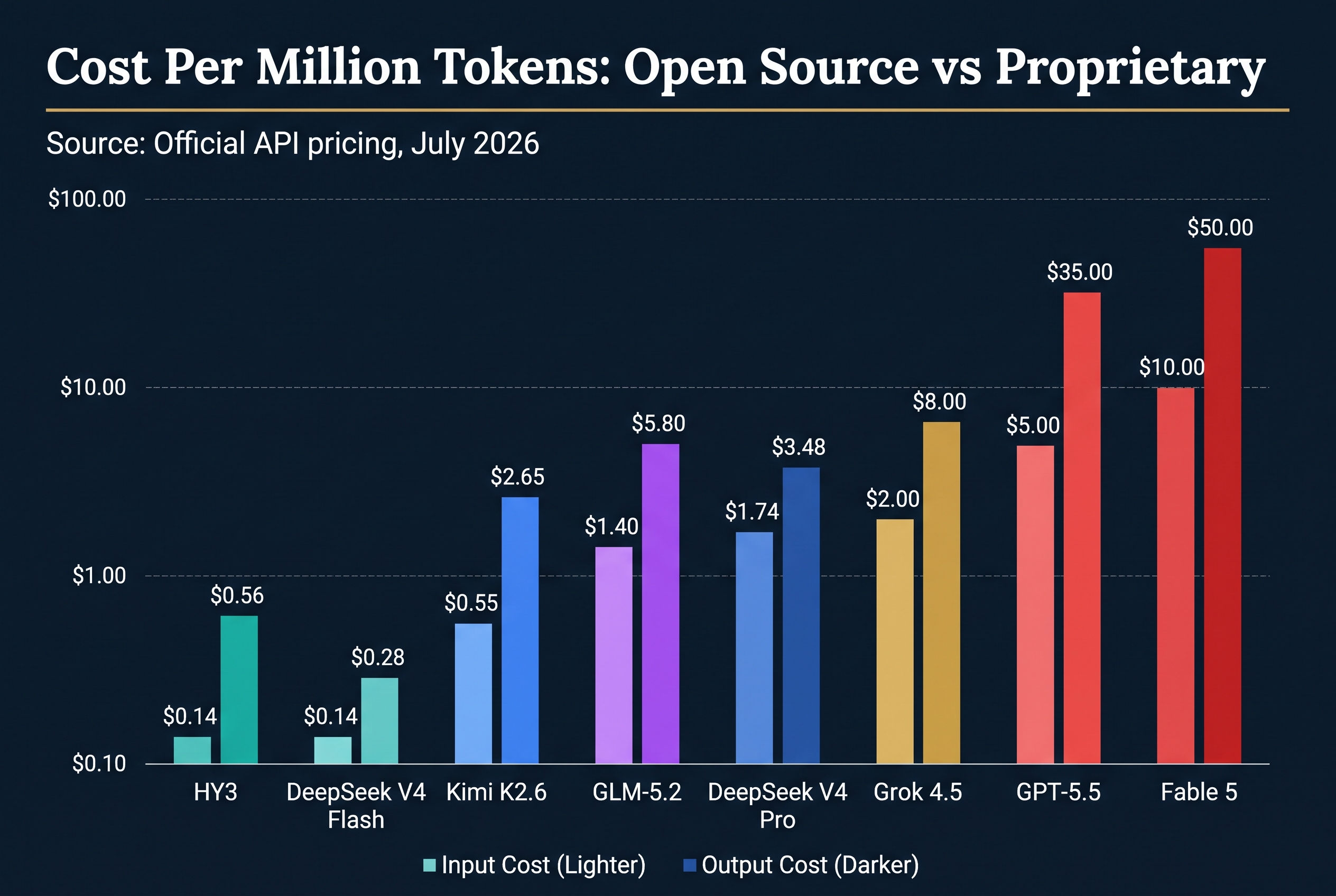
Figure 2: API cost per million tokens across open source and proprietary models. HY3 costs 71x less than Fable 5 for input tokens. Source: Official API pricing, July 2026
Figure 2: API cost per million tokens across open source and proprietary models. HY3 costs 71x less than Fable 5 for input tokens. Source: Official API pricing, July 2026
The self-hosting economics are equally compelling. HY3's FP8 footprint is under 300GB, which fits on a single 8x H200 node. GLM-5.2 requires roughly 744GB in FP8, making an 8x H200 node the minimum for production serving. HY3 was designed to run on Nvidia H20-3e, the export-compliant chip available in China, which means it runs even more comfortably on H100s, H200s, and B200s available in Western data centers.
What About Reliability and Hallucination?
This is where HY3 distinguishes itself from the pack. Tencent led with reliability metrics rather than benchmark scores, which is unusual for a model launch. The model card reads more like a production reliability report than a leaderboard announcement.
Internal evaluations show HY3's hallucination rate dropped from 12.5% in the preview version to 5.4% in the full release. Commonsense error rates fell from 25.4% to 12.7%. Multi-turn issue rates dropped from 17.4% to 7.9%. The long-dialogue benchmark score jumped from 42.9% to 75.1%.
For comparison, Grok 4.5 has a 54% hallucination rate on the AA-Omniscience Index. HY3's 5.4% is in a completely different category. Tencent achieved this through fine-grained data cleaning and training constraints built around an explicit behavior pattern: answer when grounded, state when evidence is missing, do not conflate sources, do not fabricate data.
Tencent also reports consistency across agent scaffolds, with SWE-bench variance within a few points whether the model runs inside Claude Code-style harnesses, Cline, or KiloCode. This matters because enterprises rarely control which agent framework their teams standardize on. A model that only performs well in one harness is a hidden integration cost.
Hallucination Rate Comparison
- HY3 (Tencent): 5.4% hallucination rate
- Grok 4.5 (xAI): 54% hallucination rate
- GPT-5.5 (OpenAI): approximately 15-20% (varies by benchmark)
- Fable 5 (Anthropic): lowest among frontier models (exact figures not public)
HY3 vs GLM-5.2: Which Should You Choose?
The choice between HY3 and GLM-5.2 comes down to what you are building. GLM-5.2 is the clear winner for coding performance. If your primary use case is repository-scale software engineering, agentic coding, or code generation, GLM-5.2's larger parameter count and specialized training give it a meaningful edge.
HY3 wins everywhere else. It is better at agentic search, tool orchestration, and long-context retrieval. It has dramatically lower hallucination rates. It costs less to run, both in API pricing and self-hosting infrastructure. And its Apache 2.0 license with no regional restrictions removes the legal friction that killed many GLM deployments.
Choose HY3 for: Agentic workflows, search and tool-heavy applications, reliability-sensitive production deployments, organizations with infrastructure budget constraints, teams serving global traffic including EU/UK.
Choose GLM-5.2 for: Coding-first workloads, repository-scale software engineering, teams with 8x H200 budget available, applications where coding accuracy is the primary success metric.
Choose DeepSeek V4 Flash for: Highest cost-efficiency for simpler tasks, teams where $0.14/$0.28 pricing matters more than peak capability, lighter workloads that do not require frontier reasoning.
What This Means for the Open Source AI Landscape
HY3 represents a maturation of the Chinese open source AI strategy. The first wave was about matching frontier benchmarks. This second wave is about solving production problems: reliability, deployment economics, license clarity, and cross-framework consistency.
The model is already deployed across Tencent's own products including WorkBuddy, CodeBuddy, Yuanbao, QQ Browser, and Sogou Input. Internal task success rates on the WorkBuddy platform climbed from 72% with the preview to 90% with the full release. This is not a research demo. It is a production model running at scale inside one of the world's largest technology companies.
For businesses evaluating open source AI in 2026, the calculus has shifted. You no longer need to choose between capability and cost, or between performance and reliability. HY3 does not win any single benchmark, but it might be the best overall value proposition in the open source field right now: good enough on coding, excellent on agentic tasks, dramatically cheaper to run, and reliable enough for production.
Frequently Asked Questions
Is HY3 better than GLM-5.2?
HY3 is not better than GLM-5.2 at coding. GLM-5.2 outperforms HY3 across all coding benchmarks including SWE-bench Verified, Terminal Bench, and DeepSWE. However, HY3 is better at agentic search, tool orchestration, and has significantly lower hallucination rates. It also costs less to run and has a more permissive license.
How much does HY3 cost?
HY3 costs approximately $0.14 per million input tokens and $0.56 per million output tokens through Tencent Cloud. It is currently free on OpenRouter through July 21, 2026. For self-hosting, its FP8 footprint of under 300GB fits on a single 8x H200 node, less than half the infrastructure required for GLM-5.2.
What is HY3's hallucination rate?
HY3 has a 5.4% hallucination rate according to Tencent's internal evaluations, down from 12.5% in the preview version. This is dramatically lower than Grok 4.5's 54% rate and competitive with frontier proprietary models.
Is HY3 open source?
Yes, HY3 is released under the Apache 2.0 license with no regional restrictions. This is a significant advantage over GLM-5.2, which excludes the EU, UK, and South Korea from its license terms.
Can HY3 replace GPT-5.5 or Fable 5?
HY3 cannot fully replace frontier proprietary models for complex reasoning tasks, but it can handle the majority of production workloads at a fraction of the cost. For agentic search, tool orchestration, and general knowledge work, it is competitive with GPT-5.5 and Claude Opus 4.8. For complex coding and frontier reasoning, the proprietary models still hold an edge.
About the author: AJ Awan is the founder of Flowtivity, an AI consultancy helping growing businesses build with AI. He is a former EY management consultant with TOGAF certification and 9+ years of experience delivering $15M+ in measurable business benefits.
One email a month, no noise
Practical AI notes for Australian businesses. Unsubscribe anytime.